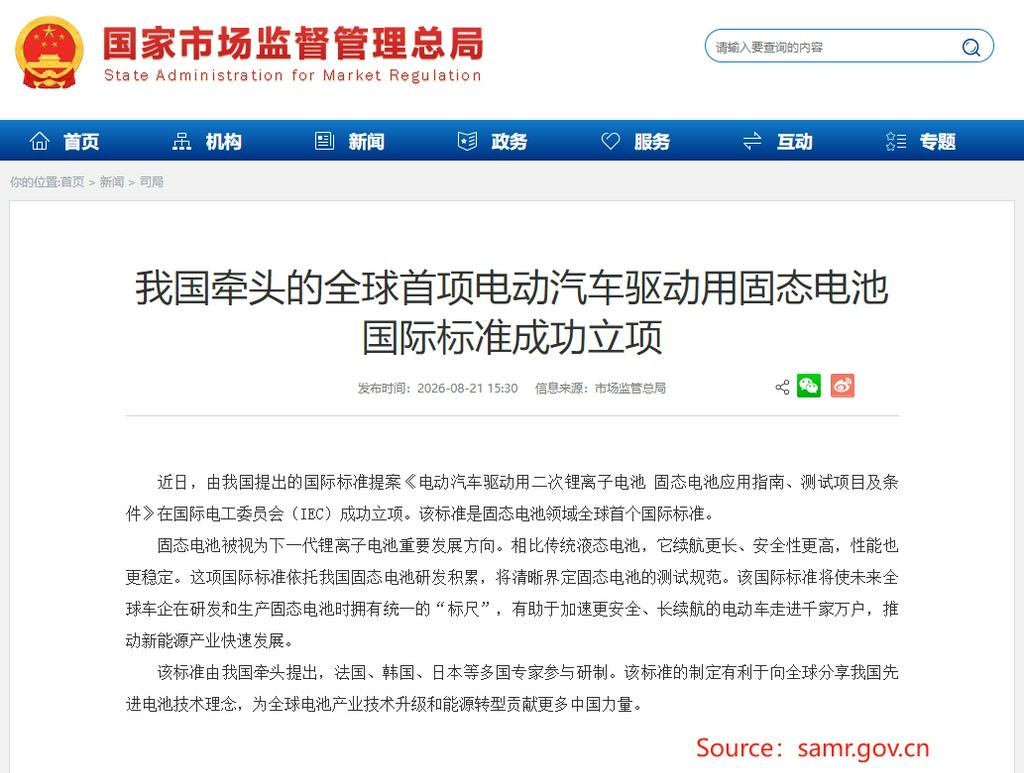
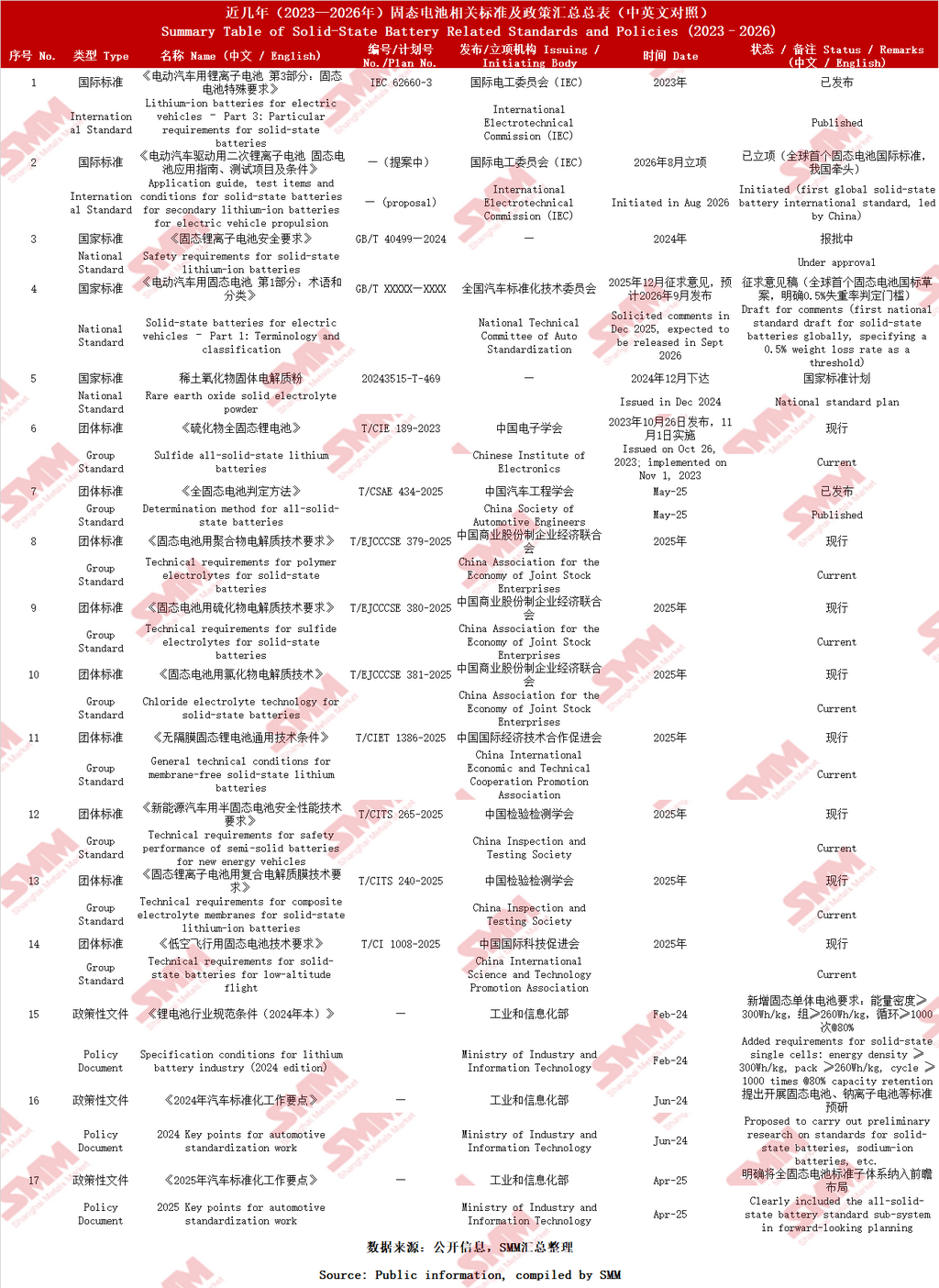
Key Points: On 21 August 2026, the State Administration for Market Regulation (SAMR) announced that China’s proposed international standard proposal, Application guide, test items and conditions for solid‑state batteries for secondary lithium‑ion batteries for electric vehicle propulsion, was successfully initiated at the International Electrotechnical Commission (IEC). This is the world’s first international standard in the solid‑state battery field. It is led by China, with experts from France, Japan, South Korea and other countries participating in its development. The standard will define clear testing specifications for solid‑state batteries, providing a unified “yardstick” for automakers worldwide.
The world’s first international standard for solid‑state batteries has now been settled: proposed by China and successfully initiated at the IEC. The IEC proposal, led by China, is formally launched, with experts from major battery‑powered nations – France, Japan, South Korea – all taking part. This is not only an international endorsement of China’s technological strength, but also a sign that the global industrial chain is beginning to accept China’s approach as the common benchmark.
 项
项
I. Why Now? – The “Thirst for Standards” at an Industrial Inflection Point
From the start to the end of the year, the solid‑state battery industry has attracted unprecedented attention, with every company touching the “solid” label gaining enormous visibility. But amid the buzz, the industry has long faced an awkward reality: everyone speaks their own language. What Company A calls “solid‑state” may be completely different from Company B’s definition – oxides, sulfides, polymers, semi‑solid, quasi‑solid, all‑solid – concepts are flying around, and testing methods vary widely.
SMM’s earlier research had already revealed that domestic solid‑state battery standards were still under development, with the Terminology and classification of solid‑state batteries having completed its draft for comments. Now that an international standard has taken the lead at the IEC, it shows that the industry has reached a critical point where standards are imperative – automakers worldwide are developing solid‑state batteries, but without a common ruler, even a simple “good or bad” comparison is impossible.
II. Why Can China Take the Lead? – Accumulated R&D Strength Paying Off
This standard builds on China’s solid‑state battery R&D accumulation. Objectively speaking, this is no accident.
On the enterprise side, Qingtao Energy started with the oxide electrolyte technology route and has built mass‑production lines; its products are already installed in SAIC models. Weilan New Energy’s semi‑solid batteries have been introduced in mass‑produced models in partnership with NIO. On the policy side, the State Administration for Market Regulation has clearly identified “solid‑state power batteries” as a key new direction to promote.
The participation of experts from France, Japan, South Korea and other countries demonstrates that technological strength has won a voice. This is not about “loud voices”, but about solid R&D accumulation and industrialisation practice.
III. What Will This Standard Change? – From “Technology Leadership” to “Rule‑Making”
In the past, we were followers in the lithium‑battery field, with standards set by others. Now, in the solid‑state battery era, the situation has changed.
First, a unified yardstick reduces global R&D friction. Without a standard, each automaker has its own test methods, making it difficult to compare R&D outcomes horizontally. With a unified standard, automakers worldwide share a common language in developing and producing solid‑state batteries, which will help accelerate the adoption of safer, longer‑range electric vehicles.
Second, Chinese concepts go global. The development of this standard will help share China’s advanced battery technology concepts with the world. This means that China’s test methods and evaluation systems may become the global default – which is more valuable than selling any amount of batteries.
Third, it forces domestic industrial upgrading. Once the international standard is in place, domestic companies that fail to meet it will not even get a ticket to “go global”. This will in turn accelerate industry consolidation and weed out outdated capacities.
IV. A Sobering Thought: A Standard Is a Starting Point, Not an Endpoint
Achieving mass deployment of all‑solid‑state batteries at the million‑unit level before 2030 is extremely difficult, though small‑scale demonstration installations in high‑end models are expected between 2027 and 2029. The current cost of solid‑state batteries is still 5 to 10 times that of conventional lithium batteries.
The standard’s initiation solves the “how to measure” problem, but the challenges of “how to make it” and “how to make it affordable” still need to be tackled. Standards are catalysts for industrialisation, not the cure‑all.
recent Chinese solid‑state battery standards
最后推荐一下SMM的精品会议,目前进展和部分参会企业及代表:

**Note:** For further details or inquiries regarding solid-state battery development, please contact:
Phone: 021-20707860 (or WeChat: 13585549799)
Contact: Chaoxing Yang. Thank you!
![[Solid-State: Xenergy Completes Over $100 Million Financing, Adds 3GWh Solid-State Battery Mass Production Line]](https://imgqn.smm.cn/usercenter/aXRJI20251217171728.jpg)