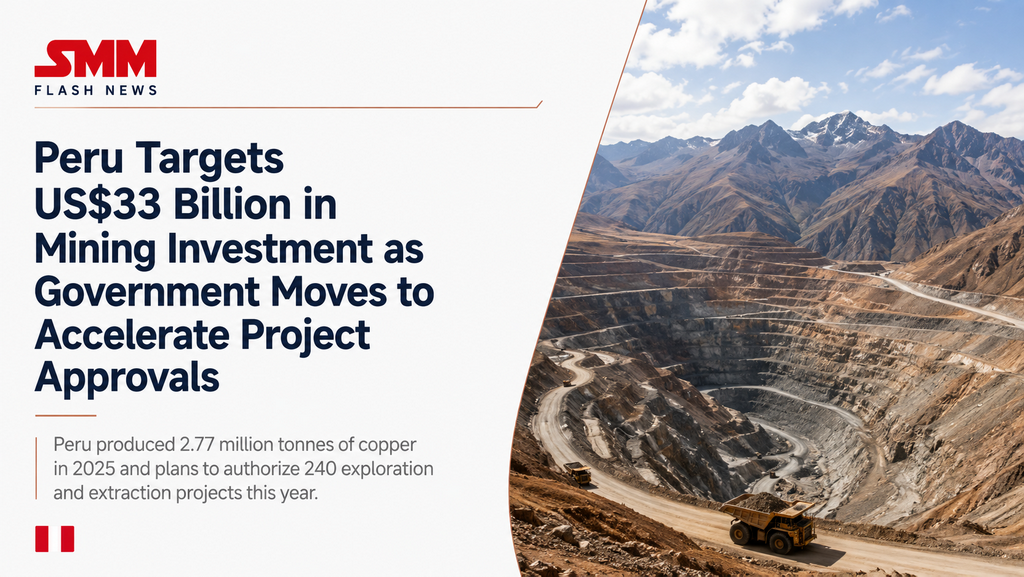
Peru’s new government is targeting at least US$33 billion in mining investment over the next five years, while moving to accelerate approvals for exploration and extraction projects in an effort to convert the country’s extensive mineral resources and project pipeline into new production.
Prime Minister Luis Galarreta told Congress that President Keiko Fujimori’s administration, which took office in July, plans to authorize 240 exploration and extraction projects this year. Private companies are expected to provide the investment, while the government intends to focus on legal certainty, more predictable permitting and faster decision-making. Officials will seek to reduce delays and overlapping procedures without weakening environmental or social requirements.
The push is particularly significant for the copper market. Peru produced 2.77 million tonnes of copper in 2025, up 1.2% year on year, according to the Ministry of Energy and Mines, marking the country’s highest annual copper production on record. Peru remains one of the world’s largest copper-producing countries, meaning improvements in project execution could have meaningful implications for longer-term global mine supply.
The investment target also comes against the backdrop of a sizeable existing project pipeline. MINEM’s 2026 Mining Investment Project Portfolio comprises 66 projects with combined estimated investment of US$64.08 billion, while eight mining projects representing around US$7.62 billion had already been identified for the start of execution during 2026.
For the copper market, the key issue is therefore less Peru’s geological potential than the speed at which projects can move through permitting, financing and construction. The Fujimori government’s plan to authorize hundreds of projects and reduce administrative bottlenecks could help unlock part of Peru’s large copper development pipeline, although the eventual production impact will depend on which projects actually progress into construction and operation.