South Korea’s lithium market gradually moved away from the cautious procurement stance seen at the beginning of 2026, with market activity improving through July. New purchases remained limited in H1 amid uncertainty in EV demand and relatively low operating rates across the domestic ternary materials sector. However, production and shipments at some materials and battery companies improved from Q2, while H2 plans for ESS and LFP production became more concrete.
The recovery has varied by product. Lithium carbonate has attracted growing interest from LFP, ESS and conversion-related demand, while lithium hydroxide has improved more selectively around high-nickel customers and projects. This suggests that the Korean lithium market is moving toward a more diversified demand structure rather than experiencing a uniform recovery.
Prices Correct After May Rally, Bringing Buyers Back to the Market
According to SMM, lithium carbonate and lithium hydroxide CIF South Korea prices remained relatively stable through March and April before rising rapidly in May. Momentum subsequently weakened, with a clearer correction emerging from late June. By July, both products had moved below their previous peaks.
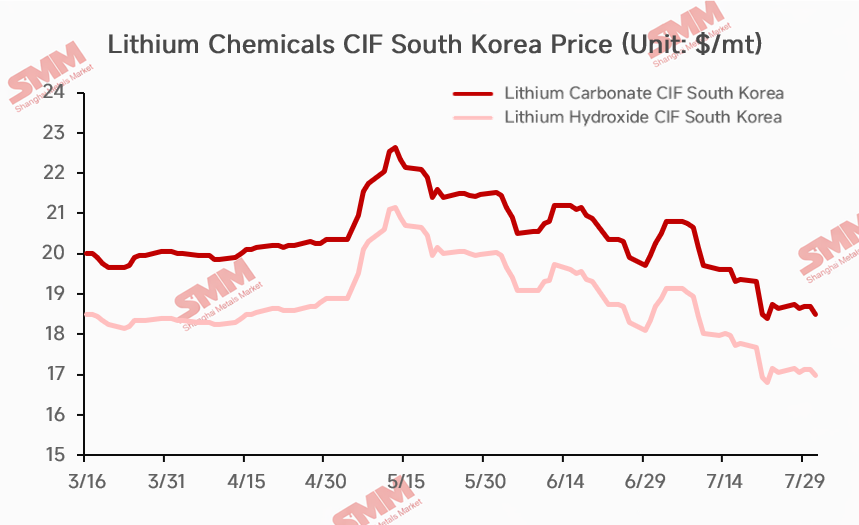
The correction also changed procurement behavior. During the rapid price increase, buyers remained cautious as they balanced the risk of further gains against higher sourcing costs. As prices eased from late June, some companies preparing for H2 production began reassessing required volumes and procurement timing.
Large-scale inventory building has yet to emerge. Purchases remain largely staged and tied to actual production schedules and existing inventories. The shift through July therefore reflects a gradual normalization of procurement activity rather than aggressive restocking.
Lithium Carbonate Gains Support From LFP, ESS and Conversion Demand
Procurement interest in lithium carbonate strengthened relatively quickly in July. Demand had remained limited earlier in the year as domestic LFP production was still at an early stage. Heading into H2, however, preparations for LFP cathode production and LFP-based ESS batteries have become more concrete, increasing interest in securing feedstock.
Lithium processors using carbonate as feedstock for hydroxide conversion have also provided an additional source of demand. As a result, the buyer base for lithium carbonate in South Korea is gradually broadening beyond conventional cathode applications.
Given the still-limited scale of domestic LFP production, large-volume procurement is unlikely to emerge immediately. Purchases are more likely to remain gradual and closely linked to production schedules. Nevertheless, the recent price correction has reduced sourcing pressure and provided buyers with a more favorable window to prepare for H2 requirements.
Lithium Hydroxide Improves, Led by Selected High-Nickel Projects
The lithium hydroxide market has also improved from Q1 levels. Purchases and cargo pick-ups by some customers increased from Q2, while selected high-nickel cathode and new cylindrical battery projects provided support to demand.
The procurement structure, however, remains different from that of lithium carbonate. Major high-nickel materials and battery producers secure a substantial share of requirements through existing long-term contracts, limiting the need for additional spot purchases even when production increases.
Cross-border flows also became more active in June, including higher lithium hydroxide shipments from China to South Korea. Monthly trade volumes, however, reflect contract shipment schedules, inventory movements and customer qualification as well as end-use demand. They are therefore better viewed as an indication of more active procurement and logistics rather than a direct measure of domestic consumption.
Going forward, demand growth is likely to remain concentrated among customers and projects with actual production ramp-ups, rather than expanding evenly across the market.
Materials and Cell-Maker Results Point to a Broader Demand Mix
H1 results from South Korean battery materials companies also showed a widening gap between customers and product segments. Some producers benefited from higher shipments to selected customers and new cylindrical battery projects, while others saw more limited volume growth due to adjustments in EV production plans.
This suggests that operating rates across the domestic ternary materials sector are becoming increasingly dependent on specific customer programs rather than moving in one direction across the industry.
A similar shift is visible among battery cell producers. In addition to conventional EV demand, ESS, data-center UPS and BBU applications, power tools and cylindrical batteries are becoming increasingly important. ESS growth and preparations for domestic LFP production are particularly relevant for future lithium carbonate demand.
At the same time, cylindrical EV batteries and other high-power applications continue to support selected high-nickel products. South Korea’s lithium demand mix is therefore gradually broadening from its traditional EV and high-nickel focus toward a structure in which LFP/ESS and high-performance battery applications coexist.
H2 Procurement to Depend More on Actual Production Ramp-Ups
Overall, South Korea’s lithium market became more active through July after a cautious start to the year. Procurement conditions improved as prices corrected from their May highs, while demand sources became increasingly diversified.
Heading into H2, actual production schedules are likely to become more important than short-term price movements in determining procurement activity. The start-up of domestic LFP production, expansion in ESS batteries, new high-nickel customer projects and higher utilization at lithium processing facilities will be key indicators to watch.
January–July 2026 can therefore be viewed as a period in which wait-and-see sentiment gradually eased and procurement activity normalized, while the next phase of demand growth became increasingly linked to specific applications and production ramp-ups.