On August 19, Indonesian Minister of Energy and Mineral Resources Mr. Bahlil Lahadalia said during the 12th Indonesia International Geothermal Convention and Exhibition, or IIGCE 2026, that the government had discussed the program with PLN President Director Mr. Darmawan Prasodjo and planned to launch a first-phase tender for 30 GW of solar projects in 2026.
Mr. Bahlil said the government would move into the first 30 GW phase and begin the tender process this year. Indonesian President Mr. Prabowo Subianto had previously proposed developing 100 GW of solar capacity over the coming years while accelerating the retirement of diesel-fired generation.
SMM believes the announcement signals a clear acceleration in Indonesia's solar policy. However, a tender launch remains several steps removed from construction and grid connection. At this stage, the 30 GW figure is better viewed as an indicative first-phase project pipeline and procurement ambition, rather than 30 GW of solar additions or immediate module demand in 2026.
First-phase target rises from 17 GW to 30 GW
In May 2026, Indonesia's Ministry of Energy and Mineral Resources proposed advancing an initial 17 GW of solar projects with supporting energy storage. Mr. Bahlil's latest statement raises the first-phase target to 30 GW, substantially increasing the government's near-term development ambition.
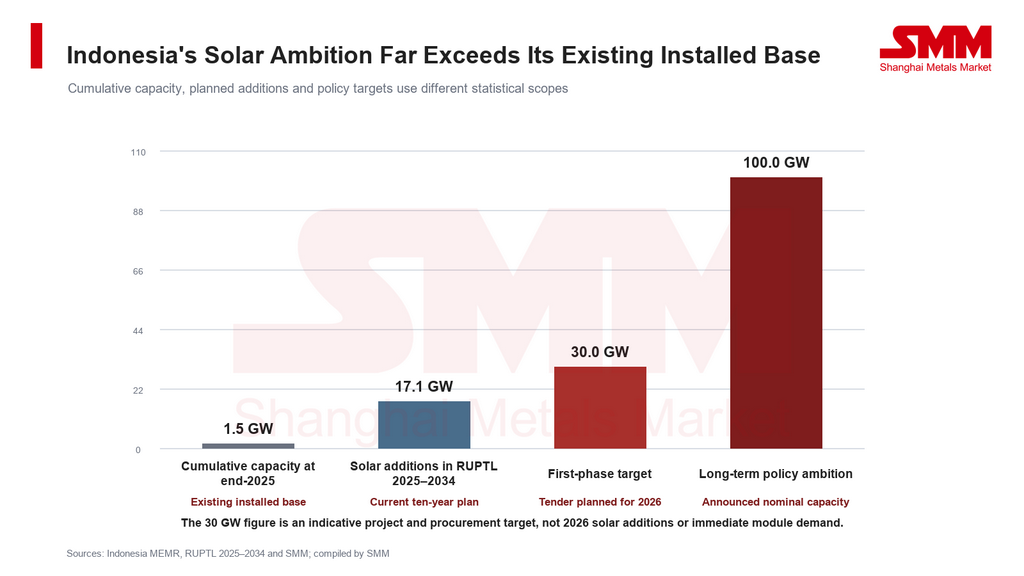
The increase from 17 GW to 30 GW within a few months also shows that the 100 GW program remains under rapid design and policy coordination. Firm demand will depend on official tender documents defining project locations, lot sizes, development models, power-purchase arrangements, storage requirements and grid-connection schedules.
Indonesia's cumulative installed solar capacity stood at approximately 1.49 GW at the end of 2025, according to the energy ministry. On that basis, the 30 GW first-phase target is about 20 times the existing installed base, while the 100 GW ambition is nearly 67 times as large.
Expansion on this scale would affect far more than module supply. It would also test the availability of inverters, storage systems, transformers, transmission and distribution infrastructure, land, engineering capacity, financing and long-term operations and maintenance services.
The 30 GW plan still needs formal alignment with RUPTL
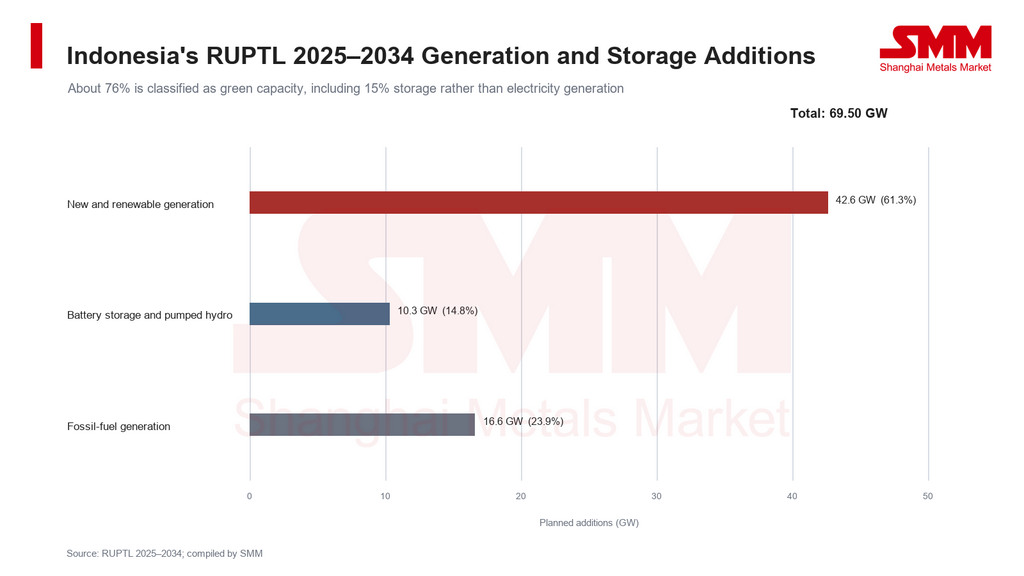
Indonesia's Electricity Supply Business Plan, or RUPTL 2025–2034, calls for 69.5 GW of new generation and storage capacity over ten years. New and renewable generation accounts for approximately 42.6 GW, or 61%, while battery storage and pumped hydro account for around 10.3 GW, or 15%. Fossil-fuel generation represents the remaining 16.6 GW, or 24%.
The government's statement that about 76% of planned additions are 'green' therefore combines 61% of new and renewable generation with 15% of storage. It does not mean that all 76% is generating capacity, nor that renewables will supply 76% of Indonesia's electricity by 2034.
The current RUPTL includes approximately 17.1 GW of new solar capacity by 2034, well below the newly announced 30 GW first-phase target. The 100 GW program may therefore require an RUPTL revision, a dedicated procurement mechanism or additional national-level project arrangements.
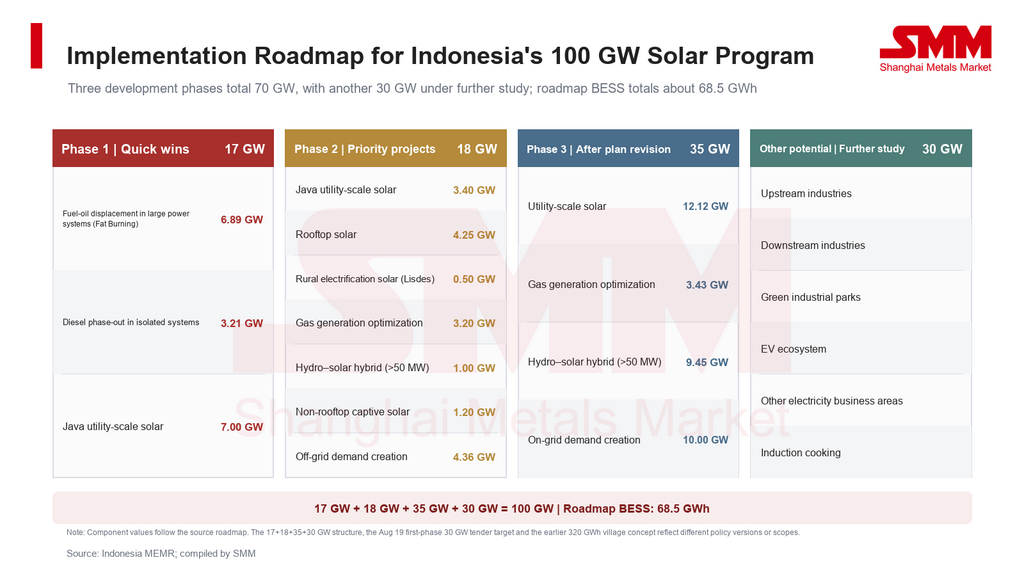
The earlier roadmap dividing the program into 17 GW, 18 GW and 35 GW development phases, plus 30 GW under further study, is not the same policy version or scope as the August 19 announcement of a 30 GW first-phase tender. Until planning documents and project lists are formally updated, the market should not incorporate the full 30 GW political target into firm installation forecasts.
Diesel replacement makes storage and grid readiness critical
The Indonesian government has also proposed accelerating the shutdown of around 13 GW of diesel-fired capacity in 2026 and replacing it with solar and other non-fossil sources. The policy aims to reduce the dependence of remote islands and weak-grid regions on diesel and imported fuel, lowering both fiscal subsidies and electricity supply costs.
Solar capacity and diesel generation capacity cannot, however, be replaced on a one-for-one basis. At a capacity factor of 15–20%, 30 GW of solar would produce average output of approximately 4.5–6 GW over a year and would provide no generation at night. Reliable diesel displacement would therefore require sufficient battery storage, dispatchable generation, microgrid controls and reserve capacity.
Indonesia's 2024 national electricity statistics reported approximately 5.82 GW of diesel-fired capacity, a substantial difference from the proposed 13 GW retirement figure. It remains unclear whether the 13 GW scope includes leased units, off-grid generators, standby units or other oil-fired assets. Assessing the actual scale of diesel displacement will require plant-level information covering system location, operating hours, fuel costs and replacement resources.
An earlier concept for the 100 GW program comprised about 80 GW of village-level distributed solar and 20 GW of utility-scale solar. The village component was intended to cover roughly 80,000 villages, with about 1 MW of solar per village and a combined 320 GWh of battery storage.
If retained, that design could create material demand for storage, microgrids and energy-management systems. However, it has not been confirmed that the first 30 GW tender will follow the same 80 GW distributed and 20 GW utility-scale structure.
Tender documents will also need to distinguish storage power from storage energy by stating both GW and GWh, together with discharge duration. A storage 'capacity' figure without duration is insufficient to assess diesel displacement or system reliability.
Transmission is another constraint. RUPTL plans approximately 48,000 circuit-km of transmission lines and around 108,000 MVA of substation capacity to address the geographic mismatch between renewable resources and load centers. In an archipelago composed of numerous islands and isolated power systems, the main bottlenecks may be financing, land access, microgrid upgrades, transformer supply, interconnection approvals and long-term operations rather than module availability.
TKDN requirements could create a two-tier module market
Local-content rules will directly shape equipment procurement under the 30 GW program. According to SMM research, demand for modules compliant with Indonesia's domestic-content framework, known as TKDN, is rising in government and PLN projects. Some projects were already beginning to align with TKDN 4.0 requirements in 2026, giving local module producers a clear access advantage where local content is mandatory.
SMM research in June 2026 placed China-port FOB prices for TOPCon modules at approximately $0.110/W and CIF prices into Indonesia at about $0.114–0.120/W. By comparison, locally produced Indonesian TOPCon modules were quoted at around $0.130/W with 25% TKDN content, $0.150/W at 40%, and as high as approximately $0.185/W above 40% local content.
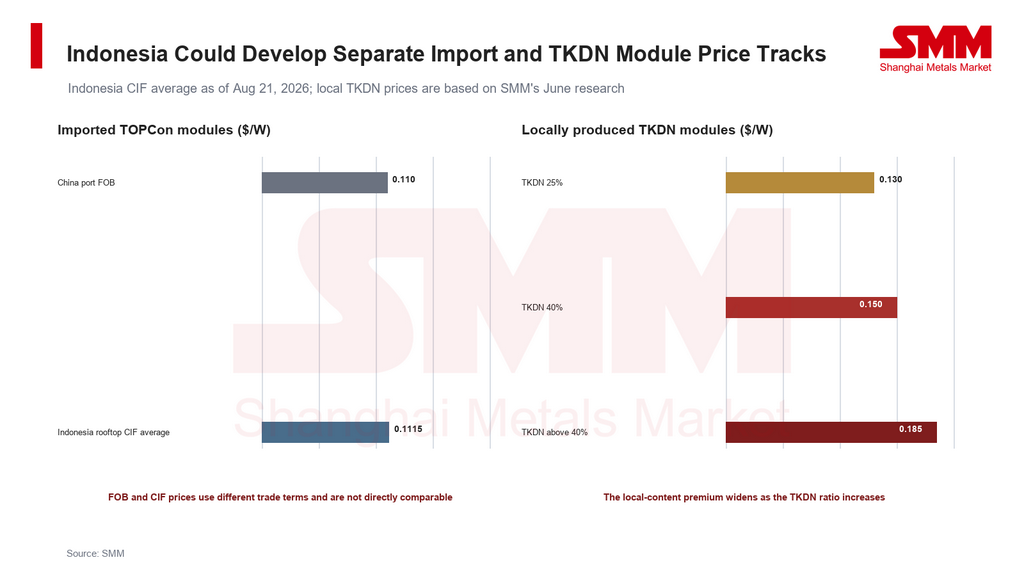
Lower-priced imported modules can reduce the upfront cost of market-based projects, but may not qualify for government or PLN projects with mandatory local-content requirements. As the 30 GW tender advances, Indonesia could develop two distinct module price tracks: a commercial-market price led by imported high-efficiency products and a policy-project price led by locally compliant TKDN modules.
TKDN policy could support Indonesian manufacturing of cells, modules, glass, frames and other materials. At the same time, a high local-content premium could increase project capital costs, power-purchase prices and financing pressure. Balancing industrial development with low-cost solar deployment will be a key feature of the tender design.
Tender volume is not the same as near-term PV module orders
Indonesia's existing project timelines show that large tenders can take several years to reach commercial operation. PLN launched the 1.225 GW Mentari Nusantara I tender in April 2026 under its bundled 'GIGA-ONE' procurement mechanism, with commercial operation planned for 2029.
Even if the first 30 GW tender starts in 2026, module procurement, financial close, construction and grid connection are likely to be released in stages. The target materially expands Indonesia's medium- and long-term market potential for modules, inverters and storage, but the full capacity should not be treated as near-term spot demand.
Bankable equipment demand will come from projects that have been awarded, signed power-purchase agreements, secured land and interconnection rights, and reached financial close.
Project conversion and execution timing matter more than headline capacity
SMM believes Indonesia's proposal to launch a first-phase 30 GW tender marks a shift in the 100 GW solar program from policy ambition toward procurement and implementation. The program could materially improve the medium- and long-term demand outlook for solar, energy storage and microgrids across Southeast Asia. At this stage, however, the key variables determining actual market growth are not the nominal 30 GW figure itself, but the conversion rate and execution timetable of the first projects.
The market should monitor the following milestones:
1. PLN's formal tender documents, including whether the 30 GW will be procured in a single round or divided by year and region.
2. The capacity allocation among distributed solar, utility-scale solar, other energy projects and energy storage.
3. Power-purchase agreements, project tariffs, financing guarantees and the proposed role of cooperatives.
4. Storage-system power and energy requirements in GW and GWh, discharge duration and battery replacement mechanisms.
5. TKDN local-content thresholds, potential exemptions and the actual delivery capability of Indonesia's local module industry.
6. The project-level retirement list and replacement schedule for the proposed 13 GW of diesel-fired generation.
7. Project award, financial-close, construction-start and commercial-operation dates.
Indonesia's solar policy ceiling is rising rapidly, but the strongest opportunities are likely to favor companies that combine local regulatory compliance with system integration, weak-grid compatibility, storage configuration and long-term operations and maintenance capabilities. Competition is also expected to shift from module price alone toward integrated 'solar + storage + microgrid + financing + local delivery' solutions.
SMM will continue to monitor tender documents, project conversion, storage requirements, TKDN rules and their implications for equipment demand and project execution.
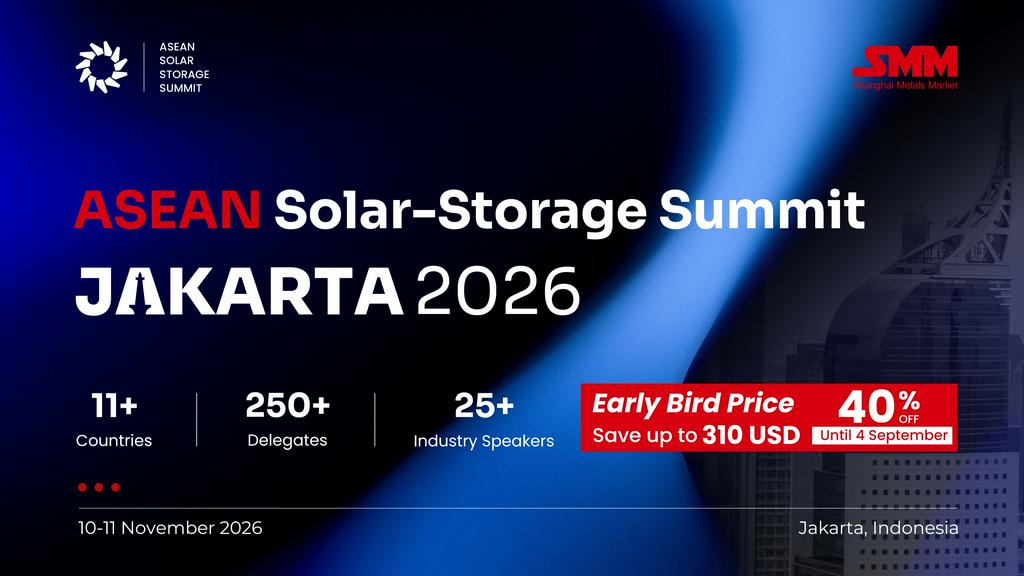
In addition, the 2026 SMM ASEAN Solar-Storage Summit will take place on November 10–11, 2026, in Jakarta, Indonesia. The summit will examine ASEAN solar and energy-storage market trends, policy frameworks, local-content requirements, technology innovation, project development and investment and financing cooperation. It will include a main forum, business matching and company visits, and is expected to bring together more than 250 industry representatives from over 11 countries and regions, alongside more than 25 speakers and over ten hours of business networking.
As Indonesia's 100 GW solar program moves toward procurement and implementation, access to projects, local partners, financing channels and delivery capabilities will become increasingly important. The summit will provide a platform not only for assessing policy and demand developments across Indonesia and ASEAN, but also for connecting government bodies, power companies, project developers, EPC contractors, solar and storage equipment suppliers, system integrators and financial institutions. Discussions and business matching will help companies explore cooperation involving project development, equipment procurement, TKDN compliance, storage configuration and project financing, supporting the transition from understanding the market to establishing partnerships and advancing investable projects.
![[Guangdong Energy Group 2026 Second Batch Centralised Procurement Winning Bid Result Announcement for PV Modules]](https://imgqn.smm.cn/usercenter/Jzkij20251217171737.jpg)
![[Today, the market price of PV modules was basically stable]](https://imgqn.smm.cn/usercenter/ZbnfH20251217171741.jpg)
![[SMM PV News Flash] Another Crystalline Silicon-Perovskite Tandem Thin-Film Cell Production Line Officially Commenced Production](https://imgqn.smm.cn/usercenter/NWqnx20251217171739.jpg)