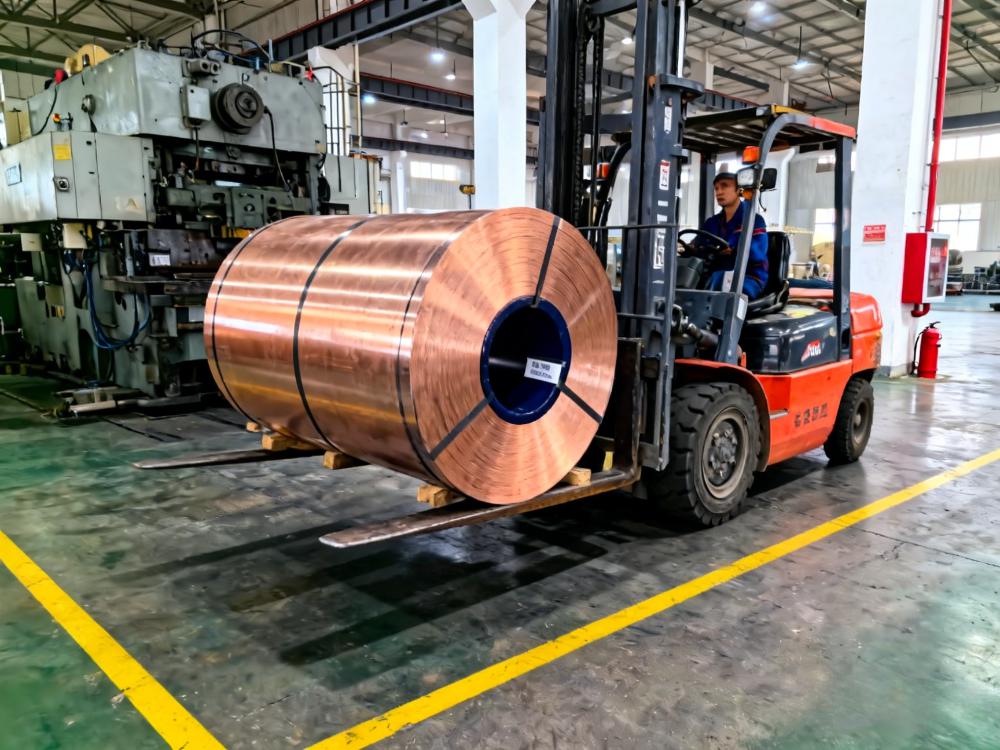
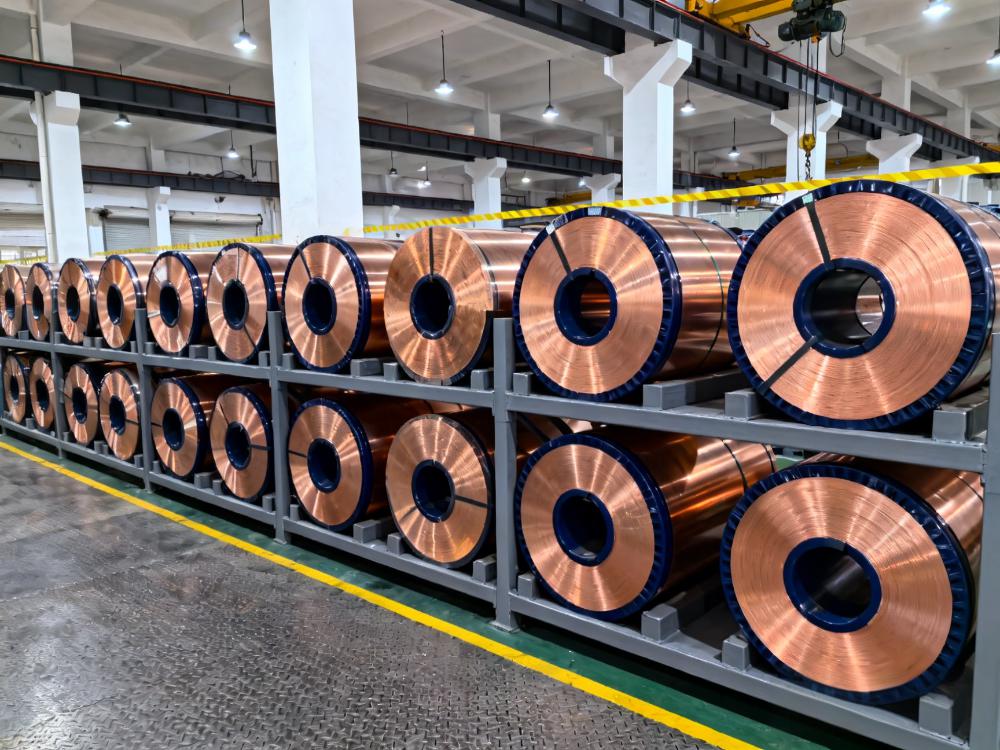
July brass billet imports sharply contracted MoM, while cumulative imports still kept up YoY [SMM analysis]

Published: Aug 21, 2026 14:58


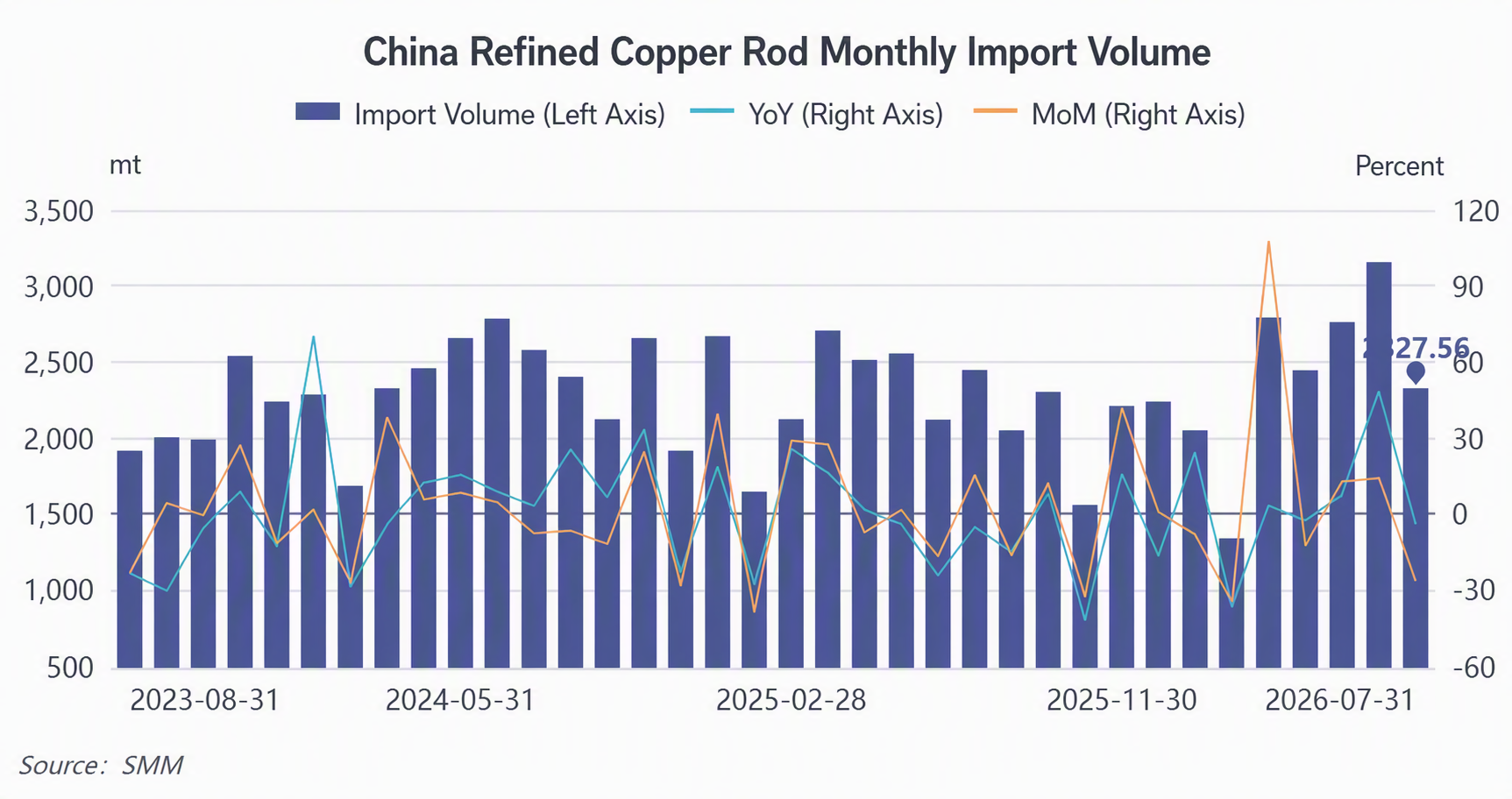
       According to the latest customs statistics, China imported 2,327.56 mt in physical content of copper-zinc alloy (brass) bars and rods (HS codes: 74072111, 74072119, 74072190) in July 2026, down 5.01% YoY and sharply down 26.27% MoM; cumulative imports from January to July totaled 16,900 mt in physical content, up 4.8% YoY.
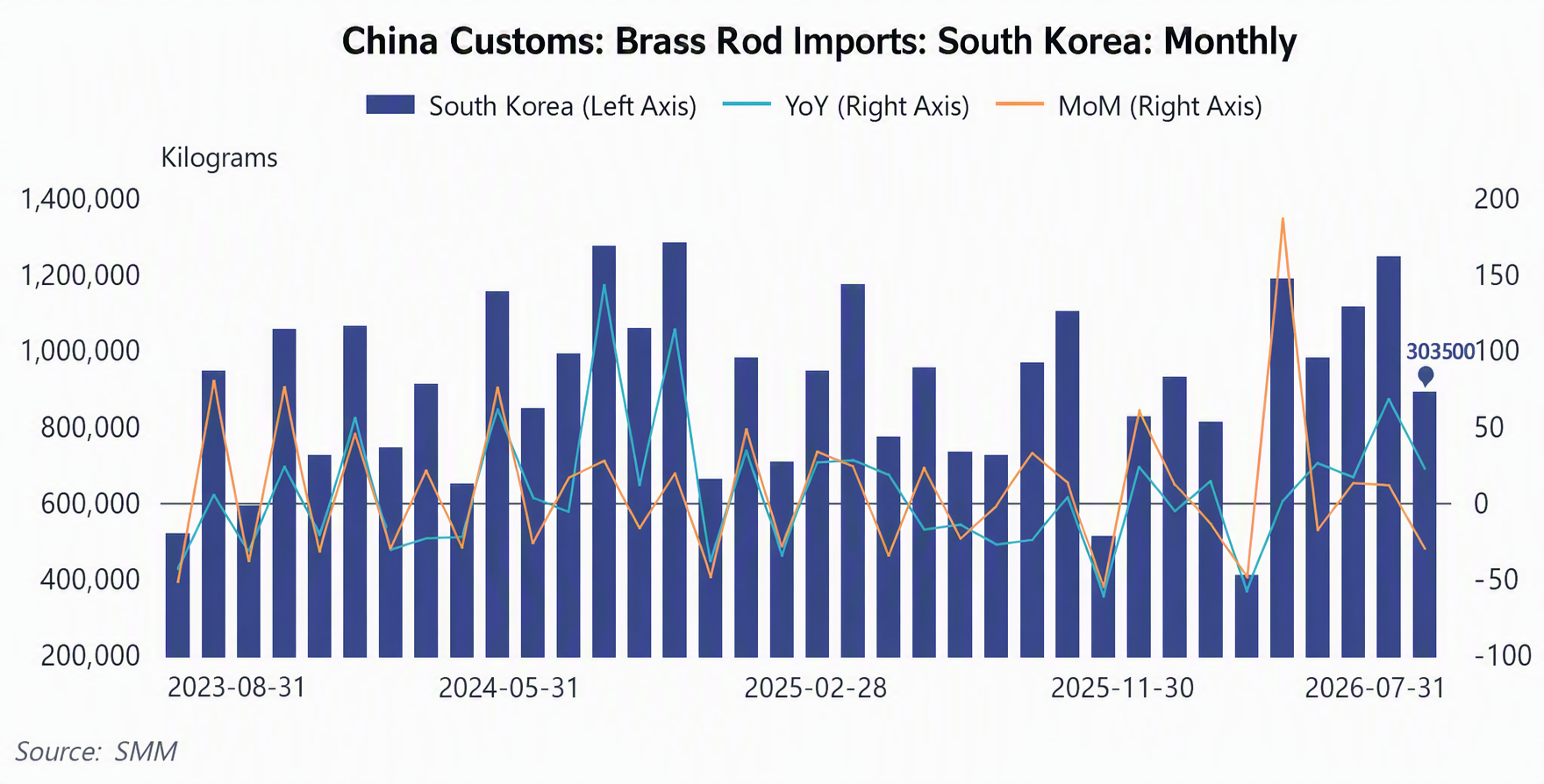
       From the perspective of import source structure, South Korea remained the largest source country for China's brass billet imports.In July, imports of brass billet from South Korea were 893 mt, down 28.53% MoM and up 22.48% YoY, accounting for 39.58% of total imports that month. Thailand rose to the second-largest source, with July imports of 334.5 mt, down 24.76% MoM and up significantly 447.99% YoY. Japan ranked third, with July imports of 326.8 mt, down 35.82% MoM and down 29.03% YoY. The three core supply countries—South Korea, Thailand, and Japan—together accounted for over 60% of total imports in July, maintaining a stable traditional supply landscape in East Asia.
       In terms of import value, the import value of brass billet in July was $22.9232 million, down 23.65% MoM and up 23.04% YoY; cumulative import value from January to July 2026 was $158.656 million, up 31.74% YoY.Monthly imports pulled back significantly MoM, but import value still posted positive growth YoY, indirectly reflecting that import value stayed high.

        SMM believes that the sharp MoM pullback in brass billet imports in July was mainly affected by the domestic downstream entering the traditional consumption off-season, with weak end-use demand for brass billet in China. Processing enterprises mainly consumed their own inventory, overseas purchase willingness weakened, and import orders contracted. However, cumulative imports from January to July still achieved positive YoY growth, indicating that ex-China supply still played a supplementary role for China.Looking ahead, China's end-use demand for brass billet has not yet shown clear signs of recovery. Without concentrated restocking, brass billet imports are likely to remain in the doldrums.

Data Source Statement: Except for publicly available information, all other data are processed by SMM based on publicly available information, market communication, and relying on SMM's internal database model. They are for reference only and do not constitute decision-making recommendations.

Images in this article contain AI-translated captions for reference only.

For any inquiries or for more information, please contact: lemonzhao@smm.cn
For more information on how to access our research reports, please contact:service.en@smm.cn
Related News
Yingkou Jianfa Shenghai Phase I 300,000 mt Copper Cathode Project Smelting Furnace Starts Production, Pyrometallurgy System Enters Furnace Drying Stage
3 hours ago
Yingkou Jianfa Shenghai Phase I 300,000 mt Copper Cathode Project Smelting Furnace Starts Production, Pyrometallurgy System Enters Furnace Drying Stage
Read More
Yingkou Jianfa Shenghai Phase I 300,000 mt Copper Cathode Project Smelting Furnace Starts Production, Pyrometallurgy System Enters Furnace Drying Stage
At 9:58 on September 12, the core smelting furnace of the pyrometallurgy system at Yingkou Jianfa Shenghai Nonferrous Metals & Chemicals Co., Ltd.'s multi-metal recovery project was successfully ignited, officially entering the furnace drying stage and marking a key step toward full-line commissioning and production. Public information shows that the Yingkou Jianfa Shenghai polymetallic complex gold-silver ore comprehensive recovery technology upgrade, relocation, and expansion project uses copper concentrates as its main raw material, with an overall planned capacity of 600,000 mt/year of copper cathode to be built in two phases, with capacity of 300,000 mt/year in each phase. Phase I is designed to produce 300,000 mt/year of copper cathode and 1.18 million mt/year of sulphuric acid, along with supporting systems for smelting, converting, anode refining, electrolysis, slag beneficiation, and precious metal recovery. After this ignition, the project will carry out standardized furnace drying and hot-state integrated trial runs across the entire system to verify equipment, instruments, interlocks, and automatic control systems. The project has not yet formally started raw material feeding and production; after furnace drying and system commissioning are completed, it will further advance the commissioning of Phase I's 300,000 mt/year copper cathode capacity. If the project is successfully brought into production, it is expected to increase copper smelting capacity in North China and further boost domestic demand for copper concentrate raw materials.
3 hours ago
Alchemy Resources Starts Drilling Copper-Gold Targets at Yellow Mountain
19 hours ago
Alchemy Resources Starts Drilling Copper-Gold Targets at Yellow Mountain
Read More
Alchemy Resources Starts Drilling Copper-Gold Targets at Yellow Mountain
Alchemy Resources announced on September 11 that reverse-circulation drilling has commenced across its Yellow Mountain and Overflow projects in New South Wales, Australia, with up to 15 holes planned during the latest exploration campaign.​ At the 80%-owned Yellow Mountain project, drilling will test extensions to previously identified copper-gold and polymetallic mineralisation, as well as two previously undrilled geophysical targets.​ Previous drilling at Yellow Mountain returned an intersection of 113 metres grading 1.17% copper equivalent, comprising 0.33% copper, 0.37 g/t gold, 24.3 g/t silver, 0.86% lead and 1.23% zinc. The latest drilling campaign is designed to test whether the known mineralised system extends into newly identified target areas.​ The program will also include drilling at the Overflow project, where Alchemy is targeting extensions to existing mineralisation along strike and at depth. Overflow currently hosts an inferred mineral resource of approximately 342,000 ounces of gold equivalent and contains gold, silver, copper, lead and zinc mineralisation.​ The commencement of drilling provides a near-term test of the scale and continuity of mineralisation at Yellow Mountain. The previously reported broad copper-gold-polymetallic intersection indicates potential for a sizeable mineralised system, while the newly defined geophysical targets provide additional exploration upside. Drilling results will be important in determining whether the mineralised footprint can be materially expanded.
19 hours ago
Freeport CEO Signals Likely Go-Ahead for $4.5 Billion Bagdad Copper Expansion
19 hours ago
Freeport CEO Signals Likely Go-Ahead for $4.5 Billion Bagdad Copper Expansion
Read More
Freeport CEO Signals Likely Go-Ahead for $4.5 Billion Bagdad Copper Expansion
Freeport-McMoRan Chief Executive Officer Kathleen Quirk has indicated that the company expects to move forward with the proposed expansion of its Bagdad copper mine in Arizona, marking a stronger commitment to the project ahead of a formal investment decision. Speaking at the Jefferies Global Industrials Conference on September 10, Quirk said the project still requires input from Freeport's board but that she expects the company will proceed. She described the expansion as a roughly three-year construction project and noted that no major permitting hurdles are expected. Freeport's latest project estimates put capital expenditure for the Bagdad expansion at approximately US$4.5 billion, around 30% above the previous US$3.5 billion estimate, reflecting cost escalation, scope changes and additional engineering. The project would more than double concentrator capacity at Bagdad and is expected to add approximately 200–250 million lb, or around 91,000–113,000 tonnes, of copper production annually, alongside an additional 10–12 million lb of molybdenum. Bagdad currently has a reserve life exceeding 80 years. Freeport's Q2 2026 regulatory filing had described the project as being prepared for a potential investment decision during the second half of 2026. The latest comments therefore represent a more positive signal from management on the likelihood of development, although formal board approval has not yet been announced. A decision to proceed with Bagdad would represent one of Freeport's most significant near-term copper growth investments in the US. The potential addition of more than 90,000 tonnes per year of copper would materially increase Freeport's US output, although first production would remain several years away given the expected construction period. Attention will now turn to formal board approval and a final investment decision.
19 hours ago
Register to Continue Reading
Gain access to the latest insights in metals and new energy
Already have an account?Sign in here
July brass billet imports sharply contracted MoM, while cumulative imports still kept up YoY [SMM analysis] - Shanghai Metals Market (SMM)