India’s steelmaking raw-material base follows three distinct trajectories. Iron ore remains its strongest domestic pillar, with provisional production reaching 312.53 million tonnes (Mt) in FY2025-26. Ferrous scrap presents a more balanced picture, as imports fell from 9.5 Mt to 7.7 Mt over the latest three-year period reported by the Ministry of Steel. Coking coal is the clear exception: domestic supply remains small relative to the steel sector’s requirements, while import volumes continue to rise.
A parliamentary committee report places current domestic coking-coal use in steelmaking at around 10% and refers to prevailing domestic blending of 10–12%. The same report says nearly 43% of India’s steel production is routed through blast furnaces. Together, those figures locate the industry’s principal raw-material vulnerability: not in iron ore, and not uniformly across the steel sector, but in the coking coal required by its blast-furnace capacity.
That vulnerability became more consequential in FY2025-26. Crude steel output increased 10.7% year on year to approximately 168.4 Mt. Coking-coal imports grew faster, rising 15.2% to 66.33 Mt from 57.58 Mt in FY2024-25.
The import surge was followed by a recovery in the HCC FOB Australia price series, per Ministry of Steel data. The indicator stood at USD 243/tonne in June 2026, up from USD 239/tonne in May and approximately USD 175/tonne in March 2025.
India therefore entered FY2026-27 with a larger annual import base and a firmer seaborne price indicator. Under the current steelmaking mix, that combination increases the potential effect of raw-material prices, freight, foreign-exchange movements and supply interruptions on blast-furnace producers.
Coking-coal imports are outpacing steel production
India’s coking-coal imports increased by 8.75 Mt in FY2025-26, reaching the highest level in the latest five-year series.
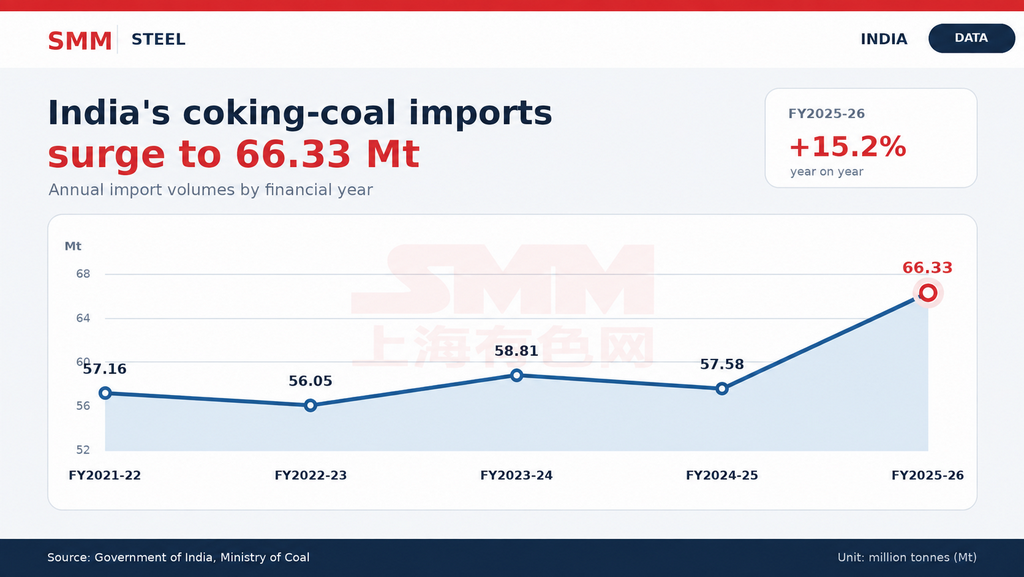
At 66.33 Mt, coking coal represented 26.9% by tonnage of India’s total FY2025-26 coal imports of 246.37 Mt. As a simple import-to-output comparison, the volume was equivalent to approximately 394 kg for every tonne of crude steel produced during the year. It is not a measure of coal consumed per tonne of steel because it does not adjust for inventories, timing or uses outside crude-steel production. The divergence continued into FY2026-27. India imported 6.01 Mt of coking coal in April 2026, up 1.34% from 5.93 Mt in April 2025. Total coal imports fell 12.95% over the same period, to 21.13 Mt from 24.27 Mt. The decline in India’s overall coal-import basket did not extend to coking coal. A Ministry of Steel release issued in July placed India’s crude steelmaking capacity at approximately 222 million tonnes per annum (MTPA) as of June 2026. The National Steel Policy targets 300 MTPA of capacity and 255 MTPA of production by FY2030-31. As long as blast furnaces retain a substantial share of that expansion, more output will require more coking-coal availability.
Higher import volumes amplify seaborne price exposure
The Ministry of Steel’s HCC FOB Australia series stood at USD 243/tonne in June 2026, 1.7% above USD 239/tonne in May. The recent price path illustrates the market’s volatility:
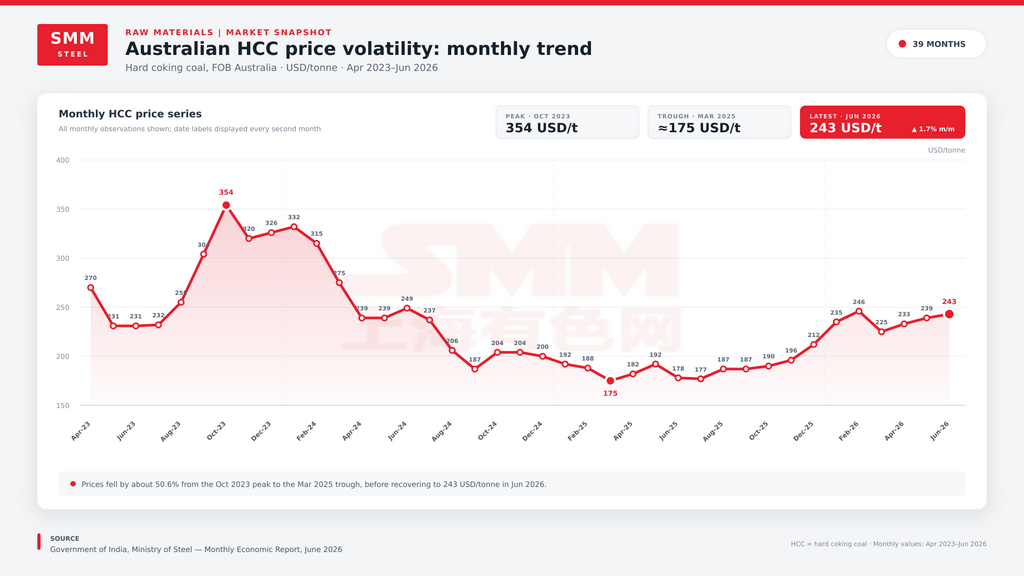
At the FY2025-26 import volume of 66.33 Mt, a USD 10/tonne change applied across the full volume would represent a notional USD 663.3 million change in gross procurement expenditure. The sensitivity is illustrative: actual costs vary with coal quality, freight, contractual pricing and hedging.
The underlying relationship is straightforward. A larger import requirement increases the potential cost impact of each movement in the seaborne market, even before freight and currency effects are included.
The constraint is usable coal, not geology alone
India has 37.37 billion tonnes of coking-coal resources, concentrated mainly in Jharkhand, with deposits also in Madhya Pradesh, West Bengal and Chhattisgarh. The government notified coking coal as a critical and strategic mineral in January 2026.
Resource tonnage, however, is not equivalent to coke-oven feedstock. Much of India’s domestic coking coal requires beneficiation to reduce ash and meet steelmakers’ specifications. The operative measure is not raw coal in the ground or at the mine mouth, but washed coal delivered at a quality that coke ovens can use.
Coal India’s raw coking-coal output weakened in FY2025-26. Production fell 2.4% to 58.21 Mt from 59.67 Mt in FY2024-25. Coking coal represented 7.6% of the company’s total FY2025-26 coal production of 768.19 Mt.
Washeries are a pivotal supply constraint
India’s washery performance improved in FY2024-25, but the volume of usable output remained small.
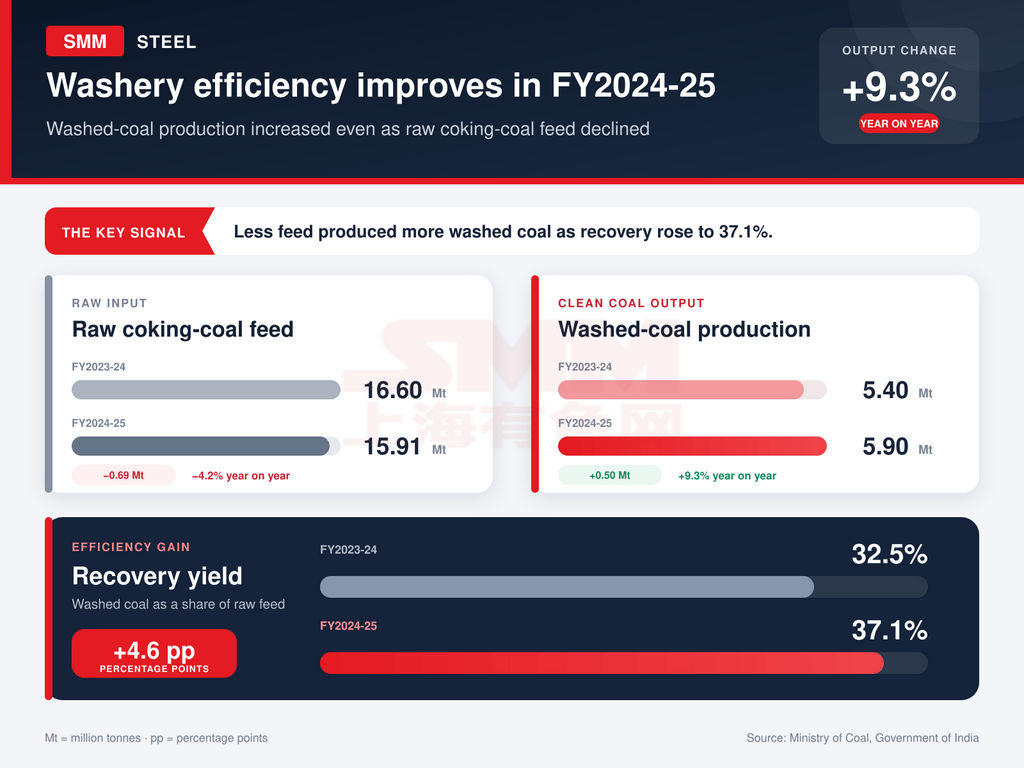
The higher yield lifted washed-coal production even as raw feed declined. Yet total output was still only 5.90 Mt. For every 100 tonnes of raw coal fed into washeries, approximately 37 tonnes of washed coal were recovered.
The parliamentary committee’s baseline counted 10 operating Coal India coking-coal washeries with combined capacity of 18.35 MTPA. Coal India subsequently reported that its 2 MTPA Bhojudih washery began commercial operations on May 26, 2026. Bhojudih was one of eight new coking-coal washeries in a 21.5 MTPA expansion plan; with it commissioned, seven projects representing 19.5 MTPA remain in the pipeline through FY2030.
The additions expand the system’s processing potential, but capacity alone does not substitute imports. Actual raw-coal feed, washery utilisation, recovery yield, product quality and the blending rates achieved by steelmakers determine how many imported tonnes are displaced.
A Ministry projection points to 138 Mt of imports
A Ministry projection reproduced in the parliamentary committee report places India’s coking-coal requirement at 161 Mt in FY2029-30, referred to here as FY2030. Its detailed supply balance is stark.
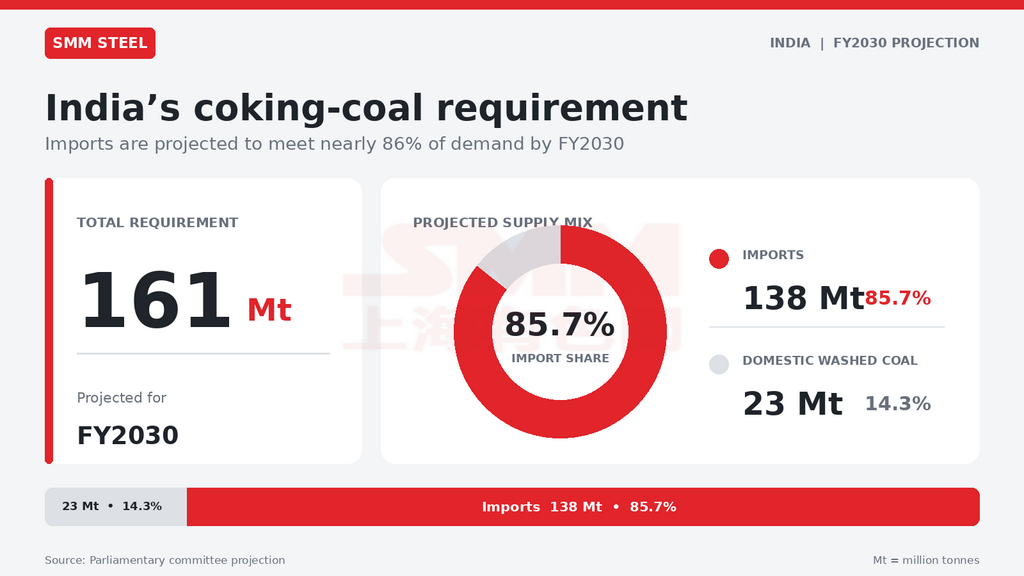
The projected import requirement of 138 Mt is 2.08 times the 66.33 Mt imported in FY2025-26.
The same report examines what would be required to raise the domestic blend to 30% in stamp-charged coke ovens. That objective would require 48 Mt of domestic washed coking coal. Against projected production of 23 Mt, the report identifies a 25 Mt supply gap.
The planning challenge is visible elsewhere in the report. Mission Coking Coal states that 140 Mt of raw domestic coking coal could yield approximately 48 Mt of usable coal, while the detailed FY2030 supply projection provides for only 23 Mt of domestic washed production. The first figure describes the usable output envisaged from the Mission’s raw-coal target; the second is the washery supply presently projected. The report leaves the difference between that potential and projected delivery unresolved and says the 25 Mt demand-supply gap is being examined with the Ministry of Steel.
Government measures include 16 auctioned coking-coal blocks expected to begin production by FY2028-29, new and modernised washeries, longer-term coal linkages and greater use of stamp-charging technology. Their effectiveness will be visible not in announced capacity, but in washed-coal output, domestic blending and imported tonnes displaced.
The 138 Mt projection does not describe India’s raw-material position as a whole. It isolates the weakness within it. Iron ore tells the opposite story.
Iron ore provides the domestic counterweight
India produced a provisional 312.53 Mt of iron ore in FY2025-26, up 8% from 289.40 Mt in FY2024-25. Production in March 2026 reached approximately 34.5 Mt, compared with 25.9 Mt in March 2025.
Iron-ore and pellet imports nevertheless increased from 4.9 Mt to 12.2 Mt over three years, a rise of approximately 149%.
The 12.2 Mt import figure was equivalent to 3.9% of FY2025-26 domestic iron-ore production. That comparison is deliberately limited: the import figure includes pellets, while the domestic production figure covers iron ore. It therefore shows relative scale rather than a direct import-dependence ratio.
Even with that distinction, domestic output of more than 312 Mt places iron ore in a fundamentally stronger position than coking coal. Rising imports may reflect grade, location and plant-specific requirements, but they do not overturn the scale of India’s domestic production base.
Scrap occupies a different position again. Its import trajectory is downward, and it primarily supports electric steelmaking rather than the blast-furnace route.
Scrap strengthens a different steelmaking route
A Ministry of Steel parliamentary reply shows ferrous-scrap imports declining from 9.5 Mt to 7.7 Mt over three years, a reduction of 18.9%. Unlike coking coal, the latest reported endpoint is lower than it was three years earlier.
India is also expanding the formal infrastructure for domestic recovery. As of July 31, 2026, 153 registered vehicle-scrapping facilities were operating across 23 states and Union Territories. The Environment Protection (End-of-Life Vehicles) Rules, 2025, the Steel Scrap Recycling Policy, 2019, and the Recycling of Ships Act, 2019, provide frameworks for recovering more material within India.
Greater domestic scrap availability supports electric steelmaking and can reduce imported-scrap requirements. It does not replace the coking coal consumed inside an operating blast furnace. Scrap and coking coal therefore address different production routes and different forms of import exposure.
That distinction completes the raw-material picture. India has a large domestic iron-ore base. Ferrous-scrap imports are below their level three years earlier, while formal recovery infrastructure is expanding. But neither changes the immediate requirement for usable coking coal in the country’s existing blast-furnace fleet.
The real test is usable tonnes
India’s raw-material security is best understood as a hierarchy rather than a single headline. Iron-ore production exceeds 312 Mt. Ferrous-scrap imports were 7.7 Mt at the latest reported endpoint, down from 9.5 Mt three years earlier. Coking-coal imports reached 66.33 Mt in FY2025-26, while a Ministry projection reproduced in a parliamentary report places them at 138 Mt in FY2030.
The central coking-coal challenge is conversion: turning domestic raw coal into low-ash washed coal that steelmakers can use. Mining targets and announced washery capacity do not establish supply security on their own.
Progress should be judged through four published indicators:
- Raw-coal feed processed by washeries
- Washed-coal recovery yield
- Domestic blending achieved by steelmakers
- Imported tonnes displaced
Until those measures show sustained improvement, India’s steel expansion—under its current production mix and raw-material structure—will continue to deepen its exposure to the international coking-coal market.

![[Domestic Iron Ore Brief] Prices in west Liaoning may stay in the doldrums, but downside is limited](https://imgqn.smm.cn/usercenter/VhIgs20251217171719.jpg)