SMM, August 20:
In the metals market:
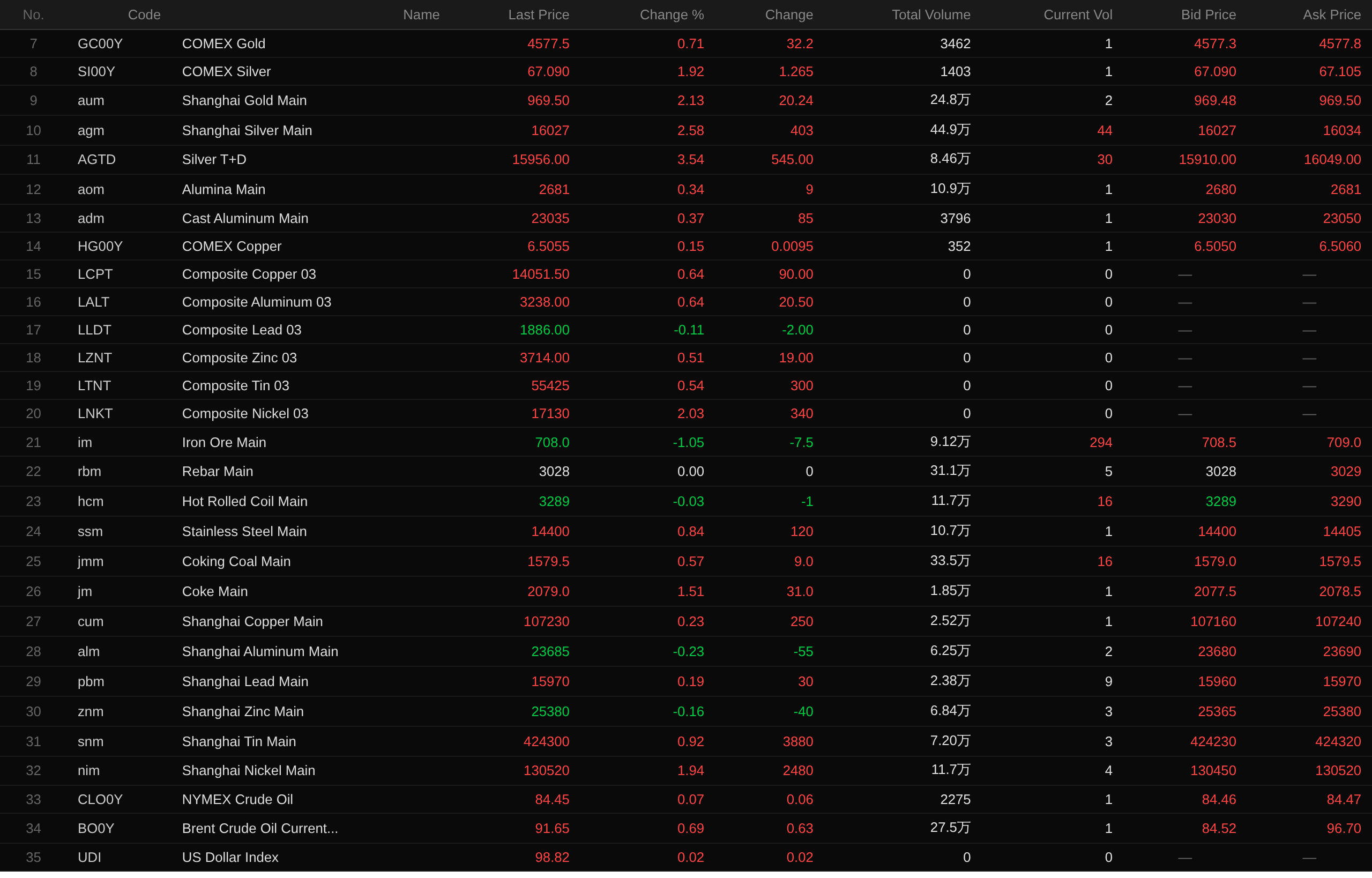
Overnight, base metals on the domestic market generally rose. SHFE copper edged up 0.23%. SHFE aluminum fell 0.23%. SHFE lead gained 0.19%. SHFE zinc lost 0.16%, SHFE tin rose 0.92%. SHFE nickel climbed 1.94%. In addition, the most-traded alumina futures contract rose 0.34%, and foundry aluminum main contract gained 0.37%.
Overnight, ferrous metals showed mixed performance. Stainless steel rose 0.84%, iron ore fell 1.05%, and rebar was flat at 3,028 yuan/mt. Hot-rolled coil edged down 0.03%. In the coking coal and coke sector, the most-traded coking coal contract rose 0.57%, and the most-traded coke contract gained 1.51%.
Overnight in the overseas metals market, LME base metals nearly all rose. LME copper and LME aluminum both gained 0.64%. LME lead dipped 0.11%. LME zinc added 0.51%. LME tin rose 0.54%, and LME nickel surged 2.03%.
Overnight in the precious metals sector : COMEX gold jumped 3.62% to settle at $4,580.7/oz, while COMEX silver surged 4.83%. Overnight, the most-traded SHFE gold contract rose 2.13%, and the most-traded SHFE silver contract gained 2.58%.
Overnight closing prices as of 7:22 AM, August 20:
Macro Front
China:
[Three Departments Jointly Issue Guidance Catalog to Further Improve National Carbon Emission Measurement Technology System] The State Administration for Market Regulation, the National Development and Reform Commission (NDRC), and the Ministry of Ecology and Environment recently jointly issued the "Guidance Catalog for Carbon Emission Measurement Capacity Building (2026 Edition)." As an updated version of the 2024 edition, the 2026 catalog further refines and improves the national carbon emission measurement technology system, providing clear measurement guidelines for the development of China's carbon market. Compared with the 2024 edition, the 2026 catalog has achieved comprehensive expansion and systematic optimization, with an expanded technical coverage scope and a significantly more complete standards and specifications system. Among them, key measurement parameters increased from 39 to 58, detection standard methods expanded from 82 to 169, measurement instruments and equipment grew from 108 to 229, national measurement technical specifications increased from 85 to 156, and public social measurement standards expanded from 55 to 115. (CCTV News)
[Shanghai Publishes the 15th Five-Year Plan for Building a "Digital Shanghai"] The General Office of the Shanghai Municipal People's Government issued the "Shanghai 15th Five-Year Plan for Building a 'Digital Shanghai'." The plan proposes that by 2030, the construction of "Digital Shanghai" will achieve leapfrog development, with significant outcomes highlighted in "internationalized connectivity, data value realization, and intelligent application." It will empower economic and social development and enhance governance capacity, promote deep transformation of production methods and revolutionary leap in productivity, and ultimately build a fully established benchmark digital city with regional driving force and broad-area influence. The city’s digital base is leading in capability, the blockchain development system is advancing, infrastructure is fully consolidated, digitalization in shipping and trade is accelerating breakthroughs, applications cover all industry sectors, and new-type infrastructure such as information and communication networks, computing power, and spatial intelligence has seen significantly enhanced effectiveness. International data cooperation is actively gaining momentum, cross-border data infrastructure is secure and convenient, and digital service platforms are diverse and rich. New-quality development momentum is driven by digital intelligence, innovation in data development and utilization is deepening, and the integration of the digital and real economies continues to deepen. (Jin10 Data APP)
[Guangzhou Home Price Index Rises for Five Consecutive Months, Market Transactions Remain Active] According to the latest data on the sales prices of commercial residential properties in 70 large and medium-sized cities released by the National Bureau of Statistics (NBS), in July, the MoM index for new home sales prices in Guangzhou was 100.1, and that for pre-owned homes was 100.4. The MoM indices for both new and pre-owned home prices have risen for five consecutive months, further consolidating the market’s stabilization and recovery trend. Against the backdrop of rebounding home prices, market transactions remained active. As the effects of policies such as raising housing provident fund loan limits, providing special subsidies for “sell old, buy new” transactions, and state-owned enterprises purchasing pre-owned homes continue to be released, market activity has recently stayed at a high level. Since July, the YoY growth in the online contract-signed floor area of new commercial housing citywide has remained positive. From July 1 to 31, the online contract-signed floor area of new commercial housing in the city rose 5.8% YoY, including a 9% YoY increase for new residential housing. In the first half of August (August 1–15), the online contract-signed floor area of new commercial housing grew 15% YoY. (Guangzhou Municipal Housing and Urban-Rural Development Bureau)
On the dollar front:
The US dollar index plunged 0.86% overnight to 98.79. The US Treasury unexpectedly announced it will at least double the scale of long-term Treasury buybacks, sending the 30-year Treasury yield down more than 9 basis points in a single day, its biggest decline since October, and the dollar index broke below the 99 mark to hit a three-month low. Goldman Sachs forex trader Shah Praneet believes the expansion has more signaling significance than actual effect for the dollar; the Treasury is demonstrating its imagination to cap the long end, with the dollar becoming the pressure-release valve in the process. (Wall Street Insights)
The US Treasury issued a notice stating that it is at least doubling the size of the liquidity support buyback operations for long-term nominal coupon securities, covering the 10- to 20-year and 20- to 30-year maturity ranges. Currently, the maximum size per operation is $2 billion, and it will be raised to at least $4 billion going forward. The adjustment will take effect on September 9, 2026, and will be implemented during the remainder of the current refunding quarter (through November 4, 2026). The Treasury will provide more information on future buyback sizes at the next quarterly refunding meeting scheduled for November 4, 2026. The expansion of the repurchase operation scale reflects the Treasury's desire to provide stronger liquidity support to the long-term nominal Treasury bond market. The Treasury will announce the updated temporary Treasury bond repurchase arrangement later. (Jin10 Data APP)
Fed meeting minutes showed that several officials leaned toward a rate hike last month, while many indicated that further tightening of monetary policy would be necessary if inflation failed to decline. However, at the July meeting, uncertainty still heavily influenced US Fed officials' judgments. The minutes stated: "Regarding the monetary policy outlook, participants reiterated that their interpretation of incoming data would be a key component of policy discussions." The FOMC decided in July with a 9 to 3 vote to maintain the benchmark interest rate in a range of 3.5% to 3.75%. Logan, Hammack, and Kashkari voted against, advocating for a 25 basis point rate hike. Two other regional Fed presidents who did not have voting rights in July — Schmid and Musalem — subsequently indicated that they would have supported a rate hike at that meeting if they had had voting rights. Most of the policy discussion at the July meeting centered on differing judgments about future inflation trends. The minutes said: "Most participants expected inflation to gradually pull back over the remainder of the year as the effects of tariffs and previous energy price increases faded, but many noted that the possibility of persistently elevated inflation remained."
Additionally, the Fed meeting minutes showed that Fed Chairman Warsh proposed an idea: reducing the number of policy meetings per year for the Federal Open Market Committee (FOMC) from eight to six. The minutes stated: "The Chairman noted that scheduling six meetings per year, approximately every two months, would allow for more information to accumulate between meetings compared to the current arrangement, and would also provide more time for policymakers and US Fed staff to study and consider strategic issues in monetary policy." Subsequently, Warsh solicited opinions from committee members on this idea. The minutes clearly stated that the number of meetings would not be adjusted this year. A reduction in the number of policy meetings would mean a significant change in how the US Fed operates.
According to CME "FedWatch": the probabilities for September are unchanged (67.3%) and a cumulative 25bp hike (32.7%); for October, unchanged (58.3%), a cumulative 25bp hike (37.3%), and a cumulative 50bp hike (4.3%). (Jinshi Data APP)
Other currencies:
Deutsche Bank analyst Raja Sanjay noted in a report that UK inflation could rise further. In July, the inflation rate jumped to 2.9% from 2.6% in the previous month. He said: "The Bank of England's core services indicators were all revised up, highlighting some unease about the momentum of price increases." He added that due to ongoing uncertainty in the Middle East, energy inflation also remained volatile. However, Raja noted that food price inflation had fallen to its lowest level since the end of 2021, and the pace of service price increases had also dropped to the lowest point in three months. Yet this may be only a temporary relief. He said: "There is good reason to believe that the direction of food prices in 2027 is likely to be only one way — up." (Jinshi Data APP)
On the macro front:
Today, data will be released including China's July Swift RMB share in global payments, China's one-year loan prime rate as of August 20, Australia's July seasonally adjusted unemployment rate, Germany's July PPI month-on-month rate, Switzerland's July trade balance, UK's August CBI industrial orders balance, US initial jobless claims for the week ending August 15, US August Philadelphia Fed manufacturing index, US July Conference Board leading index month-on-month rate, China's July year-to-date installed power generation capacity, and the year-to-date annual growth rate of China's installed power generation capacity. Additionally, attention should be paid to: the US Fed releasing the minutes of its monetary policy meeting; the Ministry of Commerce holding its first regular press briefing in August; FOMC voter for 2028 and St. Louis Fed President Musalem giving an interview to CNBC; and Alibaba releasing its financial results.
Crude oil:
Overnight, both oil futures extended gains from the previous three trading sessions, with WTI up 0.4% and Brent up 0.69%.
Oil prices crept higher amid escalating conflict between the UAE and Iran. US EIA data intensified supply concerns, as refinery operating rates rose to the highest since September 2019, led by the Gulf Coast, distillate inventories fell, Cushing crude oil inventories neared tank bottoms, and the Strategic Petroleum Reserve dropped to a 43-year low. Global Risk Management company's chief analyst Rasmussen Arne said that the escalation between the UAE and Iran, combined with the market pricing in a scenario of a prolonged closure of the Strait of Hormuz, provided sustained support for oil product prices. (Wall Street CN)
US President Trump stated, “I gave Iran more opportunities to reach a deal than anyone else. Regrettably, they missed this opportunity. Therefore, today, I am announcing the toughest economic sanctions ever imposed on Iran, which will be an unprecedented economic war and isolation.”(Jin10 Data APP)
Additionally, two US officials told Axios that the US military has quietly established a shipping lane in the Strait of Hormuz for entering and exiting the strait, handling millions of barrels of oil daily. Although the broader war remains deadlocked, this operation has achieved notable results. The operation has been ongoing for several weeks, and currently, 15 to 20 tankers have passed through the southern lane along the coast of Oman to enter and exit the Strait of Hormuz. Officials say about 10 million barrels of oil are shipped through the strait daily and enter the global energy market, but this figure is roughly half of the pre-war volume. This US-led operation is mitigating one of the most severe impacts of the war: disruptions in oil supply, which have driven crude oil prices sharply higher. Officials indicate that although the volume of oil shipped through the strait remains below pre-war levels, it has already had a clear impact on global oil supply.(Jin10 Data APP)

![Backwardation narrows slightly across months; spot premiums stay high amid divergent downstream demand [SMM Shanghai spot copper]](https://imgqn.smm.cn/usercenter/tXxfd20251217171713.jpg)
![Scarce registered copper cargoes in the market drive offers higher [SMM Yangshan spot copper]](https://imgqn.smm.cn/usercenter/LbxVx20251217171714.jpeg)