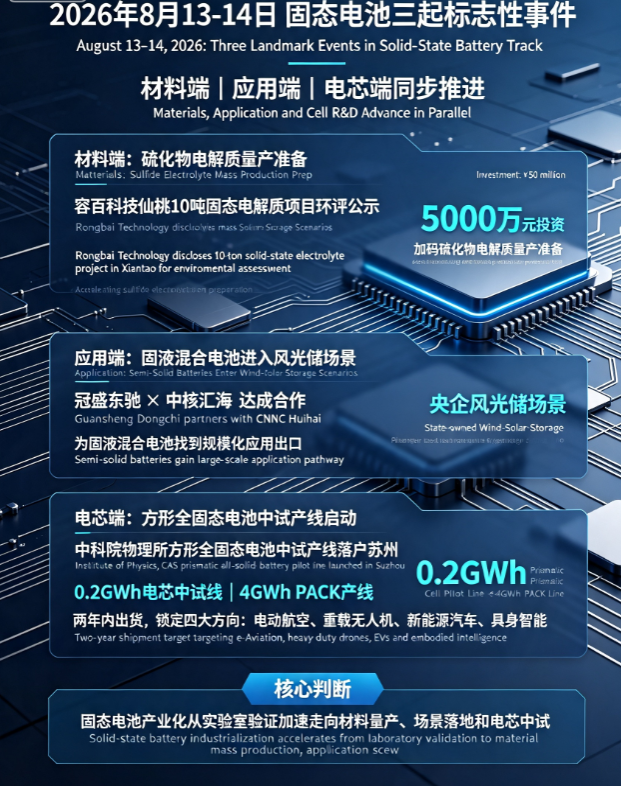
Summary – Over 13–14 August 2026, three landmark events reshaped the solid‑state battery landscape. On the material front, Ronbay Technology’s 10‑tonne solid‑state electrolyte project in Xiantao passed its environmental assessment, with a RMB 50 million investment pushing sulfide electrolyte production closer to reality. On the application front, Guansheng Dongchi partnered with CNNC Haihui, securing a state‑owned enterprise (SOE) channel for its polymer hybrid solid‑liquid batteries in wind‑solar storage projects. On the cell front, the Institute of Physics (CAS) launched a prismatic all‑solid‑state battery pilot line in Suzhou, targeting 0.2 GWh of cell pilot capacity and 4 GWh of system integration, with first deliveries aimed within two years for e‑aviation, heavy‑lift drones, EVs, and embodied intelligence. These concurrent moves signal that solid‑state battery industrialization is shifting from isolated breakthroughs to systematic advancement.



I. Material Foundation – Ronbay’s RMB 50 Million Boost to Solid‑State Electrolytes
On 14 August 2026, the Xiantao Municipal Ecology and Environment Bureau published the first‑round environmental impact disclosure for Ronbay Xiantao Lithium Material Co., Ltd.’s 10‑tonne‑per‑year solid‑state electrolyte project. The facility, located east of Xidagou Road in Changtuokou Town, involves a RMB 50 million investment and a new 693 m² production building.
Though 10 tonnes is trivial in industrial terms, it is highly significant for solid‑state batteries. The solid electrolyte is the most critical and bottlenecked component in all‑solid‑state cells. Ronbay had previously disclosed that its sulfide electrolyte pilot line was under construction, with some mass‑production equipment already validated with materials, targeting completion in early 2026 and production in the first half. This new EIA announcement moves the project into its execution phase. Notably, Ronbay already has a 400,000‑tonne cathode material project and a 6,000‑tonne polyanionic sodium‑ion cathode R&D and industrialization project in Xiantao. Adding solid‑state electrolytes further enriches its solid‑state material matrix, creating a “dual‑engine” strategy covering both cathodes and electrolytes.
II. Energy Storage Expansion – Guansheng Dongchi Finds Its SOE Outlet
On 13 August 2026, Zhejiang Guansheng Dongchi Energy Technology Co., Ltd. and CNNC Haihui Wind Power Investment Co., Ltd. formally signed a strategic cooperation framework agreement in Zhejiang. CNNC Haihui, a joint venture between CNNC and CNOOC, focuses on onshore wind, offshore wind, and independent storage project investment. Guansheng Dongchi, leveraging its parent Guansheng’s four decades of precision manufacturing expertise, specialises in polymer hybrid solid‑liquid battery R&D and commercialisation, with a complete product portfolio and mass‑production capability.
The key to this partnership is scenario access. CNNC Haihui holds a vast portfolio of renewable energy assets – the most direct deployment channel for storage systems. Guansheng Dongchi’s BAXPOWER hybrid solid‑liquid batteries feature ultra‑long cycle life and full‑temperature stability, perfectly suited for the demanding conditions of utility‑scale storage. The collaboration aims to roll out hybrid solid‑liquid solutions in wind‑solar co‑located storage and C&I storage projects.
From an industry perspective, this is a classic “technology‑seeking‑scenario” match. Solid‑state/hybrid batteries still cost more than conventional Li‑ion, and storage is highly cost‑sensitive. The demonstration effect and scale‑procurement capability of SOE projects provide exactly the push needed to cross the “valley of death.” Guansheng Dongchi’s semi‑solid LFP battery project is expected to reach its 2 GWh capacity by mid‑2026, and this agreement secures a crucial off‑take channel for that upcoming output.
III. Cell Breakthrough – CAS Physics Institute Launches Prismatic All‑Solid‑State Pilot Line
On the same day, the Advanced Prismatic All‑Solid‑State Battery Industrialisation Project was signed in Suzhou. The project is a collaboration between the Institute of Physics (CAS) and Zhongke Low‑Carbon Urban Development (Suzhou) Co., Ltd., with Zhongke Yulang Low‑Carbon Technology Industry Development (Suzhou) Co., Ltd. as the construction contractor. The first phase allocates 219 mu (≈14.6 hectares) of industrial land in Suzhou Industrial Park, with Professor Li Hong as the project leader.
Technologically, the project adopts an in‑situ solidification route – solidifying the liquid electrolyte inside the cell to solve the most challenging interfacial contact problem between electrodes and electrolyte. The line integrates five core processes: electrode integration, ion‑conductive membrane, pre‑lithiation, thermal lamination, and central liquid cooling. Most notably, the same line can flexibly produce cells ranging from 400 Wh/kg semi‑solid to 600 Wh/kg all‑solid‑state. The dry‑electrode process cuts the line length by more than half and reduces energy consumption by 40% compared with conventional wet processes.
Capacity planning includes a 0.2 GWh cell pilot line and a 4 GWh system integration line in the first phase, with first shipments targeted within two years. Target applications are e‑aviation, heavy‑lift drones, electric vehicles, and embodied intelligence – a forward‑looking choice, as 400–600 Wh/kg energy density is exactly the threshold these sectors require.
From a regional industrial‑structure perspective, this project creates differentiated complementarity within Jiangsu’s solid‑state battery ecosystem: Kunshan Qingtao focuses on oxide semi‑solid, Changzhou CALB on sulfide all‑solid, and Suzhou enters with in‑situ solidification covering the full semi‑to‑all solid spectrum. The project will also link supporting enterprises in the Suzhou‑Wuxi‑Changzhou area to form a “one‑hour supply chain circle,” expected to drive supporting industrial output worth several billion yuan.
IV. Three Takeaways
These three events, coinciding within days, send clear signals:
First, industrialisation has moved from “lab narratives” to “engineering validation.” Ronbay’s 10‑tonne electrolyte line, Guansheng Dongchi’s 2 GWh semi‑solid line, and the Physics Institute’s 0.2 GWh pilot line are all concrete capacity deployments, not PowerPoint plans. The global solid‑state battery industry is in a critical window from lab to market, with some institutions forecasting the global market could exceed RMB 1.2 trillion by 2030.
Second, technology routes are diversifying. Sulfide (Ronbay), polymer hybrid (Guansheng Dongchi), and in‑situ solidification (CAS) are advancing in parallel. Different routes suit different scenarios – storage prioritises cycle life and cost, EVs prioritise energy density and rate capability, aviation prioritises safety and lightweighting. No single route will dominate all segments; competition and complementarity among multiple pathways will be the norm.
Third, “national teams” and industrial capital are joining forces. CNNC Haihui (an SOE) provides deployment scenarios, the CAS Physics Institute leads core cell R&D, while Ronbay and Guansheng (listed companies) drive commercialisation – government, research, and industry are forming a synergistic push.
2026 is widely viewed as a pivotal year for solid‑state battery industrialisation. These three events in the same week are no coincidence. From materials to cells, from R&D to applications, from labs to production lines, the puzzle is being assembled piece by piece. The coming year will test whether these projects can truly “run” from pilot to mass production. Whoever first bridges the gap from pilot line to volume production will seize a leading position in a future trillion‑dollar market.
**Note:** For further details or inquiries regarding solid-state battery development, please contact:
Phone: 021-20707860 (or WeChat: 13585549799)
Contact: Chaoxing Yang. Thank you!
![[Solid-State Battery: Tianqi Lithium Expected to Post an H1 Profit of 2.85-4.25 Billion Yuan, Surging Lithium Chemicals Prices Drive a Sharp Jump in Performance]](https://imgqn.smm.cn/usercenter/BQoXd20251217171731.jpg)