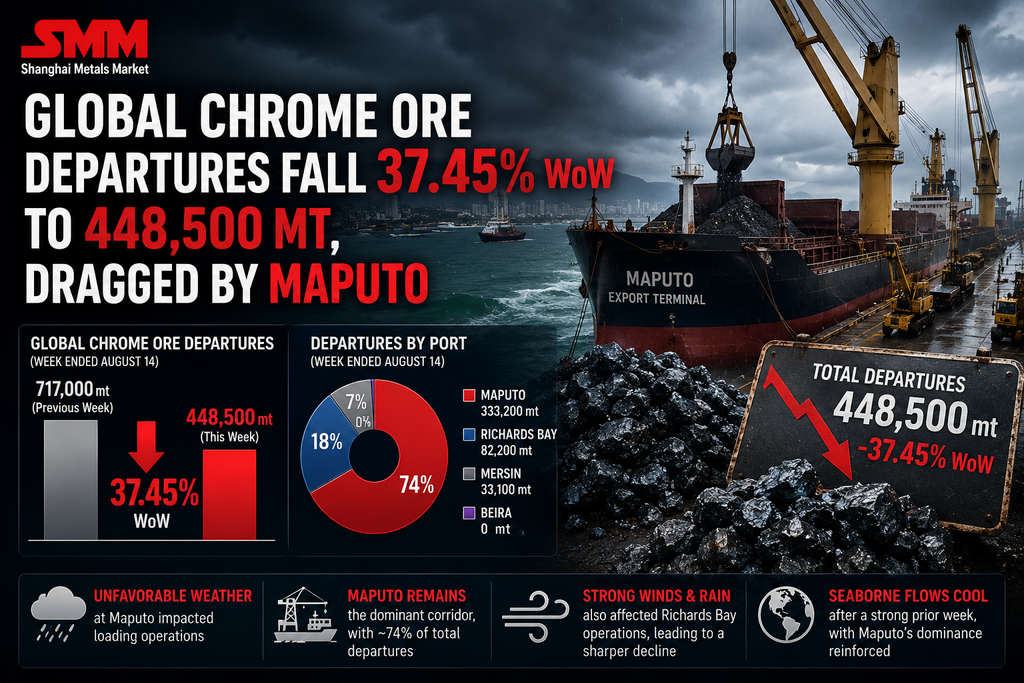
[SMM Chromium Flash] Global Chrome Ore Departures Fall 37.45% WoW to 448,500 mt, Dragged by Maputo

Published: Aug 17, 2026 15:44

Global chrome ore departures from major export ports totaled 448,500 mt in the week ended August 14, down 37.45% week-on-week, according to SMM's latest data. The pullback follows an unusually strong prior week in which total departures reached 717,000 mt, suggesting the latest figure reflects a partial normalization after elevated shipments rather than a sudden shift in underlying demand.

Maputo remained the dominant corridor even as its volume eased to 333,200 mt from 496,200 mt, still accounting for roughly 74% of total departures. The decline coincided with unfavorable weather at the port, with freezing temperatures, heavy rains, and strong winds reported during the week, likely disrupting loading operations and contributing to the lower volume. Even so, Maputo's continued outsized share in a down week underscores Mozambique's growing structural weight in the seaborne chrome ore trade alongside, and increasingly rivaling, traditional South African export routes.

Richards Bay saw a sharper proportional decline, falling to 82,200 mt from 171,500 mt, a drop-off that outpaced the market-wide contraction. The decline was likely affected by unfavorable coastal conditions, including strong winds and rain, which can slow vessel loading and berth operations at the port. Mersin departures also eased, to 33,100 mt from 49,300 mt, in line with its role as a smaller secondary loading point rather than a primary export corridor. Beira again recorded no chrome ore departures, indicating the port remains inactive in the current shipping cycle.

Taken together, the week's data points to a weather-affected cooling in seaborne chrome ore flows from Southern Africa after a strong prior week, with Maputo's resilience relative to Richards Bay reinforcing the port's increasing centrality to regional export logistics.

Data Source Statement: Except for publicly available information, all other data are processed by SMM based on publicly available information, market communication, and relying on SMM's internal database model. They are for reference only and do not constitute decision-making recommendations.

For any inquiries or for more information, please contact: lemonzhao@smm.cn
For more information on how to access our research reports, please contact:service.en@smm.cn
Related News
Kanyika Niobium Project to Strengthen Africa’s Critical Minerals Supply
2 hours ago
Kanyika Niobium Project to Strengthen Africa’s Critical Minerals Supply
Read More
Kanyika Niobium Project to Strengthen Africa’s Critical Minerals Supply
[SMM Flash] The global niobium oxide market is projected to expand significantly, with consumption forecast to rise from 13,379 tonnes in 2024 to 29,267 tonnes by 2035, equivalent to a reported 7.4% CAGR. Niobium pentoxide accounts for around 97% of demand, while metallurgy remains the largest consuming sector at approximately 52%, supported by applications in superalloys, aerospace and advanced industrial technologies. Battery applications are also emerging as a potential growth area as niobium-based materials target faster-charging and safer energy-storage technologies. Supply concentration remains a key market consideration, with Brazil accounting for more than 65% of global production according to the information provided. This concentration increases the strategic importance of alternative sources as governments and downstream industries seek greater diversification of critical-mineral supply chains. In Malawi, Globe Metals & Mining's Kanyika Project is designed to produce approximately 3,000 tonnes of high-purity Nb₂O₅ annually at full scale, potentially establishing a significant non-Brazilian source of niobium oxide. Kanyika has also made progress in securing potential downstream markets, with non-binding offtake agreements involving Affilips, Neo Performance Materials and Myst Trading. The agreements reportedly cover around 82% of Phase 1 niobium production and 100% of tantalum production, although these remain non-binding arrangements.
2 hours ago
[SMM Chromium Flash] Zimbabwe's Ferrochrome Smelters Race Against 2026 Captive Power Deadline Amid Beneficiation Push
Aug 14, 2026 21:25
[SMM Chromium Flash] Zimbabwe's Ferrochrome Smelters Race Against 2026 Captive Power Deadline Amid Beneficiation Push
Read More
[SMM Chromium Flash] Zimbabwe's Ferrochrome Smelters Race Against 2026 Captive Power Deadline Amid Beneficiation Push
[SMM Chromium Flash] Zimbabwe's Ferrochrome Smelters Race Against 2026 Captive Power Deadline Amid Beneficiation Push
Zimbabwe's government has set 2026 as the deadline for the country's ferrochrome smelters to develop their own captive power generation, primarily from renewable sources, ending a period of subsidized grid electricity tariffs for the sector, the International Chromium Development Association said earlier this year. The requirement reflects a hard physical constraint rather than a purely commercial one: ferrochrome smelting consumes 3,500-4,000 kWh per tonne of output, a load Zimbabwe's debt-strained, generation-deficient grid cannot absorb at scale without compromising supply to other users. With 2026 now more than half over, the deadline is approaching at the same time Zimbabwe is pushing an aggressive beneficiation agenda — including a February 2026 raw mineral export ban and newly announced regional beneficiation hubs earmarking chrome-producing areas for dedicated ferrochrome and chromium alloy production. Whether the country's ferrochrome producers, many of them Chinese-invested operations still ramping up capacity, have made sufficient progress toward captive renewable generation to meet the year-end deadline remains an open question, and one with direct implications for how much of Zimbabwe's chrome-beneficiation ambition can actually be realized on schedule. SMM will continue to monitor for concrete updates on captive power project progress across Zimbabwe's ferrochrome sector as the year progresses.
Aug 14, 2026 21:25
[SMM Chromium Flash] Southern Palladium Shares Sharply Higher, PGM-Chrome Project Clears Its Biggest Regulatory Hurdle
Aug 14, 2026 19:35
[SMM Chromium Flash] Southern Palladium Shares Sharply Higher, PGM-Chrome Project Clears Its Biggest Regulatory Hurdle
Read More
[SMM Chromium Flash] Southern Palladium Shares Sharply Higher, PGM-Chrome Project Clears Its Biggest Regulatory Hurdle
[SMM Chromium Flash] Southern Palladium Shares Sharply Higher, PGM-Chrome Project Clears Its Biggest Regulatory Hurdle
Southern Palladium's JSE-listed share price surged 27.8% to R23.01 on 11 August 2026, up from a prior close of R18.00, after the company confirmed that South Africa's Department of Mineral and Petroleum Resources had granted the mining right for its flagship Bengwenyama project on the Eastern Limb of the Bushveld Complex in Limpopo. The approval, dated 7 August, marks the conclusion of a regulatory process that began when the mining right application was lodged and accepted in October 2023 — nearly three years of engagement compressed into a single-day market repricing once the outcome became public. The company had requested trading halts on both the JSE and the ASX on 6 August while it assessed the terms of the grant before making an orderly disclosure. The mining right has been granted for an initial 30-year period, with Southern Palladium entitled to apply for renewal thereafter. Company leadership described the approval as a pivotal step in moving Bengwenyama from studies toward execution. For SMM's chrome coverage specifically, the milestone matters beyond the platinum group metals headline: Bengwenyama is explicitly structured as a PGM-chrome co-product project, with chrome positioned to contribute close to a third of the project's total revenue at full production once developed. Having now cleared its largest regulatory hurdle, Bengwenyama's path toward a final investment decision — and toward becoming a genuine new source of South African chrome concentrate — is measurably shorter than it was a week ago, though completion of the DFS, project financing and further permitting still stand between the mining right and construction.
Aug 14, 2026 19:35