National Bureau of Statistics (NBS) reported: From January to July, under the strong leadership of the CPC Central Committee with Comrade Xi Jinping at its core, all regions and departments thoroughly implemented the decisions and arrangements of the CPC Central Committee and the State Council, adhered to the general principle of pursuing progress while ensuring stability, effectively responded to various external shocks and internal difficulties, focused on implementing more proactive and effective macro policies, and solidly advanced high-quality development. Production and supply grew steadily, employment and prices remained generally stable, resilience in foreign trade continued to stand out, new growth drivers expanded and strengthened, and overall economic performance remained stable, sustaining a development trend featuring renewed momentum and an improved structure. From January to July, the value added of industrial enterprises above the designated size nationwide increased by 5.3% YoY. By the three major sectors, value added in mining increased by 2.5% YoY, manufacturing by 5.6%, and the production and supply of electricity, heat, gas and water by 5.4%. Value added in equipment manufacturing increased by 9.7% YoY, and value added in high-tech manufacturing increased by 13.8%, respectively 4.4 and 8.5 percentage points faster than the overall value added of industrial enterprises above the designated size.
In July 2026, the value added of industrial enterprises above the designated size increased by 4.5%
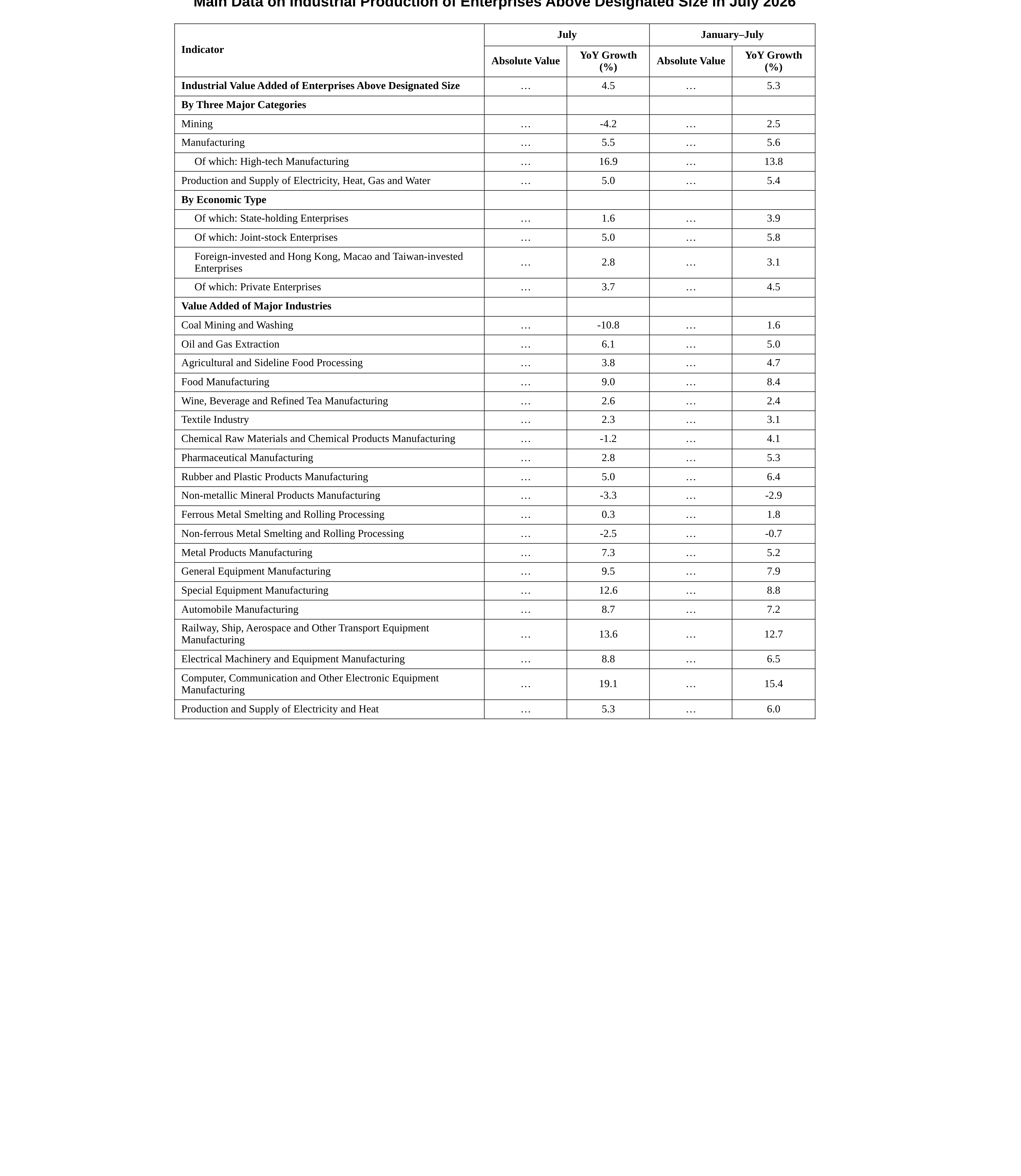
In July, the value added of industrial enterprises above the designated size increased by 4.5% YoY in real terms (all value-added growth rates are real growth rates after deducting price factors). On a MoM basis, in July, the value added of industrial enterprises above the designated size increased by 0.11% from the previous month. From January to July, the value added of industrial enterprises above the designated size increased by 5.3% YoY.
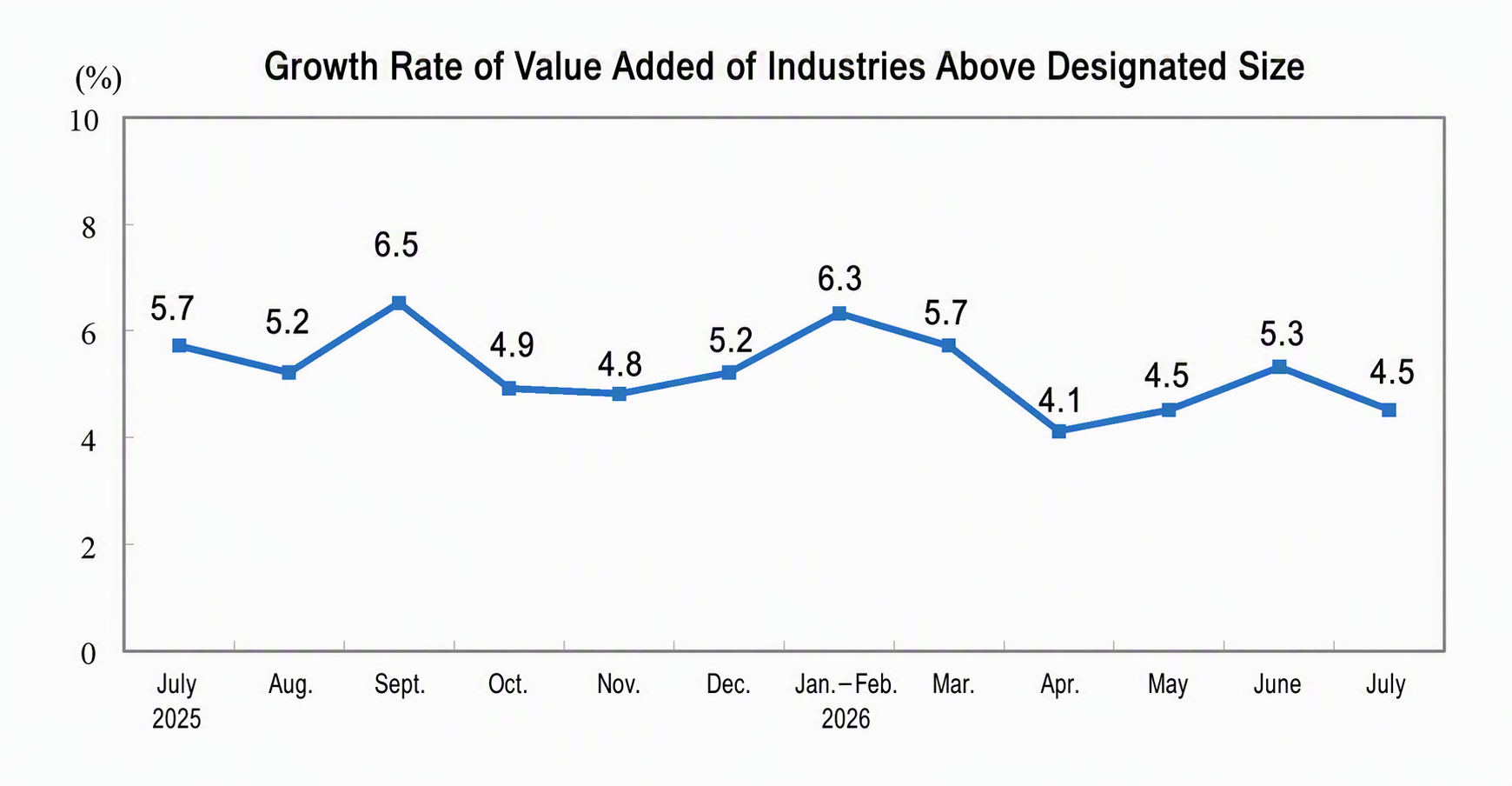
By the three major sectors, in July, value added in mining decreased by 4.2% YoY, manufacturing increased by 5.5%, and the production and supply of electricity, heat, gas and water increased by 5.0%.
By ownership type, in July, value added of state-controlled enterprises increased by 1.6% YoY; joint-stock enterprises increased by 5.0%, and foreign-funded enterprises as well as enterprises with investment from Hong Kong, Macao and Taiwan increased by 2.8%; private enterprises increased by 3.7%.
By industry, in July, among the 41 major industry categories, 25 industries maintained YoY growth in value added. Specifically, coal mining and washing declined by 10.8%, oil and natural gas extraction increased by 6.1%, processing of agricultural and sideline food products increased by 3.8%, manufacturing of liquor, beverages and refined tea increased by 2.6%, textiles increased by 2.3%, manufacturing of chemical raw materials and chemical products declined by 1.2%, manufacturing of non-metallic mineral products declined by 3.3%, smelting and pressing of ferrous metals increased by 0.3%, smelting and pressing of non-ferrous metals declined by 2.5%, manufacturing of general-purpose equipment increased by 9.5%, manufacturing of special-purpose equipment increased by 12.6%, automobile manufacturing increased by 8.7%, manufacturing of railway, ship, aerospace and other transport equipment increased by 13.6%, manufacturing of electrical machinery and equipment increased by 8.8%, manufacturing of computers, communications and other electronic equipment increased by 19.1%, and the production and supply of electricity and heat increased by 5.3%.
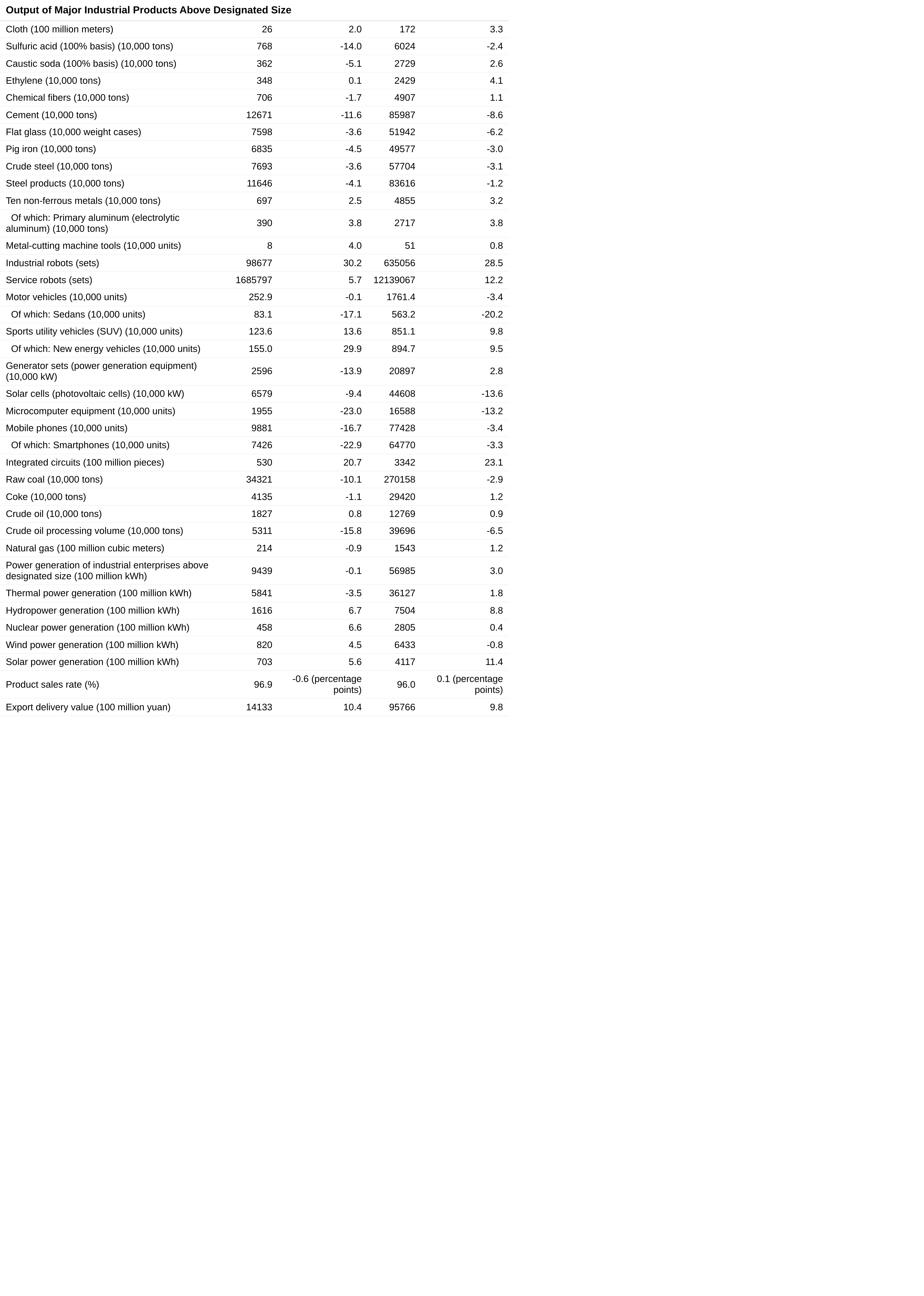
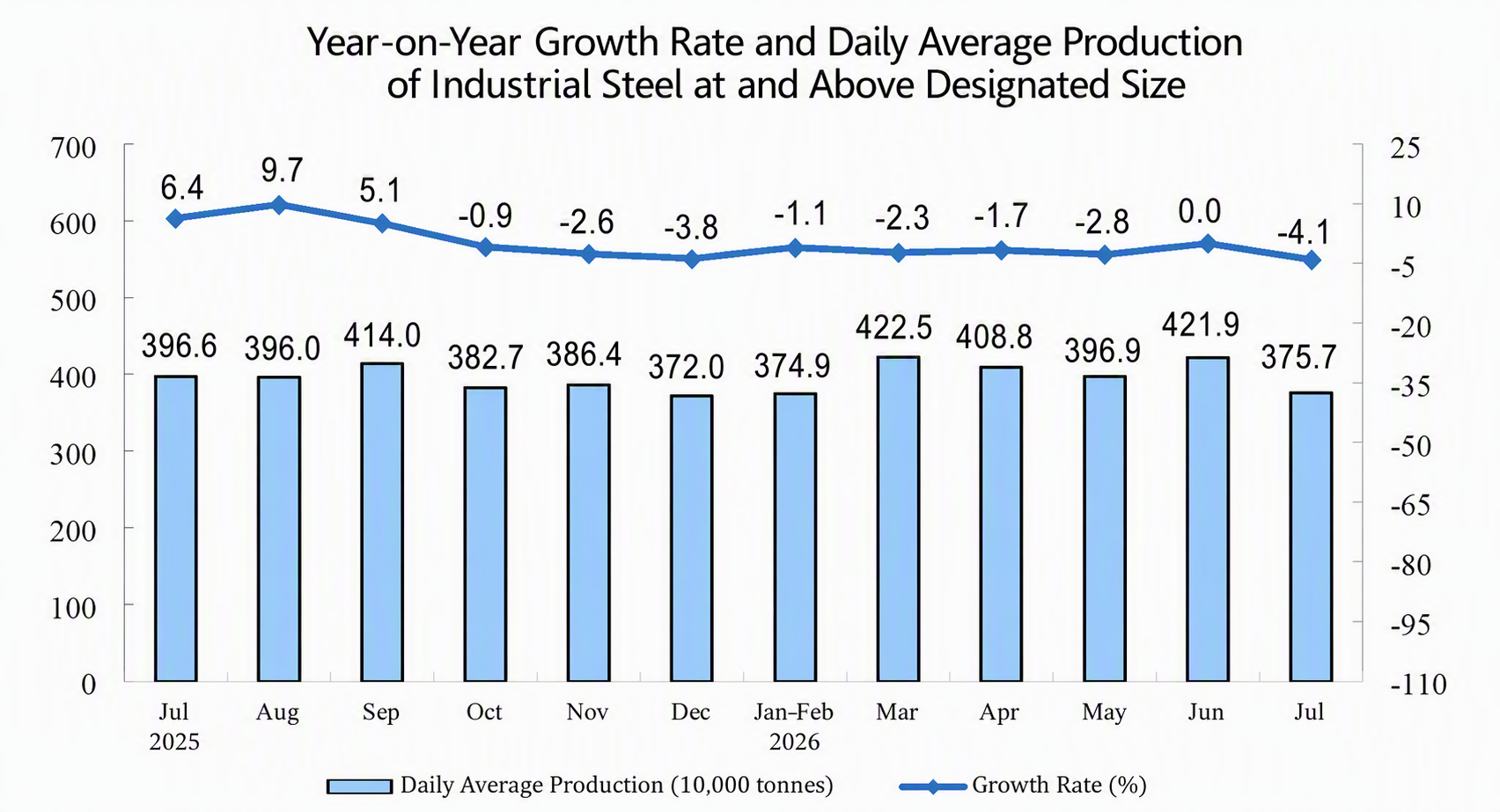
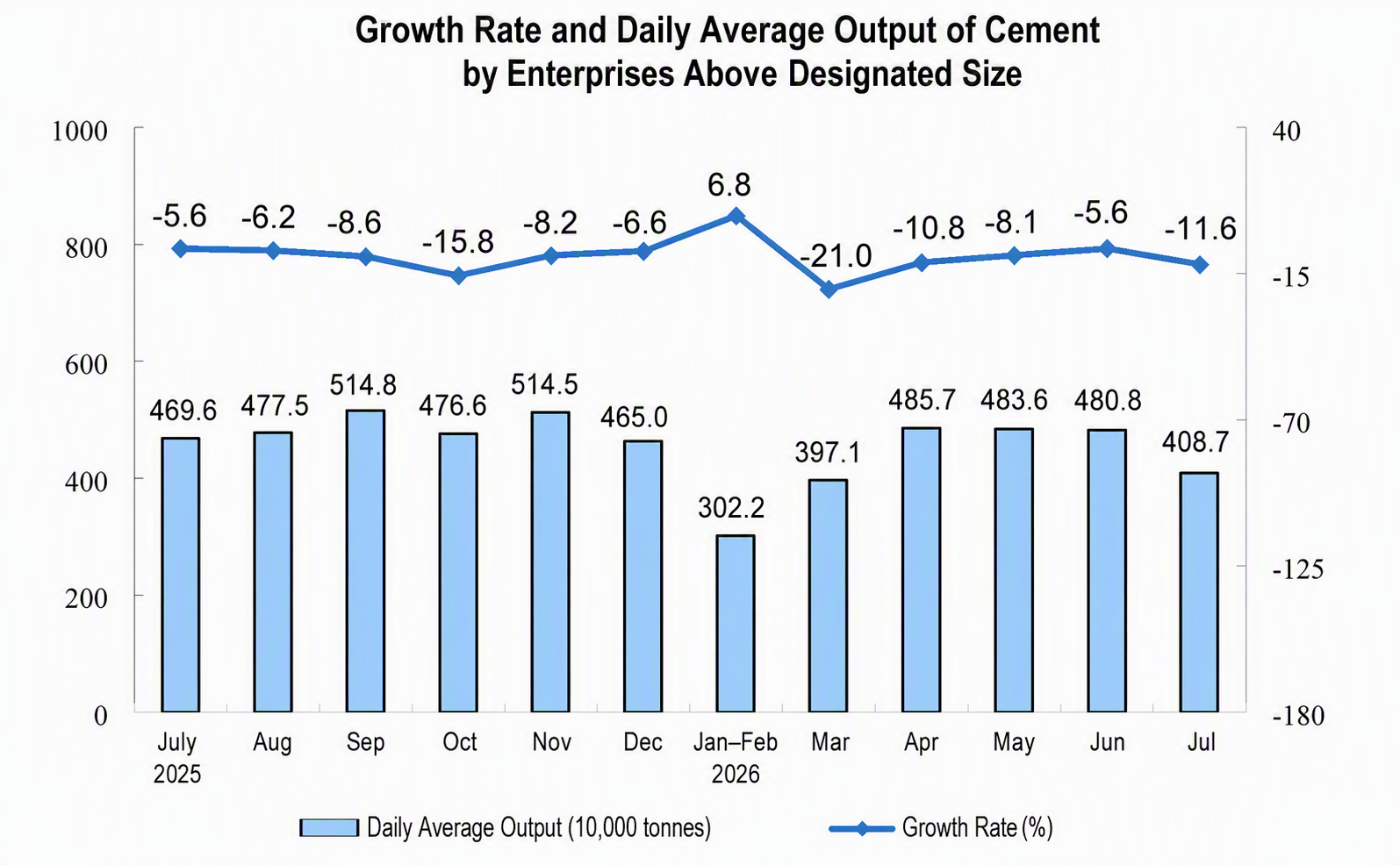
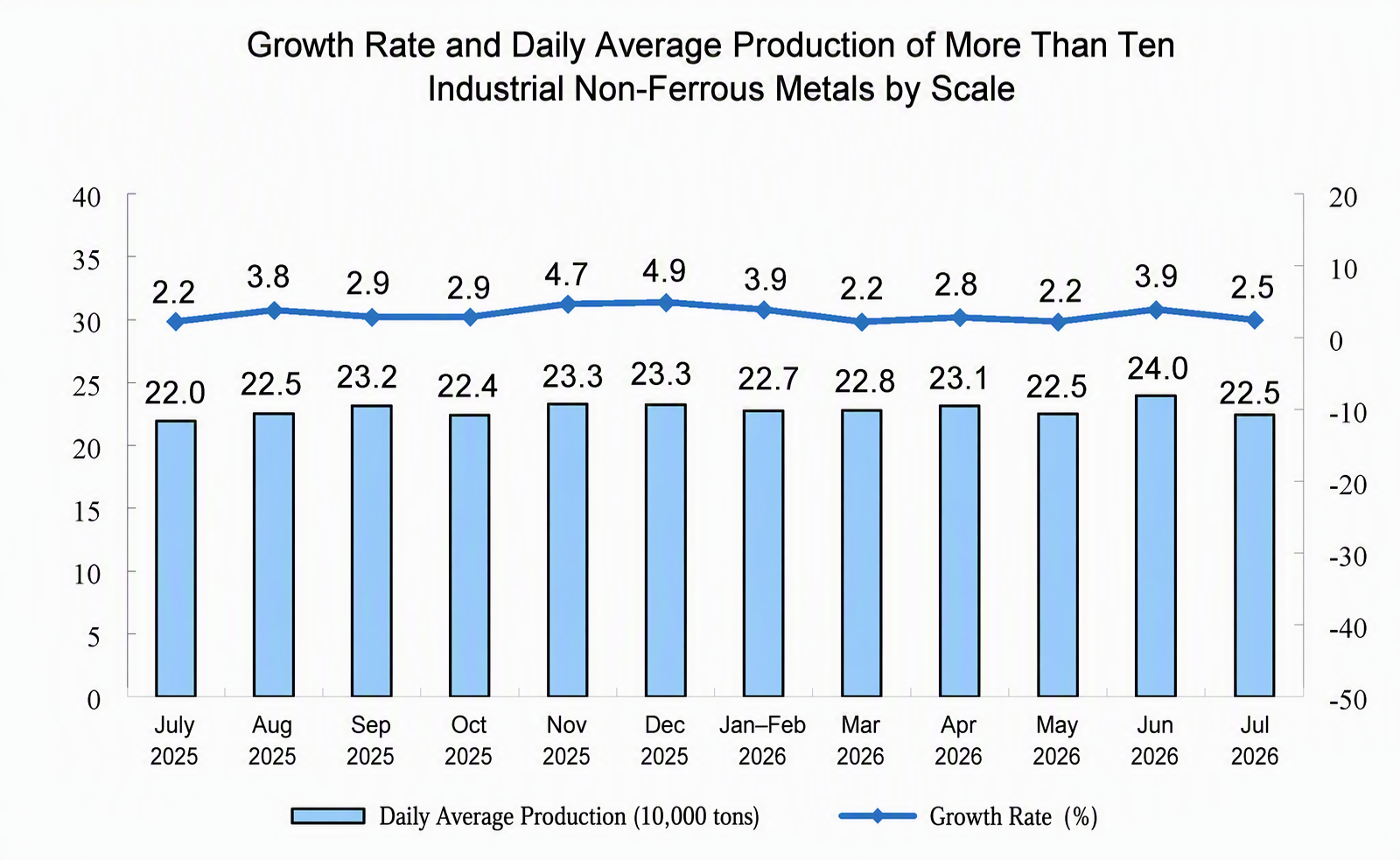
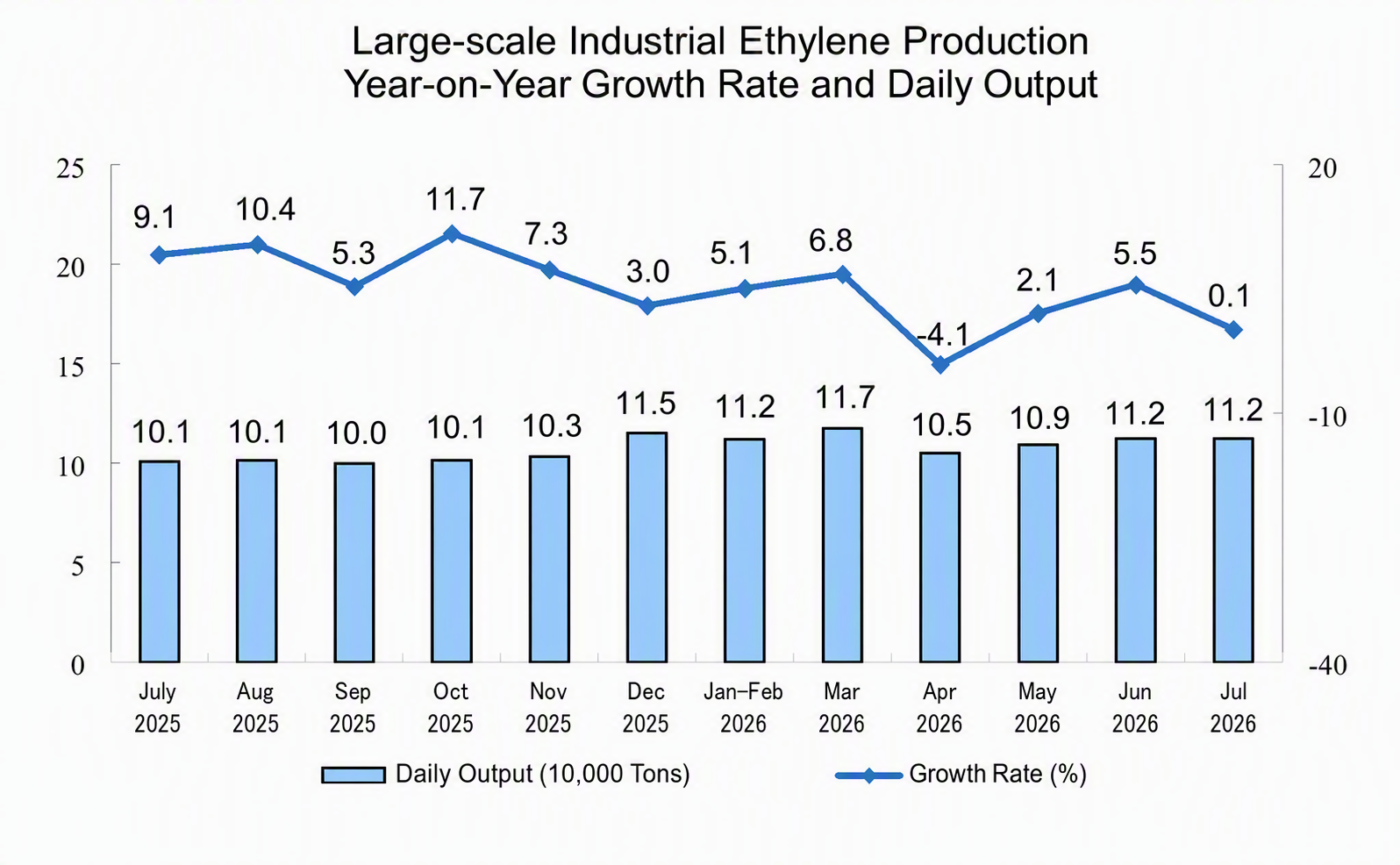
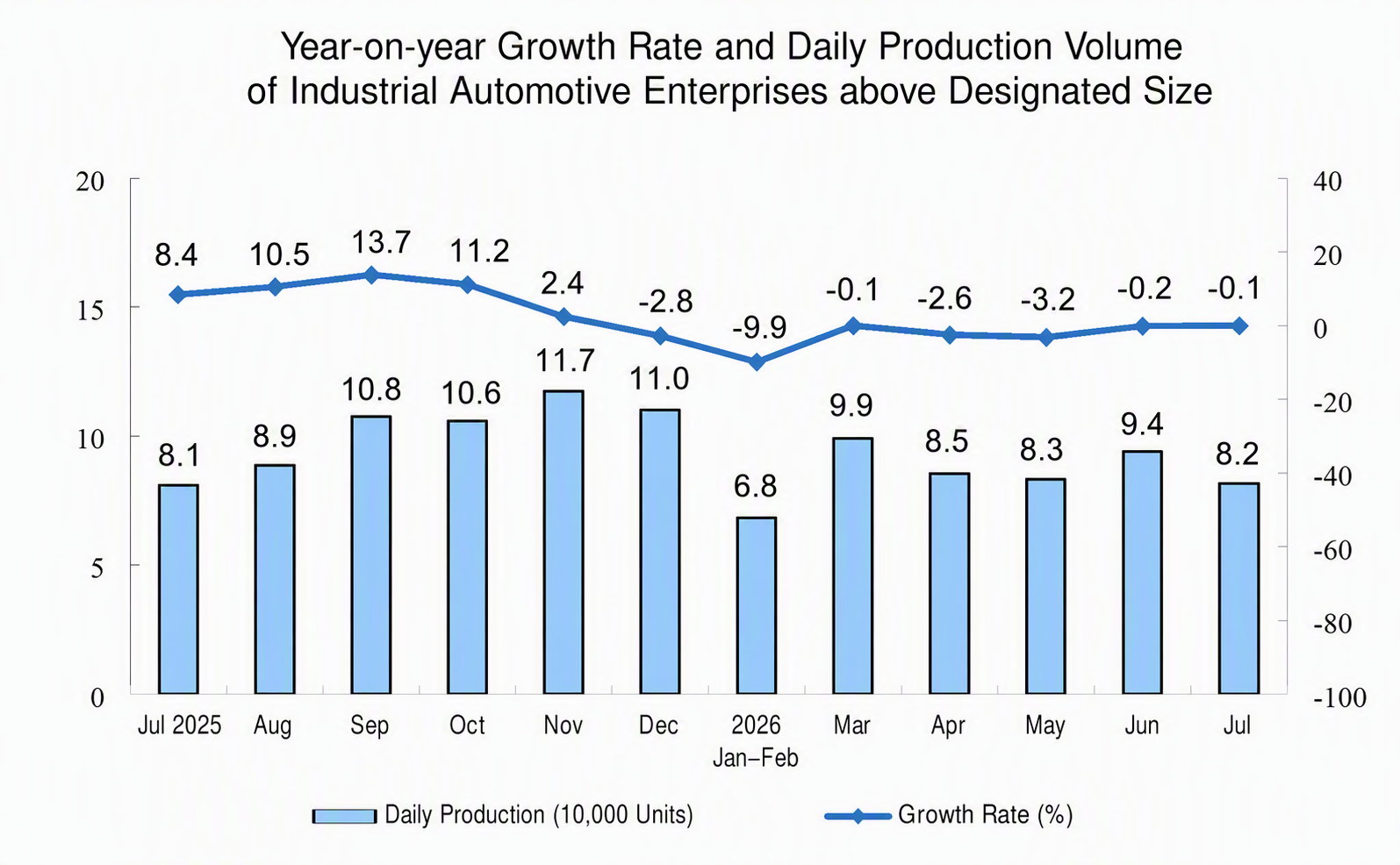
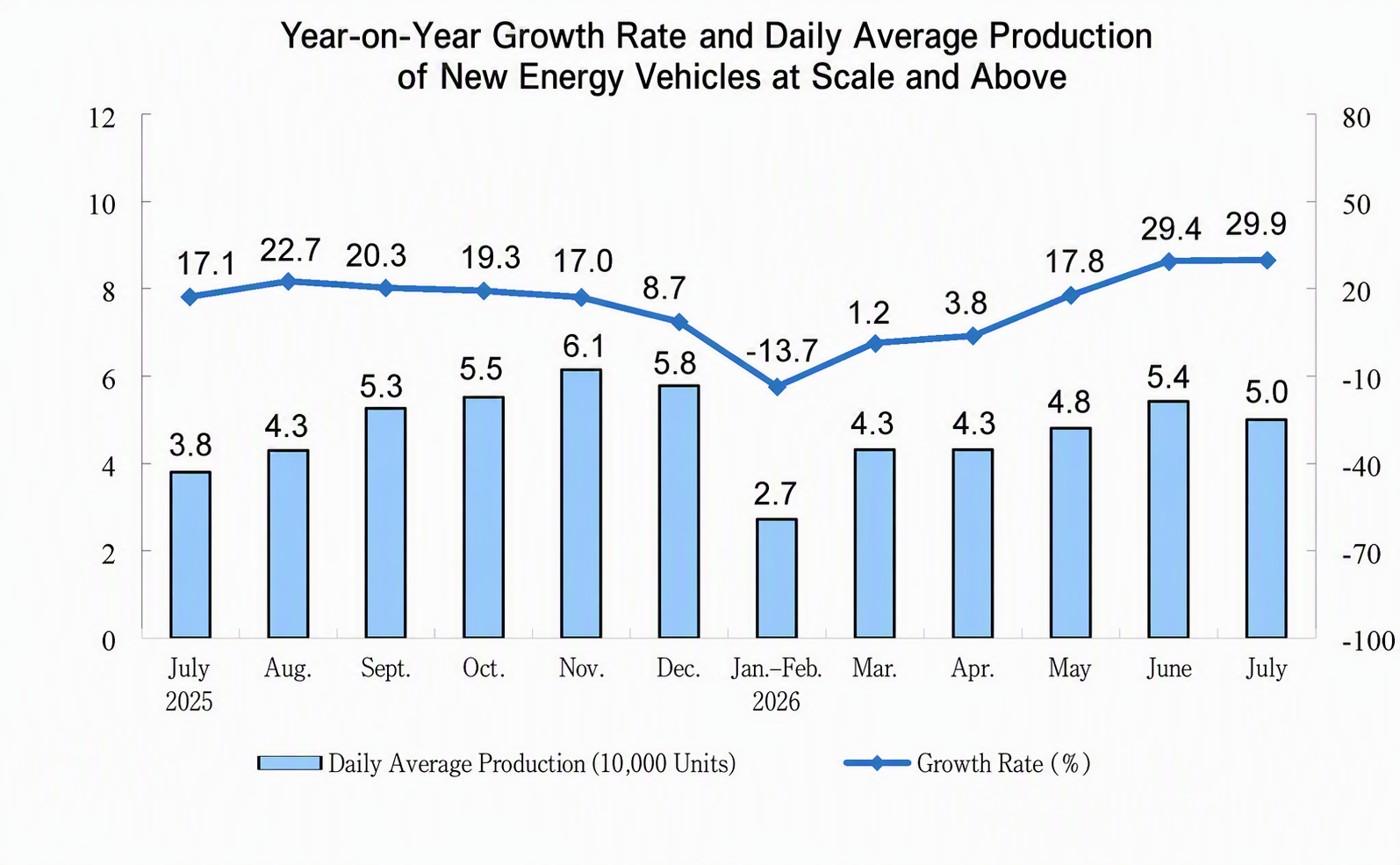
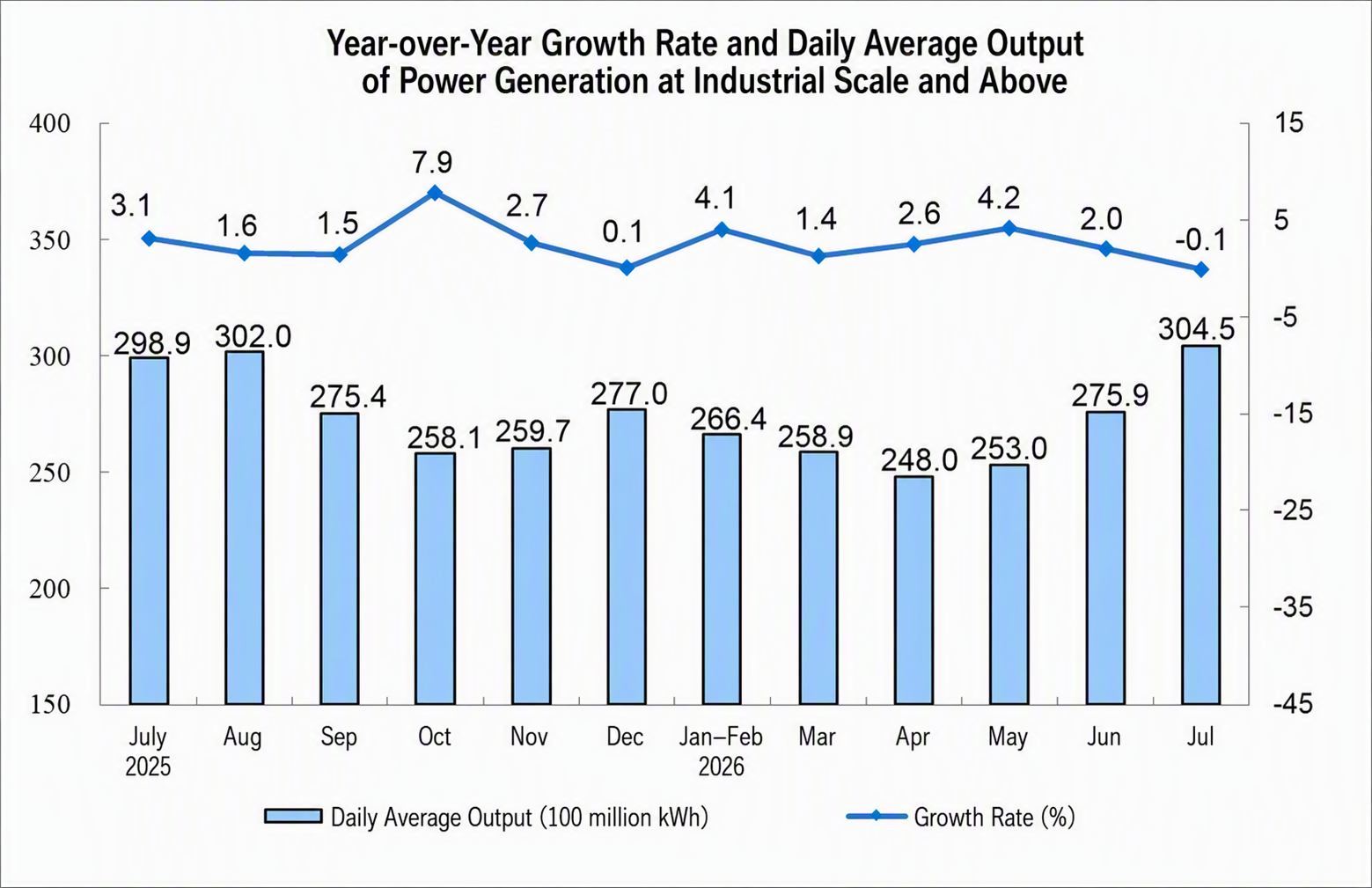
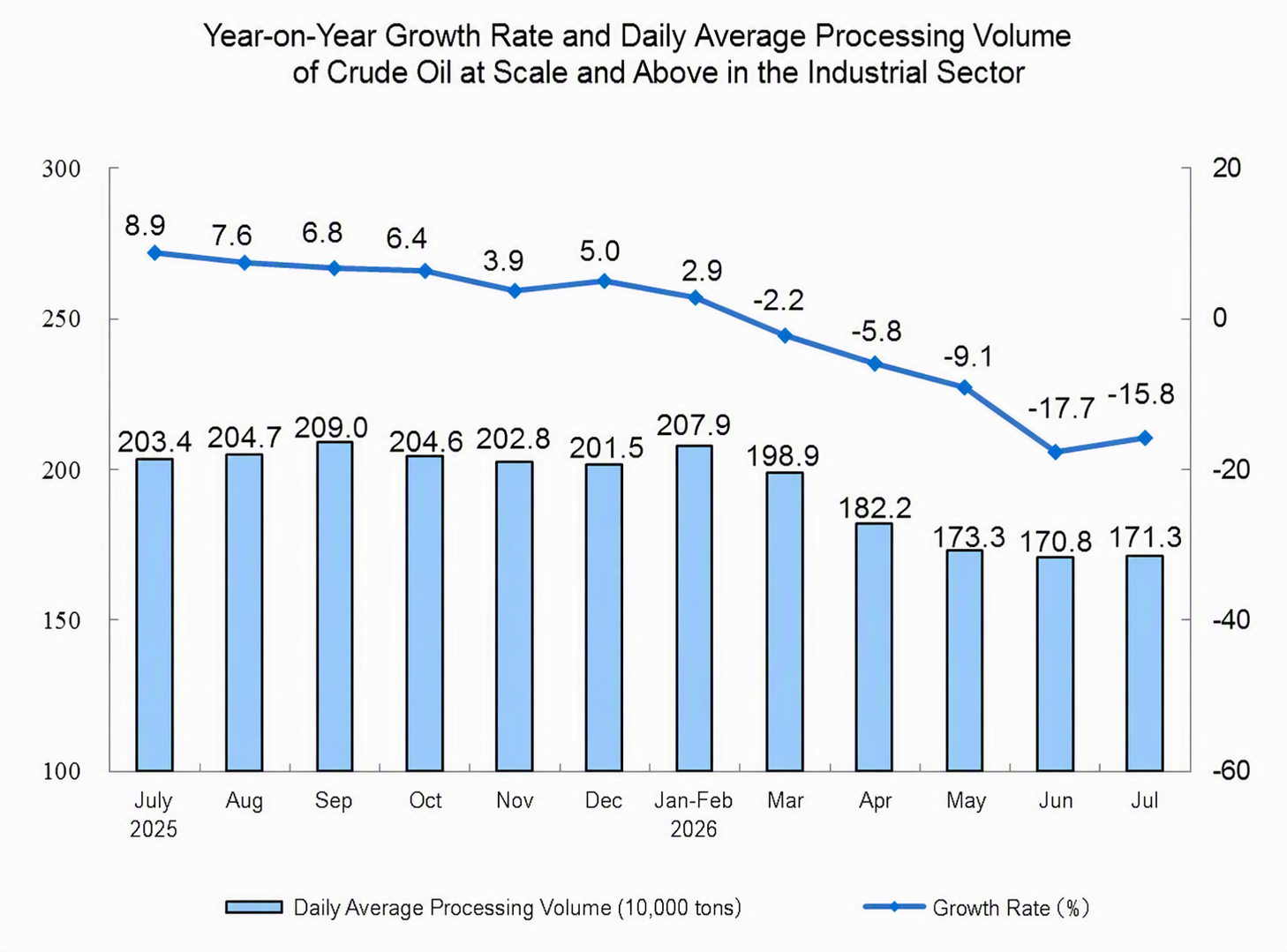
By product, in July, output increased YoY for 279 of the 626 products produced by industrial enterprises above designated size. Specifically, steel products totaled 116.46 million mt, down 4.1%; cement 126.71 million mt, down 11.6%; ten nonferrous metals 6.97 million mt, up 2.5%; ethylene 3.48 million mt, up 0.1%; automobiles 2.529 million units, down 0.1%, including NEVs at 1.55 million units, up 29.9%; power generation 943.9 billion kWh, down 0.1%; and crude oil processing volume 53.11 million mt, down 15.8%.
In July, the sales-to-production ratio of industrial enterprises above designated size was 96.9%, down 0.6 percentage points YoY; the export delivery value realized by industrial enterprises above designated size was 1,413.3 billion yuan, up 10.4% YoY in nominal terms.
From January to July, the national economy remained generally stable and maintained a development momentum toward new and better growth.
From January to July, under the strong leadership of the CPC Central Committee with Comrade Xi Jinping at its core, all regions and departments earnestly implemented the decisions and arrangements of the CPC Central Committee and the State Council, adhered to the general principle of pursuing progress while maintaining stability, effectively responded to various external shocks and internal difficulties, focused on implementing more proactive and effective macro policies, and solidly advanced high-quality development. Production and supply grew steadily, employment and prices were generally stable, foreign trade resilience continued to stand out, new growth drivers expanded and strengthened, and overall economic performance remained generally stable, sustaining a development momentum toward new drivers and a better structure.
I. Industrial production grew rapidly, with strong growth in the equipment manufacturing sector and high-tech manufacturing sector
From January to July, the value added of industrial enterprises above designated size nationwide increased by 5.3% YoY. By three major sectors, value added increased by 2.5% YoY in mining, 5.6% in manufacturing, and 5.4% in the production and supply of electricity, heat, gas, and water. Value added increased by 9.7% YoY in the equipment manufacturing sector and by 13.8% in the high-tech manufacturing sector, exceeding the overall growth of industrial enterprises above designated size by 4.4 and 8.5 percentage points, respectively. By ownership type, value added increased by 3.9% YoY for state-controlled enterprises; 5.8% for joint-stock enterprises; 3.1% for enterprises with investment from foreign countries and from Hong Kong, Macao and Taiwan; and 4.5% for private enterprises. By product, the production of 3D printing equipment, lithium-ion batteries, and industrial robots increased YoY by 52.3%, 40.2%, and 28.5%, respectively. In July, the value added of industrial enterprises above designated size nationwide increased by 4.5% YoY and by 0.11% MoM. In July, the manufacturing PMI was 49.2%, and the expectations index for enterprise production and business activities was 54.1%. From January to June, industrial enterprises above the designated size nationwide recorded total profits of 3,948 billion yuan, up 18.7% YoY.
II. The Service Sector Maintained Steady Growth, With Modern Services Showing Positive Momentum
From January to July, the national service sector production index rose 4.7% YoY. By industry, the production indices for information transmission, software and information technology services; leasing and business services; financial services; and transportation, warehousing and postal services increased 10.6%, 9.5%, 6.3%, and 5.1% YoY, respectively. In July, the national service sector production index rose 4.3% YoY. In July, the business activity index for the service sector was 49.3%, and the business activity expectations index for the service sector was 56.0%. Among them, the business activity indices for industries such as postal services, telecommunications, radio and television and satellite transmission services, and culture, sports and entertainment were in the relatively high prosperity range of 55.0% or above. From January to June, operating revenue of service enterprises above the designated size rose 5.9% YoY.
III. Market Sales Expanded, With Faster Growth in Service Retail Sales
From January to July, total retail sales of consumer goods and services rose 2.6% YoY, of which service retail sales increased 5.0% and goods retail sales increased 1.1%. Within service retail sales, retail sales in categories such as communications and information services, tourism consulting and leasing services, and cultural, sports and leisure services grew relatively quickly. From January to July, total retail sales of consumer goods reached 28,774.4 billion yuan, up 1.2% YoY. By location of business unit, urban retail sales of consumer goods were 24,928.5 billion yuan, up 1.1% YoY; rural retail sales of consumer goods were 3,845.9 billion yuan, up 2.4%. By type of consumption, goods retail sales were 25,492.2 billion yuan, up 1.1% YoY; catering revenue was 3,282.2 billion yuan, up 2.6%. Sales of basic necessities and some upgraded goods grew relatively quickly, with retail sales of grain, oil and food; communications equipment; and cosmetics by units above the designated size rising 7.2%, 15.1%, and 6.3% YoY, respectively. In July, total retail sales of consumer goods were 3,902.2 billion yuan, up 0.6% YoY and up 0.06% MoM. From January to July, nationwide online retail sales of goods and services were 11,721.4 billion yuan, up 4.8% YoY. Of this total, online goods retail sales were 7,396.5 billion yuan, up 4.6%; online services retail sales were 4,324.9 billion yuan, up 5.2%.
IV. Fixed-Asset Investment Declined, While Investment in Intellectual Property Products Grew Rapidly
From January to July, nationwide fixed-asset investment (excluding rural households) was 26,032.8 billion yuan, down 6.7% YoY; fixed-asset investment excluding real estate development fell 3.7%. Among them, investment in intellectual property products rose 9.1% YoY. By sector, infrastructure investment fell 3.6% YoY, manufacturing investment fell 1.7%, and real estate development investment fell 19.2%. Nationwide, the floor space of commercial buildings sold (newly built) totaled 450.21 million m², down 11.8% YoY; sales of newly built commercial buildings totaled 4,271.8 billion yuan, down 13.1%. By industry, primary industry investment fell 0.5% YoY, secondary industry investment fell 2.1%, and tertiary industry investment fell 9.5%. Private investment fell 9.4% YoY; excluding real estate development, private investment fell 5.7%. Investment in high-technology industries rose 5.0% YoY, with investment in information services, aircraft and spacecraft and equipment manufacturing, and electronic and communications equipment manufacturing rising 19.2%, 12.3%, and 7.1%, respectively. In July, fixed asset investment (excluding rural households) fell 1.42% MoM.
V. Goods Imports and Exports Grew Rapidly, and the Trade Structure Continued to Improve
From January to July, total goods imports and exports reached 30,126.4 billion yuan, up 17.3% YoY. Of this total, exports were 17,440 billion yuan, up 14.0%; imports were 12,686.4 billion yuan, up 22.0%. From January to July, imports and exports under Ordinary Trade rose 10.2% YoY. Imports and exports with Belt and Road partner countries rose 15.5%. Imports and exports by private enterprises rose 17.2%, accounting for 56.9% of the total. Exports of mechanical and electrical products rose 21.2%, accounting for 63.8% of total exports. In July, total goods imports and exports reached 4,658 billion yuan, up 19.2% YoY. Of this total, exports were 2,712.5 billion yuan, up 17.8%; imports were 1,945.4 billion yuan, up 21.2%.
VI. The Employment Situation Remained Generally Stable, and the Urban Surveyed Unemployment Rate Rose Seasonally
From January to July, the national average urban surveyed unemployment rate was 5.2%, unchanged from January to June and the same period last year. In July, the national urban surveyed unemployment rate was 5.2%, up 0.2 percentage points from the previous month. The surveyed unemployment rate for the local registered labor force was 5.2%; that for the migrant registered labor force was 5.2%, including 4.9% for the migrant agricultural registered labor force. The urban surveyed unemployment rate in 31 major cities was 5.2%, up 0.2 percentage points from the previous month. The national average weekly working hours for enterprise employees were 48.2 hours.
VII. Market Prices Rose Mildly, and the Increase Moderated Somewhat in July
From January to July, the national consumer price index (CPI) rose 0.9% YoY. By category, prices of food, tobacco and alcohol, and dining out fell 0.2% YoY; clothing prices rose 1.6%; housing prices fell 0.2%; prices of household goods and services rose 1.7%; transport and communications prices rose 1.6%; education, culture and entertainment prices rose 1.2%; healthcare prices rose 2.1%; and prices of other goods and services rose 10.8%. Among food, tobacco and alcohol, and dining-out prices, pork prices fell 13.4%, grain prices fell 0.3%, fresh fruit prices rose 1.1%, and fresh vegetable prices rose 3.5%. In July, the national CPI rose 0.5% YoY and fell 0.1% MoM. From January to July, the core CPI excluding food and energy prices rose 1.1% YoY. Of this, the core CPI rose 0.9% YoY in July.
From January to July, national industrial producer EXW prices rose 1.8% YoY. Of this, they rose 3.5% YoY and fell 0.7% MoM in July. From January to July, national industrial producer purchase prices rose 2.8% YoY. Of this, they rose 5.5% YoY and fell 1.0% MoM in July.
Overall, from January to July, the national economy operated generally steadily, maintaining a development momentum toward new, better, and improved. However, it should also be noted that the external environment is complex and volatile; in China, the contradiction of strong supply and weak demand is prominent; some enterprises face operational difficulties; and the foundation for the economy’s steady improvement still needs to be consolidated. In the next stage, we should adhere to Xi Jinping Thought on Socialism with Chinese Characteristics for a New Era as the guidance, uphold the general principle of pursuing progress while ensuring stability, fully, accurately, and comprehensively implement the new development philosophy, accelerate the building of a new development paradigm, remain committed to deepening reform and opening up, accelerate efforts to replace old growth drivers with new ones, step up counter-cyclical adjustments, intensify efforts to expand domestic demand and optimize supply, effectively safeguard and improve people’s wellbeing, strengthen development momentum and invigorate social vitality, and promote sustained economic development toward new, better, and improved.