China’s refined copper output is expected to decline year on year for a second consecutive month in August as persistent shortages of copper concentrate and other smelter feedstocks continue to weigh on operating rates.
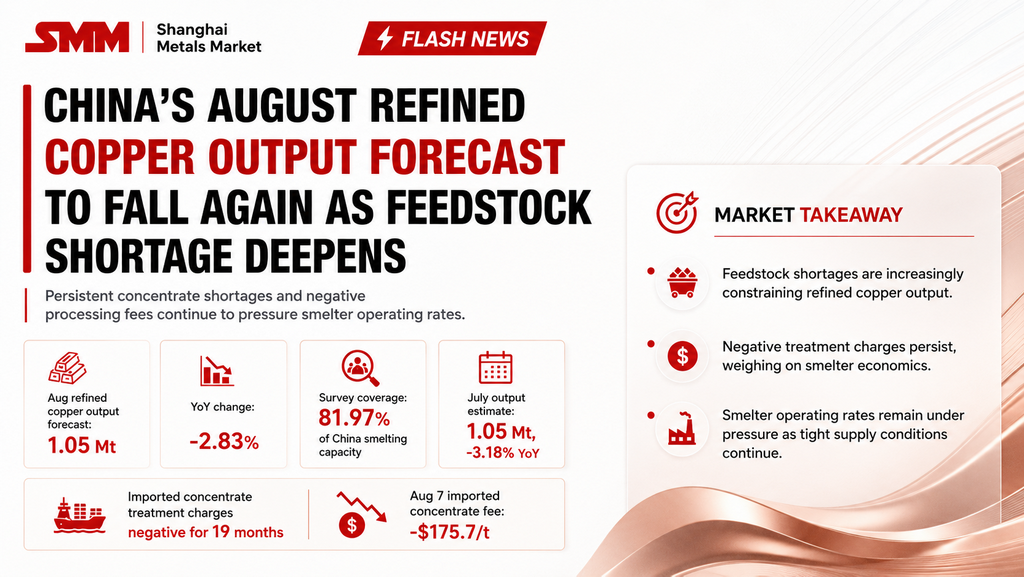
State-backed research house Antaike forecasts August refined copper production at around 1.05 million tonnes among surveyed producers representing 81.97% of China’s total smelting capacity, down 2.83% year on year. July output from the same group is estimated at a similar 1.05 million tonnes, representing a 3.18% annual decline and falling short of an earlier forecast of 1.07 million tonnes.
The expected contraction reflects increasingly tight availability of raw materials. Copper concentrate supply has remained under pressure for an extended period, prompting smelters to lower capacity utilisation as competition for feedstock intensifies.
The strain is also visible in treatment charges. Processing fees for imported copper concentrate have remained negative for 19 consecutive months, while charges fell to a record low of around minus $175.7/t on August 7, compared with minus $38.4/t during the same period a year earlier. The deepening negative charges highlight the severity of competition among smelters for available concentrate.
At the same time, tighter domestic tax-invoice regulations have constrained the supply of VAT-compliant recycled copper, reducing another important source of smelter feedstock and adding further pressure to refined output.
The expected second consecutive annual decline in refined production suggests that prolonged concentrate tightness is increasingly translating into constraints on finished copper supply. With China accounting for a dominant share of global smelting capacity, continued feedstock shortages could further tighten refined copper availability and increase the market’s sensitivity to additional disruptions in concentrate supply.
![Tight supply and sellers holding back from selling; spot copper in North China at high premium [SMM North China spot copper]](https://imgqn.smm.cn/usercenter/FERSF20251217171712.jpg)
![Copper prices surged and spot premiums rose in tandem, but downstream purchases remained active [SMM South China spot copper]](https://imgqn.smm.cn/usercenter/udUol20251217171712.jpg)