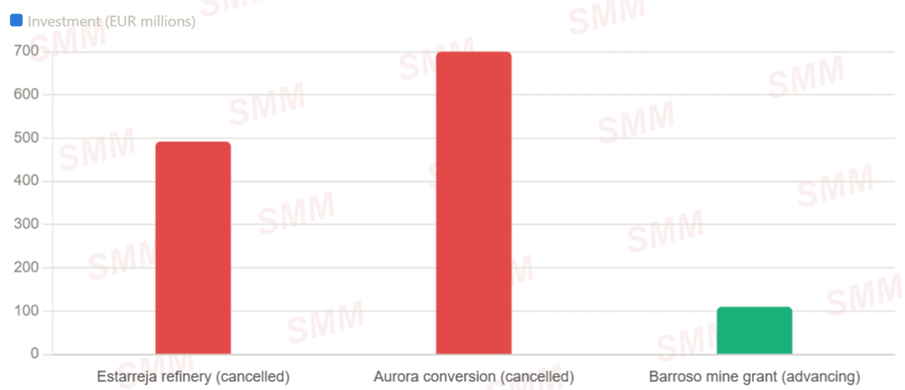
Grupo José de Mello has scrapped plans to invest €492 million ($566 million) in building a lithium hydroxide refinery in Estarreja, Portugal, dealing a fresh setback to the country's ambition of building a fully integrated domestic lithium mining and processing industry. The project, led by Lifthium Energy a subsidiary jointly held by the José de Mello Group and its chemical arm Bondalti had been designated a "Strategic Project" under the EU Critical Raw Materials Act only months before its cancellation, and had already secured €180 million in public support that was never drawn down. Group CEO Salvador de Mello confirmed the decision in an interview with Portuguese weekly Expresso, stating that despite "all the effort made to secure long-term contracts to allow investment in a factory, this was not possible," and that the company "will not proceed at this stage with an industrial investment in lithium." De Mello cited weak conditions across the European automotive and battery-lithium supply chain, noting the market "is not responding positively" to reindustrialization investments of this scale.
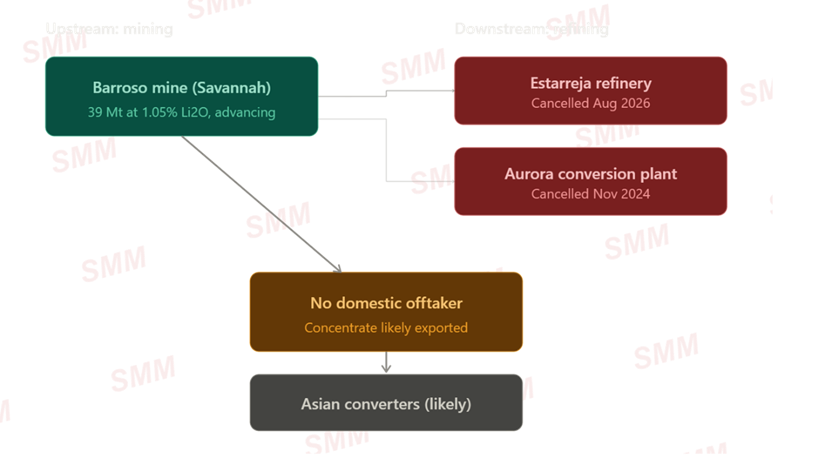
Smelting background: Lifthium Energy was established in 2023 within Bondalti before ownership was restructured to 75% direct José de Mello Group control, with Bondalti retaining 15%. The Estarreja site was chosen because it already hosts existing Bondalti chemical processing infrastructure, theoretically reducing greenfield buildout risk. As designed, the refinery would have had capacity to produce 28,000 t/y of battery grade lithium hydroxide sufficient to supply roughly half a million EV battery packs annually and would have created 150 direct jobs. Critically, the plant was engineered around an electrolysis-based "green lithium" refining process using water and clean energy rather than conventional acid-roasting, and was explicitly designed to be feedstock-agnostic not dependent on ore from domestic Portuguese mines, meaning it could have processed imported spodumene concentrate from any origin. Production was originally targeted to start in 2030, later pulled forward toward 2027 in some interim guidance, before the project stalled entirely. Bondalti had already committed around €35 million to development work and had begun environmental licensing procedures for the plant as recently as June 2026. A parallel Lifthium refinery had also been under consideration in Torrelavega, Spain, which secured over €21 million in Spanish government support in September 2024; the Estarreja cancellation casts uncertainty over that project's fate as well. The Estarreja decision follows the November 2024 abandonment of Galp's Aurora lithium conversion project in Setúbal, after battery partner Northvolt's collapse left the project without an anchor customer. With both of Portugal's flagship downstream conversion projects now shelved, the country's refining ambitions have effectively stalled twice in under two years both times citing the identical root cause: an inability to lock in bankable, long-term offtake contracts with European automakers or battery cell producers, even with substantial public co-financing on offer.
Mining background: Portugal's only advancing hard-rock lithium asset sits upstream of this collapsed conversion chain the Barroso Lithium Project, developed by London-listed Savannah Resources near the town of Boticas in northern Portugal. Savannah first took a 75% stake in the project in May 2017, when no resource estimate existed, and moved to 100% ownership by 2019. The company holds C-100 Mining Lease 5.42km², valid to 2036 plus the adjacent Aldeia Mining Lease of 2.74km², valid to 2049, and has since completed more than 50,000 metres of resource drilling. Barroso is now classified as Europe's largest known spodumene deposit, with a JORC-compliant resource of 39 Mt containing 411,900 tonnes of Li2O at an average grade of 1.05% Li2O across five orebodies, plus a notably low iron content (0.8% Fe2O3) that favours concentrate quality. Potential extension zones of a further 35-62 Mt are still being evaluated and could materially expand mine life if confirmed.
The processing plant is designed to produce roughly 191,000-200,000 t/y of spodumene concentrate at 5.5% Li2O modestly below the 6% Li2O SC6 industry reference grade over a project life generating 2.6 Mt of concentrate in total, alongside by product sales of low-grade pegmatite material and ceramic quartz tailings for the local ceramics sector Portugal has a long standing history of lithium mining for the ceramics and glass industries, though never previously at battery-grade scale. Barroso has been designated a CRMA "Strategic Project" and received a non-reimbursable €110 million grant from the Portuguese state toward construction capex, with Savannah currently targeting production from 2028. Notably, most of the project's future concentrate output remains commercially unallocated, leaving room for a future offtake partner or open market sales.
Development has not proceeded without friction. A court injunction triggered a three-week suspension of construction-related work in June 2026 before the Portuguese government stepped in, declaring the project of national and European significance and lifting the halt. Local opposition has centred on the Barroso region's UN FAO "Globally Important Agricultural Heritage System" designation the agricultural equivalent of UNESCO World Heritage status, recognizing the area's traditional polyculture farming and land management systems with community concerns focused on water use, biodiversity, and land access. Savannah has since signed benefit-sharing agreements with two of the three local "baldios" communally managed lands covering the mining concessions, and hundreds of protesters gathered at a camp in Covas do Barroso in early August 2026 to continue opposing the mine, with organisers explicitly linking their campaign to the Estarreja refinery's collapse as evidence the broader domestic lithium value-chain promise is unravelling.
SMM View: The collapse of both Portuguese refinery projects leaves Barroso without a natural domestic home for its future spodumene concentrate, exposing the project to a structural offtake gap at the very market it was designed to serve. In the absence of a European buyer, output is more likely to flow into the broader seaborne market, with Asian converters standing out as the most probable destination a pattern consistent with the raw-concentrate export dynamic typically seen in early-stage African supply before local beneficiation capacity comes online. That two separate Portuguese conversion projects have now failed for the same stated reason an inability to secure bankable long-term offtake commitments points to persistently thin confirmed demand from Europe's battery and automotive supply chain, even where state co-financing is on the table. Barroso's progress toward its 2028 construction target, further resource-extension drilling results, and any offtake developments will be key signals for how EU-origin spodumene ultimately positions itself against African and Australian supply in the global concentrate market.
![[SMM Flash] California Opens Expanded Advanced Lithium-Ion Battery Factory](https://imgqn.smm.cn/usercenter/wzbHd20251217171731.jpg)
![[SMM PV Flash] Nala Acquires 100 MW Ready-to-Build Finnish Battery Project](https://imgqn.smm.cn/usercenter/lzgUR20251217171731.jpg)