The Chilean Copper Commission (Cochilco) has revised down its forecast for Chile's 2026 copper production to 5.27 million mt, down 2.6% from 2025 and about 30,000 mt below the 5.3 million mt forecast released in May this year; copper production in 2027 is expected to rebound to 5.55 million mt. This revision mainly reflects that the recovery in Chilean copper mine production in H1 2026 fell short of expectations, with mines under Codelco and large mines operated by BHP, such as Escondida and Spence, performing weakly at certain stages and weighing on full-year production.
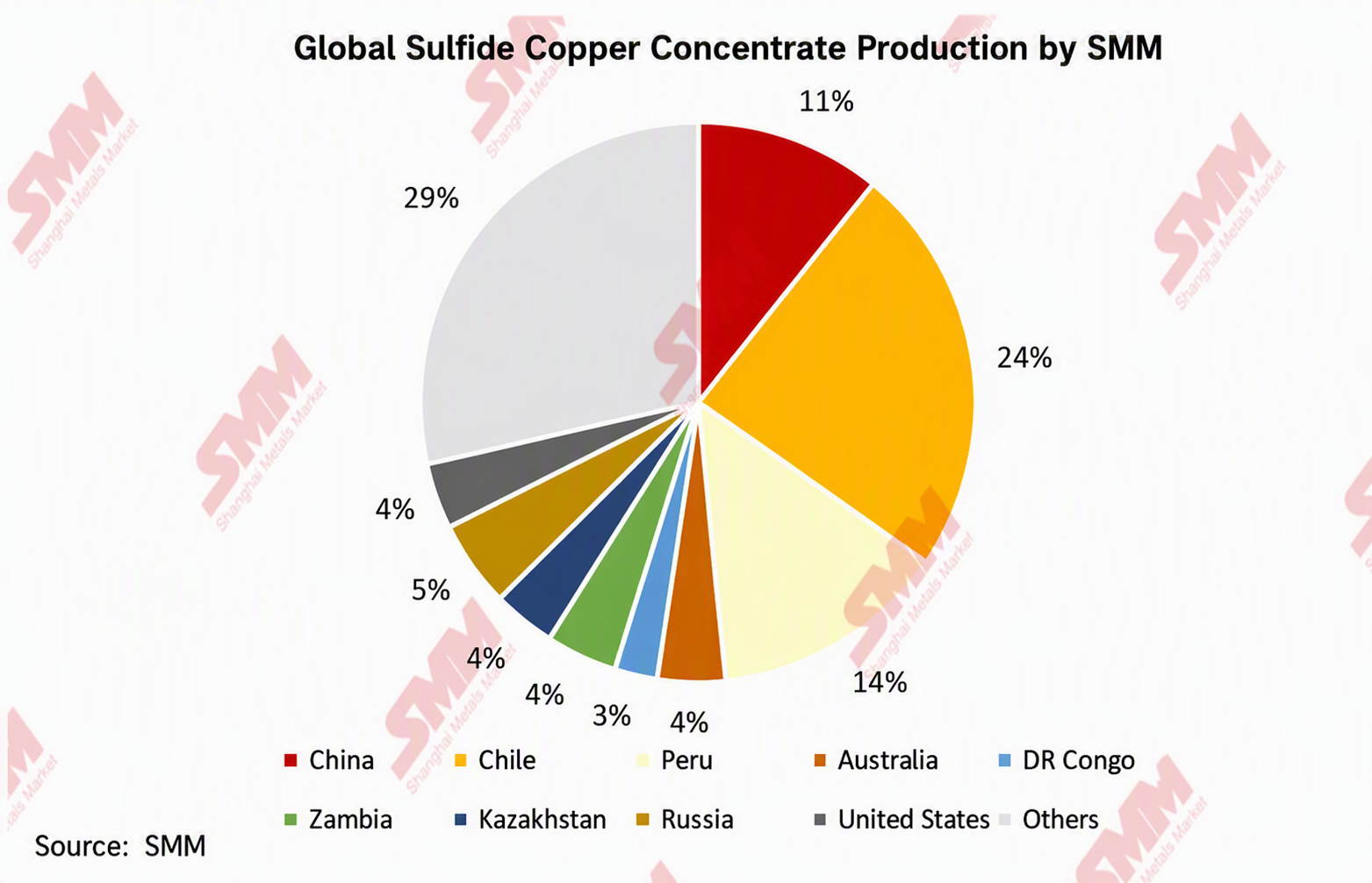
Global supply landscape, Chile remains the world's largest copper producer. According to SMM estimates, Chile is expected to account for about 24% of global copper sulfide concentrate production in 2026, continuing to rank first globally. As a core source of global copper concentrate supply, Chilean mine performance not only determines the pace at which global mine-side growth is realized, but also directly affects the international spot copper concentrate market and TC trends.
1. Weak H1 Performance at Major Mines; Structural Factors Weighed on Production
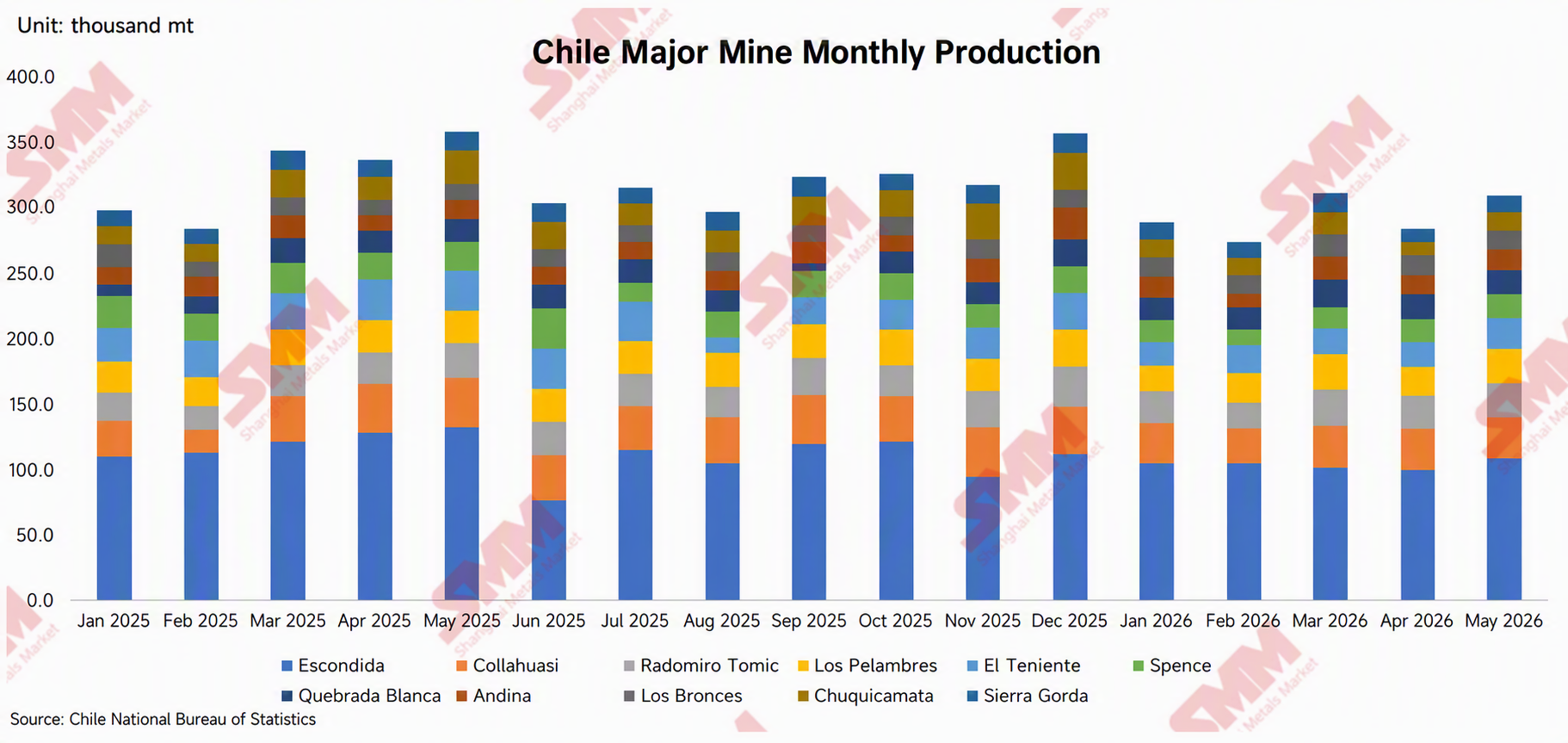
Since the beginning of 2026, Chile's major copper mines have overall operated noticeably weaker than in the same period last year. Core mines such as Escondida, Collahuasi, Spence, El Teniente, Los Bronces, and Chuquicamata all saw intermittent output declines to varying degrees. Although production at mines such as Radomiro Tomic and Quebrada Blanca improved in some months, this could not fully offset the impact of declines at large mines. Overall, production at major copper mines in January-May 2026 was generally lower than in the same period of 2025, and the pace of supply recovery was slower than the market had previously expected.
It is worth noting that this round of output declines did not stem from large-scale production suspensions, but rather reflected structural factors such as declining ore grades, planned maintenance, slower-than-expected project ramp-up progress, and operational constraints at some aging mines. In the past few years, to offset the impact of falling ore grades, most Chilean mines have continued to raise mining and processing throughput; however, because the copper content per unit of ore has declined, the increase in copper contained in copper concentrates has been markedly slower than the growth in processing throughput. This has been a common feature across Chilean copper mines so far this year.
2. Copper Product Exports Stay High; H2 External Supply Remains to Be Verified
Export side, Chile remains the world's most important supplier of copper concentrates. According to Cochilco's bulk copper product statistics based on Chilean customs data—including copper concentrates, precipitated copper, and secondary copper, with copper concentrates as the main component—Chile's exports on a copper metal content basis in 2020-2025 were approximately 3.351 million mt, 3.3113 million mt, 2.9371 million mt, 3.203 million mt, 3.7355 million mt, and 3.824 million mt, respectively. Of which, export volume in 2025 rose 2.4% YoY, the second consecutive annual increase, and hit the highest level since 2020, up about 30.2% from the temporary low in 2022. Overall, after a temporary pullback in 2022, Chile's exports of bulk copper products recovered steadily from 2023 to 2025, indicating that the country's external supply to the global copper concentrates market remains at a high level.
In 2026, YoY declines in feed grades at some large copper mines, together with factors including operating constraints, maintenance, and slower-than-expected project ramp-ups, left Chile's H1 copper output relatively weak. Whether these production pressures will further feed through to full-year copper concentrate exports still depends on output recovery at major mines, corporate inventory releases, and port shipment pace in H2.
III. China's Copper Concentrate Imports from Chile and Their Share Fell in Tandem
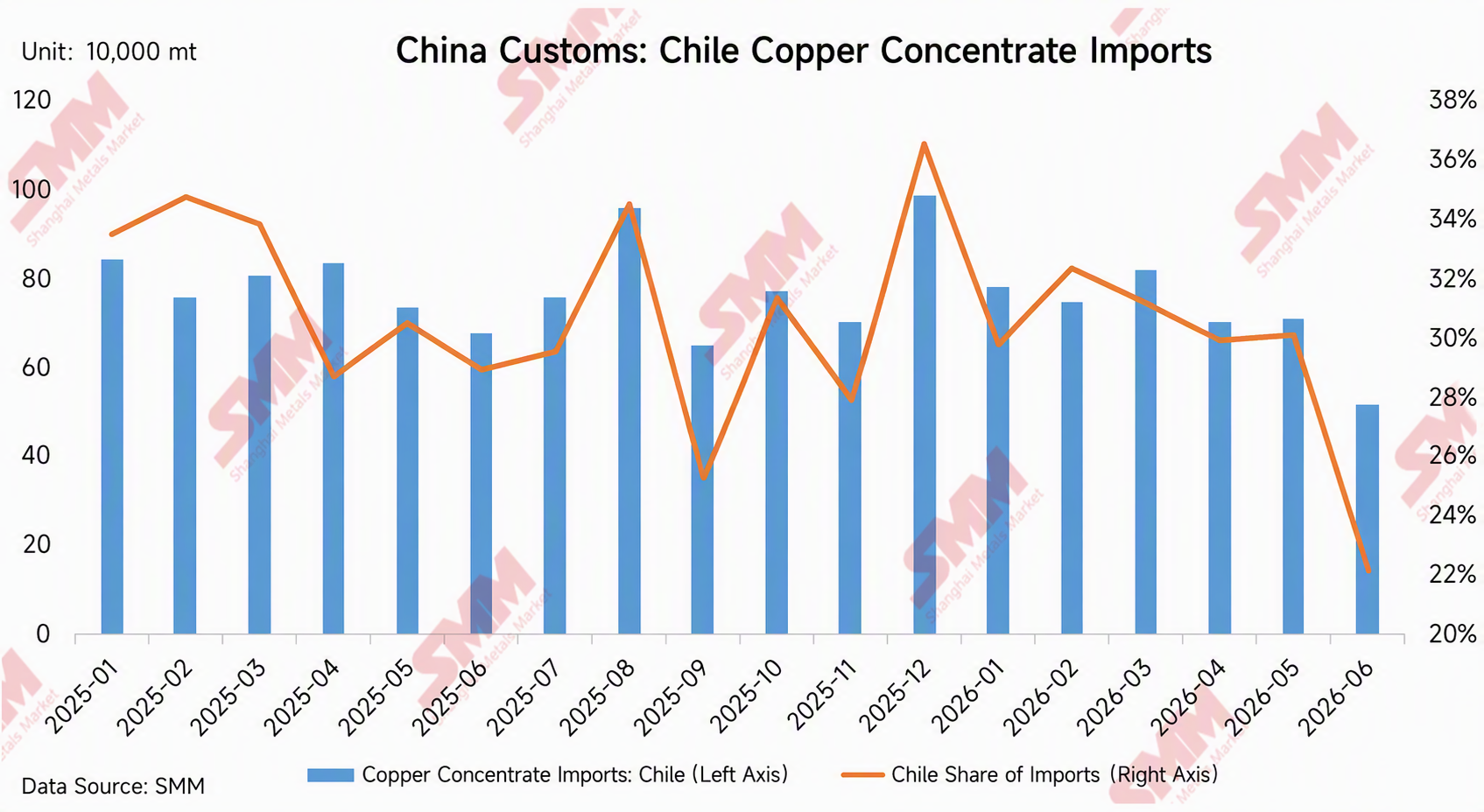
China is one of the most important consumer markets for Chilean copper concentrates. According to China Customs data, in 2025 China imported 9.4806 million mt of copper concentrates from Chile on a physical-content basis, accounting for 31.3% of China's total copper concentrate imports of 30.3347 million mt, meaning that for roughly every 3 mt of copper concentrates imported by China, nearly 1 mt came from Chile. In January–June 2026, China imported 4.2808 million mt of copper concentrates from Chile, down 7.9% YoY; over the same period, China's total copper concentrate imports were 14.6106 million mt, down only 0.8% YoY, and the share of imports from Chile fell from 31.5% in the year-earlier period to 29.3%. Meanwhile, imports from non-Chilean sources rose by about 244,000 mt YoY, indicating that growth in China's copper concentrate imports is increasingly being met by other sources.
On a monthly basis, the share of Chilean copper concentrates in China's copper concentrate imports held broadly within 30%–32% from January to May 2026, but June imports from Chile fell to 516,800 mt, down 27.4% MoM and 23.3% YoY, and the import share dropped to 22%, the lowest level since 2025. The single-month decline in imports may have been affected by shipping schedule mismatches, port shipments, and arrival pace, and cannot be directly equated to a contraction of the same magnitude in Chilean mine supply; however, the simultaneous declines in cumulative H1 imports and their share still indicate that the contribution of Chilean supply to the Chinese market has weakened during this period. If output recovery at Chile's major copper mines in H2 falls short of expectations, the marginal impact on Chinese smelters' raw material procurement, the spot cargo mix, and copper concentrate TCs will still require continued attention.
IV. Miners Have Yet to Lower Guidance; H2 Output Recovery Is Key
However, the official downward revision of Chile's national copper production forecast does not mean that most listed miners have already lowered their full-year production guidance in tandem. As of now, major mining companies including Antofagasta, Anglo American, and Teck have kept their full-year production guidance unchanged. Their rationale is mainly based on three factors:
First, full-year production is clearly “H2-weighted”. Many mines plan to enter higher-grade mining areas in H2; some maintenance has already been completed, and new and expansion projects are still in the continuous ramp-up stage, so companies generally expect H2 production to be significantly higher than in H1.
Second, companies usually retain a certain degree of flexibility in their production guidance. Even if the H1 completion rate is low, as long as operations return to normal in H2, there is still a chance of landing within the full-year guidance range, so there is no need to adjust the full-year target ahead of schedule for the time being.
Third, national production forecasts and publicly listed companies’ guidance are not entirely consistent in statistical scope. Cochilco’s forecast covers all mines in Chile, while listed companies’ disclosures are more focused on their attributable production or group-level scope, so the two cannot be directly equated.
Therefore, what the market should focus on now is whether the H2 recovery can truly materialize. If projects such as El Teniente, Rajo Inca, Quebrada Blanca and Mantoverde recover as planned, and large mines such as Escondida and Spence enter higher-grade mining areas, Chile’s full-year production is still expected to improve significantly in Q4; conversely, if grade recovery falls short of expectations and operational constraints persist, the 5.27 million mt forecast still faces further downward revision risk. For the copper concentrates market, against a backdrop of limited supply releases from new mines worldwide and spot TC remaining persistently deep in negative territory, the pace of Chile’s supply recovery will remain the key variable determining the global copper concentrates supply-demand balance and TC trend in H2.
![Tight supply coupled with rising sentiment to hold back from selling kept secondary copper prices resilient at high levels [SMM Weekly Review on Secondary Copper Raw Materials Outside China]](https://imgqn.smm.cn/usercenter/HhNHP20251217171708.jpg)
![[Mingyi Electronics Launches High-Aspect-Ratio Gantry Line Electroplating Equipment for AI Servers and IC Substrates]](https://imgqn.smm.cn/usercenter/CaDcj20251217171711.jpg)
![US Inflation Exceeds Expectations, Combined with Inventory Buildup in China, Copper Prices Rebound Under Pressure [SMM Macro Weekly Review]](https://imgqn.smm.cn/usercenter/JnFuh20251217171711.jpg)