SMM, August 13:
Metals:
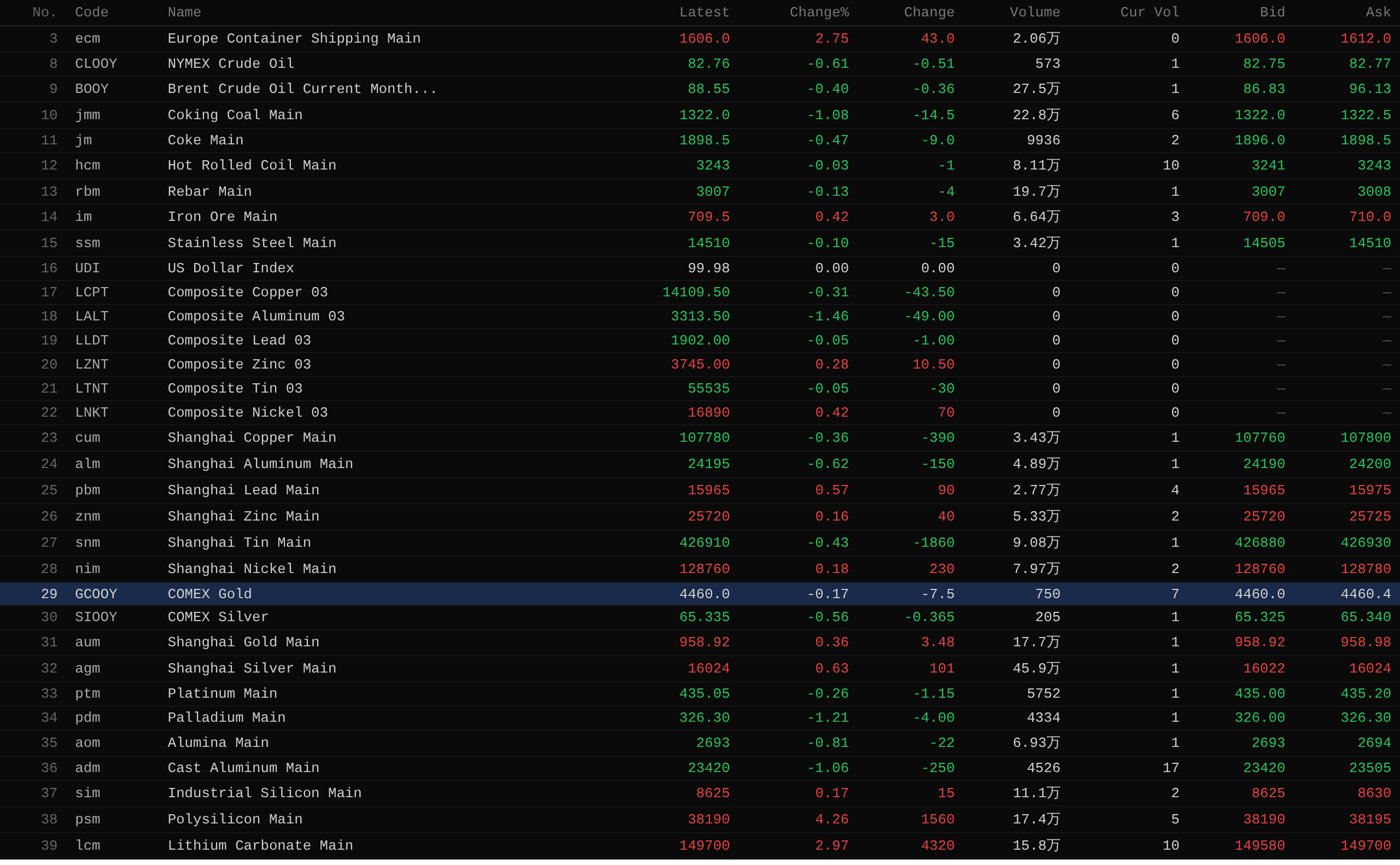
Overnight, base metals in both domestic and overseas markets showed mixed performance, with LME aluminum leading losses by falling 1.46%, SHFE lead leading gains with a 0.57% rise, SHFE aluminum falling 0.62%, and the remaining metals all edging down slightly. The most-active alumina contract fell 0.81%, and cast aluminum fell 1.06%.
Overnight, ferrous metals broadly fell, with only iron ore rising, by 0.42%. Stainless steel, rebar, and hot-rolled coil all saw modest declines; in the coking coal and coke segment, coking coal fell 1.08% and coke fell 0.47%.
In precious metals, overnight COMEX gold rose 0.63% and posted a four-day winning streak, while COMEX silver rose 0.92%. In China, SHFE gold rose 0.36% and SHFE silver rose 0.63%, both notching a seven-day winning streak.
Overnight closing quotes as of 6:37 on August 13:
Macro Front
China:
[PBOC: Timely Plan and Introduce Practical and Effective Incremental Policies and Strengthen Counter-Cyclical Adjustment]The PBOC released its Q2 2026 monetary policy implementation report. It will promptly plan and introduce pragmatic and effective incremental policies, strengthen counter-cyclical adjustment, step up efforts to expand domestic demand and optimize supply, and promote sustained, higher-quality and improving economic development. It will unswervingly follow the path of financial development with Chinese characteristics, further deepen financial reform and high-standard opening up, accelerate the building of a strong financial sector, improve the central bank system, build a scientific and sound monetary policy system and a comprehensive macroprudential management framework, and smooth the monetary policy transmission mechanism.
US Dollar:
As of the overnight close, the US dollar index rose 0.15% to 99.97. US core inflation in July was mild, which likely eased pressure on the Fed to raise interest rates. Data released by the US Bureau of Labor Statistics on Wednesday showed that core CPI, which excludes volatile food and energy categories, rose 0.2% MoM in July. The YoY increase was 2.5%, matching the slowest pace since March 2021. Overall, July CPI rose 0.1% MoM and 3.4% YoY. The report indicated that the energy-price shock from the Iran war continued to fade in July. As the Fed discusses whether to raise interest rates at its September meeting, the data may give the Fed more room to balance inflation pressures against the recent slowdown in hiring. Before the September meeting, policymakers will also see more reports on employment and inflation, while investors will closely watch a speech by Fed Chairman Warsh, expected later this month at the annual Jackson Hole symposium. US stock index futures moved higher, and Treasury yields were basically flat. Investors reduced bets on a September rate hike. (Jinshi Data App)
CITIC Securities said in a research note that US July CPI was fully in line with expectations, core inflation remained mild, and second-round inflation effects were subdued, which helped further ease market concerns about inflation risks. The firm still believes US inflation is not sticky and expects headline CPI YoY to broadly continue its mild slowdown in Q3 and bottom in September, before rebounding slightly in Q4 this year and falling rapidly next March. It still expects the Fed to stay on hold throughout this year, and there is still room for the rate-hike expectations priced into derivatives markets to be revised further downward. (Jinshi Data App)
CICC said in a research note that US July CPI rose 0.1% MoM seasonally adjusted and 3.4% YoY, while core inflation rose 0.2% MoM and 2.5% YoY, all in line with market expectations. Energy prices continued to fall, but international oil prices have moved higher again since August, adding uncertainty to future energy prices. On the core inflation front, goods were firm and services were soft; in particular, prices of information technology products such as computers and software continued to rise, reflecting that the supply-demand mismatch brought by AI capital expenditure expansion is gradually being transmitted to the consumer side. We believe US inflation may have entered a new phase, with its drivers gradually shifting from supply shocks such as tariffs and oil prices to demand expansion from AI investment, which may extend the persistence of inflation. For the Fed, this data has eased near-term pressure to raise rates, but compared with supply-driven inflation, demand-driven inflation requires more attention from policymakers. (Jinshi Data App)
J.P. Morgan Asset Management’s chief global strategist said the Fed should keep interest rates unchanged and expects inflation to gradually decline as mounting evidence shows that a sustained wage-price spiral will not form. David Kelly said after the July CPI release, “The Fed absolutely should stay on hold, and I actually think they will.” The report showed that US core inflation remained mild in July, and after the release, Treasuries extended gains. Kelly noted that three forces are working together to drive a clear cooling in inflation: tariff costs will decline on a YoY basis; oil prices will fall as the market turns optimistic that the Iran war will end; and wage growth continues to lag inflation. He added that the last point weakens the momentum needed for price pressures to form a self-reinforcing cycle and also means the Fed does not need to raise rates to contain inflation. Kelly noted that financial markets are currently highly leveraged, and even a small rate hike could trigger asset repricing. (Jinshi Data App)
According to CME FedWatch: the probability that the Fed will keep interest rates unchanged by September is 59.9%, and the probability of a cumulative 25 bp rate hike is 40.1%. The probability that the Fed will keep rates unchanged by October is 45.3%, the probability of a cumulative 25 bp rate hike is 44.9%, and the probability of a cumulative 50 bp rate hike is 9.8%. (Jinshi Data App)
Macro Front:
Today will bring data including the US August 12 10-year Treasury auction high yield and bid-to-cover ratio, US initial jobless claims for the week ending August 8, US July PPI YoY, US July PPI MoM, UK Q2 GDP YoY preliminary, UK June three-month GDP MoM, UK June manufacturing output MoM, UK June seasonally adjusted goods trade balance, UK June industrial output MoM, and eurozone June industrial output MoM.
In addition, JD.com will hold its Q2 earnings call; 2026 FOMC voting member and Cleveland Fed President Hammack will speak; and 2027 FOMC voting member and Richmond Fed President Barkin will speak on the economic outlook.
Crude Oil:
Overnight, both oil benchmarks fell, with US crude down 0.75% and Brent down 0.4%. Oil prices edged down after five straight sessions of gains, as traders awaited signs of progress in reopening the Strait of Hormuz. WTI crude fell below $82 a barrel after rallying 11% over the previous five sessions; Brent briefly fell below $87. On the Middle East front, there were almost no signs of progress in reopening the Strait of Hormuz, and US President Trump said the US has “full control” over the waterway. The International Energy Agency (IEA) said that as the US-Iran war continues, the global oil market faces a supply shortfall of 1.8 million barrels per day this quarter, more than double its previous forecast; the 2026 oil supply gap could be the largest in five years. According to the American Automobile Association (AAA), gasoline and diesel prices in the US have never been this high at this time of year. (Jinshi Data App)
Satellite imagery showed that very large crude carriers docked at the Juaymah terminal near Ras Tanura, Saudi Arabia’s main export port on the Persian Gulf, for the first time in weeks, indicating that Saudi Arabia is working to maintain crude exports. However, due to the Iran war, the situation in the Strait of Hormuz and threats from Houthi forces, shipping activity at Saudi ports remains affected. As the world’s largest oil exporter, Saudi Arabia has recently shifted some crude transport to the Red Sea port of Yanbu and is exporting to the Mediterranean via the SUMED pipeline. At the same time, activity at Yanbu port has declined from earlier, with only three tankers currently observed at berth, capable of carrying about 3.4 million barrels of crude. Analysts believe that Saudi export routes are shifting from the traditional route to Asian markets via the Bab el-Mandeb Strait toward an alternative route that runs north through the Red Sea and connects to the Suez Canal, in order to reduce regional security risks. Because some tankers have turned off their automatic identification systems and satellite observations have gaps, the actual scale of Saudi crude loadings remains difficult to fully confirm. (Jinshi Data App)
Russia’s July crude production was nearly 1 million bpd below its OPEC+ quota, because Ukraine has been attacking Russian oil infrastructure almost every day. According to OPEC’s monthly report, Russia’s average daily crude output last month was 8.887 million barrels. Although this was only 6,000 bpd lower than the revised June average, July’s daily average output was clearly below Russia’s 9.824 million barrel monthly target under its agreement with allies. The data came as the Russian oil industry faces continued attacks from Ukraine. Last month, Kyiv shifted targets from refineries to tankers and other facilities, with the focus of attacks constantly changing, threatening Russia’s crude processing volumes and exports while the global energy market was already under pressure from the Middle East conflict. (Jinshi Data App)
The latest IEA monthly report showed that, due to the rekindling of the Middle East conflict and disruptions to maritime transport,the global oil market is currently facing a supply shortfall of about 1.8 million barrels per day, and the IEA has doubled its Q3 oil supply shortfall forecast and expects the full-year 2026 gap could be the largest in five years.Since the conflict broke out, global observed oil inventories have fallen by 410 million barrels, including a decline of 69 million barrels in July alone. Meanwhile,the IEA has raised its forecast for the decline in global oil demand in 2026 by 510,000 bpd to 1.6 million barrels per day,implying that global oil demand this year will see its largest annual decline since 2020.But even with demand suppressed by high oil prices, supply losses continue to keep inventories under pressure. (Wallstreetcn)
![Backwardation Spread Widened Sharply, Shanghai Spot Copper Discounts Expanded Rapidly [SMM Shanghai Spot Copper]](https://imgqn.smm.cn/usercenter/OsOmo20251217171709.jpg)
![Most Metals Fell; Alumina Led Losses; Cast Aluminum and Coking Coal Fell Over 1%; Europe Container Shipping Rose Nearly 2% [SMM Midday Commentary]](https://imgqn.smm.cn/usercenter/fNuSg20251217171735.jpg)
![Actual Transaction Activity Sluggish, Market Divergence in Tug of War [SMM Yangshan Spot Copper]](https://imgqn.smm.cn/usercenter/grvgR20251217171710.jpg)