SMM, 12 de agosto:
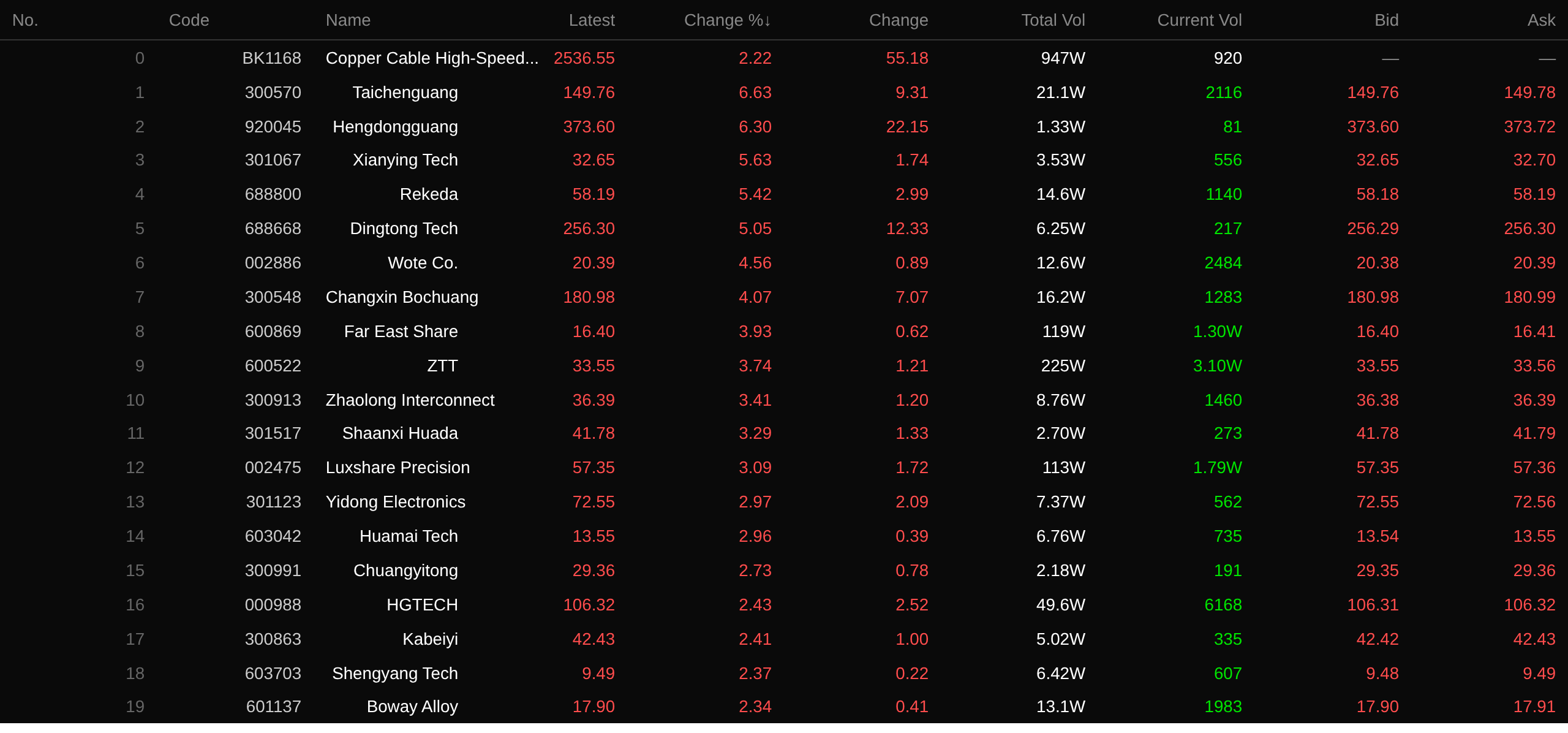
El informe semestral de Foxconn Industrial Internet registró un fuerte crecimiento de los beneficios, lo que confirma aún más el fuerte impulso de la infraestructura de computación de IA y está impulsando una recuperación del sentimiento en toda la cadena industrial de interconexión de alta velocidad. En un contexto de expansión de la capacidad de cómputo, los cables de cobre de alta velocidad han captado la atención de ciertos fondos del mercado como una solución clave de interconexión de corto alcance para los servidores de IA. Al mismo tiempo, SMM observa que la carrera de instalación de baterías de potencia, la alta prosperidad del almacenamiento de energía y el aumento de la demanda de computación de IA han impulsado colectivamente un incremento sostenido de las tasas de operación en la industria de láminas de cobre. Hasta el cierre del 12 de agosto, el concepto de cables de cobre de alta velocidad subió un 2,22 %. Entre las acciones individuales, Taichenguang y Hengdongguang se dispararon más del 6 %, mientras que los mayores avances incluyeron a Xianying Technology, Ruikeda, Dingtong Technology, Far East, Changxin Bochuang, ZTT y Zhaolong Interconnect.
Noticias del mercado
[Shanghái: Construir clústeres de computación inteligente ultragrandes de 100 000 tarjetas en Songjiang, Lingang, Qingpu, etc.]La Comisión Municipal de Economía e Informatización de Shanghái publicó el «15.º Plan Quinquenal para el Desarrollo de la Industria de Software y Servicios de Información de Shanghái». El plan menciona la creación de un sistema de suministro escalonado que sinergiza «grandes clústeres + pequeños clústeres + computación en el borde», construyendo clústeres de computación inteligente a escala ultragrande de 100 000 tarjetas en Songjiang, Lingang y Qingpu, y clústeres de 1000 tarjetas en Baoshan, Pudong y Jiading. Orienta la transformación de centros de datos tradicionales y salas de servidores TIC en centros de computación inteligente perimetral de 100 tarjetas para satisfacer las demandas de computación de latencia ultrabaja de empresas y particulares. Centrándose en sectores como finanzas, educación, sanidad, cultura y turismo, y fabricación, el plan apoya la construcción de plataformas de Modelo como Servicio (MaaS), ofreciendo mercados de aplicaciones sectoriales, personalización y alojamiento de modelos, creación de agentes, desarrollo de bajo código, interfaces API, provisión y gestión de potencia de cómputo, y servicios de inferencia de IA, mejorando así las capacidades de servicios en la nube de computación inteligente. También destaca la tarea de abordar arquitecturas de modelos de próxima generación y promover la exploración de múltiples rutas tecnológicas basadas en arquitecturas no-Transformer, como modelos de espacio de estados, variantes de redes neuronales recurrentes y redes neuronales líquidas. Se acelerarán los esfuerzos para implantar sistemas tecnológicos para modelos fundacionales de vanguardia, incluyendo inteligencia física, modelos del mundo, inteligencia cuántica e inteligencia neuromórfica. El plan aborda además avances en tecnologías de redes para clústeres de computación inteligente a ultra gran escala, centrándose en segmentos clave como chips de computación de alto rendimiento (GPU/NPU), chips cuánticos (QPU), interconexiones ópticas de alta velocidad (CPO), memoria de gran ancho de banda (HBM) y servidores heterogéneos, para impulsar la capacidad de suministro de hardware de computación inteligente y facilitar la integración profunda de chips propios con los grandes modelos convencionales. Con énfasis en nuevos sistemas de recuperación en almacenamiento y colaboración entre datos y modelos, el plan busca lograr avances en procesamiento heterogéneo de alta precisión, fusión multimodal nativa y alineación dinámica de valores, además de construir un razonamiento complejo automatizado que abarque todo el ciclo de vida de los datos de corpus.
[Foxconn Industrial Internet: el beneficio neto del primer semestre de 2026 sube un 95,99 % interanual; la demanda de computación con IA siguió disparada durante el período de referencia]Foxconn Industrial Internet anunció el 11 de agosto que sus ingresos del primer semestre de 2026 fueron de 557.861 mil millones de yuanes, un 54,63 % más interanual. El beneficio neto atribuible a los accionistas de la empresa cotizada fue de 23,74 mil millones de yuanes, un 95,99 % más interanual. El beneficio neto atribuible a los accionistas tras deducir pérdidas o ganancias no recurrentes fue de 22.984 mil millones de yuanes, un 96,99 % más interanual. El beneficio básico por acción fue de 1,2 yuanes. La empresa no tiene previsto repartir dividendos en efectivo, ni emitir acciones gratuitas ni capitalizar la reserva de capital. La variación de los ingresos de explotación se debió principalmente al beneficio derivado del aumento continuo de la demanda de capacidad de computación con IA, al incremento constante de la cuota de mercado entre los principales clientes y al sólido comportamiento del negocio de servicios en la nube, lo que impulsó el crecimiento general de los ingresos. La variación del beneficio neto se debió principalmente al beneficio derivado del aumento continuo de la demanda de capacidad de computación con IA, logrando la compañía una mejora constante de la rentabilidad en sus operaciones principales. (Jin10 Data)
[CoreWeave: los ingresos del segundo trimestre se duplican y las acciones se disparan un 12 % tras el cierre]CoreWeave (CRWV.O) subió un 12 % en las operaciones tras el cierre del martes después de informar de unos ingresos en el segundo trimestre de 2.580 millones de dólares, un 112 % más interanual y superando las expectativas de Wall Street, lo que indica que la demanda de capacidad de computación con IA sigue creciendo rápidamente; la pérdida neta fue de 626 millones de dólares, frente a los 290 millones del mismo período del año anterior; la cartera de pedidos alcanzó los 104.000 millones de dólares, con proyectos en construcción que suman una capacidad total de 1,5 gigavatios. CoreWeave está acelerando la expansión de su negocio de centros de datos, compitiendo con gigantes de la computación en la nube como Amazon, Google y Microsoft para capturar el mercado de centros de datos equipados con chips capaces de ejecutar modelos de IA generativa. Sin embargo, CoreWeave aún no ha alcanzado la rentabilidad. Al final del trimestre, su deuda en el balance ascendía a 35 000 millones de dólares, utilizada para cubrir los costos de adquisición de GPU NVIDIA y otros equipos. Este trimestre, Meta anunció que invertiría 21 000 millones de dólares adicionales en CoreWeave. Además, CoreWeave anunció un acuerdo de cooperación plurianual con Anthropic y recibió un compromiso de 6 000 millones de dólares de la empresa de trading cuantitativo Jane Street. (Datos de Jin10)
[El chip de IA de alta potencia de próxima generación de Axera completa el tape-out y admite la cascada de múltiples chips para la inferencia completa de modelos grandes en el borde] De la conferencia de resultados del informe semestral de 2026 de Axera, se supo que el chip de IA de alto rendimiento y alta potencia de próxima generación de la compañía ha completado el tape-out, con un aumento significativo en las especificaciones de potencia de cálculo, equipado con alto ancho de banda y admite la cascada de dos o cuatro chips, lo que permite la inferencia de alto rendimiento de modelos grandes completos en el borde.
[Alcanzada una intención de cooperación estratégica, Huawei suministrará equipos de computación Ascend a Beijing Data Group] Según Beijing Data Group, el 7 de agosto, Beijing Data Group y Huawei mantuvieron conversaciones de trabajo y alcanzaron una intención de cooperación estratégica. A continuación, ambas partes se centrarán en profundizar la cooperación en clústeres de potencia de cálculo y la construcción de infraestructuras de computación a nivel de ciudad. La filial de Beijing Data Group, Tongniu Information, participará en la construcción de la infraestructura de computación a nivel de ciudad de Pekín, coordinando el despliegue, las operaciones diarias y los servicios de computación de los clústeres de computación autoinnovadores del grupo. Huawei apoyará plenamente a Beijing Data Group en el avance del despliegue de computación autoinnovadora en toda la ciudad, proporcionando equipos de computación Ascend avanzados, soluciones técnicas integrales y soporte de servicios para construir conjuntamente una base de computación fiable a nivel de ciudad en Pekín, liberando continuamente el valor de los motores de computación y ofreciendo un soporte de computación estable y fiable para el desarrollo de “Beijing Inteligencia Digital”.
[Nvidia anuncia una asociación con seis gigantes financieros para organizar un sistema de financiación de infraestructuras de IA de 500 000 millones de dólares]Nvidia (NVDA.O) anunció el día 10, hora local, que ha establecido una asociación estratégica con Apollo, BlackRock, Blackstone, Brookfield, Goldman Sachs y KKR para crear una plataforma independiente de financiación de la computación, con el objetivo de movilizar más de 500 000 millones de dólares de capital de terceros a largo plazo para la construcción de infraestructuras de inteligencia artificial. Nvidia afirmó que la nueva plataforma de financiación transforma la infraestructura informática y de IA integral de Nvidia en una clase de activos invertible para el capital global, amplía el acceso a las fábricas de IA, consigue ingresos recurrentes vinculados al uso y respalda el crecimiento del ecosistema de Nvidia en ventas de hardware y aplicaciones de software.
[Tesla: El plan Terafab se lanza en Texas, con el objetivo de más de 1 teravatio de capacidad informática anual]El 6 de agosto, Tesla (TSLA.O) afirmó que a principios de este año, SpaceX y Tesla anunciaron el lanzamiento del proyecto "Terafab", la mayor iniciativa mundial de fabricación de chips, que integra chips lógicos, chips de memoria y tecnología de encapsulado avanzado en una sola instalación. En abril, Tesla inició la construcción de una nueva fábrica de I+D en el campus norte de su Gigafactoría en Texas, que fue la predecesora de Terafab. Y hoy, anunciamos oficialmente que Terafab estará ubicado en el condado de Grimes, Texas. Esta instalación será una fábrica avanzada de obleas semiconductoras, diseñada para cerrar la enorme brecha entre la capacidad actual de suministro mundial de chips y la futura demanda informática. Se espera que la demanda combinada de chips de SpaceX y Tesla supere 1 teravatio (TW) de potencia informática, superando con creces la capacidad actual de suministro global. Agradecemos enormemente a nuestros proveedores actuales de chips y los alentamos a ampliar la capacidad siempre que sea posible, pero la creciente brecha entre oferta y demanda futura es la razón central del proyecto Terafab. El objetivo de Terafab es fabricar nueva capacidad informática a una escala y velocidad sin precedentes. El proyecto prevé construir una fábrica integrada verticalmente con un área de fabricación superior a 9,29 millones de metros cuadrados. La instalación abarcará la fabricación, encapsulado y prueba de chips lógicos y de memoria avanzados. Concentrar estos procesos en un solo lugar facilitará una rápida iteración y acelerará el despliegue de nueva potencia informática.
[ZTE se asocia con Sky47 para construir el mayor centro de datos de computación inteligente de Pakistán]Recientemente, se celebró en Islamabad la ceremonia de inauguración de Sky47 Karakoram-01, el mayor centro de datos integrado de propósito general y computación inteligente de Pakistán, construido conjuntamente por ZTE y Sky47, el principal proveedor de servicios en la nube de Pakistán. Como el primer centro de datos Tier III nativo de IA personalizado de Pakistán, Sky47 Karakoram-01 tiene una capacidad total de suministro eléctrico de 8,5 MW. El centro proporcionará un sólido soporte de computación en la nube, alojamiento de datos y servicios digitales avanzados en todo Pakistán, satisfaciendo plenamente las necesidades de capacidad de cómputo del gobierno y las empresas en campos como inteligencia artificial (IA), aprendizaje automático (ML) y computación de alto rendimiento (HPC).
La fiebre por la instalación de celdas de baterías y la fuerte demanda de la cadena industrial de IA mantienen al alza la tasa operativa de las láminas de cobre
Según SMM, en julio, la tasa operativa de la industria de láminas de cobre continuó subiendo, respaldada por la sólida demanda final del sector downstream. En el segmento de baterías de litio, los programas de producción de las principales empresas chinas de baterías de litio alcanzaron otro récord en julio. La urgencia por instalar celdas de baterías de potencia impulsó los programas de producción, y la demanda de láminas de cobre para baterías de litio se mantuvo positiva. En el segmento de circuitos electrónicos, la demanda vinculada a la cadena industrial de IA siguió siendo fuerte; la capacidad continuó desplazándose hacia productos de gama alta, y la demanda de láminas de cobre para circuitos electrónicos en todas las especificaciones se mantuvo robusta.
Voces de todas las partes
El informe de investigación de CSC Financial señala que el escalado de los modelos frontera ha entrado en una etapa de desarrollo paralelo por múltiples vías. La industria estima que Anthropic Mythos 5 y Fable 5 tienen 8 billones y 5 billones de parámetros, respectivamente; Kimi K3 cuenta con un total de 2,8 billones de parámetros; y se informa que ByteDance está preentrenando un modelo con hasta 10 billones de parámetros. El postentrenamiento se extiende además a trayectorias de agentes de millones de tokens, miles de llamadas a herramientas y tareas complejas de varias horas. La revisión de RSI publicada el 8 de julio cubrió 1.250 artículos, de los cuales el 74 % se publicaron en 2026, lo que indica una clara aceleración en la automatización de la I+D de IA. Consideramos que la competencia de modelos está pasando de la mera expansión de parámetros a una evolución coordinada que involucra preentrenamiento, aprendizaje por refuerzo, cómputo en tiempo de inferencia, RSI y capacidades de agentes a largo plazo. La demanda de potencia de cómputo se ampliará del entrenamiento a la inferencia y la ejecución de agentes. Mantenemos una visión positiva sobre el ecosistema de Capex de los principales actores, los chips nacionales y supernodos, los servicios de computación, Pre-AI, las aplicaciones de IA para empresas (B-end) y la inferencia local.
El informe de investigación de Founder Securities indica que el rebote de sobreventa del mercado ha entrado en una fase crítica, con divergencias entre los sectores tecnológicos y de crecimiento cíclico. Continúe enfocándose en oportunidades de asignación en tres áreas. En primer lugar, las acciones tecnológicas también requieren un posicionamiento selectivo por estructura. A nivel de índices, el Sci-Tech Innovation Board y el ChiNext han rebotado alrededor del 10% desde sus mínimos, y aún hay potencial al alza respecto a la amplitud típica del rebote de sobreventa de los grandes temas. La narrativa de la IA ha experimentado algunos cambios tras los informes de ganancias de los CSP estadounidenses, con un debilitamiento marginal del gasto de capital competitivo; el negocio en la nube y un flujo de caja saludable son factores decisivos. Por lo tanto, dentro de la IA, el hardware y las aplicaciones se equilibrarán más. Céntrese en los nombres centrales de potencia de cómputo en el extranjero con baja concentración de posiciones, así como en segmentos de potencia de cómputo nacional con alta visibilidad de ganancias, como equipos y materiales semiconductores; las aplicaciones de IA relativamente infravaloradas y el índice Hang Seng Tech merecen atención. En segundo lugar, esté atento a las oportunidades en activos HALO, a medida que las expectativas de alzas de tasas de la Reserva Federal se moderan. Más allá de los metales no ferrosos y productos químicos básicos relacionados con recursos, los sectores de energía antigua y nueva sobrevendidos, incluyendo redes eléctricas y equipos eléctricos, carbón y petroquímicos, etc. En tercer lugar, los nombres farmacéuticos líderes con fundamentos que mejoran, baja concentración de posiciones y vientos en contra que remiten.
Un informe de investigación de CITIC Securities señala que desde 2023, el rápido desarrollo de la IA ha impulsado la mejora iterativa de la tecnología de módulos ópticos. Nuevas tecnologías como las mejoras en la velocidad de los chips ópticos, la integración de fotónica de silicio y la arquitectura CPO están impulsando conjuntamente la actualización iterativa de los equipos de prueba de módulos ópticos. Junto con la rápida expansión de la infraestructura de potencia de cómputo para IA, esto está provocando un "aumento de volumen y precio" en los equipos de prueba de módulos ópticos. Actualmente, los actores internacionales se mantienen relativamente a la vanguardia en el mercado de gama alta de 1.6T, pero las empresas nacionales están acelerando su recuperación, reduciéndose la brecha de manera constante. Somos optimistas sobre el desarrollo a largo plazo de la industria nacional de módulos ópticos y la tendencia de sustitución de importaciones para los equipos de prueba de módulos ópticos de gama alta.
China Merchants Securities, al revisar nueve fuertes correcciones del mercado de acciones A desde 2015, encontró que las caídas pronunciadas fueron provocadas en su mayoría por choques externos o riesgos de liquidez, y la estabilización se produjo mediante respuestas de política. La ventana de rebote promedio después de una corrección es de 34 días hábiles, con el índice Wind All A-Share rebotando más de un 19% en promedio, y cuanto mayor es la caída previa, mayor tiende a ser el rebote posterior. El comportamiento de los sectores muestra una rotación en "dos fases": en los primeros 10 días de negociación de un rebote, los sectores de beta alta y sobrevendidos, como la electrónica y la informática, lideran las ganancias; después de 20 a 60 días de negociación, el mercado se orienta hacia temas con respaldo fundamental, como equipos eléctricos y alimentos y bebidas. Para el ciclo actual, se recomienda una asignación en dos pasos: inicialmente, priorizar TMT y otros sectores sobrevendidos de beta alta (con foco en los líderes de capacidad de cómputo en China y en el extranjero); después de 10 a 20 días de negociación, regresar a un reequilibrio basado en fundamentales, centrándose en equipos eléctricos, químico-farmacéutico, carbón y financieras no bancarias. Dentro de las temáticas sectoriales, las oportunidades clave a capturar son el potencial de convergencia en la cadena de aumento de precios de la capacidad de cómputo en el extranjero, la elasticidad del hardware de potencia de cómputo nacional y el valor del oro como activo de refugio y reequilibrio. La asignación global gira en torno a tres temas principales: innovación tecnológica, internacionalización de empresas y reequilibrio de los sectores tradicionales de baja valoración.
Según la investigación de CICC, desde mediados a finales de junio, las cadenas globales de IA experimentaron retrocesos notables, siendo Corea del Sur—caracterizada por un alto apalancamiento, alta concentración y alta participación minorista—la más afectada. Detrás de esto se encontraban los efectos amplificadores de la alta concentración y el alto apalancamiento, las perturbaciones de factores macro (como las crecientes expectativas de aumentos de tasas de interés de la Fed estadounidense y el nuevo bloqueo del Estrecho de Ormuz que impulsó al alza los precios del petróleo), y las preocupaciones del mercado sobre una burbuja de IA que resurge (por ejemplo, Meta alquilando capacidad de cómputo, la disminución del gasto en tokens). De hecho, antes de que la burbuja finalmente estallara en marzo de 2000, el mercado de acciones tecnológicas experimentó al menos cuatro rondas de correcciones prolongadas a gran escala. Los desencadenantes de estas caídas son muy similares a los del ajuste actual: retrocesos de corto plazo en las tendencias de la industria, vientos en contra en el entorno macro y un sentimiento de valoraciones sobrecalentadas. El eventual rebote de las acciones tecnológicas también se debió a la relajación de estas tres presiones. Por lo tanto, en correspondencia con el presente, para que el mercado se estabilice e incluso inicie una nueva ronda de subidas, se necesitan estos tres factores: la asimilación de la alta concentración y el alto apalancamiento (en gran medida lograda), la relajación de las expectativas de subidas de tasas de la Fed estadounidense o el anuncio efectivo (estén atentos a la reunión del FOMC de julio), y, más importante aún, nuevos catalizadores procedentes de informes de resultados y la evolución del sector (la temporada de resultados de julio-agosto).
Lectura recomendada: