[SMM Analysis] Mali Lithium Royalty Market: Goulamina's Production, Logistics, and Royalty Exposure Limits

Published: Aug 11, 2026 19:14

Lithium Royalty Corp's acquisition of a 1.5% Goulamina royalty gives Western capital revenue linked exposure to Mali's flagship spodumene project without operating risk. But the royalty's 500,000-tonne annual volume cap sits almost exactly at Goulamina's current Phase I capacity, meaning any upside from Ganfeng's planned Phase II expansion largely bypasses the royalty holder. Lithium Royalty Corp (LRC) has entered into a definitive agreement to acquire a 1.5% Trailing Product Sales Fee (TPSF) royalty on Ganfeng Lithium's Goulamina project in Mali, purchased from Leo Lithium for A$40 million (approximately $27 million). The deal extends LRC's battery metals footprint beyond direct mine ownership, adding to an existing royalty on Ganfeng's Mariana brine project in Argentina within a broader 37-royalty portfolio.

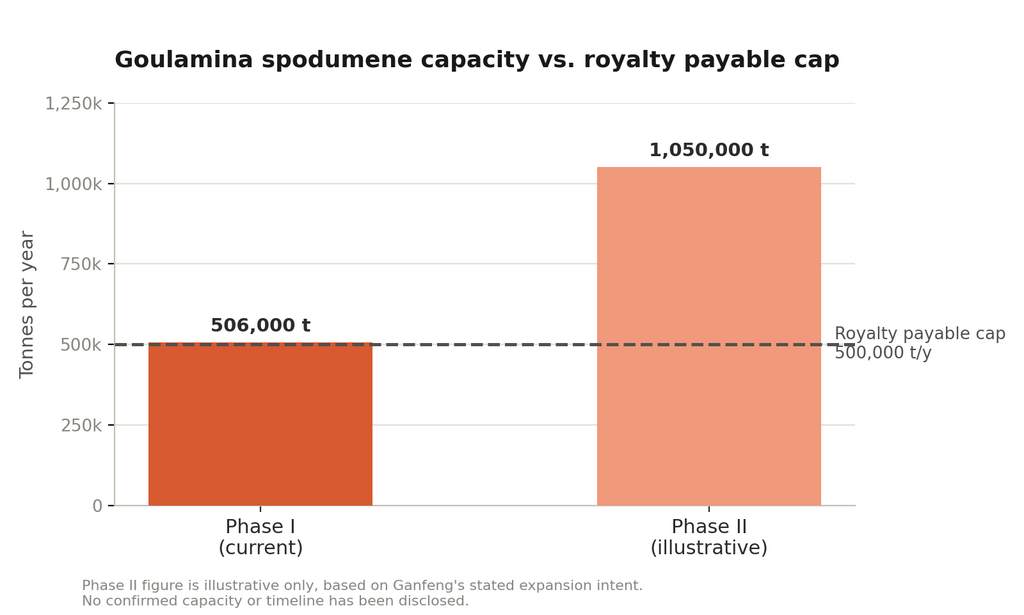
1. Royalty Structure Caps Volume, Extends Duration: LRC's royalty entitles it to quarterly payments over a 20-year term, with the cashflow window running through August 2045. Early monetisation is confirmed: Leo Lithium received a first quarterly payment of $574,748 in Q3 2025. Crucially, payable volume is capped at 500,000 tonnes per year of spodumene a ceiling that limits LRC's exposure if Goulamina's output scales materially beyond current design capacity.

2. Production Volume and Ramp-Up Sit Close to the Cap: Goulamina's Phase I nameplate capacity is 506,000 tonnes per year of spodumene concentrate just above LRC's payable cap, meaning the royalty already captures close to its practical maximum at present output. Ganfeng has publicly indicated intent to pursue a Phase II expansion that would materially exceed current capacity, though a confirmed timeline and design capacity have not been disclosed. Any such expansion would leave royalty-linked cashflow structurally unchanged given the fixed cap.


3. Supply Status Remains Consistent Since First Shipment: Goulamina has shipped concentrate consistently since commencing exports in June 2025, with output sold under offtake arrangements to Chinese buyers holding controlling stakes in the project.

4. Logistics Add a Distinct Risk Layer: Concentrate is trucked approximately 1,000km from Goulamina to the port of Abidjan, Côte d'Ivoire, the primary export corridor, with San Pedro and Dakar serving as secondary routes. This overland logistics profile differs materially from Zimbabwe's rail-based Beira and Durban corridors, introducing distinct cost and timing exposure for Mali-origin material.

Corridor

Mode

Distance

Role

Goulamina → Abidjan

Overland truck

≈1,000 km

Primary export route

Goulamina → San Pedro

Overland truck

Secondary corridor

Alternate loading port

Goulamina → Dakar

Overland truck

Secondary corridor

Alternate loading port

5. Ownership Structure Ties Returns to Policy Environment : Ganfeng holds 65% of Goulamina, with Mali's government holding the remaining 35% following the country's revised mining code. This ownership split ties royalty performance not only to production economics but to Mali's evolving fiscal and regulatory stance toward foreign-operated mining assets.

SMM View: The royalty cap sitting almost exactly at Phase I capacity is the structural detail worth flagging for African lithium coverage: LRC gains near-full exposure to current output but stands to capture little of the incremental upside if and when Phase II lifts capacity beyond current design levels. This positions the deal as a disciplined, lower-risk way to gain Mali spodumene exposure, but one whose real return profile is bounded well below the project's potential growth trajectory. For SMM's ongoing tracker, the more actionable signals are confirmation of Ganfeng's Phase II timeline and specifications, and whether Abidjan-corridor logistics face the kind of congestion already constraining Zimbabwean concentrate flows either of which could reshape the volume and margin assumptions underlying this and future royalty-style deals in the region.

Data Source Statement: Except for publicly available information, all other data are processed by SMM based on publicly available information, market communication, and relying on SMM's internal database model. They are for reference only and do not constitute decision-making recommendations.

For any inquiries or for more information, please contact: lemonzhao@smm.cn
For more information on how to access our research reports, please contact:service.en@smm.cn
Related News
[SMM Flash] Zimbabwean Spodumene Concentrate Prices Fall Across All Grades, Led by 5% Li₂O Down 1.99%
1 hour ago
[SMM Flash] Zimbabwean Spodumene Concentrate Prices Fall Across All Grades, Led by 5% Li₂O Down 1.99%
Read More
[SMM Flash] Zimbabwean Spodumene Concentrate Prices Fall Across All Grades, Led by 5% Li₂O Down 1.99%
[SMM Flash] Zimbabwean Spodumene Concentrate Prices Fall Across All Grades, Led by 5% Li₂O Down 1.99%
Zimbabwean spodumene concentrate prices, CIF Chinese main ports, declined across all three tracked grades on August 7, with the lower-grade material posting the steepest percentage drop. The 6% Li₂O grade (SMM-Li-SC-005) settled at $2,010/tonne, down $25 (-1.23%), trading in a $1,970-$2,050 range. The 5.5% Li₂O grade (SMM-Li-SC-006) closed at $1,885/tonne, down $30 (-1.57%), within a $1,860-$1,910 band. The 5% Li₂O grade (SMM-Li-SC-007) fell hardest, settling at $1,725/tonne, down $35 (-1.99%), with the widest daily range of the three at $1,660-$1,790. The pullback widened the grade differential at the lower end of the curve: the 6%-5.5% spread stood at $125/tonne, while the 5.5%-5% spread widened to $160/tonne, up from typical spread levels, pointing to comparatively softer demand for lower-grade Zimbabwean material relative to higher-Li₂O concentrate on the day. SMM View: The broad-based decline across all three Zimbabwean spodumene grades tracks the wider softness in China's lithium chemical complex, with lower-grade material bearing the brunt of the pullback as buyers favour higher-grade feedstock amid cautious purchasing. SMM will continue to monitor whether the widening 5.5%-5% spread persists into the next pricing session or reflects a single-day liquidity effect.
1 hour ago
[SMM Analysis] Corica Mali Wins $348M Open-Pit Mining Contract at Ganfeng's Goulamina Lithium Project
1 hour ago
[SMM Analysis] Corica Mali Wins $348M Open-Pit Mining Contract at Ganfeng's Goulamina Lithium Project
Read More
[SMM Analysis] Corica Mali Wins $348M Open-Pit Mining Contract at Ganfeng's Goulamina Lithium Project
[SMM Analysis] Corica Mali Wins $348M Open-Pit Mining Contract at Ganfeng's Goulamina Lithium Project
Corica Mali, a subsidiary of Corica Mining Services, has been awarded the open-pit mining services contract at the Goulamina spodumene project in Mali, valued at approximately $348 million. The contract follows a competitive tender process and covers six months of pre-production activity followed by a fixed five-year term. Corica has already mobilised to site under an early works arrangement and is currently carrying out pre-strip and direct shipped ore (DSO) mining and crushing. Scope covers grade control, drill and blast, load and haul, and plant ore-feed services, with a planned material movement target of 18-20 Mt/y over the contract term. This figure refers to total mined material (ore plus waste), distinct from finished spodumene concentrate output Goulamina's Stage 1 definitive feasibility study outlines nameplate production of roughly 506,000 tonnes per annum of 6% Li₂O spodumene concentrate (SC6), with test work validating high-quality, low mica concentrate. On logistics, Goulamina is landlocked, located roughly 50 km west of Bougouni in southern Mali, and spodumene concentrate produced at site is trucked overland to coastal ports for onward shipment to end markets, predominantly Chinese converters. Industry practice for landlocked West African spodumene projects is to sell concentrate on an FOB basis at the export port, with the buyer arranging and bearing ocean freight from that point; Mali-origin concentrate has historically moved primarily via Abidjan, with San Pedro and Dakar available as secondary corridors. Specific Incoterms and export routing for Goulamina's commercial shipments were not disclosed in the contract announcement and should be confirmed against offtake documentation rather than assumed. Goulamina holds all key approvals and permits required for production. Ownership has changed since the original mining contract announcement: Ganfeng Lithium, previously a 50% joint-venture partner, acquired the remaining 40% interest from Leo Lithium in a transaction completed through 2024-2025, and now holds the project alongside the Government of Mali's equity interest under the country's revised mining code terms of the state's current stake should be verified against the latest Malian government disclosure rather than the original 10% free-carry figure cited at contract signing. First commercial shipment from Goulamina occurred in August 2025, superseding the original H1 2024 production target referenced when this contract was first announced. Corica has operated in the West African mining services sector for over 20 years and reports more than 2,000 employees, according to company-supplied figures; these have not been independently verified by SMM. SMM View: The Corica contract underlines the scale of open-pit mining services demand accompanying Mali's ramp-up as a spodumene supply source, with an 18-20 Mt/y material movement target supporting Goulamina's roughly 506,000 tpa SC6 nameplate capacity. With Ganfeng now holding full private ownership following its 2024-2025 buyout of Leo Lithium's stake, offtake and logistics decisions at Goulamina sit entirely with Ganfeng and the Malian state, reinforcing China's direct control over a growing share of West African spodumene supply reaching Chinese conversion capacity. SMM will monitor further disclosure on Goulamina's export routing and contractual Incoterms as shipment volumes scale.
1 hour ago
[SMM Analysis] Zimbabwe Lithium Producers Commit $1.45B to Local Processing, Seek Export Ban Flexibility"
1 hour ago
[SMM Analysis] Zimbabwe Lithium Producers Commit $1.45B to Local Processing, Seek Export Ban Flexibility"
Read More
[SMM Analysis] Zimbabwe Lithium Producers Commit $1.45B to Local Processing, Seek Export Ban Flexibility"
[SMM Analysis] Zimbabwe Lithium Producers Commit $1.45B to Local Processing, Seek Export Ban Flexibility"
Zimbabwe's lithium producers have collectively committed approximately US$1.45 billion to local beneficiation infrastructure, according to Lithium Producers Association Chairman Innocent Rukweza, who also heads Mutapa Energy Resources. Speaking at the Mine Entra Beneficiation and Value Addition Symposium in Bulawayo, Rukweza said the industry has sought government flexibility on the pending export restriction on unbeneficiated spodumene concentrate, citing limited sulphate-plant readiness across the sector. SMM notes the ban's effective date and any adjustment to it should be confirmed against the latest government notice rather than symposium commentary, and that the US$1.45 billion figure is association-reported and has not been independently verified. Of seven major producers, only the Huayou-linked plant at Prospect Lithium Zimbabwe's Arcadia site has completed and commissioned sulphate conversion capacity to date. The US$400 million facility exported Africa's first locally produced lithium sulphate in April 2026 and is now operating. Sinomine's US$500 million sulphate plant at Bikita remains under construction, Kamativi Mining Company's US$200 million-plus sulphate project is at investment stage with commissioning status unconfirmed, and a fourth, unnamed facility is targeted for end-2027. The gap between committed capital and commissioned output is the operative supply constraint behind the industry's request for timeline flexibility: the remaining producers are still moving concentrate rather than sulphate and would be directly exposed if the unbeneficiated export restriction takes effect before their plants come online. Logistics add a further layer of risk to that timeline. Spodumene concentrate is currently exported CIF China, routed predominantly via Beira in Mozambique and Durban in South Africa, and sulphate output from commissioned and future plants will likely need to move through the same corridors absent dedicated arrangements. ZETDC grid instability continues to affect processing-plant uptime, bearing directly on how quickly the remaining sulphate facilities can ramp to nameplate capacity once commissioned, while congestion at the Machipanda border post and along the Beitbridge Durban and Maputo rail corridors affects turnaround times independent of on-site production readiness. Even where sulphate capacity comes online on schedule, these constraints will shape whether the sector can convert commissioned capacity into consistent export volumes ahead of any tightened concentrate-export policy. On the fiscal side, the industry's effective tax burden is estimated at around 40% of sales revenue, comprising a 10% export tax on unbeneficiated lithium, 7% royalties, a 3% community development levy, a 1% MMCZ marketing fee and 15.5% VAT, before corporate income tax, payroll and foreign currency retention requirements are added. The association has called for a review, noting Zimbabwe's rate sits above global peers. Beyond lithium, the association has pointed to unrecovered value in tantalum, niobium and caesium from lithium operations, and government has since introduced mandatory mineral declaration and on-site assay laboratory requirements at producing mines. Specific loss and investment figures cited for this by-product stream were not independently attributed at the symposium and are not carried here pending primary sourcing. SMM View: Zimbabwe's beneficiation drive is currently a one-plant story, with Arcadia commissioned and exporting sulphate while Bikita, Kamativi and the fourth facility remain at construction or investment stage. The binding constraints on closing that gap are not purely financial grid reliability and corridor congestion at Machipanda and along the Beitbridge–Durban and Maputo routes will shape how quickly commissioned capacity converts into consistent export volumes. The roughly 40% effective tax burden remains a separate and likely more durable point of friction with Harare. SMM will confirm the committed investment figure and current export-policy status once further primary disclosures are available.
1 hour ago