Overview
Africa supplies most of the world's Platinum Group Metals (PGM), but the geography of that supply is narrow. A review of company and regulatory disclosures to August 2026 identifies 51 PGM mining assets on the continent. Forty-four sit in South Africa, in the Bushveld Complex. Seven sit in Zimbabwe, along the Great Dyke. No other African country holds a verified commercial PGM mine or a committed development project. This article maps what operates today and what is being built.
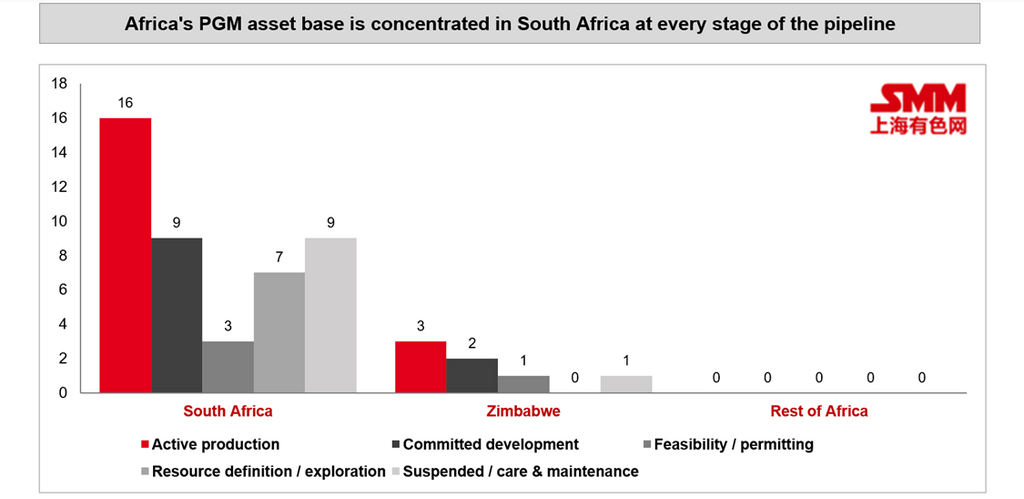
Mapped PGM mining assets by country and stage.
South Africa: the Centre of Africa's PGM industry
South Africa remains the undisputed king of Africa's PGM industry, with 16 out of the 19 active African mining operations concentrated across the Bushveld Complex. The Western Limb around Rustenburg, Brits and Pilanesberg is the densest production area, while the Northern Limb is becoming increasingly important as large-scale operations such as Valterra Platinum's Mogalakwena and Ivanhoe Mines' newly commissioned Platreef develop. The Eastern Limb retains a substantial operating base but also contains a relatively large concentration of stalled and deferred projects. This uneven distribution highlights an important feature of South Africa's PGM industry: geological abundance has translated into a highly developed mining ecosystem, but not every identified resource is progressing towards production. Changes in asset classification also matter; for example, Kroondal is no longer treated as a separate mine following the transfer of its assets into Sibanye-Stillwater's Rustenburg complex in January 2025, while Pilanesberg, held by Sedibelo Resources, ceased mining and processing in December 2023.
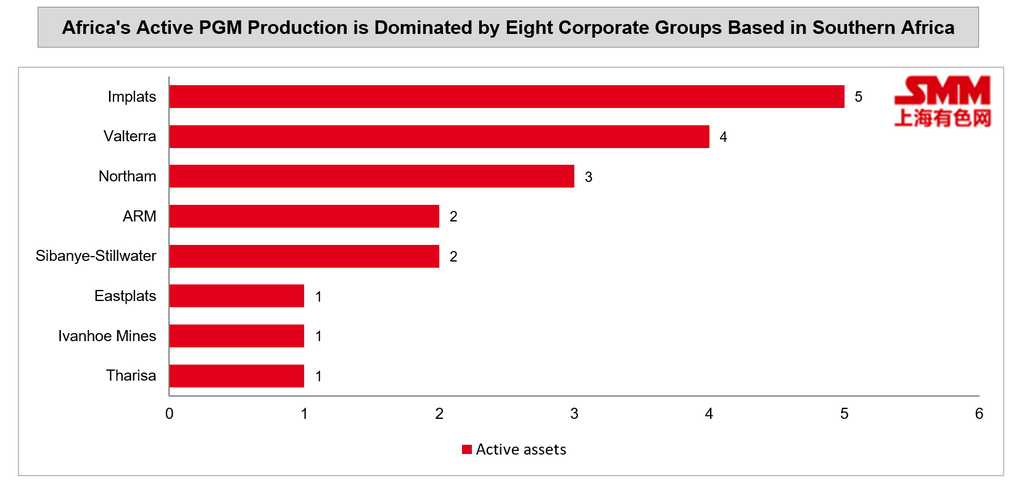
Africa's 19 active PGM operations by Company.
The Northern Limb around Mokopane holds the largest single operation, Mogalakwena, and the newest, Platreef, which produced its first concentrate on 18 November 2025. The Eastern Limb around Steelpoort and Burgersfort holds five active operations, Two Rivers (ARM and Implats), Modikwa (ARM and Valterra Platinum), Marula (Implats), Mototolo (Valterra) and Booysendal (Northam Platinum), and also the largest number of stalled assets. Zondereinde (Northam) and Amandelbult (Valterra) anchor the northern end of the Western Limb. Five groups, Implats, Valterra Platinum, Northam, Sibanye-Stillwater and ARM, operate 13 of South Africa's 16 active mines, with Tharisa, Eastplats and Ivanhoe Mines holding one each.
The country's future supply profile is supported by nine committed development projects, but much of this pipeline represents extensions, replacements or underground developments around existing operations rather than entirely new mines. Platreef is the most significant new production story, with Phase 2 targeted to exceed 450,000 ounces annually by the end of 2027. Other developments, including Valterra's Sandsloot at Mogalakwena, Northam's Zondereinde Western extension, Tharisa's underground operation, ARM's Bokoni redevelopment and Southern Palladium's Bengwenyama, indicate that established producers and new entrants are pursuing different routes to future supply.
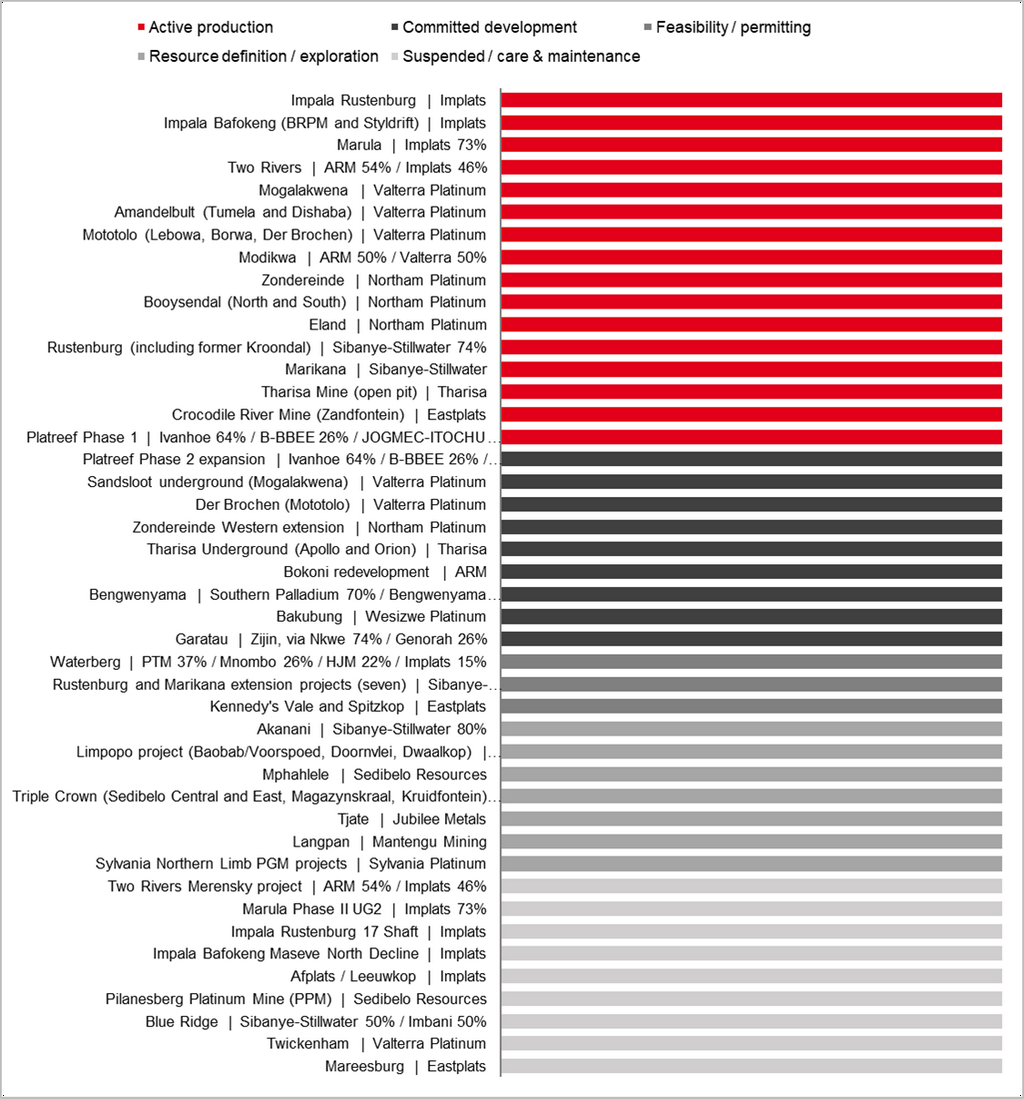
South African PGM assets with their owners, grouped by stage of development.
However, the broader project inventory is considerably larger than the genuinely committed pipeline. Ten additional assets remain at study or exploration stage, while nine are suspended or under care and maintenance. Waterberg, operated by Platinum Group Metals with Implats among its partners, illustrates the gap between geological potential and near-term supply. The distinction is therefore important for assessing South Africa's future output. The country has a deep resource base and numerous projects, but only a relatively small proportion is currently positioned to add new production. Secondary recovery also contributes to the supply picture, reinforcing South Africa's role not only as the continent's dominant mining centre but also as a highly integrated PGM production and processing hub.
Zimbabwe: the Second Centre
Zimbabwe has three active operations, all on the Great Dyke. Zimplats operates the Ngezi complex of five underground portals, an open cast mine, three concentrators and the Selous smelter. Mimosa and Unki make up the balance. Project count understates the country's weight. Zimplats alone accounted for 45 per cent of Implats' attributable mineral reserve of 49.1 million ounces on a six-element basis at 30 June 2025, and 31 per cent of the group's resource base. Three operations therefore carry a reserve position that no single South African district matches.
Two projects are in committed development. Tharisa's Karo Platinum is under construction, with about US$241 million invested by the second quarter of the 2026 financial year, a mining contractor mobilised, waste stripping under way and first ore targeted for the mill in 2027 at roughly 226,000 ounces a year over the first decade. Zimplats' Mupani mine replaces three depleting mines and is scheduled to reach full capacity of 3.6 million tonnes a year in the 2029 financial year, with US$360 million of a US$386 million budget spent by the end of 2025.
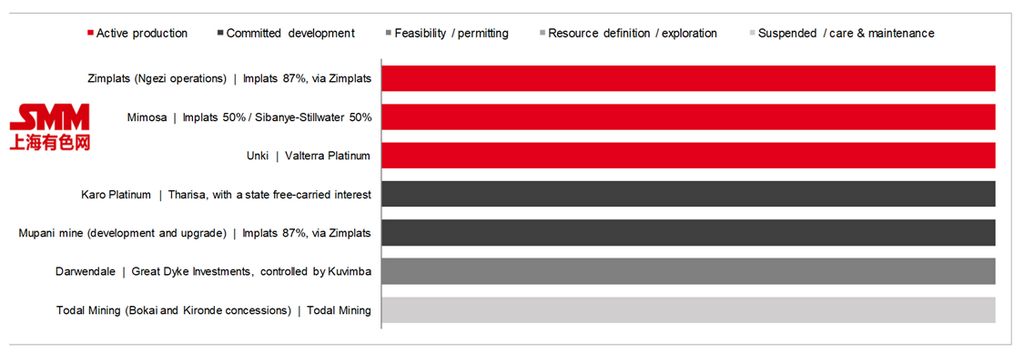
Zimbabwean PGM assets with their owners
One project sits in study. Darwe ndale, once planned as a US$450 million underground mine, has been re-scoped as an open pit needing about US$50 million of initial capital. It has neither committed funding nor a processing solution, and Implats has said it is in discussions about processing. The Todal concessions near Shurugwi remain dormant. Zimbabwe's beneficiation requirements are also drawing capital into processing, with Zimplats reporting its smelter expansion and first phase of sulphur dioxide abatement as technically complete.
Other African countries
No country outside South Africa and Zimbabwe hosts a verified commercial PGM mine or a committed PGM development project. Botswana has recovered platinum group elements historically as a by-product of base metal ores, without an established PGM mining and processing industry. Early-stage exploration claims circulate for Tanzania and Ethiopia, but they could not be corroborated against licence-holder disclosure and are not treated as projects here.
The conclusion is a screen result rather than a statement about geology. Prospective ground exists across the continent. Defined commercial projects do not.
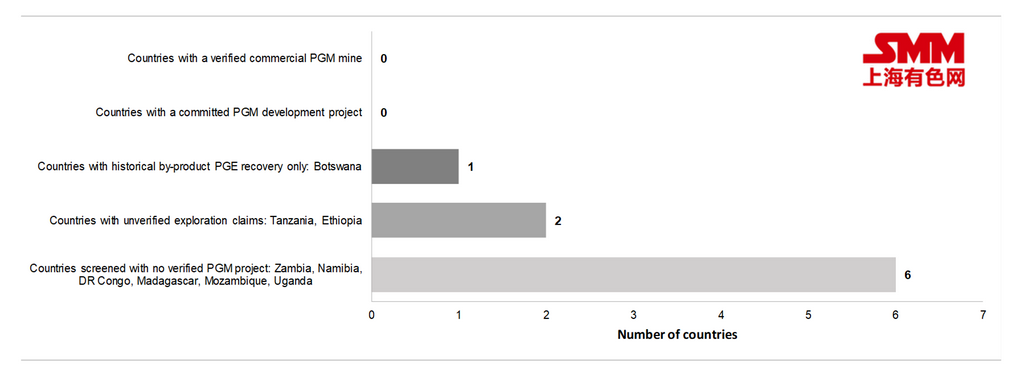
Other African countries screened beyond the two producers
What the mapping shows
First, concentration is extreme and holds at every stage. South Africa accounts for 16 of the 19 active operations, 9 of the 11 committed projects and 9 of the 10 suspended assets. Second, the committed pipeline is thin. Eleven of the 51 mapped assets, or about a fifth, are in construction or committed development. Almost as many, 10 assets, are suspended or on care and maintenance. A further 11 sit in study or exploration with no committed programme. Third, no single company drives the next phase of supply. The 11 committed projects are held by nine corporate groups with only Tharisa and Valterra Platinum holding two each.
Outlook
In the near term, African supply rests on the 19 operations already running. Their output will likely move with grade, depth and reliability rather than with new capacity. In the medium term, the credible additions are identifiable but few. Platreef Phase 2 and Tharisa's Apollo decline should deliver first volumes within the current decade. Karo and Mupani should follow in Zimbabwe. Bokoni is scheduled to reach steady state around 2032.
Beyond that, the decisions to watch are more financial than geological. Sandsloot faces an investment decision in the first half of 2027. Waterberg still needs financing and an offtake agreement. Bengwenyama must convert a new mining right into funded construction. Africa's future PGM supply therefore depends less on the number of deposits it holds than on the ability of a small group of projects to secure capital, processing capacity and competitive economics.

![[SMM Precious Metals Express]](https://imgqn.smm.cn/usercenter/obeMy20251217171735.jpg)