South Africa exported 123,310.23 tonnes of high-carbon ferrochrome in June 2026, down a modest 0.32% month-on-month but sharply lower — down 44.57% — year-on-year. The near-flat monthly reading suggests exports have found a temporary floor after an extended period of decline, but the scale of the annual drop confirms that South Africa's ferrochrome trade remains firmly on the back foot, in stark contrast to the chrome ore side of the business, which posted export volumes nearly 39% higher than a year earlier over the same month.
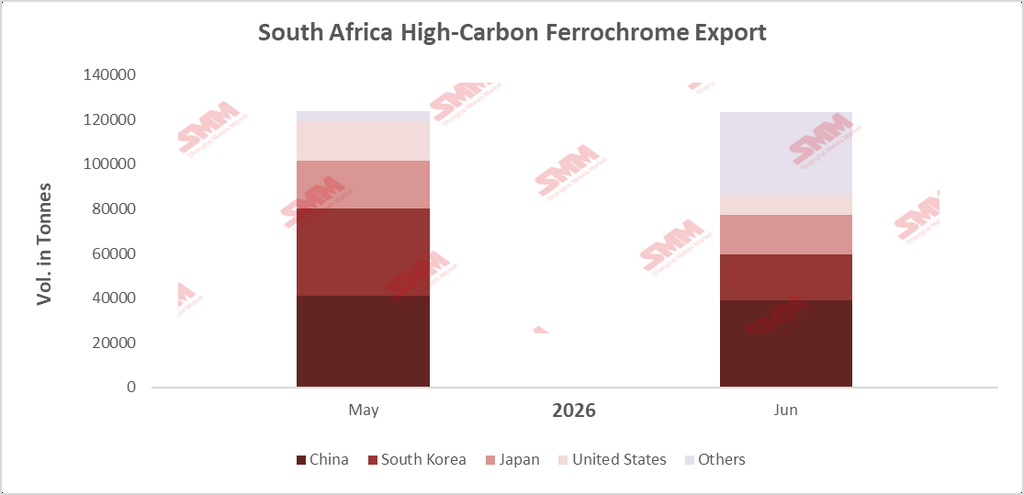
Figure 1: South Africa high-carbon ferrochrome export volume and destination breakdown, June 2026
A Decline Rooted in the Smelters, Not the Market
The subdued year-on-year performance is best explained by looking at what has been happening inside South Africa's ferrochrome furnaces rather than at demand abroad. Merafe Resources' H1 2026 production report, released in late July, showed the scale of the domestic problem directly: attributable ferrochrome production from the Glencore Merafe Chrome Venture collapsed 75% to just 28,000 tonnes, driven by extended suspensions at the Wonderkop and Boshoek smelters and a partial suspension at Lion. With a significant share of the country's ferrochrome-producing capacity effectively offline for much of the period being compared against, a steep year-on-year export decline is a direct, mechanical consequence of reduced output — not evidence that international buyers have gone elsewhere. Read this way, June's export weakness is a supply-side story, not a demand-side one.
A Destination Mix That Looks Nothing Like Chrome Ore's
China remained South Africa's largest ferrochrome destination in June, but at 31.56% of shipments, its share was far lower than the 67.61% it commanded in the equivalent chrome ore export data for the same month. That gap is telling: China's ferrochrome smelters are built to process imported raw chrome ore into alloy domestically, which is precisely why the country absorbs such an outsized share of South African ore but a comparatively smaller share of already-finished ferrochrome. South Korea's position as the second-largest destination, at 16.63%, fits the same logic from the opposite direction — Korea has limited domestic chrome ore resources and no comparable smelting base, so its stainless steel producers rely on imported semi-finished ferrochrome rather than ore. Together, the two destinations underscore how the ferrochrome trade is shaped by which countries can smelt their own ore and which cannot, a very different dynamic from the ore trade's concentration around Chinese furnace demand alone.
A Possible Turning Point Ahead
The timing of June's data is worth noting. Around the same period, Eskom and South Africa's ferrochrome producers reached a negotiated electricity tariff agreement, and Merafe subsequently announced the restart of the Wonderkop and Boshoek smelters at the very end of June. If that restart translates into a sustained production ramp-up through the second half of 2026, it raises the prospect that the worst of the year-on-year export declines may be behind the industry, with H2 2026 figures potentially beginning to narrow the gap against 2025 comparatives. That said, restarting idled smelters is rarely instantaneous, and the extent of any recovery will depend on how quickly output ramps back toward pre-suspension levels — a trend worth tracking closely over the coming months rather than assuming resolved.
A Policy Backdrop Pulling in the Opposite Direction
It's worth noting that ferrochrome sits on the other side of South Africa's chrome policy debate compared with raw ore. Where chrome ore exports have drawn government intervention — export permitting through ITAC and a proposed export tax, aimed specifically at discouraging raw shipments and pushing more material toward domestic beneficiation — ferrochrome is the very outcome that policy is designed to encourage more of. Seen against that backdrop, June's weak ferrochrome export figures represent something close to the opposite of the government's stated goal: less beneficiated product reaching export markets, even as raw ore shipments continue to climb. That contrast adds a layer of urgency to the smelter restart story, since a durable recovery in ferrochrome export volumes would be a more direct sign of the beneficiation strategy gaining traction than any adjustment to ore-export policy alone.
A Note on Demand Resilience
While South Korea's steady share of June shipments points to continued underlying buying interest, it's worth flagging that Chinese domestic high-carbon ferrochrome tender pricing had shown signs of softening in mid-July, with a bearish outlook for the following month's tender round. That suggests demand resilience may not be uniform across all destination markets, and is a detail worth weighing alongside the export volume data rather than assuming steady global demand across the board.
Bottom Line
June's ferrochrome export data tells a story of a market held down by supply constraints rather than weak demand, with a destination mix shaped by which countries smelt their own ore and which import the finished alloy. With Wonderkop and Boshoek now restarted and a new electricity tariff framework in place, the coming months will be the real test of whether South Africa's ferrochrome trade can begin closing the gap with 2025 levels, or whether the divergence between a booming chrome ore trade and a struggling ferrochrome trade becomes the defining feature of the country's chromium sector for the rest of 2026.