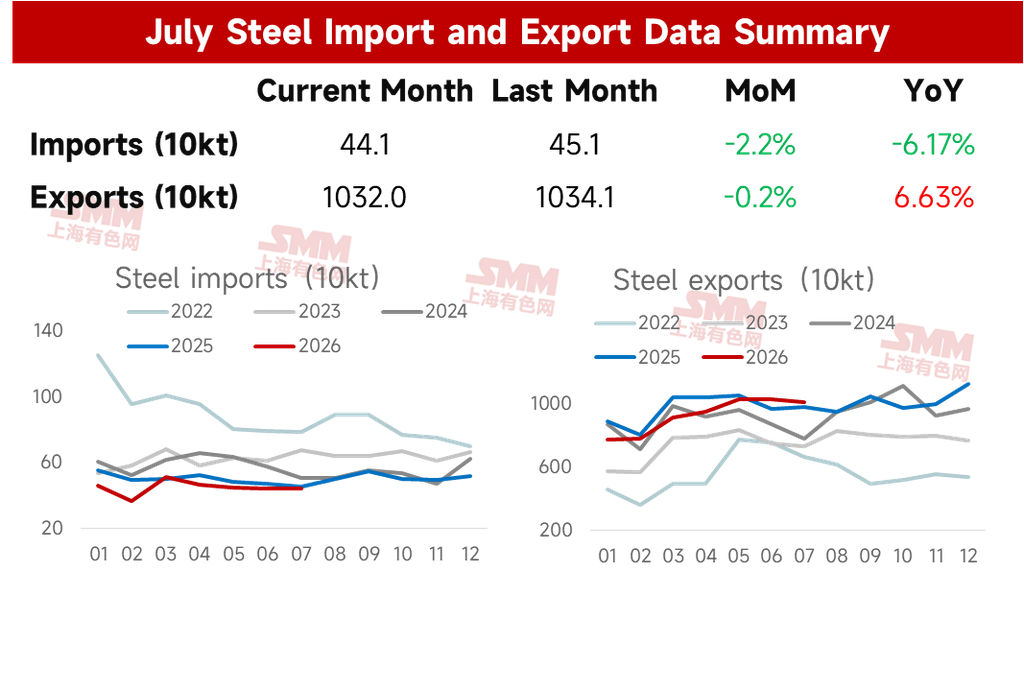
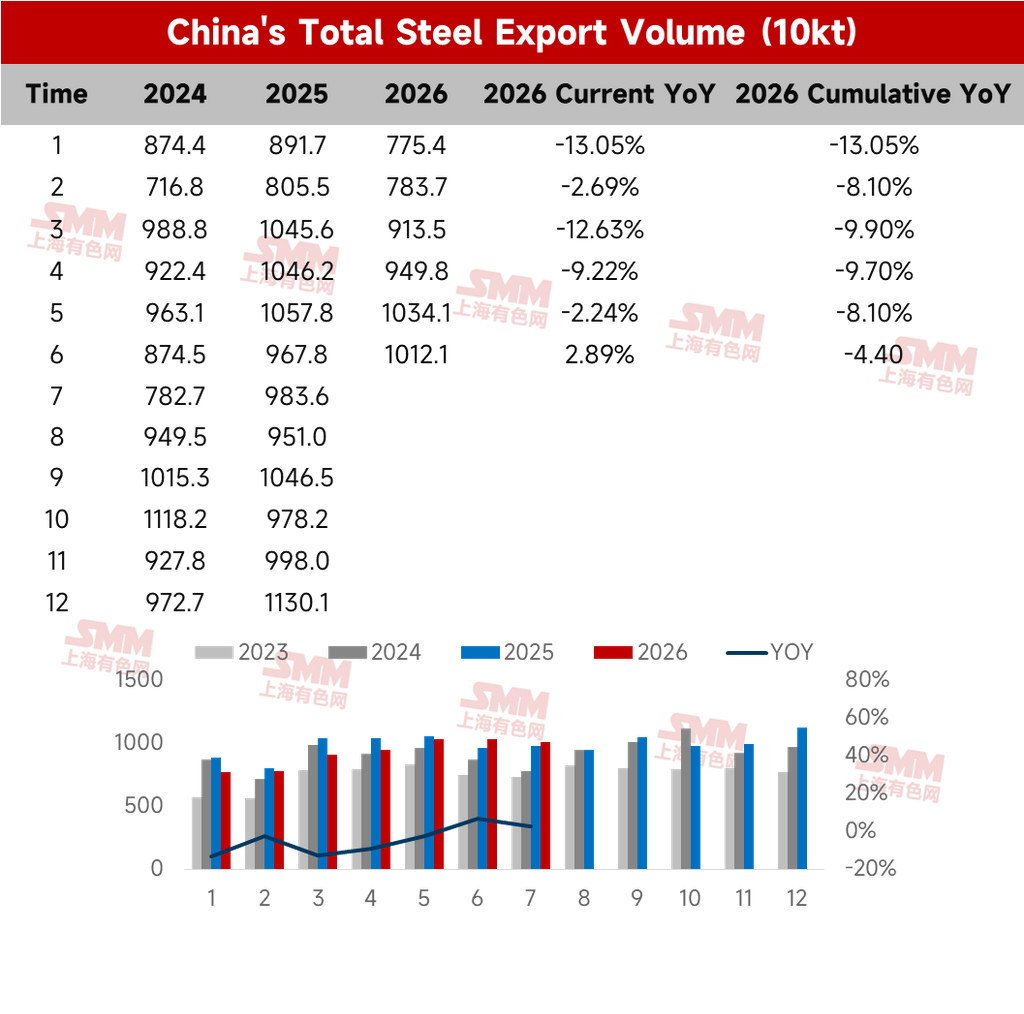
On August 7, data from the General Administration of Customs showed that China exported 10.211 million mt of steel products in July 2026, down 199,000 mt MoM, or 1.9% MoM; cumulative exports from January to July reached 64.995 million mt, down 4.4% YoY.
In July 2026, China imported 445,000 mt of steel products, up 4,000 mt MoM, or 0.8% MoM; cumulative imports from January to July were 3.14 million mt, down 10.1% YoY.
Table 1: Steel Imports and Exports Data Summary, January-July
Source: SMM
• China's steel exports stayed elevated with fluctuations in July
According to SMM's July export schedule survey, the planned HRC export volume for the month was 1.059 million mt, slightly higher than actual exports in June. SMM export order data showed that export orders for steel products declined from a high level in May. At that time, port inspections on MD and other activities were relatively strict, which slowed down the pace of some export orders. However, orders at steel mills improved slightly. Coupled with the fact that cargoes delayed due to earlier inspections were gradually shipped out in July, overall steel exports in July still delivered a relatively decent performance.
Table 2: China's Total Steel Exports
Source: SMM
• July steel imports remained low
On the import side, steel imports in July were 445,000 mt, up 4,000 mt MoM, or 0.8% MoM; cumulative imports from January to July were 3.14 million mt, down 10.1% YoY. Net exports of steel reached 61.855 million mt.
Short-term Steel Export Outlook
1. Global manufacturing slid further MoM; overseas demand remained in off-season mode
According to J.P. Morgan's global PMI data, the Global Manufacturing PMI for July 2026 came in at 52.1. Although it remained in expansion territory, the pace of expansion slowed for the third consecutive month. The preemptive steel stockpiling demand earlier triggered by geopolitical disruptions in Middle Eastern shipping has been fully cleared. Combined with persistently weak demand for consumer goods, property, and infrastructure among end-users in Europe and the US, global commodity and physical steel orders collectively fell into contraction territory. Alongside this, ASEAN manufacturing PMI also declined again. China's Manufacturing New Export Orders Index for July was 49.6%, down 0.5 percentage points MoM, slipping back into contraction territory.
2. Overseas steel mills have proactively controlled production; supply contraction lacks sustainability
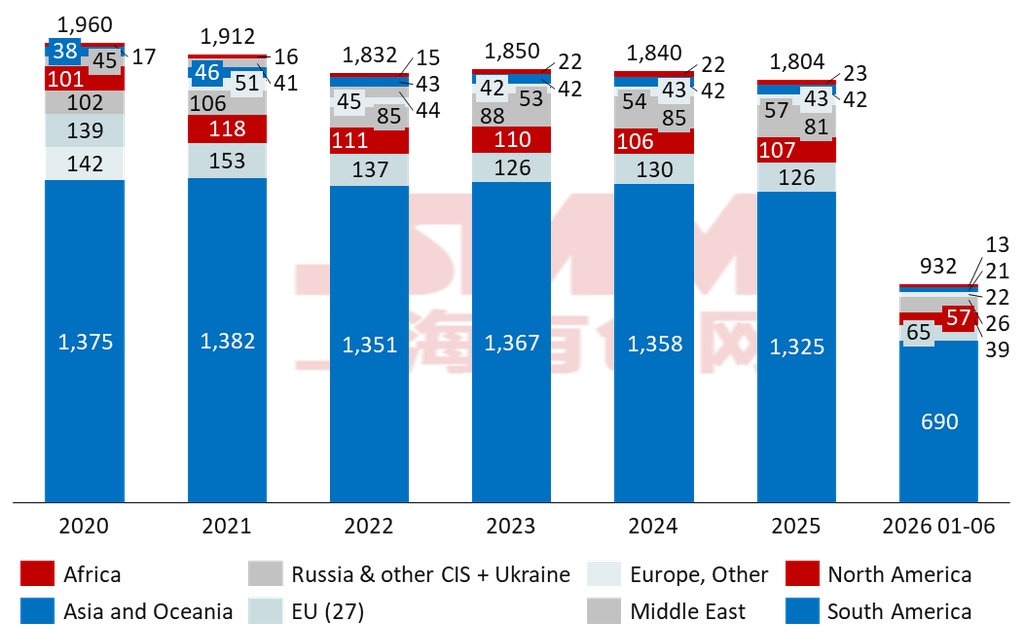
In June 2026, global crude steel production fell 0.3% YoY to 157.9 million mt. In China, as the southern rainy season and high-temperature off-season deepened, downstream steel product construction was significantly hampered. Under heavy pressure from persistently inverted profit margins, steel mills' monthly output edged down 0.8% MoM. Excluding China, production in the rest of the world declined 2.0% MoM, with performance diverging in Asia's core regions. India and Vietnam both saw flat MoM output in June; the former was supported by robust domestic infrastructure resilience, while the latter benefited from earlier concentrated stockpiling and steady operation following new capacity ramp-up. In contrast, Japan and South Korea were dragged by slowing production schedules in downstream automotive and manufacturing sectors, showing a seasonal slight correction. Notably, the Middle East and CIS regions, which had plunged deeply in May, saw marginal recovery. Meanwhile, Europe and the US collectively entered a seasonal weakening trajectory. EU production in June dropped significantly by 5.3% MoM, with Germany tumbling 9.4%; North America declined 5.9% MoM and the US also fell 4.0%. The main reasons for the pullback in Europe and the US were, on one hand, the industry's entry into the routine summer maintenance period, and on the other, the high summer electricity prices and steel scrap prices squeezing electric furnace margins, significantly dampening mills' willingness to operate. The decline in overseas production theoretically offers structural opportunities for China's exports. However, the drops in end markets like Europe and the US were more due to proactive production cuts driven by falling demand. Coupled with India and Vietnam still maintaining high output, China's exports continue to face pressure.
Figure 1: Global Crude Steel Production by Region
Source: SMM
3. Price advantage continued to narrow; export order-taking pressure persisted
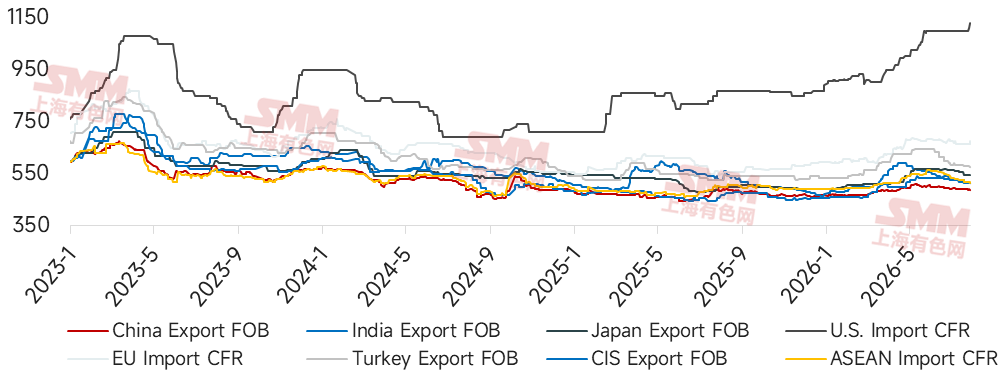
As of July 31, 2026, the HRC export offers (FOB) for India, Turkey, and the CIS stood at $515/mt, $575/mt, and $515/mt, respectively, while China's HRC export offer (FOB) was $486/mt. China's HRC offers were -$29/mt, -$89/mt, and -$29/mt lower than those other countries, respectively. China's steel export price advantage further narrowed MoM from June. Overseas markets remained in the off-season, and low-price promotions remained the main channel for those countries to ease domestic pressures. In contrast, domestic sales pressure was not evident, and prices remained relatively firm. The price spread between Chinese and overseas markets continued to narrow, and pressure on export order-taking persisted.
Figure 2: HRC Offers in Major Global Markets
Source: SMM
4. Export orders rebounded from a bottom in June-July; order-taking improved slightly
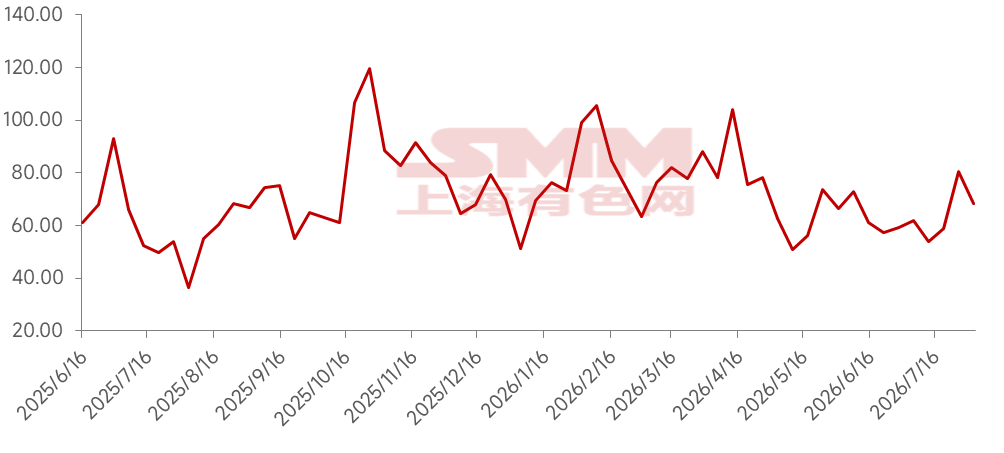
According to SMM's latest steel mill export order schedule, the planned HRC export volume this month was 1.023 million mt, down 2.8% MoM from the actual level last month. SMM steel export order data showed that although overseas markets remained in the off-season, recent restrictions on resource exports from the Middle East (especially Iran) created a notable supply gap in semi-finished products in overseas markets, particularly in Southeast Asia. This shortfall was quickly filled by Chinese resources. On the other hand, traders took profits from spot-futures price spread operations in late July, offering lower actual prices to facilitate transactions, which led to a bottoming rebound in export order data in July. In reality, overseas demand had not yet emerged from the off-season, and a steady recovery in export order-taking still faces pressure.
Figure 3: SMM Steel Export Order Volume
Source: SMM
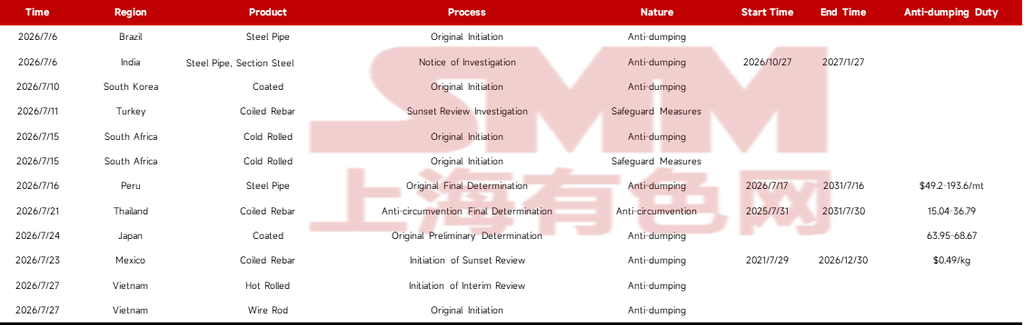
5. Anti-dumping cases related to steel increased in July
In July, the number of new anti-dumping cases related to steel initiated against China increased, covering products such as steel pipes, coated steel, sections, coiled rebar, wire rod, and hot-rolled coils. Details of specific cases and affected volumes are shown in the table below:
Table 3: New Anti-Dumping Cases in July
Source: SMM
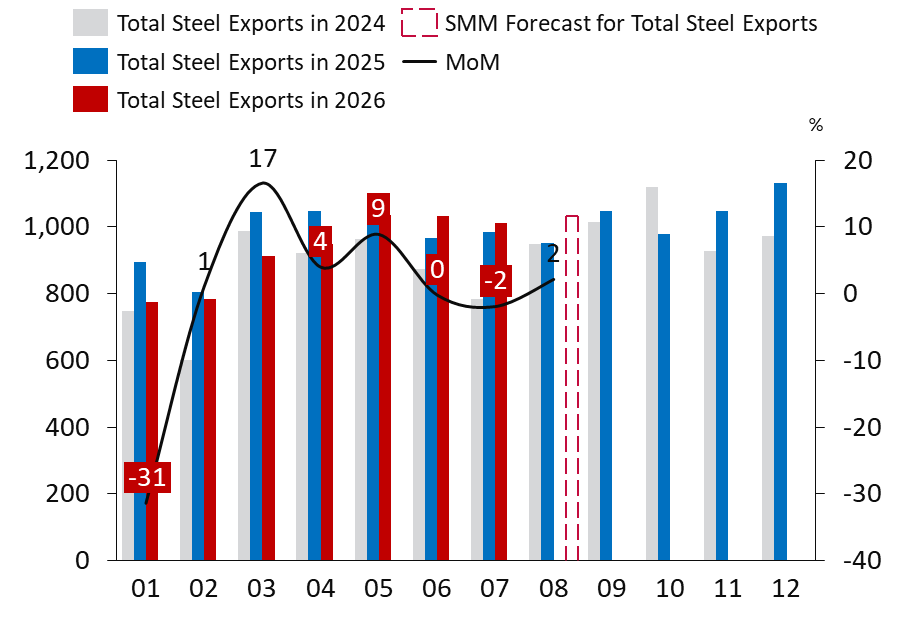
Taking all factors into account, lower actual transaction prices stimulated some volume growth, with semi-finished products accounting for a larger share. Given that July export numbers have already been significantly elevated, SMM expects that total steel exports in August will not sustain a strong unilateral upward trend. Instead, they will move sideways in a high range, while semi-finished product exports will remain relatively high.
Figure 4: Steel Exports and Forecast, 2024-2026
Source: SMM
Data Source Statement: Except for publicly available information, other data are processed by SMM based on public information, market communication, and SMM's internal database models. They are for reference only and do not constitute decision-making advice.
Note: This article is an original work of this official account. For requests related to reprinting, whitelisting, cooperation, etc., please contact us. Without permission, no part may be reproduced, modified, used, sold, transferred, displayed, translated, compiled, disseminated, or otherwise disclosed to any third party, nor may any third party be authorized to use it. Otherwise, once discovered, SMM will pursue legal action for infringement, including but not limited to holding the infringing party liable for breach of contract, restitution of unjust enrichment, and compensation for direct and indirect economic losses.
Scan the QR code for free access to information
Scan to join the group
Scan to add WeChat for consultation
![[SMM Sheets & Plates Daily Review] Focus on Pre-Holiday Restocking Next Week](https://imgqn.smm.cn/usercenter/tgoYV20251217171715.jpg)
![[Domestic Iron Ore Concentrates Briefing] China's iron ore concentrates prices are likely to consolidate on a subdued note](https://imgqn.smm.cn/usercenter/gmcdk20251217171720.jpg)
![[Total Electricity Consumption in August Exceeds 1 Trillion kWh Again]](https://imgqn.smm.cn/usercenter/NtHAJ20251217171719.jpg)