
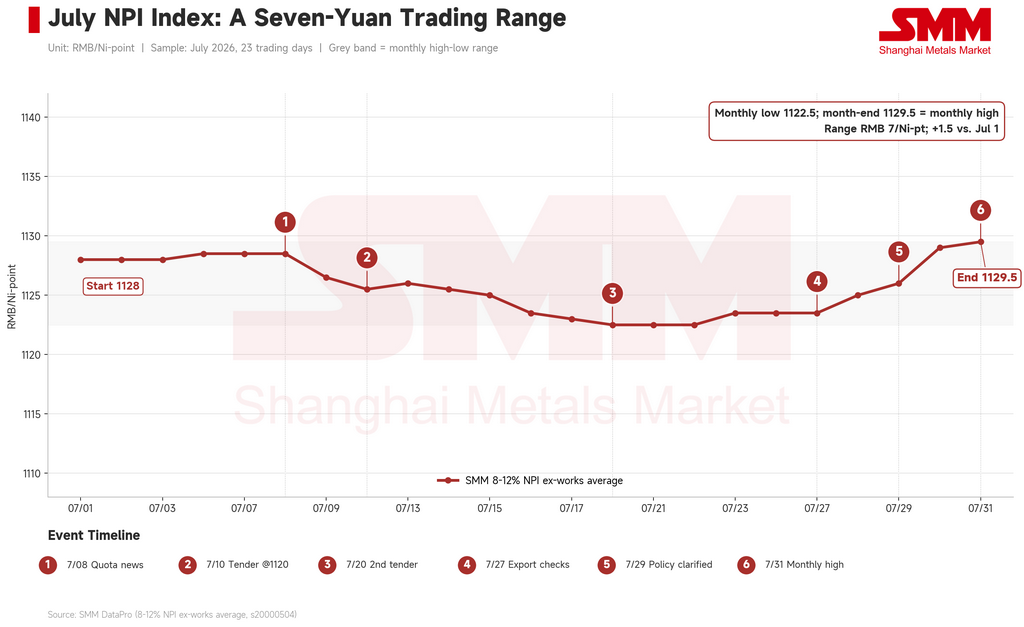
In the final week of July, China's nickel pig iron (NPI) market repriced twice within a handful of trading days. News that Indonesia had added export-inspection requirements for strategic minerals held up cargoes at port and pushed offers and premiums higher; two sessions later sentiment flipped back, with buyer counterbids returning to around RMB 1,115 per nickel point. Then, in the last two sessions of the month, Jakarta clarified its export rules and forward-looking bullishness took over: the index closed July 31 at RMB 1,129.5/Ni-pt (≈$166), its monthly high.
That whipsaw was July in miniature. Within one month, some buyers worked backwards from refined nickel prices to argue NPI was "worth" closer to RMB 1,000/Ni-pt, while sellers at one point offered as high as RMB 1,200. Yet the SMM 8–12% NPI ex-works average moved from just RMB 1,128 to RMB 1,129.5 over the entire month — up RMB 1.5, with a monthly low of RMB 1,122.5 and a total range of about RMB 7.
That was July's defining feature: a nearly motionless index sitting on top of widening disagreement and rapidly changing trading terms.
(A note on units: Chinese NPI is priced in RMB per nickel point — per 1% of nickel content per tonne — on a VAT-inclusive domestic basis. These prices are not directly comparable to FOB USD quotes.)
A flat price, built from a standoff
Frequent inquiries, aggressive counterbids and a flat index look contradictory. Set against China's summer demand lull and Indonesia's policy-adjustment cycle, they are not: the price was stable not because the market agreed, but because neither side had the leverage to break it.
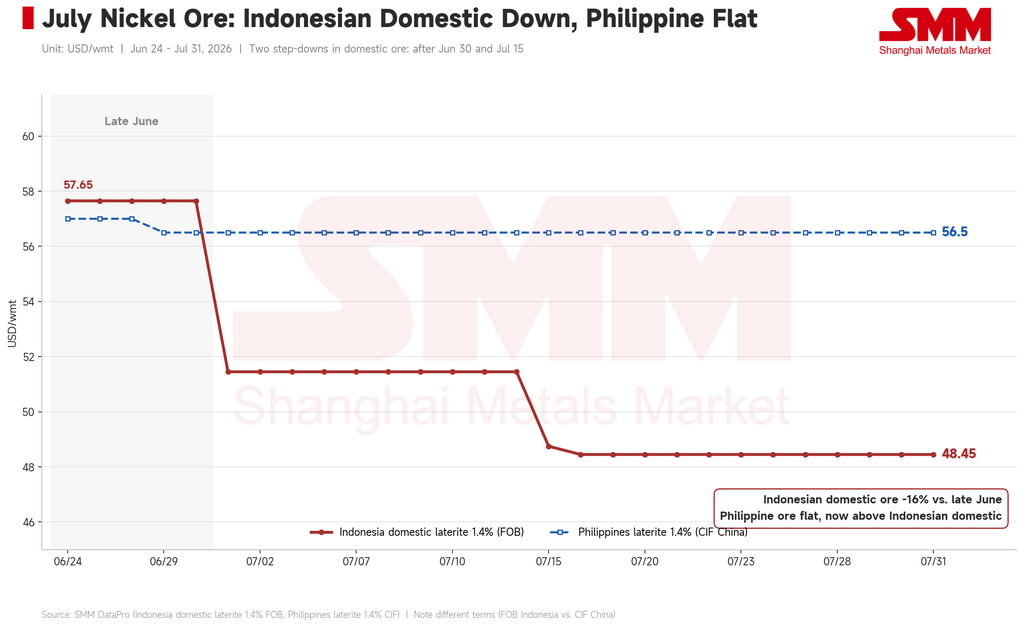
Three floors held prices up. First, production costs. Indonesian domestic laterite ore fell from $51.45 to $48.45/wmt during July — down roughly 16% from its late-June high — but remains historically elevated, and some Indonesian smelters say RMB 1,120/Ni-pt is already below their June production cost. Second, ore quotas: Indonesia cut its 2026 RKAB mining quota to roughly 270 million wet tonnes from 379 million in 2025, and one of the world's largest single nickel mining projects exhausted its allocation in May. A mid-year supplementary-quota window opened in July, but approvals take time to become ore. Third, spot scarcity: major suppliers have pre-sold domestic material into September and Indonesian material into August. Every lowball bid ran into the same question — at that price, where is the deliverable tonnage?
One ceiling held prices down. China's Q2 GDP grew 4.3% year on year, the weakest since late 2022; stainless steel is in its seasonal trough, and 300-series production schedules were cut sharply in July, shrinking mills' NPI requirements.
The much-quoted RMB 1,120/Ni-pt is simply the tender price at which one leading mill bought. The index never traded below RMB 1,122.5 all month, retail deals mid-month still printed near RMB 1,155, and quotes and transactions clustered between RMB 1,120 and 1,160.
Three phases: probe lower, set a floor reference, policy shock
Early July belonged to the bears. Talk of supplementary Indonesian quotas surfaced around July 8, ore prices slipped and Shanghai nickel weakened; by July 9 some mills had cut bids to RMB 1,090, and buyers working from a refined nickel price near RMB 125,000/mt (≈$18,400) argued fair value was close to RMB 1,000. It stayed theoretical: leading traders reported no willing sellers below RMB 1,100. Falling ore moves expectations; near-term spot prices are still rationed by available tonnage.
Mid-month, a leading mill's tender set the low-side reference: 40,000 tonnes of ~11% material at RMB 1,120 on July 10. Other mills' inquiries then clustered at RMB 1,120–1,140, sellers held offers above RMB 1,150, and retail business still printed around RMB 1,155. The tender defined the bottom of the negotiating range — not the market's center of gravity. Stainless scrap prices were cut twice in a week, about RMB 200/mt (≈$29) each time, stiffening buyers' resolve.
Late July was policy-driven. Around July 27, some Indonesian NPI cargoes ran into new pre-export testing for strategic minerals — 17 rare earth elements plus uranium and thorium — with customs clearance expected to lengthen by roughly five days. Sellers withheld material and offers briefly reached RMB 1,145–1,160. On July 29, after sentiment had already turned and counterbids slipped back to RMB 1,115, Indonesian authorities clarified that existing rules ban only pure rare-earth products (HS 28053000); processed mineral products may keep exporting while implementing standards are drafted.
In the last two sessions, forward trade picked up sharply — traders pushed late-August and September delivery cargoes — and the index rose to RMB 1,129 and then RMB 1,129.5, the monthly high. Spot transactions stayed thin: the month-end high was built on forward sentiment and shipping friction, not improved physical buying.
Stainless steel: deliberate cuts on a 2% margin
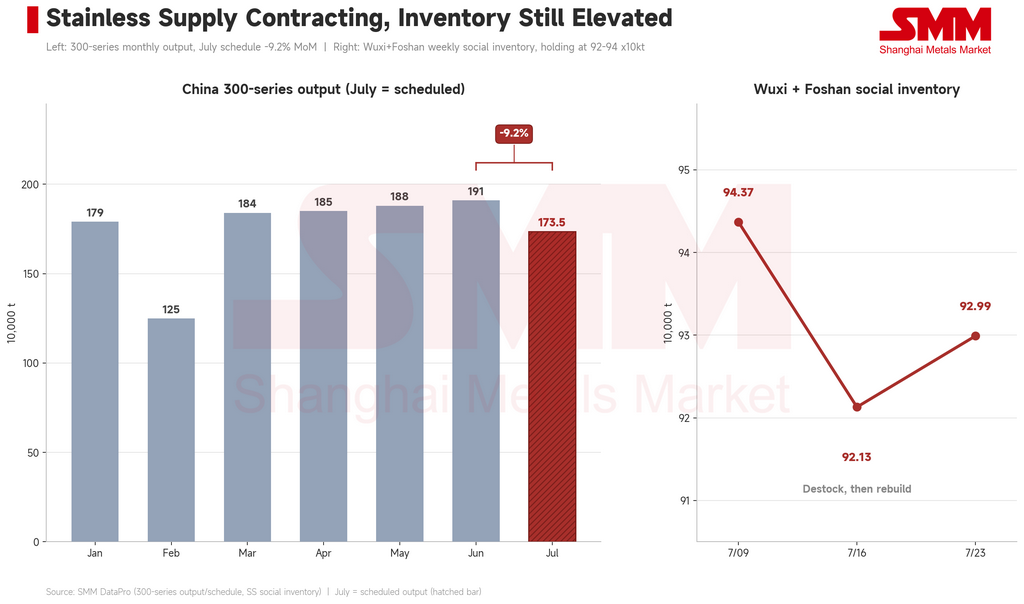
Mills could hold the RMB 1,120 line because of their own fundamentals. China's 300-series stainless output was 1.91 million tonnes in June; July schedules dropped to 1.735 million tonnes, down about 9% month on month. At roughly 8% nickel content, that alone removes more than 10,000 tonnes of monthly nickel demand. Some leading mills report raw-material inventories sufficient to run into October — giving them every reason to wait.
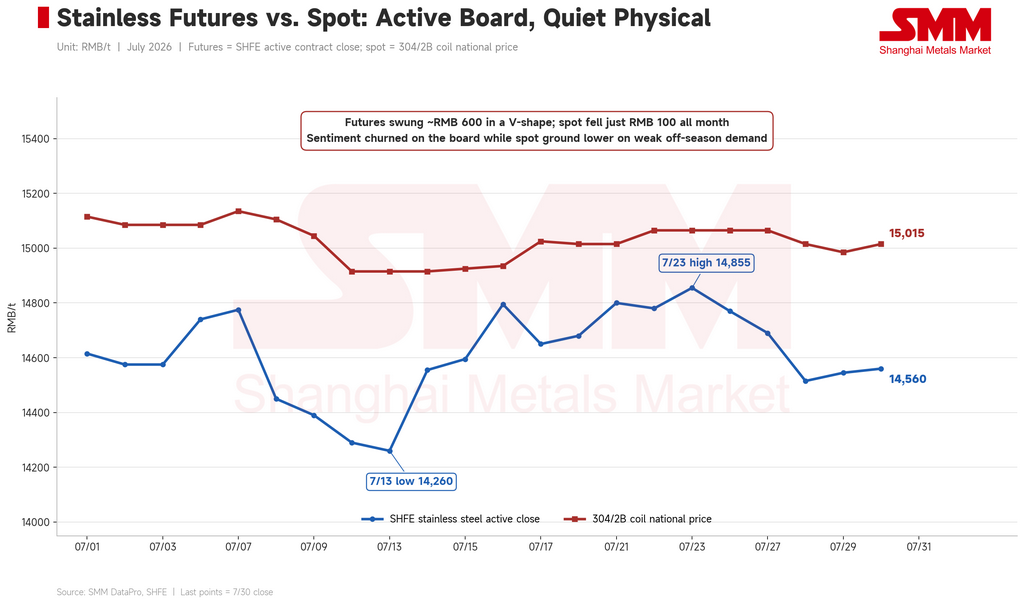
Prices told the same story. National 304/2B coil slipped from RMB 15,115/mt (≈$2,226) at the start of July to a low of RMB 14,915 (≈$2,197) before ending at RMB 15,015 (≈$2,211); a benchmark mill's cold-rolled list price in Wuxi — a major stainless trading hub in eastern China — was cut RMB 300 to RMB 14,700 (≈$2,165). Futures swung harder, from RMB 14,615 down to 14,260 and back up to 14,855 before closing the month near RMB 14,560, with no sustained trend in either market.
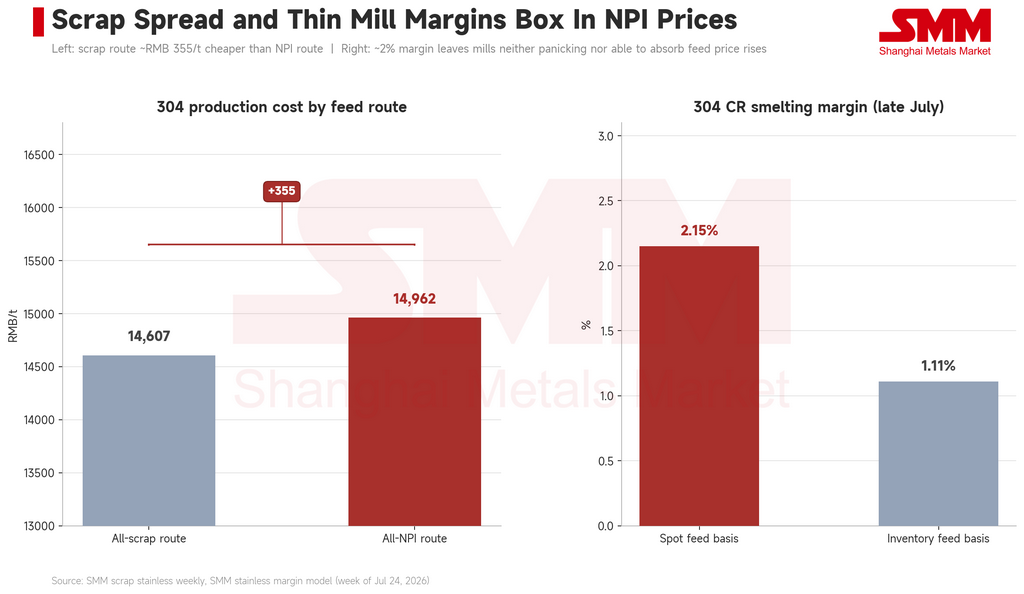
Inventories stayed heavy: combined social stocks in Wuxi and Foshan — China's two main stainless distribution hubs — touched 943,700 tonnes early in the month, fell to 921,300 tonnes on typhoon-delayed arrivals and a futures bounce, then rebuilt to 929,900 tonnes by July 23. Margins were the binding constraint: SMM's 304 cold-rolled smelting margin ran about 2.15% on spot-priced feedstock and 1.11% on inventory costing. A 2% margin means mills are neither desperate enough to slash output nor able to absorb dearer feedstock. And scrap kept them honest: an all-scrap production route costs about RMB 14,607/mt versus RMB 14,962 for an all-NPI route — a RMB 355/mt (≈$52) gap that lets mills rebalance feed mix whenever NPI tries to rally, with one leading mill buying around 150,000 tonnes of stainless scrap per month.
Trade flows: feed imports shrink, steel exports surge
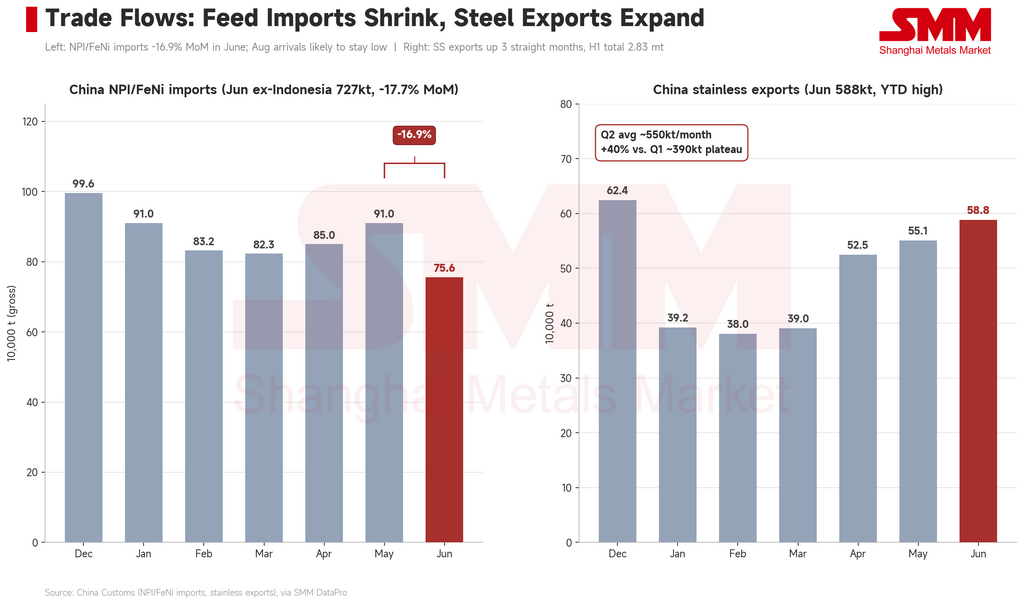
Customs data show China imported 756,000 tonnes of NPI/ferronickel in June, down 16.9% month on month, with Indonesian supply down 17.7% to 727,000 tonnes. Market feedback suggests part of the drop reflects Indonesian high-grade producers deliberately slowing shipments while running at full rates — holding stock for better prices — rather than weaker Chinese demand alone. With late-July inspection friction on top, August arrivals are likely to stay low. The "scarce spot" the market has been feeling is visible in the import data.
Exports ran the other way. China shipped 588,300 tonnes of stainless steel in June, a year-to-date high; Q2 averaged about 550,000 tonnes a month, roughly 40% above Q1's plateau, taking first-half exports to 2.83 million tonnes. Exports are a key reason 300-series output has not fallen further. The offset is fragile on both ends: Indian buyers have bid Indonesian NPI as low as ~$135/Ni-pt against an FOB index of $145.9 (July 30), and stainless exports face a crowded second-half trade-policy calendar.
Price discovery has moved to premiums and delivery windows
The more important July development was the near-disappearance of fixed-price deals. Trade shifted overwhelmingly to futures-average-plus-premium structures; by July 29 premiums on 11% material had narrowed to RMB 8–10/Ni-pt, and September-delivery negotiations were already under way, with some leading mills booking at average-plus-RMB 8.
The cause is simple: freely tradable spot ran short. Sellers repeatedly reported being sold out, and remaining bulk tonnage sat with a handful of holders. Fixed-price quoting requires known tonnage and known costs; lacking both, sellers switched to index-linked pricing to manage risk. The implication for anyone reading this market: the month-end print of RMB 1,129.5 is closer to a nominal reference than a traded price. The real supply-demand signal now lives in premiums, grade spreads and delivery windows.
High-grade premiums compressed — because mills have options
High-grade NPI premiums narrowed steadily. Early in July, 14%+ material was still offered above RMB 1,200 and roughly 5,000 tonnes of 13.5–14% material traded at RMB 1,185 on July 6; by July 23 expected premiums for 12% material had fallen to RMB 20–25/Ni-pt, and 11% material to around RMB 10.
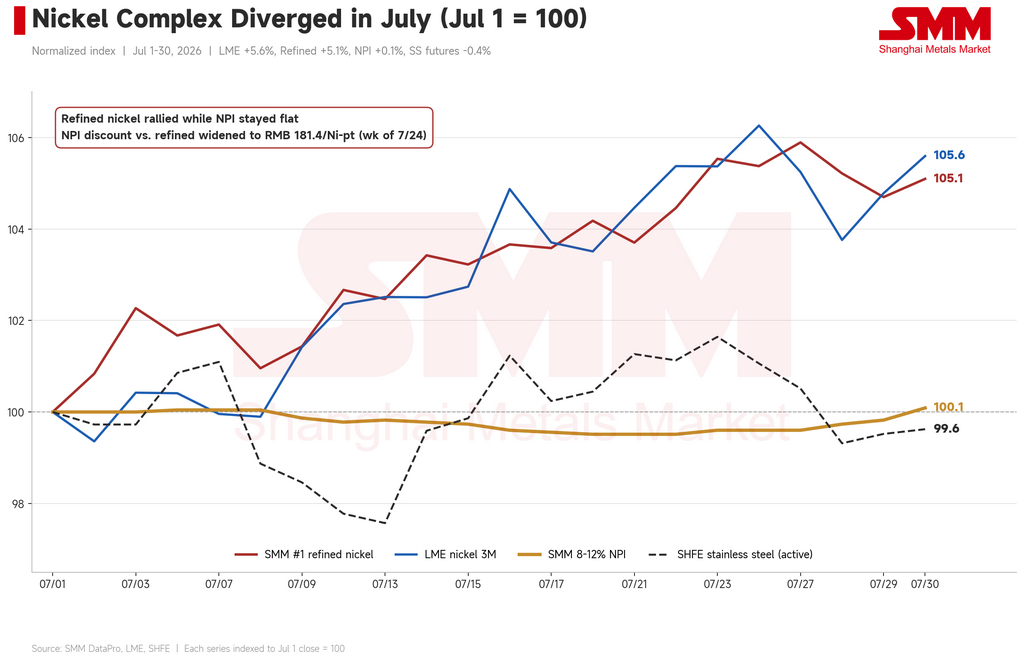
At first glance this clashes with the refined-nickel move: LME nickel rallied from $16,250 (July 2) to $17,379/mt (July 24) while NPI stood still, widening NPI's discount to refined nickel to RMB 181.4/Ni-pt — improving NPI's relative value overall. But the high-grade premium prices the marginal nickel unit, not NPI as a whole. Mills can base-load with mid-grade NPI and top up nickel units with cathode, granulated nickel or scrap; the more channels available, the less reason to pay up for 14% material. The compression reflects feed-mix flexibility more than any single month's refined nickel move — a stricter attribution would require a burdening-cost model.
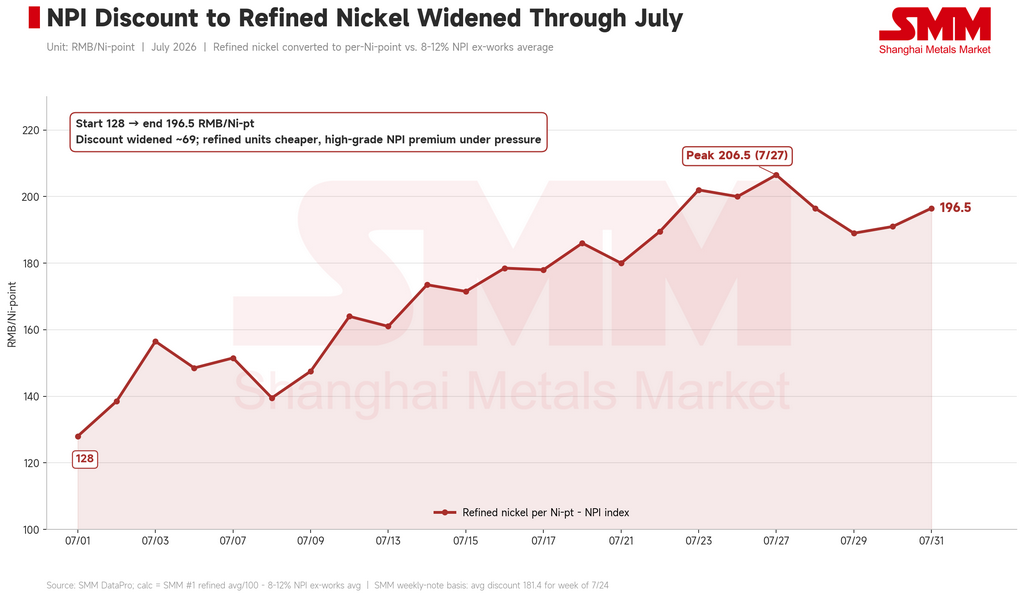
Some market participants back-calculating from LME put fair NPI value at $130–135/Ni-pt, against Indonesian high-grade tender targets of $153–155. Facing thinner Chinese premiums, some Indonesian suppliers have postponed tenders or plan to relaunch around September, and with Indian buyers accepting $150+, more high-grade tonnage may flow away from China.
Indonesia: shipping rhythm now set by regulators, not just mine costs
July delivered two opposing Indonesian policy signals. The supplementary RKAB window (July 1–31) prioritizes compliant miners with integrated domestic smelting; it hit the market as bearish news on July 8, but approval-to-ore lead times of about a month cap its third-quarter impact. The export-testing episode ran the other way: rare-earth, uranium and thorium checks spread from alumina to NPI on the back of local customs enforcement cases, before the July 29 clarification allowed processed products to keep moving — with thresholds and testing standards still to be written.
Both point to the same conclusion: marginal Indonesian nickel supply is increasingly set by approvals, quotas and customs execution rather than mine-site economics. Late July demonstrated the asymmetry — a procedural change moved spot expectations faster than a 16% ore-price decline moved costs.
Outlook: same range, watch the paperwork
Quotes and transactions are likely to stay within RMB 1,100–1,160/Ni-pt near term. Major buyers expect August to run at RMB 1,100–1,120; some leading mills see RMB 1,100–1,130, with RMB 1,150 possible on better demand.
Four variables could break the range. First, supplementary-quota approvals: a smaller-than-expected award supports ore prices and hardens the cost floor, while generous case-by-case awards — plus restarts and idled-line switchbacks — would test RMB 1,100. Second, whether export testing becomes a permanent process; the month-end index rise already prices in some of that risk. Third, whether September's seasonal restock materializes — forward premiums have pre-paid part of it, and the trade calendar looms: the EU's sunset-review deadline for anti-dumping duties on Indonesian cold-rolled falls on August 19; India's anti-dumping investigation into 300- and 400-series cold-rolled completed exporter sampling in June, with preliminary findings possible in Q3; India's blanket QCO certification suspension covers cargoes shipped before October 26, while the flat-product exemption has separately been extended to March 31, 2027. Fourth, the macro backdrop: with GDP at 4.3%, any rally needs policy and end-demand to cooperate.
The key judgment from July fits in one sentence: the index went nowhere, but price discovery has moved — from fixed prices to premiums, grade spreads and delivery windows. RMB 1,120 was only the largest buyer's tender bid. The question for August is what that buyer pays when it returns to the market, and where the price gets discovered when it does.
Written by Bruce Chew
Nickel & Stainless Steel Analyst, Shanghai Metals Market
Email: bruce.chew@metal.com
Tel: +601167087088
![[NPI Daily Review] Steel Scrap Prices Continue to Fall Amid Weak Demand, Reinforcing Expectations of a Bottom in the NPI Market](https://imgqn.smm.cn/usercenter/PFIti20251217171734.jpg)