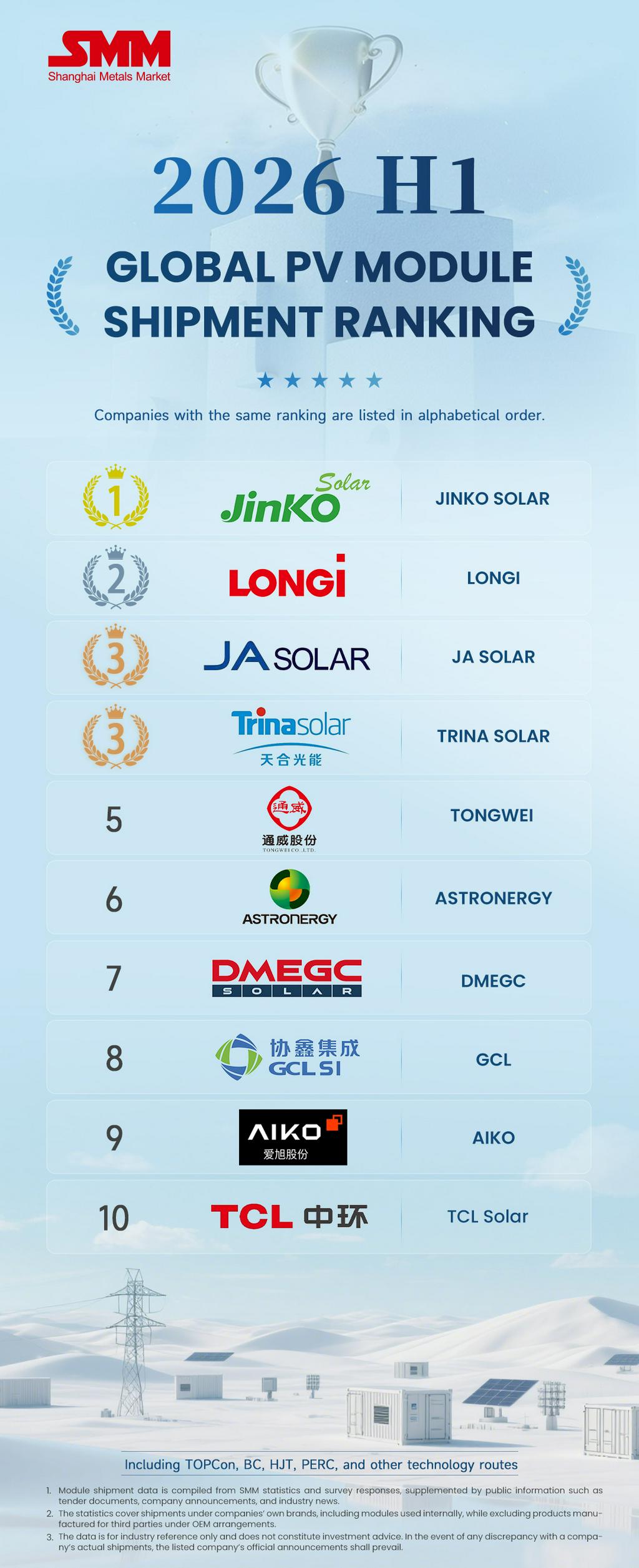
SMM has released its global PV module shipment rankings for the first half of 2026. Total shipments reached approximately 260 GW, representing a modest year-on-year increase of 4.88%. Ex-China markets provided the industry’s main source of demand support, while China entered a cyclical adjustment phase.
Market leaders reinforce their positions as second-tier competition intensifies
Compared with the full-year 2025 rankings, the leading group remained highly stable, with top-tier manufacturers continuing to strengthen their scale, cost, and channel advantages. Competition among second-tier suppliers intensified. Emerging module manufacturers achieved notable shipment growth by building localized Ex-China production capacity and rapidly scaling up new technologies. Technology upgrades which including the transition to N-type products and the commercialization of BC modules, as well as vertical integration have become the two central forces reshaping the competitive landscape.
Ex-China markets drive shipment growth
In Europe, channel inventories continued to decline, while premiums for high-power N-type and BC modules remained stable. Utility-scale PV projects also progressed steadily. India further tightened its domestic manufacturing and localization requirements, accelerating the replacement of imported modules with local supply. As a result, the country’s import demand declined temporarily. Underlying demand continued to emerge across the Middle East and Africa. Residential and commercial and industrial module demand expanded steadily in these emerging markets.
China enters a cyclical adjustment phase
In China, utility-scale projects led by central and local state-owned enterprises were affected by adjustments to the power-pricing mechanism and grid-integration constraints. Project starts and grid connections slowed significantly, while many previously awarded projects were postponed. China added 72.07 GW of new PV capacity in the first half of 2026, down 66.04% year on year. China’s new mandatory energy-efficiency standard for crystalline-silicon PV modules and inverters was released at the end of June and will take effect on January 1, 2027. Its implementation is expected to accelerate the retirement of outdated, low-efficiency capacity while steering N-type capacity toward higher-efficiency TOPCon and BC technologies.
Outlook
Releasing Ex-China demand and an anticipated acceleration in Chinese utility-scale project construction are expected to provide dual support in the second half. Chinese module manufacturers are likely to increase both production schedules and shipments on a sequential basis. As implementation of the new energy-efficiency standard approaches, the industry will enter a period of capacity and product-mix optimization. The clearance of outdated capacity and further market consolidation should help ease cutthroat competition among largely undifferentiated products. Combined with a recovery in end-market demand, these developments are expected to improve operating conditions and allow module manufacturers’ losses to narrow in stages.
SMM 2026H1 PV Module Shipment Ranking


![[SMM PV News] New Breakthrough in Perovskite–Organic Tandem Solar Cell Research](https://imgqn.smm.cn/usercenter/rwvLy20251217171739.jpg)
![[SMM PV News] Yunnan Wenshan: Launches Selection of 290 MW Wind and Solar Projects](https://imgqn.smm.cn/usercenter/PkttC20251217171742.jpg)