[SMM Analysis] Korea’s Battery Downstream Market: Diverging Trends Between NEV Recovery and Weak Cell Production

Published: Jul 31, 2026 19:48
In H1 2026, South Korea’s NEV sales and exports posted double-digit growth, while domestic battery output declined. BEV sales rebounded from a low base, but export growth was led by hybrids, limiting the impact on large-format battery and NCM demand. NCM cell output continued to fall, while LFP capacity expanded. LFP-based ESS is emerging as a new growth driver, but remains too small to offset the NCM decline.

The NEV Market Recovered, but Domestic Sales and Exports Were Driven by Different Segments
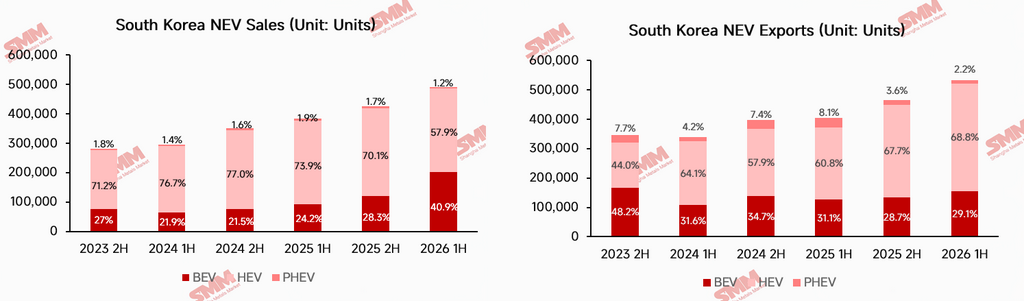
South Korea’s domestic NEV sales reached approximately 491,000 units in the first half of 2026, up around 28% year on year. NEV exports rose by approximately 32% to about 533,000 units over the same period, indicating a clear recovery in both domestic and overseas markets.

However, the composition of growth differed significantly. In the domestic market, BEV sales more than doubled year on year to approximately 201,000 units, driving most of the overall increase. A substantial portion of this growth reflected the low base created by weak sales in early 2025. Nevertheless, monthly sales remained relatively strong through the latter part of the first half, suggesting that demand also underwent a degree of normalization.

HEVs still accounted for the largest share of the domestic market. Sales remained broadly flat year on year at approximately 284,000 units, but represented about 58% of total NEV sales. This indicates that HEVs continue to provide the main demand base for Korea’s electrified vehicle market, as consumer concerns over EV pricing, charging convenience, battery safety and residual values have not been fully resolved.

The export market showed an even stronger HEV bias. HEV exports increased by approximately 49% year on year to around 367,000 units, accounting for nearly 69% of total NEV exports. BEV exports also increased, but at a more moderate rate of approximately 23%. Consequently, most of the growth in Korea’s NEV exports during the first half came from HEVs.

This composition means that growth in NEV sales and exports should not be interpreted as an equivalent recovery in battery demand. HEVs carry substantially smaller battery packs than BEVs, meaning that vehicle sales growth does not translate into the same rate of growth in cell and cathode-material consumption.


Domestic Cell Production Declined Despite Higher Vehicle Sales
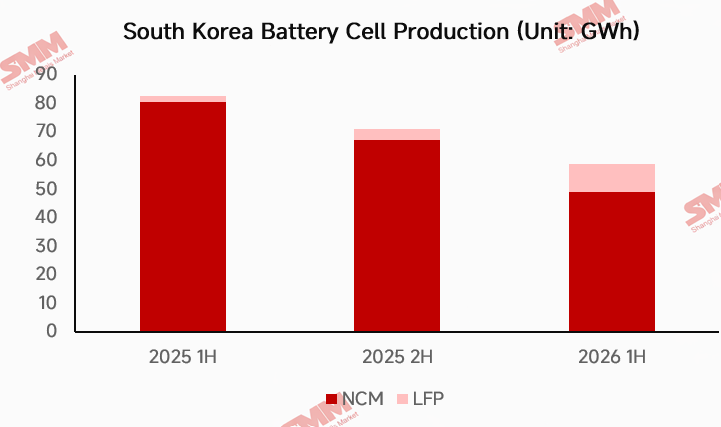
In contrast to the increase in NEV sales and exports, combined domestic NCM and LFP battery production by major Korean manufacturers was estimated at approximately 59 GWh in the first half of 2026, down around 29% year on year.

NCM battery production declined by approximately 39%. Given that Korea’s domestic battery production base remains heavily concentrated in ternary batteries for EV applications, the decline indicates that demand for premium and mid-to-large BEVs, as well as order recovery from major customers, remained insufficient.

The divergence between vehicle sales and battery production reflects both the composition of demand and the continued localization of overseas production. Although BEV sales recovered in the domestic market, export growth was led primarily by HEVs. At the same time, Korean battery and automotive manufacturers have expanded production in North America and Europe, weakening the direct link between overseas vehicle sales and cell production in Korea.

Accordingly, vehicle sales volumes and export values alone are becoming less effective indicators of Korean battery-material demand. Analysis increasingly needs to incorporate battery capacity per vehicle, the share of Korea-produced cells in vehicle supply, production allocation among overseas plants and utilization rates at domestic cell facilities.


LFP-Based ESS Is Emerging as a New Growth Pillar

While overall battery production declined, LFP output expanded rapidly. LFP battery production by major Korean manufacturers was estimated at approximately 10 GWh in the first half of 2026, more than four times the level recorded a year earlier. As a result, LFP’s share of combined NCM and LFP production increased from approximately 3% in the first half of 2025 to around 17% in the first half of 2026.

This does not mean that the Korean battery industry is shifting its core technology platform from NCM to LFP. NCM remains central to premium and mid-to-large EV applications, where energy density and driving range continue to be key requirements. LFP, by contrast, is expanding mainly through ESS applications, where cost competitiveness, safety and cycle life carry greater importance.

In the domestic market, the centralized ESS procurement market and longer-term deployment policies are creating initial demand. Korean battery manufacturers are also expanding their ESS businesses through North American projects and localized supply chains. Rather than competing solely on cell prices with Chinese suppliers, they are seeking to differentiate themselves through local production, system safety, fire-prevention technologies and long-term operating reliability in non-Chinese markets.

However, the expansion of LFP production remains insufficient to offset the decline in total battery output. LFP production increased by roughly 8 GWh year on year in the first half, while NCM production fell by approximately 31 GWh. Although ESS is beginning to establish itself as a meaningful new demand channel, the contraction in traditional NCM demand remains significantly larger.


Outlook

The first half of 2026 showed that structural changes in downstream demand were more significant than the headline recovery in vehicle sales. Domestic BEV sales rebounded from a low base, but HEVs continued to represent the largest portion of the market. In exports, HEVs accounted for most of the overall growth. As a result, stronger automotive indicators did not lead to a broad recovery in domestic NCM battery and material demand.

Meanwhile, LFP-based ESS is emerging as a new growth channel, supported by domestic policy demand and overseas projects. The strength of Korea’s battery-market recovery will therefore depend less on headline NEV sales growth and more on whether the BEV share continues to expand and whether rising LFP production for ESS applications can gradually offset the decline in the existing NCM production base.
Data Source Statement: Except for publicly available information, all other data are processed by SMM based on publicly available information, market communication, and relying on SMM's internal database model. They are for reference only and do not constitute decision-making recommendations.

For any inquiries or for more information, please contact: lemonzhao@smm.cn
For more information on how to access our research reports, please contact:service.en@smm.cn
Related News
[AfDB €100M Loan Backs Gotion's Morocco Battery Plant]
6 mins ago
[AfDB €100M Loan Backs Gotion's Morocco Battery Plant]
Read More
[AfDB €100M Loan Backs Gotion's Morocco Battery Plant]
[AfDB €100M Loan Backs Gotion's Morocco Battery Plant]
The African Development Bank Group (AfDB) has officially approved a €100 million (approximately $114 million) loan to Gotion Power Morocco, a subsidiary of Gotion High‑Tech, for the construction of the first lithium iron phosphate (LFP) battery gigafactory in Africa and the MENA region. As the lead arranger under the “New Architecture for Financing Africa's Development” (NAFAD) initiative, the AfDB also plans to raise up to an additional €141 million from partner financial institutions to ensure sufficient project funding. The project is located in Phase III of the Kenitra Atlantic Free Zone, in the Rabat‑Salé‑Kenitra region of Morocco, and covers the full industrial chain from cathode material production, cell manufacturing, to battery pack assembly. Phase I is planned with an annual capacity of 10 GWh for EV battery cells and packs; with subsequent phased expansions, the total capacity is expected to gradually reach 100 GWh in the long term. Phase I is projected to directly create more than 600 high‑skilled jobs and raise Morocco's local industrial integration rate to 70%, significantly boosting the local supplier ecosystem and technical workforce development. AfDB Vice President Kevin Kariuki noted that battery energy storage is the “missing piece” in Africa's clean energy transition. The plant will primarily operate on renewable energy (wind and solar power), which will not only support large‑scale grid integration of new energy but also provide low‑carbon and reliable energy storage solutions. Leveraging Morocco's abundant phosphate resources and China's advanced battery refining and manufacturing technologies, the project will accelerate the local high‑value‑added conversion of critical minerals, shifting away from the traditional export of raw materials. It will help Morocco establish itself as a green mobility industrial hub serving both Europe and the entire African continent. This investment is highly aligned with the AfDB's four strategic pillars: resilient infrastructure development, accelerated industrialization, regional integration, and value addition to natural resources. It marks a milestone in the improvement of Africa's new energy industrial chain.
6 mins ago
[Zijin Mining's First Lithium Concentrate Shipment from DRC  Body]
19 mins ago
[Zijin Mining's First Lithium Concentrate Shipment from DRC Body]
Read More
[Zijin Mining's First Lithium Concentrate Shipment from DRC  Body]
[Zijin Mining's First Lithium Concentrate Shipment from DRC Body]
On July 22, 2026, the first batch of spodumene concentrate produced by Manono Lithium – a company 54.9% owned by Zijin Mining – was shipped from Mutowa Port in Tanganyika Province, Democratic Republic of the Congo (DRC), bound for international markets via Kigoma, Tanzania. Prior to shipment, the cargo was inspected and certified by the DRC's Centre d'Expertise, d'Évaluation et de Certification des Substances Minérales (CEEC), which stated that this transport marks the country's first-ever export of lithium products. The Governor of Tanganyika Province supervised the loading and noted that the shipment represents a key milestone for the province's integration into the regional mining trade network. He also called on the operating company to prioritize local hiring, so that the development of the mineral supply chain can generate more jobs and broader economic benefits for local residents. However, the commercial significance of the shipment remains difficult to assess, as the export volume, concentrate grade, transaction value, buyer identity, and final destination after arrival in Kigoma have not been disclosed. Future export plans have also not been announced.Manono Lithium operates the northeastern part of the Manono deposit under mining permit PE 15775. Its shareholding structure is: Zijin Mining affiliates hold 54.9%, DRC state-owned mining company Cominière holds 35.1%, and the DRC government holds 10%. The project is designed to process 5 million tonnes of ore annually, with a target output of approximately 1 million tonnes of spodumene concentrate per year. Subsequent crushing, flotation, and lithium compound processing facilities will be built in phases, and the first-stage lithium sulphate raw material production project is expected to be completed by the end of 2026.
19 mins ago
[China's charging services power consumption jumps 56.9%]
30 mins ago
[China's charging services power consumption jumps 56.9%]
Read More
[China's charging services power consumption jumps 56.9%]
[China's charging services power consumption jumps 56.9%]
According to a press conference held by the National Energy Administration (NEA), in the first half of this year, driven by the rapid development of high‑tech industries such as new energy vehicles and artificial intelligence, electricity consumption in the charging and swapping service sector and the internet data service sector grew strongly, reaching 81.0 billion kWh and 49.4 billion kWh respectively, up 56.9% and 44% year‑on‑year. Together, they contributed 0.9 percentage points to the growth of total electricity consumption of the whole society.
30 mins ago
Register to Continue Reading
Gain access to the latest insights in metals and new energy
Already have an account?Sign in here
[SMM Analysis] Korea’s Battery Downstream Market: Diverging Trends Between NEV Recovery and Weak Cell Production - Shanghai Metals Market (SMM)