Key Points: At the Davos Forum in June 2026, Zeng Yuqun, using the TRL (Technology Readiness Level 1–9) framework, judged that all-solid-state batteries are “currently only at Level 4.” On July 29, in a response on the IR Easy platform, CATL stated that “small-scale production is expected in 2027.” The two statements were 36 days apart, which the market interpreted as a “self-correction,” but in fact they use different evaluation coordinate systems: the former anchors on technology readiness level (TRL), while the latter anchors on manufacturing readiness level (MRL 7–8). Taking into account Chief Scientist Wu Kai’s previously stated goal of reaching “Level 7–8 in 2027,” the pace of CATL’s 2GWh pilot line in Yibin, and SMM’s tracking of the industry chain, small-scale trial production in 2027 does not conflict with “unlikely to achieve million-unit vehicle installation before 2030.” The all-solid-state industrialisation is still in the transition phase from “pilot verification to demonstration mass production,” and the industry timetable consensus remains: semi-solid (solid-liquid) installation in 2026, all-solid small-scale production in 2027, and large-scale commercialisation after 2030.
Foreword:
In 2026, the main theme of the solid-state battery industry is shifting from a “sample race” to a “sprint for pilot production and on-board validation.” Kt-scale capacity for sulphide electrolytes is being realised, demand for dry electrode equipment is picking up, and top-tier battery makers are intensively rolling out 20–60 Ah-class cells. However, engineering challenges such as solid–solid interfacial impedance in all-solid batteries, handling of H₂S from sulphide materials, and yields in stacking/isostatic pressing remain unresolved. Against this backdrop, top-tier players are simultaneously issuing “cooling statements” and “timetable confirmations,” which in itself signals that industrialisation has entered deep waters.

1. Two Statements: Different Coordinate Systems, Not a Reversal of Progress
June 23 Davos statement (Zeng Yuqun): According to the TRL 1–9 scale, all-solid-state batteries are currently at about TRL-4, meaning laboratory prototype verification has been achieved but system-level engineering verification has not yet been entered. He also clearly delineated three stages: “technology route / product route / commercial route,” and stated that million-unit-scale vehicle installation before 2030 is highly unlikely.
July 29 IR Easy statement (CATL) : CATL continues to invest in all-solid-state batteries and maintains industry leadership, and small-scale production is expected in 2027.
Bridging statement (Wu Kai’s earlier remarks): Using the “Technology and Manufacturing Readiness Levels 1–9,” CATL targets reaching Level 7–8 in 2027. Level 7 corresponds to “system prototype validated in a representative environment,” while Level 8 corresponds to “process frozen and small-batch capability demonstrated,” which is exactly the entry point for small-scale trial production.
SMM believes: TRL-4 represents “where we are now,” while MRL 7–8 represents “where we will be next year.” The gap will be bridged by equipment commissioning at the Yibin pilot line in H2 2026, battery cell stacking yield ramp-up, and A-sample/B-sample validation with automakers—not a technological leap within 36 days.
2. Cross-Validation of Industrial Pace: Small-Scale Production in 2027 ≠ Volume Ramp-Up in 2027
CATL side: The Yibin base plans a roughly 2 GWh pilot/prototype line, with equipment commissioning in H2 2026 and small-batch trial production in 2027, consistent with the “no million-scale vehicle installation before 2030” statement.
Peer anchor points: BYD’s “small-batch in 2027, large-scale in 2030”; SAIC + Qingtao small-batch delivery in 2027; Samsung SDI SolidStack plans mass production in H2 2027; Academician Ouyang Minggao predicts “test vehicles from late 2026 to 2027, with large-scale mass production another 3–5 years away.”
Semi-solid (solid-liquid) batteries are taking the lead: 2026 has already been defined by SMM as the inaugural year for semi-solid (solid-liquid) vehicle installation, with solid-liquid hybrid battery cells from MG, SAIC, CALB and others achieving 400 Wh/kg-level energy density in batch deliveries, playing the dual role of “transitional cash flow + process rehearsal for all-solid-state.”
In other words, the “small-batch” that the industry will see in 2027 is more likely to involve A/B samples for high-end vehicles, specialized scenarios (eVTOL/robots), and limited installation in flagship car models, rather than penetration into the mass market.
III. Sources of market fluctuations: asymmetric expectations management
The Interactive Easy platform only replied “small-batch in 2027” without simultaneously reiterating “difficulty in large-scale vehicle installation before 2030,” and after the information was truncated, it was easily interpreted unilaterally as positive news; meanwhile, “Level 4” at Davos was also truncated and interpreted as negative.
SMM observed the same pattern in both the March and July solid-state battery sentiment cycles—each time a sample enterprise “cools expectations” or “confirms a timetable,” the sector’s volatility amplifies for 2–3 trading days, yet industry-side pilot tenders and mt-level electrolyte procurement show no synchronized jumps.
Market anxiety essentially stems from three points:
1. Various timetables are interwoven, lacking a unified acceptance standard;
2. Equating “small-batch” with “commercialization inflection point”;
3. Ignoring that in the three-stage leap of TRL-MRL-CRL (commercial maturity), the difficulty of the latter two stages (supply chain cost, after-sales, and recycling) is no less than that of the first stage.
IV. Why “calmness” itself constitutes a barrier
The engineering challenge of sulphide all-solid-state batteries lies not in formulation but in manufacturing:
1. Solid-solid interfacial contact resistance requires nanoscale composite cathodes + 3D conductive networks;
2. Sulphides are sensitive to moisture and oxygen, and H₂S suppression relies on coating/fluorine-doped salts (CATL’s WIPO patent direction);
3. The yield and cycle time of post-lamination warm isostatic pressing (at approximately several thousand atmospheres of pressure) will determine whether the small-batch cost can be pushed below 1 yuan/Wh in 2027 (this is currently seen as extremely challenging; according to SMM’s forecasts, the cost of sulphide solid-state batteries is expected to break through 1 yuan/Wh in 2031-2032. Of course, given China’s pace of industrialisation, an earlier breakthrough is quite likely, but the technology is not yet mature for 2027.).
Before these variables are resolved, prematurely declaring "mass production" will not alter the yield curve. CATL has positioned the current status at TRL-4 and its targets at MRL 7-8 by 2027, offering trackable milestones instead: pilot line commissioning in H2 2026, small-batch A-sample installations in 2027, product roadmap closure in 2028-2029, and commercial roadmap volume ramp-up post-2030. This approach of "graduated disclosure by maturity level" aligns with the three-phase framework SMM has consistently highlighted: "2026 as the verification year, 2027 as the demonstration year, and post-2030 as the commercial year."
Summary:
Zeng Yuqun’s "Level 4" and the "small batch in 2027" note from Hudongyi are not contradictory signals but rather projections of the same roadmap on two different coordinate systems: TRL and MRL. The current industrial position of all-solid-state batteries: on the technology side, climbing from TRL-4 to TRL-5/6; on the manufacturing side, aiming for MRL 7-8 by 2027; on the commercial side, lacking million-unit-level economic viability before 2030. For the industry chain, what is truly trackable in 2026 is not "who declares mass production first," but the mt-level price of sulphide electrolytes (SMM tracks current LPSC prices at 5,000 yuan/kg-grade and approximately 3,000 yuan/kg at mt-level), the lamination yield on pilot lines, and the number of B-sample designations from leading automakers. These three things are closer to the truth of industrialisation than the Level numbers.
Glossary
1. TRL (Technology Readiness Level)
2. MRL (Manufacturing Readiness Level)
3. CRL (Commercial Readiness Level)
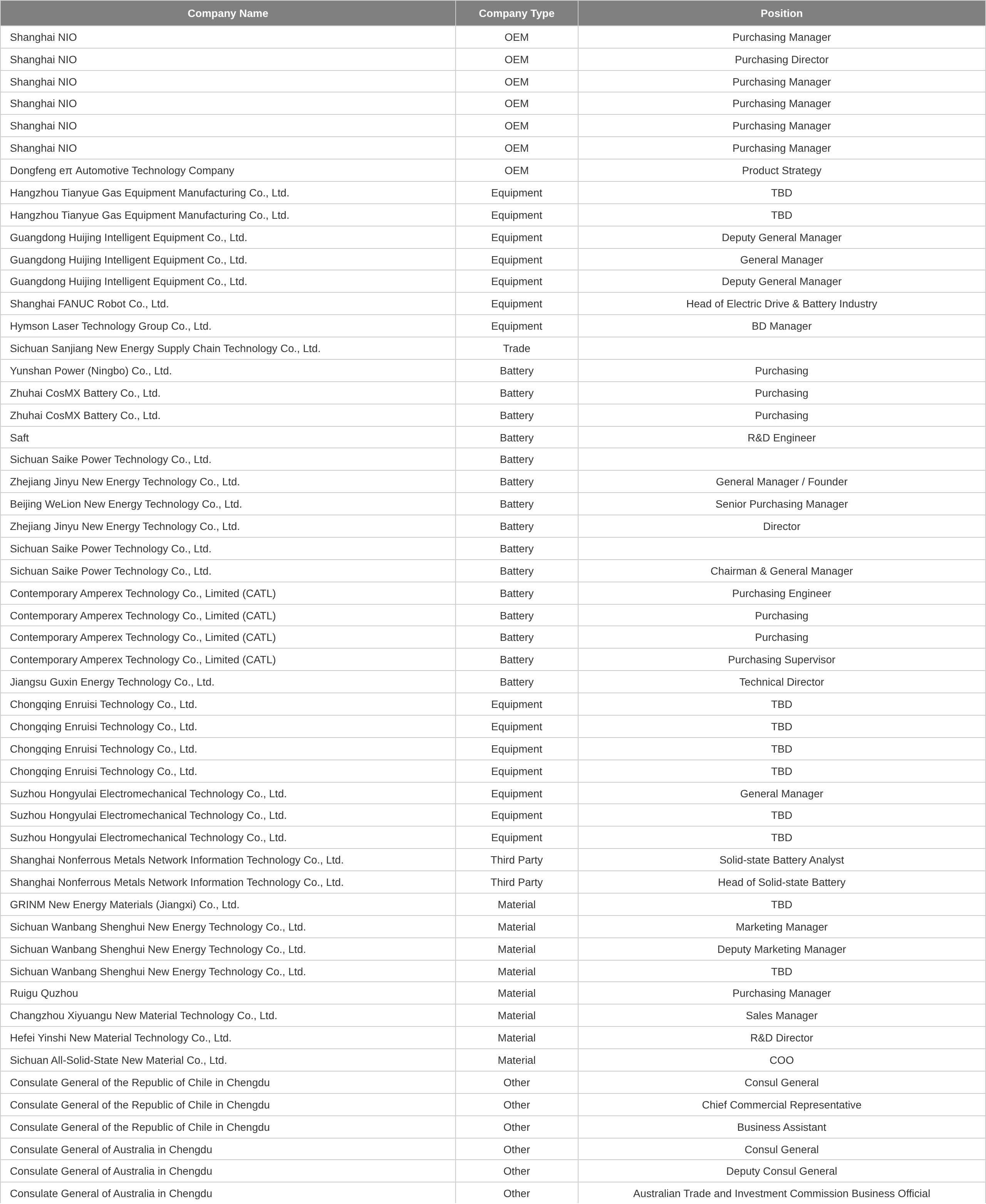
Finally, we would like to recommend SMM’s premium conference. Current progress and some participating enterprises and representatives:
Tel: 021-20707860 (or add WeChat: 13585549799) Yang Chaoxing, thank you!
Related Information
![[SMM News] Lithium Africa Samples 1.98% Lithium Oxide at Agboville's Kanien Trend](https://imgqn.smm.cn/usercenter/jZvMC20251217171729.jpg)
![[SMM News] Surge Evolution Nevada North Joint Venture Produces Battery-Grade Lithium Carbonate](https://imgqn.smm.cn/usercenter/WyqWW20251217171729.jpg)
![[SMM News] American Lithium Achieves Higher-Than-Expected Recovery Rates at Falchani Pilot Plant in Peru](https://imgqn.smm.cn/usercenter/wZUBk20251217171729.jpg)