On July 28 local time, the U.S. Federal Communications Commission updated its Covered List to include foreign-produced advanced robotic devices and connected power inverters. Under the new rules, models that have not yet secured FCC equipment authorization will be barred from the U.S. market, while previously authorized models are not immediately affected.
The measure is therefore more accurately described as a restriction on market access for new foreign-produced connected inverter models, rather than a blanket ban on all Chinese inverter imports.
New-model access is restricted, but existing products remain on sale
SMM research indicates that the FCC's Covered List operates in tandem with the U.S. equipment authorization regime. Devices on the list cannot receive new FCC authorizations. Most electronic equipment with wireless communications, remote monitoring, or data transmission functions must complete the relevant authorization process before it can be imported, marketed, or operated in the United States.
The latest measure primarily affects new models that have not yet entered the U.S. market. Inverters with existing FCC authorization may continue to be imported and sold for now, while projects already in operation and previously installed equipment are not subject to immediate removal. However, the FCC retains mechanisms to impose additional restrictions on existing authorizations, so suppliers will need to monitor how the scope of enforcement develops.
Previous rules covering drones and routers suggest that foreign suppliers may seek conditional approval from relevant U.S. security agencies. Reuters, citing people familiar with the matter, reported that the FCC may create exemption pathways for some non-Chinese suppliers. If implemented, the rules would formally apply to foreign-produced equipment, but the burden would likely fall disproportionately on Chinese companies.
This is not a conventional technology blockade. Traditional technology controls restrict the export of advanced equipment, software, or know-how to China. The latest FCC action instead limits access to the U.S. market. It is better understood as a technical market-access barrier based on national security and cybersecurity concerns, with clear supply-chain exclusion and industrial-protection objectives.
Why is the United States acting now?
Inverters are evolving from basic power-conversion equipment into digital grid nodes with remote control, data transmission, software updates, and grid-interaction capabilities.
As solar, energy storage, and data-center loads expand, inverters play a larger role in power-system operations. U.S. authorities argue that connected inverters could be used for remote shutdowns, data collection, system monitoring, or cyberattacks, potentially affecting the grid and other critical infrastructure. An FCC security determination also identified remote connectivity as a central source of risk.
The United States is also accelerating investment in artificial intelligence (AI) data centers and associated power infrastructure. These facilities require reliable electricity, as well as solar generation, energy storage, backup power, and energy-management systems. Connected inverters have consequently become part of the broader debate over the security of the AI infrastructure supply chain.
The policy also extends an emerging regulatory approach from drones and routers to inverters and robotics. Unlike tariffs, FCC authorization restrictions can directly block new models from entering the market. Conditional approval can also provide a mechanism for selectively exempting certain suppliers.
U.S. officials have further linked the measure to concerns about concentrated supply chains, drawing comparisons with rare-earth dependence. This suggests that the policy objective has moved beyond reducing imports toward preventing strategic equipment and resources from becoming concentrated in a limited number of suppliers. Encouraging domestic production of inverters and related hardware and software is another policy goal.
Total exports rose 3.9%, while the U.S. share fell to 5.75%
According to GTT data for Chinese exports under HS 850440, covering static converters and measured by unit count, total exports reached 2.652 billion units in H1 2026. This was up 3.9% from 2.551 billion units in the same period of 2025. June exports totaled 487.1 million units.
Exports to the United States reached 152.4 million units in H1 2026, down 0.7% from 153.4 million units a year earlier. The U.S. share of China's total export volume fell from 6.01% to 5.75%, a decline of 0.27 percentage points. In June alone, exports to the United States totaled 29.71 million units, equivalent to 6.10% of China's monthly export volume.
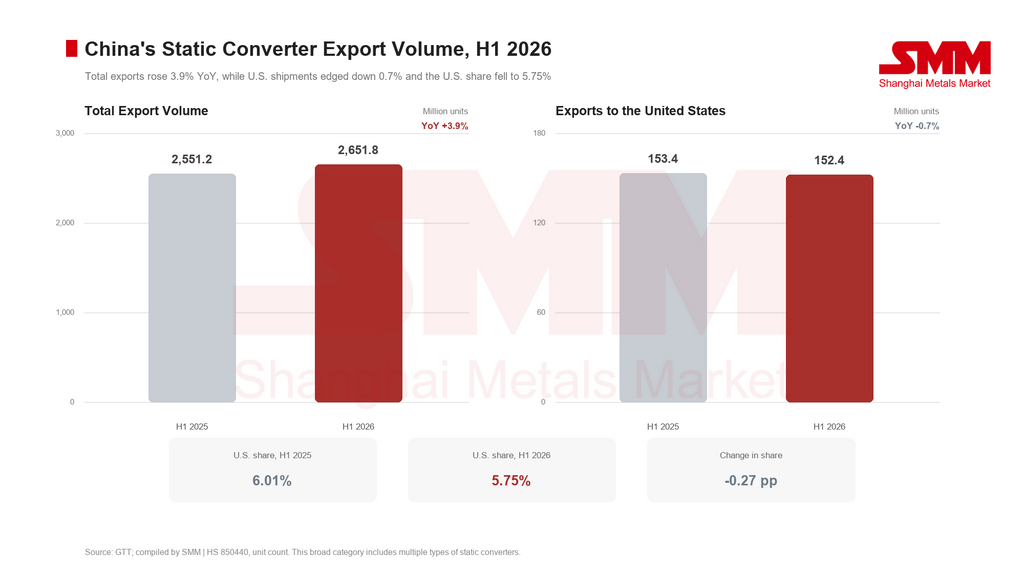
The figures show that China's overall exports of static converters continued to expand, while shipments to the United States remained broadly stable and their share edged lower. On an industry-wide volume basis, the U.S. market is not the sole determinant of China's overall export trajectory.
HS 850440 is a broad customs category that includes multiple types of static converters in addition to grid-connected photovoltaic inverters. The data are therefore used here to assess overall export trends and market exposure. The implications for photovoltaic inverters specifically will also depend on product power ratings, applications, and individual suppliers' product portfolios.
Asia-Pacific accounted for 57.0%, while North America represented 8.0%
On the same volume basis, China's exports to Asia-Pacific reached 1.511 billion units in H1 2026, accounting for 56.99% of the total. Europe received 428.5 million units, or 16.16%, while Africa accounted for 291.2 million units, or 10.98%.
Exports to North America totaled 212.8 million units, representing 8.02%. Latin America received 134.1 million units, or 5.06%, and the Middle East accounted for 74.0 million units, or 2.79%.
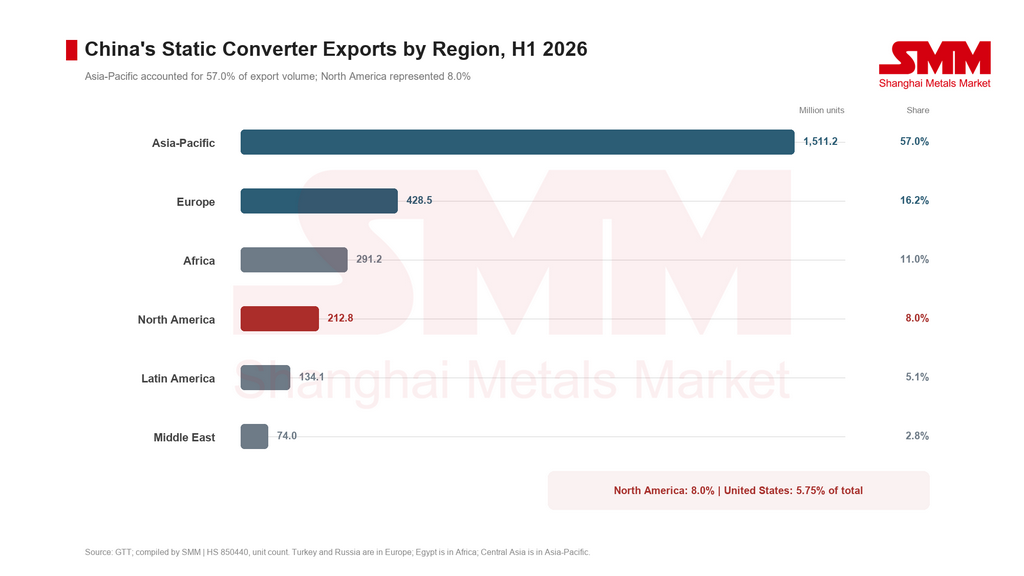
The United States accounted for approximately 71.6% of China's export volume to North America and 5.75% of China's global total. From an industry-wide perspective, tighter access for new models in the United States is therefore unlikely to reverse the overall export trend immediately.
However, industry averages do not reflect the exposure of individual suppliers. The U.S. market imposes stringent certification and bankability requirements and typically offers attractive project economics, making it an important destination for higher-power and higher-value products. Companies with significant U.S. exposure, new products undergoing certification, or plans to participate in utility-scale storage and data-center projects may face an impact well above the 5.75% industry-wide volume share.
The first effects will emerge through product replacement cycles
In the near term, previously authorized models may remain on sale. Some suppliers could accelerate deliveries of existing products or extend their product life cycles. Chinese inverters are therefore unlikely to disappear from the U.S. market immediately.
The pressure will increase as suppliers upgrade power ratings, replace communications modules, revise software architectures, or update energy-storage systems. These changes often require new models and fresh authorization. The new rules will make it harder for Chinese suppliers to remain competitive in the United States through routine product upgrades.
If companies must rely on existing models, they may gradually fall behind exempted competitors in efficiency, power density, storage compatibility, and digital operations and maintenance capabilities. The impact may therefore emerge progressively over the product renewal cycle rather than through a one-off drop in export volume.
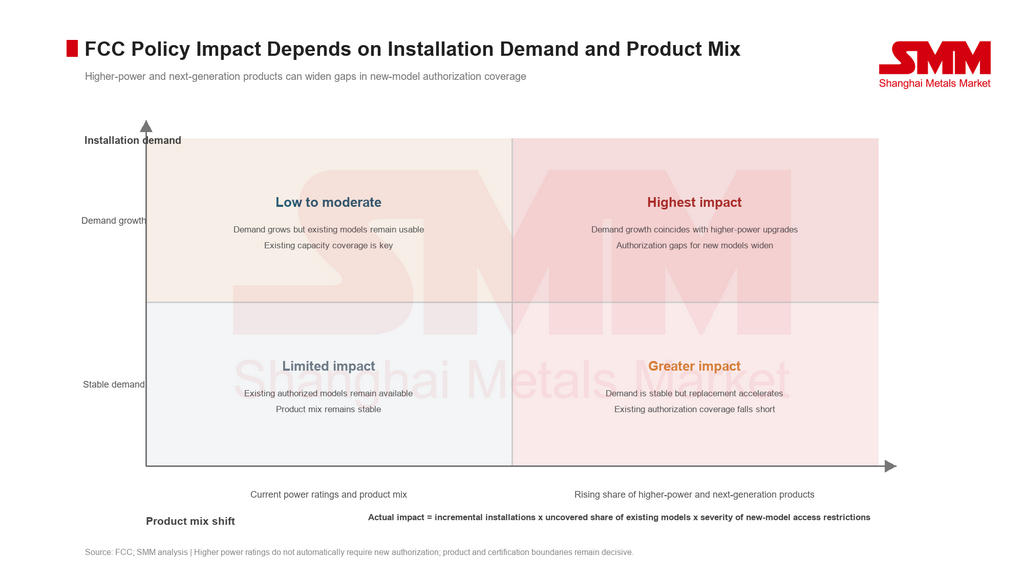
If U.S. installation demand and required product power ratings remain broadly unchanged, existing authorized models may continue to cover much of the market, limiting the near-term impact. If incremental demand shifts toward higher-power platforms, higher-capacity storage systems, or next-generation grid-control products, restrictions on new models will become more consequential.
Chinese suppliers may also redirect more products toward Europe, Asia-Pacific, the Middle East, Africa, and Latin America. This diversification could offset some losses in the U.S. market, but it may also intensify price competition elsewhere.
Regulatory spillover to Europe presents a larger risk
Europe accounted for 16.16% of China's HS 850440 export volume in H1 2026, making it the second-largest regional market after Asia-Pacific. Whether Europe tightens cybersecurity, local data storage, supplier screening, or eligibility requirements for publicly funded projects could be more important to Chinese suppliers than the immediate impact of the U.S. measure itself.
Reuters previously reported that U.S. officials considered recent European regulatory developments while drafting inverter restrictions. Europe has not introduced a unified restriction covering all Chinese inverters, but scrutiny of high-risk suppliers, remote-control functions, cloud platforms, and publicly funded projects is increasing. [Earlier Reuters report](https://whbl.com/2026/06/30/exclusive-us-working-on-ban-targeting-chinese-energy-inverters-sources-say/)
If the U.S. equipment authorization model is adopted in other markets, Chinese suppliers would face more than tariffs and localization requirements. Compliance reviews could extend across hardware origins, communications modules, firmware, cloud platforms, data flows, and remote-control permissions.
How can Chinese inverter suppliers respond?
- Build market-specific product and certification road maps. Suppliers should determine in advance whether changes to power ratings, communications modules, or software will trigger new authorization requirements, while reducing dependence on a single model or market.
- Strengthen security-by-design capabilities. This includes improving hardware and software traceability, maintaining a software bill of materials, using signed firmware, establishing vulnerability-response processes, conducting third-party penetration tests, and applying least-privilege controls to remote access.
- Localize data management and operations where required. Options include local servers, local key management, local service teams, and offline operating modes that do not depend on foreign cloud platforms. Future competition will involve cybersecurity and data governance as well as conversion efficiency and cost.
- Assess localization strategies carefully. The rules focus on production location, supply-chain relationships, and potential control. Simple transshipment through third countries or low-value assembly may not resolve market-access concerns and could trigger rules-of-origin and anti-circumvention scrutiny.
- Continue expanding in Asia-Pacific, the Middle East, Africa, and Latin America while closely monitoring European policy. China's HS 850440 export volume increased 3.9% year on year in H1 2026, indicating that demand remains geographically diverse enough to absorb additional supply. Diversification should reduce exposure to individual markets rather than rely on price cuts to place redirected products.
Outlook
The FCC rules are unlikely to cause a sharp near-term decline in China's total inverter exports. The United States accounted for 5.75% of China's HS 850440 export volume, while previously authorized models still provide a near-term route to market.
The policy nevertheless shows that U.S. restrictions on China's clean-energy industry are extending beyond solar cells and modules to inverters, communications systems, and digital energy infrastructure. The regulatory focus is also shifting from tariffs and rules of origin toward equipment authorization, cybersecurity, remote control, and supply-chain trust.
The larger concern is not the immediate volume of U.S. orders at risk. It is whether this regulatory framework spreads to Europe and other high-value markets, and whether future restrictions extend from new models to existing products, key components, software, and cloud services.
SMM will continue to track the implementation of the FCC rules and their implications for Chinese inverter exports and product development.
Written by:
Ryan Tey Tze Yang | SMM PV Analyst
+60 127179370 | ryan.tey@metal.com
![[Polysilicon prices today are largely stable overall]](https://imgqn.smm.cn/usercenter/qQwIB20251217171741.jpg)
![[SMM PV News Flash] Save over 70% on monthly electricity bills | Chint New Energy Empowers South Africa Saverite Mart Community Supermarket PV+ESS Project](https://imgqn.smm.cn/usercenter/ZqmSz20251217171738.jpg)
![[SMM PV Flash News] DMEGC: H1 PV Product Shipments Exceeded 12GW](https://imgqn.smm.cn/usercenter/VprpL20251217171738.jpg)