[SMM Analysis] South Korea Plans Tighter Copper Scrap Export Declarations—Could Asian Trade Flows Shift?

Published: Jul 29, 2026 16:31
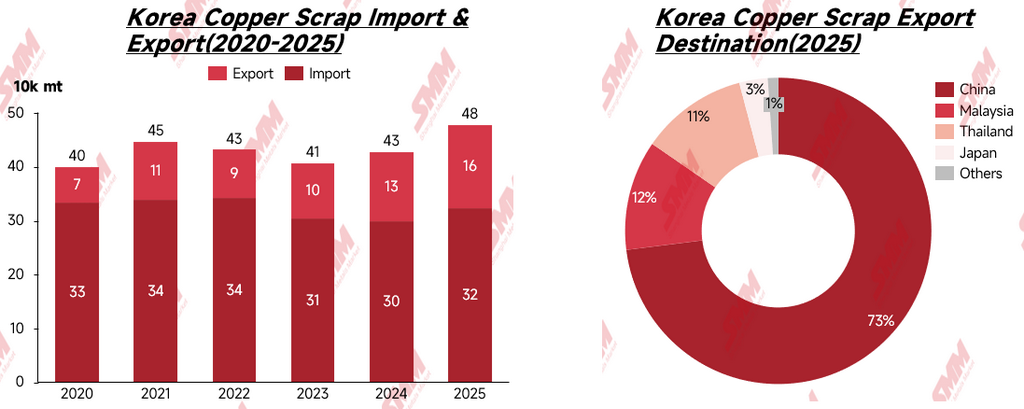
[SMM Analysis: South Korea Plans Tighter Copper Scrap Export Declarations—Could Asian Trade Flows Shift?] South Korea plans to require export declarations for ferrous and non-ferrous scrap from 2027. The move targets misdeclaration rather than restricting legal trade. With China, Malaysia and Thailand taking 95.86% of 2025 exports, impacts should be limited for compliant high-grade cargoes but greater for mixed and complex scrap.

In mid-July, South Korea’s Ministry of Climate, Energy and Environment announced a proposed revision to bring ferrous and non-ferrous scrap, previously exempt from reporting, under the country’s waste export declaration system. The proposal is open for public consultation from July 16 to August 5 and is scheduled to take effect on January 1, 2027, after regulatory and legal reviews.

Since South Korea introduced its waste import and export declaration system in 2008, ferrous and non-ferrous scrap has generally remained exempt. Under the proposed rules, exporters would be required to submit documents including material composition analyses and export contracts, allowing regulators to track the actual movement of valuable secondary resources more closely.

The revision is mainly intended to curb misdeclaration. South Korean authorities have identified cases in which high-value materials, including electronic waste and copper scrap, were declared as ordinary ferrous scrap before being exported. One example cited was an August 2024 case involving copper scrap misdeclared as ferrous scrap and smuggled to China.

South Korea is an important copper scrap supplier in Asia. In 2025, the country exported approximately 154,700 mt of copper scrap. China received around 112,900 mt, accounting for 72.99% of the total, while Malaysia and Thailand imported approximately 17,900 mt and 17,400 mt, representing 11.59% and 11.28%, respectively. Together, the three markets accounted for 95.86% of South Korea’s copper scrap exports.

However, the proposed policy is neither an export ban nor an export quota. It would only require cargoes that were previously exempt to complete formal declaration procedures. Companies with clearly documented cargo origins, grades, compositions and contracts should, in principle, still be able to export normally.

As a result, South Korean copper scrap exports may not decline sharply after the policy takes effect. The immediate impact is more likely to come from additional administrative procedures, testing and documentation costs, as well as potentially longer export lead times. Mixed-metal scrap, dismantled materials, electronic waste and other complex cargoes with unclear classifications are expected to face greater scrutiny than Millberry, No. 1 copper scrap and other clearly defined high-grade materials.

For South Korea’s domestic market, tighter declarations could improve transparency and reduce the outflow of valuable materials under incorrect tariff classifications. If some non-compliant exports are restricted, more scrap could remain within the domestic market and become available to local copper rod plants, brass producers, secondary smelters and other processors.

For buyers in China and Southeast Asia, South Korean copper scrap is unlikely to disappear from the international market in the near term. In Malaysia, for example, much of the material imported from South Korea is reportedly high-grade Millberry supplied to Korean and Japanese copper foil plants operating locally. These trade flows have relatively clear cargo specifications and end uses, and are therefore expected to face limited disruption from the new declaration requirements.

Overall, the proposed revision is aimed at strengthening oversight of cross-border flows of valuable secondary resources rather than directly restricting copper scrap exports. Before the rules take effect in 2027, exporters are likely to adjust their classification, testing and documentation procedures.

Whether Asian copper scrap trade flows change significantly will depend on the final declaration requirements, approval timelines and enforcement standards. If the policy mainly targets misdeclaration and illegal exports, its impact on compliant trade should remain limited. However, if inspections and documentation requirements become significantly stricter, buyers in China and Southeast Asia may need to source more material from Japan, the US and other markets.

Data Source Statement: Except for publicly available information, all other data are processed by SMM based on publicly available information, market communication, and relying on SMM's internal database model. They are for reference only and do not constitute decision-making recommendations.

For any inquiries or for more information, please contact: lemonzhao@smm.cn
For more information on how to access our research reports, please contact:service.en@smm.cn
Related News
Panguna Copper Mine Moves Closer to Potential Redevelopment as Lloyds Metals Receives Preparatory Works Approval
11 hours ago
Panguna Copper Mine Moves Closer to Potential Redevelopment as Lloyds Metals Receives Preparatory Works Approval
Read More
Panguna Copper Mine Moves Closer to Potential Redevelopment as Lloyds Metals Receives Preparatory Works Approval
According to foreign media reports, Lloyds Metals & Energy has been authorized to undertake preparatory works and feasibility activities aimed at assessing the potential redevelopment of the Panguna copper-gold mine in Bougainville, Papua New Guinea, nearly four decades after the operation was shut down. The Autonomous Bougainville Government granted the authorization on August 7, allowing Lloyds to carry out an approved programme of preparatory and feasibility work required to assess and plan the future redevelopment of the mine. Lloyds is acting as the approved development partner of government-owned Bougainville Minerals, which holds the mining lease covering Panguna. The project represents a potentially significant source of long-term copper supply. Panguna's remaining reserves are estimated at approximately 5.3 million tonnes of copper and 19.3 million oz of gold, while Lloyds plans to revalidate the project's resource base as part of the redevelopment process. The mine has remained closed since 1989. The latest authorization follows the granting of a 25-year mining lease to Bougainville Minerals in June, providing a framework for further evaluation of the dormant asset. However, the current approval does not permit construction or copper production to begin. Any progression into those stages will require additional approvals, meaning a potential restart remains subject to further technical, regulatory and development work. The renewed progress at Panguna is notable given the scale of the historical deposit and growing efforts globally to develop additional copper supply. The immediate impact on mine supply remains limited, but successful feasibility work and resource revalidation could provide greater clarity on whether one of the world's largest dormant copper assets can eventually return to production.
11 hours ago
Bezant Resources Completes First Blast at Namibian Copper-Gold Project, Aiming for Concentrate Production
12 hours ago
Bezant Resources Completes First Blast at Namibian Copper-Gold Project, Aiming for Concentrate Production
Read More
Bezant Resources Completes First Blast at Namibian Copper-Gold Project, Aiming for Concentrate Production
Bezant Resources PLC has completed the first blast at the Hope open pit within its 90%-owned Hope & Gorob copper-gold project in Namibia, marking a further step toward mining and future concentrate production at the project. The initial blast involved approximately 20,000 tonnes of material and is expected to liberate around 2,000 tonnes of commercially viable mineralisation. Preliminary evaluation of the exposed mineralisation indicates that its location and grade are broadly consistent with the project's existing geological block model. Following the blast, grade-control work will compare assay results from blasthole samples with the exposed mineralisation to refine ore selection. Mining and transportation of run-of-mine (ROM) ore to the Tsaoxaub Metals flotation plant are expected to begin shortly, where material will be stockpiled ahead of future plant commissioning. Preparations for further mining are also progressing. Blastholes have already been drilled for a second blast, while the mining contractor has commenced ground clearance and separation of ore and waste for haulage. Recruitment of plant operators is ongoing following the appointment of the plant site manager, while the mine geology team is working with external consultants to validate the existing block model. The first blast represents an important operational milestone as Hope & Gorob moves closer to the processing stage. The next key developments will be the delivery of ROM ore to the plant, commissioning of the flotation facility and eventual production of saleable concentrate, providing clearer indications of the project's transition from development into copper-gold production.
12 hours ago
Antofagasta Cuts 2026 Copper Output Guidance Following Los Pelambres Shutdown
12 hours ago
Antofagasta Cuts 2026 Copper Output Guidance Following Los Pelambres Shutdown
Read More
Antofagasta Cuts 2026 Copper Output Guidance Following Los Pelambres Shutdown
According to foreign media reports, Chilean copper producer Antofagasta has lowered its 2026 copper production guidance following a weather-related shutdown at its Los Pelambres mine, reducing expected output at a time when global copper mine supply remains under pressure.​ Antofagasta now expects to produce 625,000–655,000 tonnes of copper in 2026, compared with its previous guidance of 650,000–700,000 tonnes. The revised range lowers the midpoint of the company's production outlook by 35,000 tonnes and reduces the upper end of its forecast by 45,000 tonnes.​ The downgrade follows the temporary shutdown of Los Pelambres in July after extreme rainfall affected Chile's Coquimbo Region. Although no significant damage was reported to major infrastructure, repairs are required to some pipeline platforms and water-management systems following the disruption.​ Despite lower production, stronger copper prices supported Antofagasta's financial performance during the first half of 2026. EBITDA increased 27% year on year to $2.84 billion, while operating cash flow rose 53% to $2.77 billion. First-half cash costs declined 8% year on year to $1.22/lb, although the company previously indicated that full-year costs are expected to increase amid persistently elevated fuel prices.​ From a copper-market perspective, the guidance reduction represents a further downward adjustment to expected mine supply from Chile, the world's largest copper-producing country. The disruption at Los Pelambres also highlights the continued vulnerability of near-term supply to operational and weather-related interruptions, with Antofagasta's reduced production outlook adding to existing constraints on global copper mine growth.
12 hours ago