Cheaper modules are no longer enough to offset grid, financing, engineering and site risks, leaving Germany's June rooftop PV auction undersubscribed and award prices close to the ceiling.
Germany's large rooftop solar market is sending a warning: module prices continue to fall, but projects are becoming harder to develop. The June 2026 auction suggests that the market's main constraint has shifted from equipment costs to the availability of financeable, grid-ready projects.
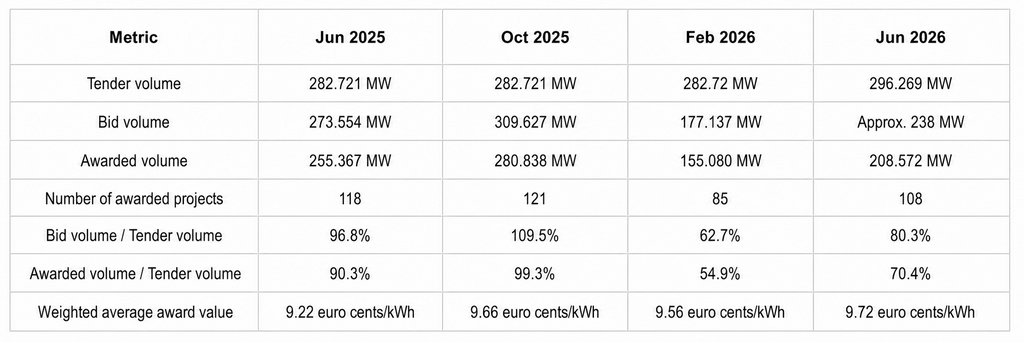
Germany's Federal Network Agency, the Bundesnetzagentur, offered 296.269 MW in its June auction for second-segment solar installations, which covers PV systems on buildings and noise barriers. The auction attracted 125 bids totalling 238.272 MW, equivalent to only 80.4% of the available volume and marking the second consecutive undersubscribed round.
Seventeen bids were excluded. The agency ultimately awarded 108 bids with a combined capacity of 208.572 MW, filling just 70.4% of the tender volume.
Successful bids ranged from 8.40 to 10.00 euro cents/kWh. The volume-weighted average reached 9.72 euro cents/kWh, equivalent to EUR 97.2/MWh and 97.2% of the 10.00 euro cents/kWh ceiling.
The results show that the rooftop auction recovered from February, but effective price competition has yet to return.
June rebound fails to restore competition
Compared with February 2026, the June auction showed a clear improvement. Submitted capacity increased by 34.5%, from 177.137 MW to 238.272 MW, while awarded capacity rose from 155.080 MW to 208.572 MW. The number of successful projects increased from 85 to 108.
The longer-term comparison is less encouraging. In June 2025, bids totalled 273.554 MW and awards reached 255.367 MW, with a volume-weighted average price of 9.22 euro cents/kWh.
This means that June 2026 bid volume was approximately 12.9% lower year on year, while awarded capacity declined by 18.3%. At the same time, the average award price increased by about 5.4%.
Source: Germany's Federal Network Agency, the Bundesnetzagentur
The clearest turning point came between October 2025 and February 2026. In October, the market submitted 309.627 MW of bids against an auction volume of 282.721 MW, producing a coverage ratio of 109.5%. Both the February and June 2026 rounds were subsequently undersubscribed.
The June improvement should therefore be viewed as a rebound from an unusually weak February result, rather than a return to the competitive conditions seen in 2025.
Under Germany's pay-as-bid mechanism, each successful project receives the price it offered. When qualified bid volume is materially below the auction volume, developers face less competitive pressure to reduce their prices.
The lowest successful bid increased from 7.88 euro cents/kWh in February to 8.40 euro cents/kWh in June, while the highest successful bid again reached the 10.00 euro cents/kWh ceiling. This indicates that the market still lacks a sufficient pipeline of lower-cost projects.
Bid exclusions further widened the supply gap. The 17 excluded bids represented 13.6% of all submissions, while their combined capacity of 29.700 MW was equivalent to approximately 12.5% of total submitted volume.
Small projects dominate a geographically concentrated market
The 108 successful projects had a combined capacity of 208.572 MW, giving an average project size of about 1.93 MW. The median project size was approximately 1.42 MW, while individual projects ranged from 1.001 MW to 9.5 MW.
Fifty-nine projects, or 54.6% of the total, had capacities of no more than 1.5 MW. Only 15 projects, or 13.9%, reached 3 MW or more.
Although the second-segment auction is intended for large rooftop installations, its project base consists mainly of dispersed, medium-sized commercial and industrial rooftops rather than a small number of very large developments.
Corporate concentration was also limited. The ten largest successful bidders secured approximately 53.9 MW, representing only 25.8% of awarded capacity. Industrial companies, logistics property platforms, agricultural businesses, specialist rooftop developers and municipal energy companies all participated in the market.
Source: Germany's Federal Network Agency, the Bundesnetzagentur
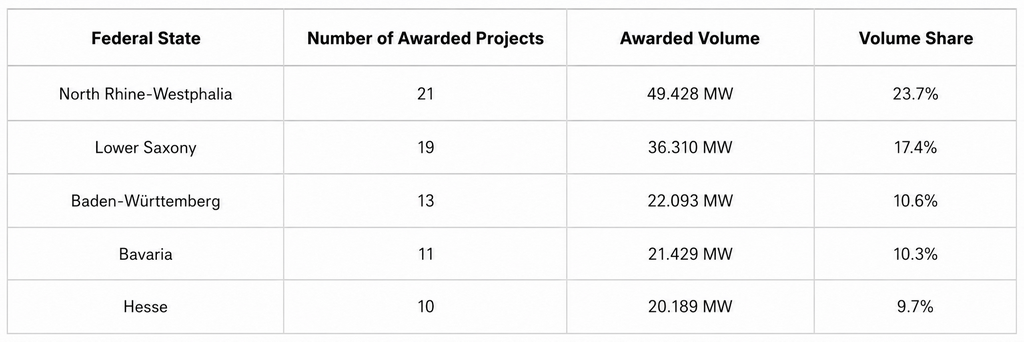
The geographical distribution was much more concentrated. The five leading federal states accounted for about 71.7% of awarded capacity, while North Rhine-Westphalia and Lower Saxony together represented more than 40%.
This concentration reflects the importance of warehouses, manufacturing plants, agricultural facilities and logistics buildings as development platforms for large rooftop solar projects.
Cheap modules cannot offset site-specific costs
The ability to expand Germany's rooftop solar market increasingly depends on access to suitable industrial and logistics properties, roof structural conditions, electricity demand profiles, lease arrangements and available grid capacity.
Once a project enters development, it must also absorb the costs of roof reinforcement, fire protection, lifting equipment, electrical upgrades, grid connection, financing and operations and maintenance.
Low module prices therefore confirm that equipment costs are continuing to decline, but they do not eliminate the non-module costs and risk premiums attached to rooftop projects.
The increase in the average award price to 9.72 euro cents/kWh suggests that the primary bottleneck in Germany's large rooftop market has shifted from expensive equipment to difficult project execution.
Ground-mounted and rooftop solar move further apart
Germany's ground-mounted and large rooftop solar markets are showing sharply different competitive conditions.
In the March 2026 first-segment auction, the Bundesnetzagentur offered approximately 2.295 GW and received 4.622 GW of bids, producing a coverage ratio of more than two times. The volume-weighted average award price was only 4.94 euro cents/kWh.
By comparison, bids in the June rooftop auction covered only 80.4% of the available capacity, while the average award price reached 9.72 euro cents/kWh, almost double the ground-mounted level.
The two project categories cannot be compared on a fully equivalent cost basis. Nevertheless, the price gap clearly demonstrates the advantages enjoyed by land-based utility-scale projects in standardisation, scale, financing and construction management.
Rooftop projects, by contrast, remain fragmented and highly site-specific, creating a substantial development premium.
Germany's overall solar market has not stalled. Preliminary registry data show approximately 7.4 GW of net PV additions in the first half of 2026, including 493.8 MW of building-mounted capacity commissioned in June.
However, projects above 1 MW that must participate in the second-segment auction have now faced two consecutive undersubscribed rounds. This highlights a growing divide within the rooftop market: residential solar, self-consumption systems and plug-in solar installations operate under very different business models and constraints from large commercial and industrial rooftop projects.
Germany's July 1 first-segment auction has already closed. The round offered 2.134567 GW with a price ceiling of 5.90 euro cents/kWh, but the Bundesnetzagentur has not yet published the results.
It therefore remains unclear whether ground-mounted projects will continue to attract strong oversubscription and aggressive pricing in the second half of the year. The March results should be treated as a historical reference rather than a definitive indicator for the remainder of 2026.
What this means for equipment suppliers
The June auction sends three important signals.
First, the increase in bid volume from February confirms that Germany's pipeline of large rooftop projects has not disappeared. However, bids still failed to cover the auction volume, making the recovery closer to a low-base rebound than a genuine market turnaround.
Second, the rise in the average award price to 9.72 euro cents/kWh shows that lower module prices have not fully translated into lower project-level electricity costs. Financing, grid access, labour, engineering modifications and regulatory uncertainty are now more important cost variables.
Third, the fragmented project and developer structure means that success in Germany increasingly depends on local development, engineering, construction, financing and energy management capabilities.
For China-based module manufacturers, the marginal value of competing on price alone is declining. High power density, rooftop compatibility, reliability, European inventory availability, delivery certainty and integration with energy storage and energy management systems are likely to have a greater influence on equipment selection.
Outlook
The Bundesnetzagentur plans to hold the next auction for rooftop and noise-barrier solar projects on October 1, 2026, with an expected volume of approximately 296.3 MW.
The market should focus on four indicators: whether submitted capacity can again exceed the auction volume, whether the bid exclusion rate declines, whether the average award price moves away from the ceiling, and whether Solarpaket I measures, including the proposed reduction of the minimum bid size from 1.001 MW to 751 kW, receive the approvals needed for implementation.
If bid volume remains below the available capacity and the average price stays near 9.7-10.0 euro cents/kWh, weakness in Germany's large rooftop market may have shifted from a temporary financing disruption to a structural development bottleneck.
Conversely, if tender rules are relaxed, grid visibility improves and more medium-sized commercial and industrial rooftops enter the project pipeline, effective competition could gradually return.
The June result does not mean that solar PV has lost its economic appeal. Instead, value is moving along the project chain. In an era of inexpensive modules, the scarce asset is no longer a cheaper panel, but a project with a suitable roof, confirmed grid access, stable cash flow and a financeable contractual structure.
Written by:
Ryan Tey Tze Yang | SMM PV Analyst
+60 127179370 | ryan.tey@metal.com
![[SMM PV Flash] Energiequelle Sells French Unit and 500 MW Renewables Portfolio to H2air](https://imgqn.smm.cn/usercenter/wBAsG20251217171742.jpg)
![[SMM PV Flash] Play Signs 15-Year Wind and Solar PPA with Qair in Poland](https://imgqn.smm.cn/usercenter/JNxfy20251217171742.jpg)
![[SMM PV Flash] Greenvolt Starts Construction of 600 MW/2.4 GWh Polish BESS](https://imgqn.smm.cn/usercenter/zMauQ20251217171742.jpg)