As the first half of 2026 draws to a close and H2 commences, industry chain enterprises are concentratedly releasing their H1 2026 performance forecasts. Notably, against the backdrop of a significantly higher lithium price center YoY, steady NEV industry demand, and continued strength in energy storage, most lithium industry chain-related enterprises are expected to post varying degrees of profit growth. SMM has compiled the performance forecasts of some enterprises in the industry chain as follows:
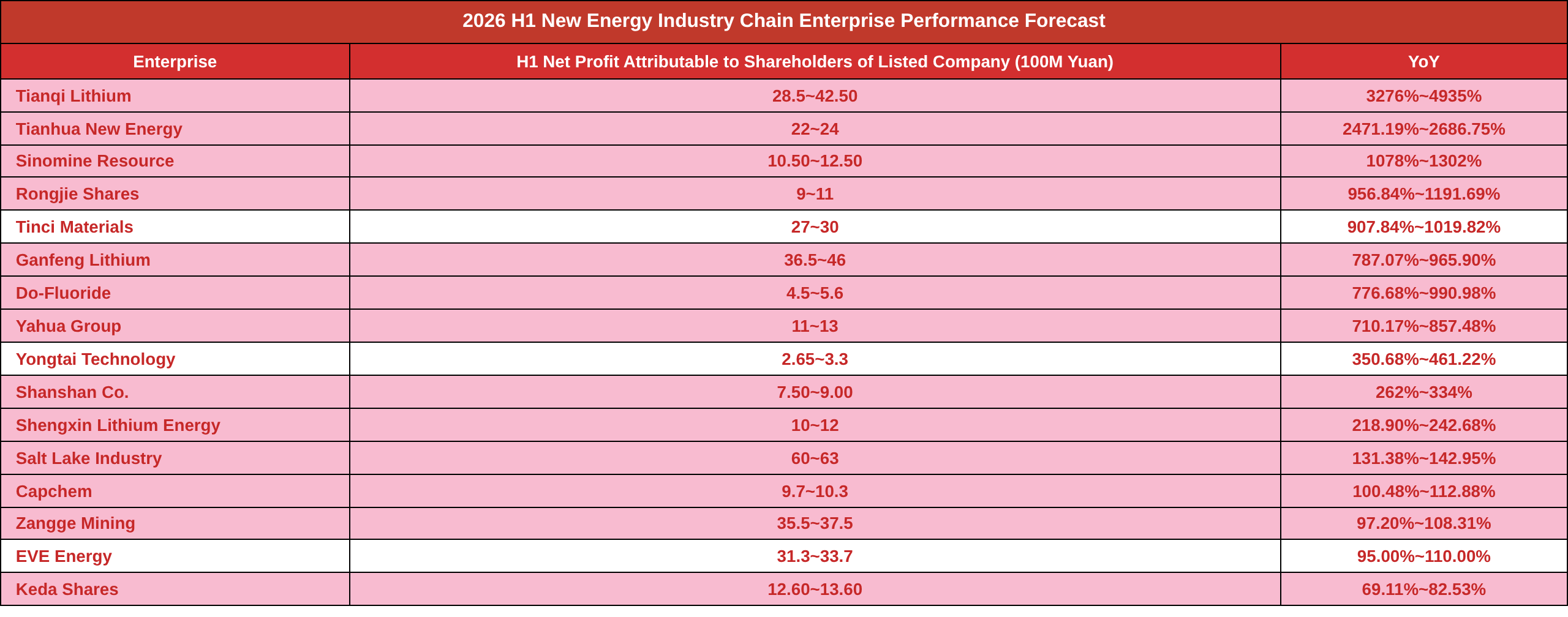
The light purple segment in the chart above mainly represents upstream and midstream enterprises in the industry chain, such as those in lithium ore and lithium chemicals. It can be seen that the performance expectations of these enterprises are generally higher than those in other segments. In the reasons cited for their performance changes, these enterprises also highlighted the significant YoY increase in lithium concentrate and lithium chemical prices in H1 as a contributing factor. This is vividly reflected in SMM's spot quotations. Taking spodumene concentrates (CIF China) as an example, their average H1 2026 price was $2,288.09/mt, an increase of $1,515.64/mt or 196.21% from $772.45/mt in H1 2025. On the spot lithium carbonate side, the average H1 2026 price was around 163,400 yuan/mt, up approximately 93,000 yuan/mt or roughly 132.1% from about 70,400 yuan/mt in H1 2025.
H1 Lithium Ore and Lithium Chemical Prices Surged Over 130% YoY—What’s the Outlook for H2?
A detailed look at the H1 lithium ore and lithium chemical market conditions:
Lithium ore prices, according to historical SMM data, the main theme in H1 2026 was a retreat after a rapid rise, rather than a unidirectional increase in the price center. The SMM spodumene concentrate index price (SC6, CIF China) started the year at around $2,000/mt (January average), briefly pulled back to $1,875 in early February, drifted higher along with lithium carbonate futures, shot up to a year-to-date high of $2,780–$2,840 in mid-May, and pulled back to the $2,385–$2,480 range in June. This trajectory almost perfectly mirrored that of lithium carbonate—spot lithium carbonate was around 130,000 yuan/mt at the start of the year, surged above 200,000 yuan/mt in May, and pulled back to the 160,000–180,000 yuan/mt range in June.
SMM believes that the strength in ore prices in H1 was not the result of "tight effective supply supporting higher prices." The true drivers were the combination of front-loaded demand (export rush triggered by adjustments to export tax rebates), expectations of supply disruptions (repeated delays in the resumption of production at Jianxiawo, Zimbabwe’s export ban), and sentiment in the futures market. When warrant accumulations and macro headwinds were released in May, and the expectation of Jianxiawo’s production resumption materialized in June, prices pulled back as expected, only to surge significantly later due to demand expectations.
And for lithium carbonate, it also showed a trend of retreat after rapid rise in H1 2026, with its price center moving up significantly YoY. According to SMM spot price data, at the beginning of the year, spot battery-grade lithium carbonate was around 110,500 yuan/mt, climbed to a high of 200,500 yuan/mt on May 13, then pulled back to 156,500 yuan/mt by end-June. The average price in H1 2026 was around 163,400 yuan/mt, up 93,000 yuan/mt from the average of around 70,400 yuan/mt in H1 2025, an increase of about 132.1%.
Looking specifically at the quarterly performance of lithium carbonate prices, SMM's analysis is as follows:
Q1: Pre-holiday stockpiling and price holding games, prices rose, then fell, and rebounded again
In January, spot lithium carbonate prices surged with high volatility, with a monthly average of 156,000 yuan/mt, up 55% MoM. Supply-side output remained basically stable, but as the proportion of long-term contracts signed between upstream and downstream declined, the delivery volumes under lithium chemical plants' long-term contracts shrank accordingly, willingness to sell spot orders was low, and sentiment to hold back from selling and hold prices firm gradually built. On the demand side, downstream material plants conducted pre-holiday stockpiling for the Chinese New Year in February, but their acceptance of rapidly surging spot prices was limited; they generally adopted a “buy the dip” strategy, only restocking opportunistically when prices pulled back. During the month, the spot battery-grade lithium carbonate price hit a high of 181,500 yuan/mt, then corrected to near 168,000 yuan/mt by month-end. In February, prices declined first and then rose, with a monthly average of 149,600 yuan/mt, down 3.5% MoM. At the beginning of the month, downstream enterprises continued their pre-holiday stockpiling pace, but their purchasing strategy remained cautious, mainly buying on dips. From mid-month, downstream enterprises largely finished restocking, market trading turned thin, and most turned to a wait-and-see stance. On the supply side, upstream lithium chemical plants continued to show weak willingness to sell spot orders, their intention to hold prices firm unchanged; they only sold small volumes at high prices, and the overall market fell into a stalemate. In March, prices strengthened again, with the monthly average up 5% MoM. On the supply side, as the maintenance season ended, production gradually recovered, and lithium chemical plants' willingness to sell at relatively high levels around 170,000 yuan/mt increased. On the demand side, cathode material enterprises continued their dip-buying strategy, showing strong purchase willingness in the 140,000-150,000 yuan/mt range. With demand remaining robust, some enterprises engaged in large-scale restocking at low prices. During the month, prices shot up to 172,500 yuan/mt at the beginning of the month, then fell back to near 163,000 yuan/mt by month-end.
Q2: External shocks combined with supply disruptions, prices made a deep V-shaped reversal then retreated after rapid rise
In April, the market staged a V-shaped reversal, with the monthly average up 6% MoM. Early in the month, affected by escalating geopolitical conflicts in the Middle East, global risk-off sentiment heated up, and nonferrous metals and lithium carbonate prices came under pressure and drifted lower. From mid-to-late month, supply side disruptions emerged one after another — Zimbabwe issued an export ban, Jiangxi mines entered a permit renewal cycle — and combined with rising cost support, these pushed prices to rebound, with the price center shifting notably higher at month-end. Upstream-downstream purchases remained in a stalemate, and the psychological price spread widened week by week: upstream held prices firm and held back from selling, keeping offers elevated; downstream only made just-in-time procurements, with psychological price levels concentrated in the 155,000–175,000 yuan/mt range. That month, the price fell to around 155,500 yuan/mt early on, then pulled strongly higher to 177,000 yuan/mt by month-end. In May, prices drifted higher with the center rising markedly, and the average monthly price rose 12% MoM. Supply disruptions continued to ferment, and with downstream cathode material and battery cell production schedules staying high and expectations that the June schedule would accelerate further, the supply-demand timing mismatch persisted. Upstream lithium chemical plants’ sentiment to hold prices firm and hold back from selling lasted the whole month; downstream showed divergence — some enterprises bought the dip to restock, but most had limited appetite for high prices and mainly made just-in-time purchases, leaving actual transactions relatively sluggish. On the futures market, the most-traded contract briefly broke above the 200,000 yuan/mt round number intra-month, and market sentiment was euphoric for a period. As June began, the price center consolidated lower. On the supply side, news about Jiangxi mine permit renewals continued to disturb the market, but China’s lithium carbonate imports in May hit a record high, while GFEX warrants remained at a high level of around 50,000 mt, resulting in notable social inventory pressure. Demand growth met market expectations but lacked upside surprises, leaving insufficient upward price momentum. Upstream lithium chemical plants showed weak willingness to sell spot orders, with their attitude of holding prices firm and holding back from selling unchanged; downstream material plants and battery cell manufacturers continued their dip-buying strategy, purchasing large volumes to stockpile when prices fell below 160,000 yuan/mt, forming a certain floor.
Looking at H1 as a whole, the lithium carbonate market, influenced by intertwined factors such as supply disruptions, geopolitics, and pre-holiday stockpiling, saw a trend of wild swings with a rising center. The psychological price gap between upstream and downstream persisted, the market tug-of-war became increasingly refined, and the linkage between futures and spot prices strengthened further. As H2 begins, the pace of supply recovery and the actual realization of end-use demand will be the key variables determining price direction.
Since H2 began, although the center of spot lithium carbonate quotes has continued to move lower, considering both supply and demand, SMM expects that the China lithium carbonate market in H2 will show sustained and substantial destocking. While supply growth is steadily released, rigid demand growth and structural upgrades, coupled with limited import supplementation, will together drive the supply-demand gap wider. Under this structure, lithium carbonate prices are expected to maintain a fluctuating upward trend.
Supply side, SWMM expects H2 lithium carbonate production to reach approximately 786,000 mt. By raw material, the lepidolite side, benefiting from the production resumption expectations of a leading mine in Jiangxi, will see actual effective supply increase YoY; the spodumene side remains the core source of full-year growth, driven by a combination of end-use demand resilience and the upward shift in lithium price averages, with toll processing orders for non-integrated enterprises surging and operating rates of production lines increasing, pushing production to grow significantly. The salt lake and recycling sides are driven by the accelerated ramp-up and steady release of new capacity, with production steadily improving and making a direct contribution to full-year growth. Overall, robust end-use demand coupled with rising lithium prices significantly improves lithium chemical enterprises' production profit expectations, driving companies to increase production loads, and the full-year operating rate is expected to be notably higher YoY.
Demand side, SMM expects the LFP market to maintain high prosperity in H2, while the ternary cathode market will remain stable with progress. In H2, substantial new capacity will gradually be built and enter the production ramp-up stage. Total capacity in the LFP industry is expected to surpass 10 million mt per year, with full-year total production expected to reach 6.12 million mt, but attention is needed on the ramp-up progress of new production lines and the impact of actual full production attainment on the supply pace.
Lithium battery industry chain enterprises broadly forecast profits, with some miners' net profit expected to increase by up to over 4,900%
Tianqi Lithium
After market close on July 14, Tianqi Lithium released its H1 2026 earnings preview, showing that the company's net profit attributable to shareholders of the publicly listed firm in H1 was approximately between 2.85 billion yuan and 4.25 billion yuan, up 3,276% to 4,935% YoY . Regarding the reasons for the performance changes, Tianqi Lithium stated that it mainly benefited from multiple positive factors including the development of the new energy industry and downstream demand growth, leading to a significant YoY increase in the average selling prices of the company's major lithium products during the reporting period. As of the date of this earnings preview announcement, the company’s significant associate, Sociedad Química y Minera de Chile S.A. (hereinafter referred to as “SQM”), has not yet announced its Q2 2026 earnings report. The company has fully considered the reliable information available and has consistently used Bloomberg’s forecast for SQM’s Q2 2026 earnings per share, among other data, as the basis for calculating the company’s investment income from SQM during the period. Based on the aforementioned forecast data, SQM’s H1 2026 performance is expected to grow significantly YoY, and therefore, the company has recognized a substantial YoY increase in investment income from this associate during the current reporting period.
Canmax
On July 8, 2026, Canmax released its H1 2026 performance forecast, projecting net profit attributable to shareholders of the publicly listed firm at roughly 2.2 billion to 2.4 billion yuan, up 2471.19%–2686.75% YoY. Explaining the reasons for the performance changes, Canmax stated that during the reporting period, due to robust demand for lithium battery resources from downstream sectors such as energy storage and power batteries, the company's lithium battery materials business saw both volume and price rise, with sales revenue and profit growing.
Sinomine Resource Group
Recently, Sinomine Resource Group released its H1 2026 performance forecast, expecting net profit attributable to shareholders for H1 2026 to be 1.05 billion to 1.25 billion yuan, up 1078%–1302% YoY. Regarding the reasons, Sinomine Resource Group noted that, on one hand, benefiting from the development of downstream energy storage and power battery industries, lithium chemical product prices rose YoY, its lithium battery new energy raw material development and utilization segment saw improved operating efficiency, profit achieved YoY growth, and overall profitability increased; on the other hand, the company's Tsumeb smelter in Namibia significantly narrowed its loss compared with the same period last year due to business transformation.
YOUNGY
Recently, YOUNGY released its H1 2026 performance forecast, indicating expected net profit of 900 million to 1.1 billion yuan, up 956.84%–1191.69% YoY. Explaining the performance changes, YOUNGY stated that during the reporting period, lithium concentrates production and sales volumes and selling prices grew significantly YoY, and net profit at its joint venture lithium chemical enterprise Chengdu Youngy Lithium surged, leading to a sharp YoY increase in the company's net profit.
Tinci
On July 8, 2026, Tinci released its H1 2026 performance forecast, expecting net profit of 2.7 billion to 3 billion yuan, up 907.84%–1019.82% YoY. Regarding the reasons, Tinci stated that robust market demand for lithium-ion battery materials electrolyte and LiPF6 products led to significant sales volume growth and a steady rise in capacity utilization rate; meanwhile, the continuous optimization of the industry supply-demand pattern drove product market prices upward, jointly boosting overall gross margin. Preliminary statistics show the company's electrolyte shipments in H1 increased by over 40% YoY. As of June 2026, its capacity utilization rate for electrolyte and LiPF6 was near full capacity. Based on downstream clients’ demand forecasts, the company’s electrolyte production schedule for Q3 2026 is expected to increase further QoQ, with downstream demand remaining robust. Given the current operational status of production lines at various production sites, to meet the continuously growing downstream demand and ensure stable product supply, the company will simultaneously advance renovation and expansion projects at its electrolyte production sites in Jiujiang and Fuding, etc., to bolster capacity reserves and support steady medium and long-term business expansion.
Ganfeng Lithium
After the market close on July 14, Ganfeng Lithium released its H1 2026 performance forecast, projecting that the net profit attributable to shareholders of the listed company for H1 would be approximately RMB 3.65–4.6 billion, up 787.07–965.90% YoY, compared to a loss of RMB 531 million in the same period last year.
Regarding the reasons for the performance change, Ganfeng Lithium stated that during the reporting period, benefiting from the rapid development of the global new energy industry, downstream clients’ demand for lithium chemicals increased, and the selling prices of the company’s lithium chemical products rose significantly compared to the same period last year; meanwhile, with the gradual release of capacity from lithium resource projects, the company’s cost structure was effectively optimized. Coupled with the continuous growth in demand from the energy storage market, the production and sales volumes of the lithium battery segment improved markedly, jointly driving a YoY increase in the company’s operating performance.Furthermore, during the reporting period, to optimize asset structure and strengthen cash management, the company sold part of its holdings in PLS Group Ltd (PLS) shares and recognized corresponding investment gains. In addition, investment income from associates and joint ventures also increased, further enhancing the company’s current-period profit.
DFD
On July 9, DFD released its H1 2026 performance forecast, stating that the net profit for H1 2026 is estimated to be RMB 450–560 million, up 776.68–990.98% YoY.Regarding the reasons for the performance growth, DFD stated that, on one hand, the energy industry’s prosperity continued to improve, with steadily increasing demand from downstream clients in energy storage, NEV, and other markets. The company’s core product, LiPF6, benefited from the optimization of the industry’s supply-demand pattern, with both volume and price rebounding notably YoY; by leveraging its long-term stable cooperation system with quality clients, the company secured and consolidated its market share, and relying on its integrated upstream raw material layout, it provided solid support for overall profitability. On the other hand, the company’s new energy battery business, deeply tied to top-tier players in various sub-sectors, achieved substantial growth in production and sales in H1, and through refined cost control across the entire industry chain, gross margins improved significantly. The synergy of multiple factors drove a sharp YoY increase in the company’s H1 operating performance.
Yahua Group
In early July, Yahua Group released its H1 2026 performance forecast. The announcement mentioned that the net profit attributable to shareholders of the publicly listed firm in H1 2026 is expected to be approximately 1.1 billion to 1.3 billion yuan, up 710.17% to 857.48% YoY, with net profit in the same period last year around 136 million yuan. Regarding the reasons for the change in the company's performance, Yahua Group stated that during the reporting period, lithium chemical market prices continued to rise, and the company's sales volume and average selling price of lithium chemical products increased simultaneously, leading to a significant increase in main operating revenue. Meanwhile, the company continued to deepen end-to-end production and operation management, strengthened the balance among ore, production, and sales, optimized production efficiency, and strictly controlled production costs, which resulted in a simultaneous improvement in profitability. Driven by improving industry conditions and internal operational quality and efficiency enhancements, the company's operating performance for the current period increased substantially compared to the same period last year.
Yongtai Technology
In early July, Yongtai Technology released its H1 2026 performance forecast. The report showed that the company's net profit attributable to shareholders of the publicly listed firm in H1 is expected to be 265 million to 330 million yuan, up 350.68% to 461.22% YoY. Regarding the reasons for the change in performance, Yongtai Technology stated that during the reporting period, benefiting from the rapid growth in demand in the NEV and energy storage markets, the sales volume and prices of the company's core lithium battery material products, such as LiPF6, lithium bis(fluorosulfonyl)imide (LiFSI), vinylene carbonate (VC), and electrolyte, all increased YoY; at the same time, the newly commissioned 5,000 mt/year VC capacity at the end of 2025 was steadily released, together forming a dual engine of revenue scale expansion and sustained improvement in operating efficiency, driving YoY growth in performance.
Shanshan Co., Ltd.
On July 13, Shanshan Co., Ltd. released its H1 2026 performance forecast, expecting net profit attributable to shareholders of the publicly listed firm in H1 to be 750 million to 900 million yuan, an increase of 543 million to 693 million yuan compared to the same period last year (statutory disclosed data), up 262% to 334% YoY. For the reasons behind the performance change, Shanshan Co., Ltd. stated that the operating performance of its core businesses improved significantly YoY. The combined net profit of its two main businesses, anode materials and polarizer, is expected to be 880 million to 950 million yuan, achieving substantial YoY growth. Benefiting from the sustained high prosperity in downstream application fields such as NEVs and energy storage, the anode material market maintained robust demand. The company seized the window of opportunity in industry development, with full orders on hand. By refining production scheduling to optimize capacity allocation and enhance delivery efficiency, product sales achieved significant growth, driving further improvement in business performance.
Downstream market demand for polarizers remained generally stable. The company continued to deepen its high-end strategic layout, continuously optimizing its product mix, with the sales proportion of high-value-added products steadily increasing. Coupled with cost reduction and efficiency gains from production process improvements and supply chain optimization, the profitability of the polarizer business further strengthened, with net profit for the period rising significantly YoY. In addition, the operating performance of major associates accounted for under the equity method improved continuously YoY, among which the cathode business company BASF Shanshan Battery Materials Co., Ltd. and others turned losses into profits compared to the same period last year.
Chengxin Lithium
On July 9, Chengxin Lithium released its H1 2026 performance forecast, expecting net profit attributable to shareholders of the publicly listed firm to be approximately 1–1.2 billion yuan , up 218.90%–242.68% YoY , a significant turnaround from the 840 million yuan loss in the same period of 2025. Regarding the reasons for its performance growth, Chengxin Lithium stated that during the reporting period, benefiting from the rapid development of the global new energy industry, the selling prices of lithium chemical products rose substantially compared to the same period last year . The company continuously optimized production efficiency and promoted cost control and efficiency gains, with the capacity of its Indonesian lithium chemical plant being significantly released. In H1, the company's lithium chemical products achieved increases in both volume and price, resulting in a substantial improvement in business performance compared to the same period last year.
Salt Lake Co.
In early July, Salt Lake Co. released its H1 2026 performance forecast, expecting net profit attributable to shareholders of the publicly listed firm to be approximately 6–6.3 billion yuan, up 131.38%–142.95% YoY. Regarding the reasons for its performance growth, Salt Lake Co. stated that during the reporting period, its potassium chloride production was approximately 1.6817 million mt, with sales of approximately 2.2473 million mt; lithium carbonate production was approximately 49,400 mt, with sales of approximately 39,100 mt. Driven by increased sales and YoY price rises, the profitability of the potassium chloride segment grew significantly. At the same time, the 40,000 mt/year basic lithium chemicals project reached mass production, driving a YoY increase in lithium carbonate production and sales. With market prices on an upward trend, this contributed to substantial growth in the company's overall performance.
Capchem
In early July, Capchem released its H1 2026 performance forecast, noting that the company's net profit attributable to shareholders of the publicly listed firm was 970 million–1.03 billion yuan, up 100.48%–112.88% compared to the same period last year. Regarding the reasons for the company's performance change, Capchem stated that during the reporting period, the company strengthened in-depth technological and market synergies among its three main business segments. Production and sales volumes of major products increased rapidly, leading to significant growth in the company's operating performance. The company's battery chemicals business capitalized on the booming energy storage market and steady growth momentum in the power sector. By leveraging industry chain synergies and brand advantages, and through partnerships with joint venture company Shi Lei Fluorine Materials to secure key raw material supply, product sales volumes grew rapidly, with sales and profitability achieving substantial YoY growth. The electronic information chemicals business seized development opportunities in emerging downstream fields such as semiconductors, computing power and digital infrastructure, and new energy. Coupled with the accelerating implementation of innovative products, the market share of core products steadily increased, thereby driving rapid business development and a significant improvement in performance. The organic fluorine chemicals business continued to contribute stable performance through high-quality operations, while continuously laying out new products targeting semiconductors, computing power and digital infrastructure, and green low-carbon initiatives, continuously enhancing the business's growth resilience and momentum.
Zangge Mining
On July 6, Zangge Mining released its H1 2026 performance forecast, estimating that the net profit attributable to shareholders of the publicly listed firm for H1 would be approximately 3.55 billion to 3.75 billion yuan, up 97.20%–108.31% YoY. Regarding the reasons for the company's performance change, Zangge Mining indicated it was mainly due to a significant improvement in the profitability level of its main business and a substantial YoY increase in investment income from its equity-accounted investee. Details are as follows: On one hand, the company's potassium chloride business profitability continued to improve. During the reporting period, the company's potassium chloride production was approximately 510,300 mt and sales were approximately 525,300 mt. Influenced by the industry's supply-demand pattern, the market selling price of potassium chloride rose YoY in H1, driving a YoY increase in revenue for the potassium chloride business. Meanwhile, the company continuously optimized internal management and implemented cost control and efficiency enhancement, leading to a YoY decline in the per-mt sales cost of potassium chloride. The rise in selling prices and the decline in per-unit sales costs led to a YoY increase in gross margin, actively driving an overall YoY improvement in the company's performance. Furthermore, the performance of the lithium carbonate business improved significantly. During the reporting period, the company's lithium carbonate production was approximately 5,400 mt and sales were approximately 4,000 mt. Driven by market supply and demand, lithium carbonate selling prices increased substantially compared to the same period last year, helping to drive significant growth in the operating performance of the lithium carbonate segment.
Additionally, investment income from Julong Copper increased significantly. Benefiting from the rise in copper prices and the capacity release resulting from the completion and commissioning of Phase II of the Julong copper mine, profits at equity-accounted company Julong Copper improved substantially YoY. Under the equity method of accounting, the company expects to recognize approximately 2.8 billion yuan in investment income for the current period, a notable increase compared to the same period last year.
EVE
In mid-June, EVE released its 2026 H1 performance forecast, expecting net profit attributable to shareholders of the publicly listed firm for H1 to be approximately 3.13 to 3.37 billion yuan, up 95.00% to 110.00% YoY.
Regarding the reasons for the performance change, EVE stated that, on one hand, the company has been committed to product iteration, service upgrades, and process optimization, seizing market growth opportunities to drive sustained business growth, with operating revenue up about 60% YoY. On the other hand, to effectively cope with the significantly climbing supply chain cost pressure, the company proactively implemented pre-positioned management, through diversified supply chain layout, strategic procurement planning, and prudent use of financial instruments, effectively cushioning the fluctuations in material cost increases and ensuring the stability of the main business's profitability.
Keda Co., Ltd.
On July 8, Keda Co., Ltd. released its 2026 H1 performance forecast, stating that, based on preliminary estimates by the finance department, net profit attributable to shareholders of the publicly listed firm for H1 2026 is expected to be 1.26 billion to 1.36 billion yuan, an increase of 515 million to 615 million yuan compared to the same period last year, up 69.11% to 82.53% YoY.
Regarding the reasons for the performance change, Keda Co., Ltd. stated that in H1 2026, its building materials business outside China benefited from the continuous release of capacity from earlier commissioned projects and well-maintained product prices, with operating revenue and net profit achieving good YoY growth and profitability continuing to strengthen. Meanwhile, the ceramic machinery business, driven by market expansion outside China and the coordinated advancement of spare parts and consumables services, maintained a stable development trend overall; The anode material business, supported by market demand and driven by capacity optimization, saw improvements in production, sales, and profitability YoY. In terms of strategic investments, the associate company Qinghai Salt Lake Lanke Lithium Co., Ltd. (hereinafter referred to as "Lanke Lithium") achieved lithium carbonate production of about 20,200 mt and sales of about 17,800 mt during the reporting period. Driven by rising lithium carbonate prices, Lanke Lithium's net profit increased significantly YoY, and the company's investment income recognized accordingly also grew well compared to the same period last year.
CATL:
Recently, CATL released its 2026 H1 performance report, mentioning that the company achieved total revenue of 276.9 billion yuan in H1, up 54.8% YoY, with net profit attributable to shareholders of the publicly listed firm of approximately 43.3 billion yuan, up 41.98% YoY.
Addressing the main drivers of its performance, CATL stated that against the backdrop of global energy transition and sustained industry growth, the company's competitive advantages in technology R&D, product innovation, extreme manufacturing, supply chain management, and sustainable development have been further enhanced based on its strong innovation genes, deep industry insights, and efficient operational management. In the power battery sector, according to SNE Research data, the company's global market share of power battery usage reached 40.2% in January–May 2026, up 2.2 percentage points YoY. The company continues to lead industry development, achieving steady business growth and creating more value for shareholders.
During an investor survey, CATL was asked about the outlook for energy storage demand in the next two years, among other topics. The company stated that,based on the current situation, the energy storage market is expected to maintain relatively rapid growth this year and next. In H1, the company’s capacity utilization rate was essentially saturated, and it had already stockpiled to meet related client demand and advanced capacity construction. In H1, domestic energy storage sales accounted for a slightly higher share than overseas sales, with ESS making up nearly 70%, and the 587Ah large energy storage cell has achieved large-scale delivery.
On the outlook for power battery demand, CATL indicated,in H1, while domestic passenger NEV sales faced some pressure, a substantial increase in vehicle battery capacity still drove positive growth in the domestic passenger vehicle power battery industry. European passenger NEV sales grew rapidly, with a YoY growth rate of around 30% in H1. Additionally, domestic new energy commercial vehicles maintained relatively high growth. Overall, the global electrification trend is very clear, and overall industry growth is relatively less affected by demand fluctuations in a single market or segment.
![[Solid-state battery: Qinghai's 3,000 mt per year lithium sulfide project completed filing]](https://imgqn.smm.cn/usercenter/AYpRQ20251217171727.jpg)
![[Solid-state battery: Zhidongli's H1 loss narrowed, strategically deployed lithium sulfide, a solid-state battery material]](https://imgqn.smm.cn/usercenter/OjVzX20251217171727.jpg)
![Cobalt Products Quotations in the Doldrums; Refined Cobalt Has Dropped Over 20,000 Yuan in a Single Week; Cobalt Sulphate Quotations Have Fallen for Five Consecutive Days! [Weekly Review]](https://imgqn.smm.cn/usercenter/Jgxij20251217171726.jpg)