On July 22, 2026, Bharat Coking Coal Limited (BCCL), a Mini Ratna public sector undertaking and subsidiary of Coal India, reported unaudited results for Q1 FY2026-27 (ending June 30, 2026). The company swung from a net profit a year ago to a net loss – its first quarterly loss since listing in January this year.
According to the company’s regulatory filings and multiple Indian financial media reports, raw coal production fell to 6.56 million mt in the quarter, down about 27.4% YoY from 9.04 million mt a year earlier. Coal sales (offtake) also pulled back to 7.72 million mt, a decline of about 14% YoY (8.98 million mt a year ago). The smaller drop in sales than in output suggests the company drew down inventory to some extent to maintain deliveries. Revenue from operations stood at Rs 35.87 billion, down about 3.6% YoY but still about 9.3% higher QoQ from Rs 32.83 billion at end-March 2026.
The production contraction was not accompanied by weak pricing – the realized price per mt of coal rose about 12% YoY to Rs 4,647 per mt. However, the price improvement was not enough to offset the twin drag from lower output and higher costs: EBITDA plunged about 81% YoY from Rs 3.733 billion to Rs 715 million, with the EBITDA margin narrowing from 5.26% to 1.92%. Profit before tax swung from a profit of Rs 2.474 billion to a loss of Rs 1.031 billion, resulting in a net loss of Rs 681 million, compared with a net profit of Rs 1.769 billion a year earlier. Performance also deteriorated markedly against the previous quarter (Q4 FY26), which recorded a net profit of Rs 273 million.
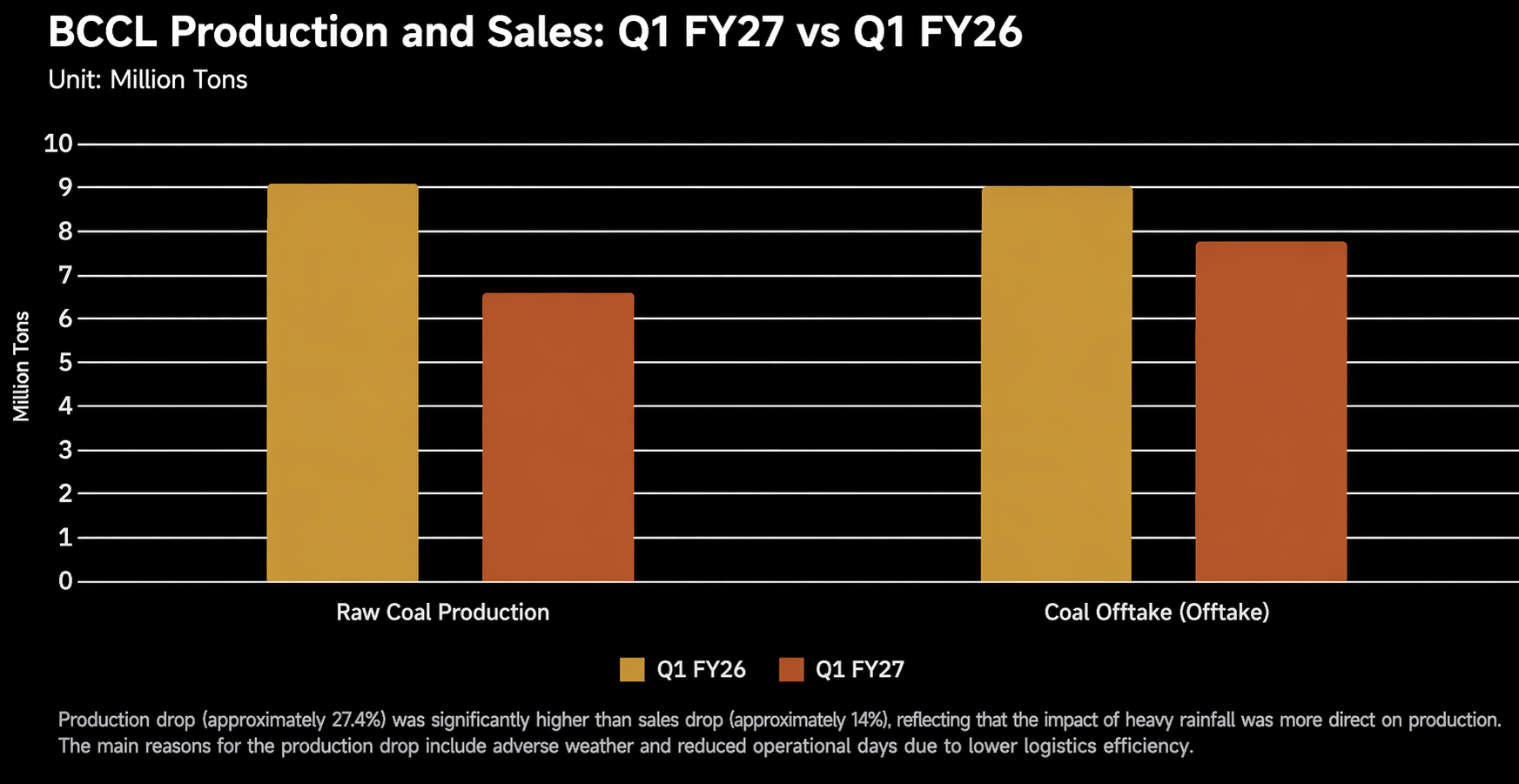
The quarterly loss was the combined result of production, production costs, and finance costs. On the output side, heavy rainfall from an early monsoon, lower overburden removal, and logistics bottlenecks directly squeezed actual mine output. On the cost side, diesel prices rose sharply in early fiscal 2026. SMM noted that early gains were in the range of Rs 7.5–8 per liter, directly inflating contract-based mining and transportation expenses.
The shift in the expense structure was particularly critical. Total expenses rose to Rs 38.263 billion from Rs 36.544 billion a year earlier, an increase of about 4.7%. Within this, although employee benefits (Rs 15.538 billion) and contract expenses (Rs 9.176 billion) were lower YoY, other expenses rose about 10.4% YoY, finance costs jumped about 84% YoY, and depreciation increased about 26.7% YoY – the main drivers weighing on profits. In other words, the revenue side was relatively stable; what truly breached the break-even point was the rise in rigid costs such as finance and depreciation, combined with the adverse impact of lower sales on fixed-cost absorption.
Despite operational pressure in the quarter, BCCL pushed forward with multiple strategic projects focused on medium and long-term capacity, highlighting a clear divergence between near-term financials and long-term positioning. On product mix upgrading, the new Bhojudih coal washery started commercial operations on May 26, 2026, with an annual processing capacity of 2 million mt. Using spiral separation, dense medium cyclone, and flotation processes to produce medium-grade washed coking coal, its commissioning raised BCCL’s total washing capacity to about 17.35 million mt (including 1.7 million mt operated by Tata Steel).
On mining model innovation, the ASGKCC mine in the Katras area, developed under a Mine Developer and Operator (MDO) revenue-sharing model, started producing coal this quarter, with Q1 FY27 production of 11,980 mt, and BCCL receiving 9% of the mine’s revenue as per agreement. In addition, the company completed surface compatibility testing of longwall mining equipment at the Moonidih mine, clearing a key step toward commercial deployment of this mechanized project. On asset optimization, the company handed over the old Dugda washery to JSW Steel on June 17 as part of a plan to revitalize existing assets—though none of these moves were reflected in the quarter’s financials.
India’s Coking Coal Self-Sufficiency Weakness
BCCL is India’s largest coking coal producer, and its production fluctuations hold indicator significance for the domestic steel industry chain. Coking coal is an irreplaceable reducing agent and energy source for the blast furnace–converter (BF-BOF) route, and India happens to be one of the major economies most reliant on coking coal imports globally. According to Indian government and industry bodies, about 95% of India’s steelmaking coking coal relies on imports, with imports rising from around 51.2 million mt in FY2020-21 to about 57.58 million mt in FY2024-25. In January 2026, India listed coking coal as a critical and strategic mineral to accelerate domestic mining, attract private investment, and reduce import dependency.
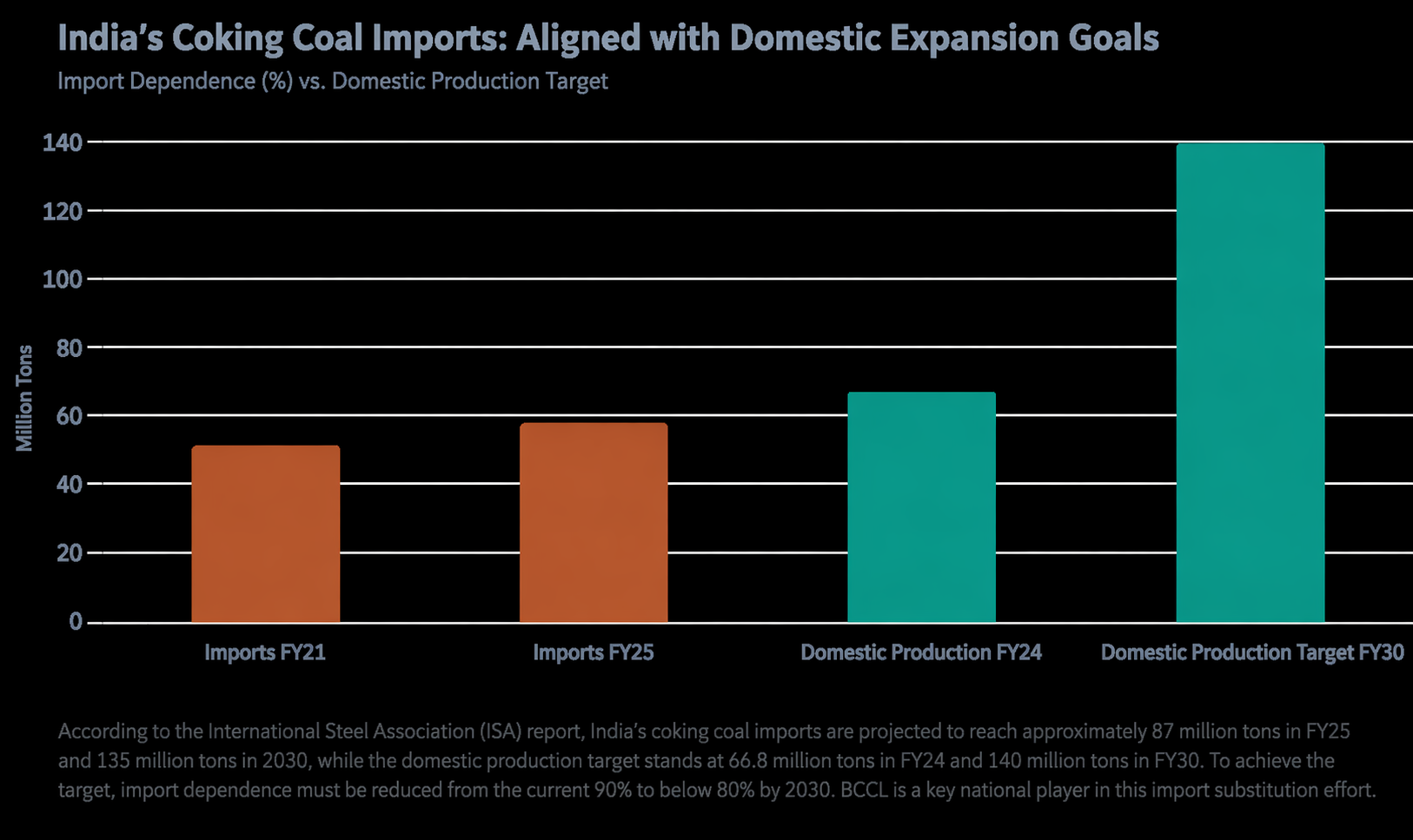
Against this backdrop, BCCL’s quarterly production cut, while a short-term disruption, when viewed nationally, once again exposed the vulnerability of India’s domestic coking coal supply to monsoon, logistics, and cost shocks. If supply from major domestic miners remains unstable, steel mills will have to rely more on imported premium hard coking coal from places like Australia and the US, increasing their exposure to cost fluctuations and creating tension with India’s Atmanirbhar coal strategy. As steelmakers like JSW and Tata pursue an expansion target of 300 million mt of crude steel capacity by 2030, India's coking coal imports in 2026 are expected to be around 81.6 million mt, making every incremental increase in domestic supply increasingly critical.
![[SMM Analysis] 33% Overproduction: Oman’s DRI Plant Operated Continuously for 188 Days, Rewriting Global DRI Standard](https://imgqn.smm.cn/usercenter/DpLok20251217171715.png)