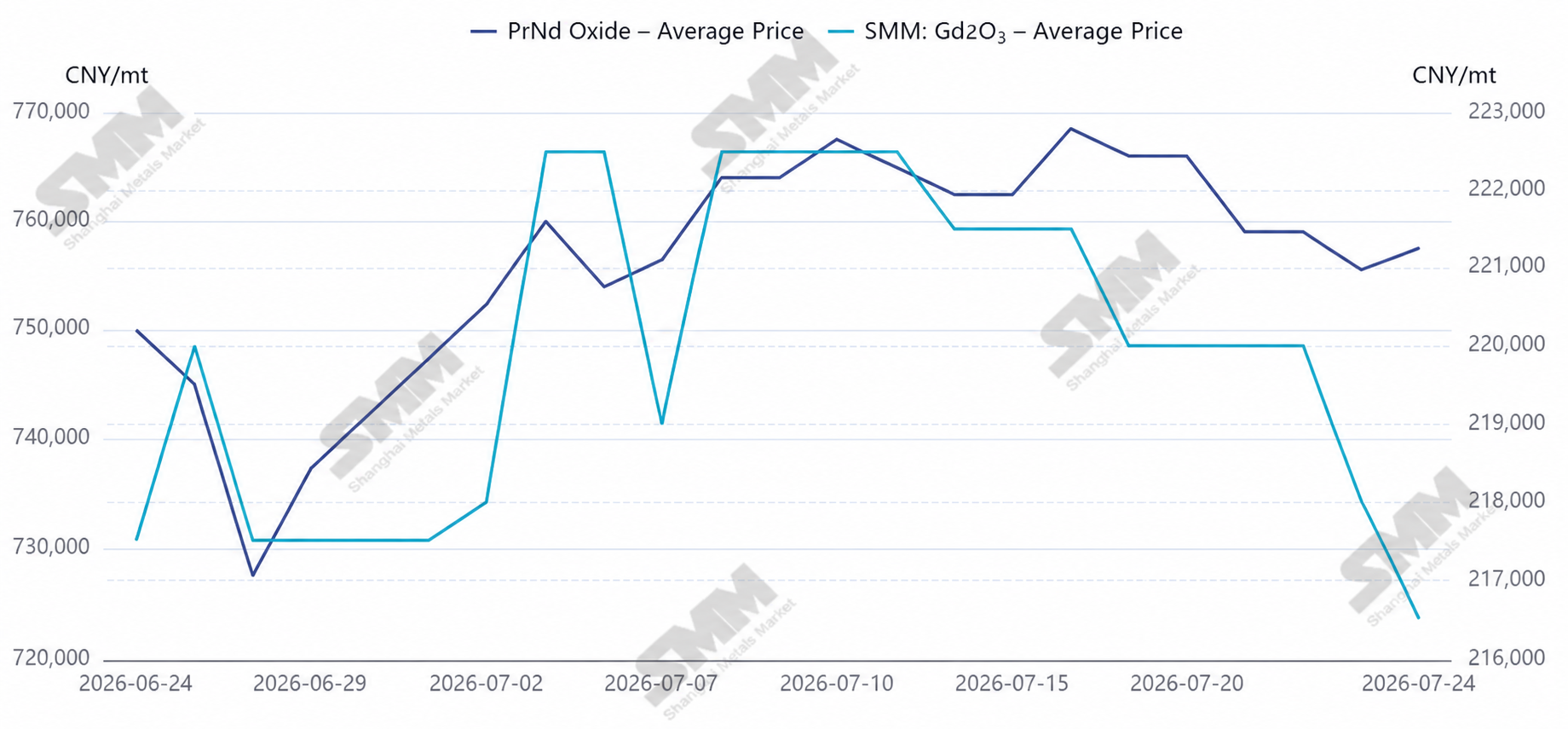
SMM Jul. 24: This week, the rare earth oxide market was under pressure and in the doldrums overall, with the price centers for Pr-Nd, dysprosium, and terbium all shifting lower to varying degrees, though a clear divergence signal emerged near the weekend. Pr-Nd oxide fell steadily from early week to Thursday, dropping from about 763,000-766,000 yuan/mt to 752,000-755,000 yuan/mt, a cumulative decline of roughly 11,000 yuan/mt. On Friday, driven by a rise in futures prices and positive news, spot suppliers' willingness to sell at low prices diminished, and offers rebounded slightly, but actual transaction follow-through was limited, with downstream magnetic material enterprises remaining inactive in inquiries.
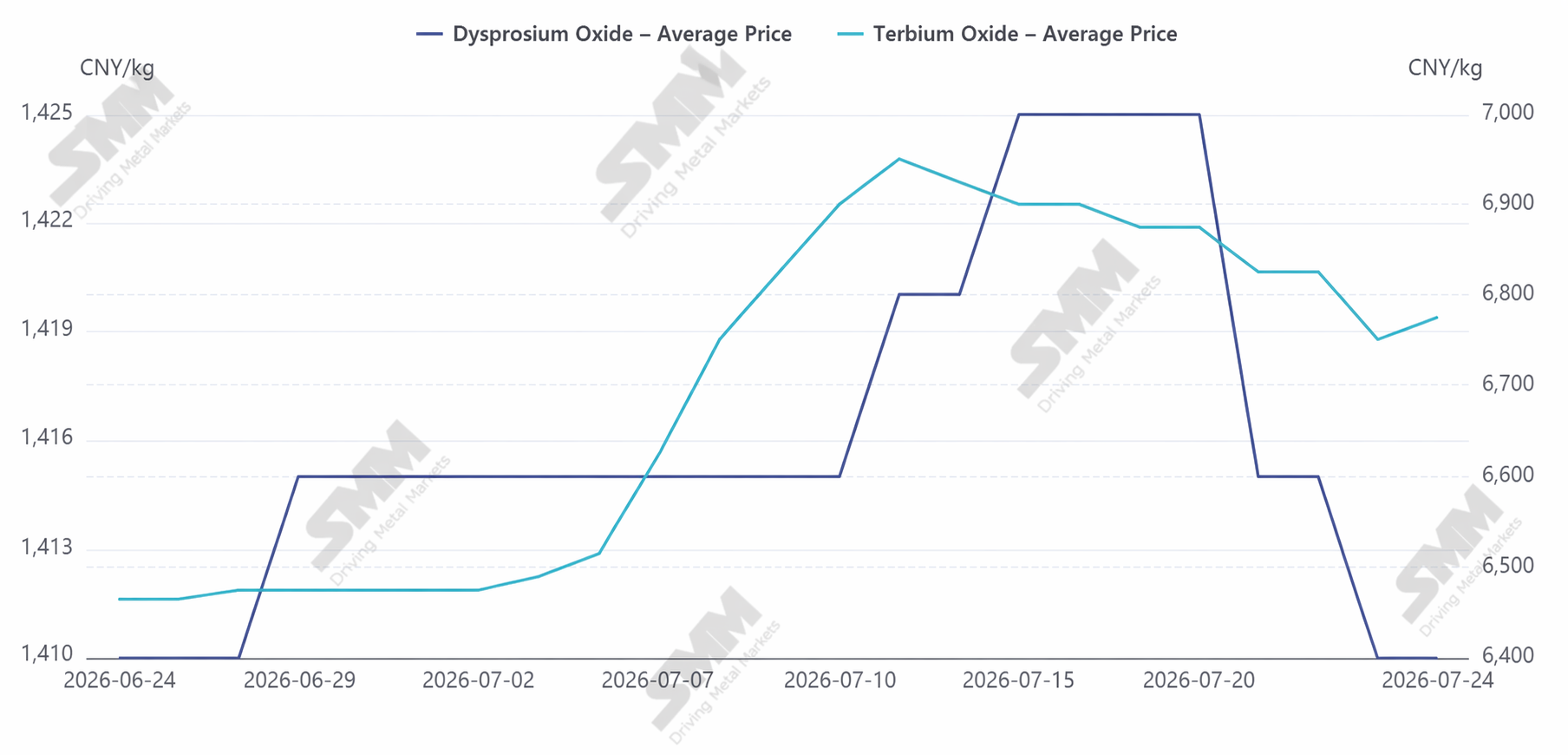
Dysprosium oxide ground lower throughout the week. Prices held steady early in the week, but against a backdrop of persistently sluggish inquiries and stagnant trading, the price center gradually moved lower. As of today, dysprosium oxide price has pulled back to the range of 1.4-1.42 million yuan/mt. Terbium oxide fluctuated the most this week, falling steadily for the first four days. As of Thursday, offer prices had pulled back to the 6.7-6.8 million yuan/mt range. On Friday, as top-tier players entered to purchase, low-priced supply quickly tightened, suppliers raised their offers accordingly, and prices saw a slight rebound.
Overall, the main factor weighing on the rare earth market this week was weak downstream demand. July marks the off-season for consumption; magnetic material enterprises had insufficient new orders and adopted extremely cautious procurement strategies, only restocking for immediate needs, leaving inquiries and transactions persistently sluggish. Meanwhile, the Pr-Nd oxide spot market was gripped by heavy wait-and-see sentiment, and the tug-of-war between upstream and downstream was intense. Some traders slightly cut prices to sell, but factories, supported by costs, were keen to hold prices firm, making low-priced sources consistently hard to find and resulting in a stalemate in actual transactions. At present, overall trading activity in the rare earth oxide market is low, and the sustainability of Friday's price rebound remains to be observed.
Looking ahead to the near term, under the upstream-downstream stalemate, Pr-Nd product prices are expected to continue moving sideways, with limited room for a sharp rise or fall. Supportive factors lie on the supply side: recently, some raw ore separation enterprises halted operations, and scrap recycling enterprises' production remained persistently low, leaving overall oxide supply relatively tight and providing bottom support for prices. Meanwhile, suppressing factors come from the demand side: in the short term, new orders for magnetic material enterprises are unlikely to recover quickly, buyers' acceptance of high prices is low, and the market lacks momentum for a sustained rally. On the heavy rare earth front, dysprosium and terbium, after this week's adjustments, are expected to stabilize gradually as major buyers step in. In the medium term, most industry participants hold expectations for a demand recovery in the traditional peak season at the end of Q3, and combined with the prospect of improving new export orders, the rare earth price center still has the potential to shift upward steadily after a period of consolidation. But in the short term, operationally, close attention should be paid to the pace of downstream restocking and the purchasing moves of top-tier players.