Despite overcapacity, China’s large-scale exports of non-oriented electrical steel are underpinned by its complete industrial chain of the iron and steel sector.
China has witnessed continuous capacity expansion of non-oriented electrical steel in recent years, leading to prominent overcapacity of mid-to-low grade conventional products. Coupled with limited incremental domestic demand from traditional home appliances and industrial motors, newly added output cannot be fully absorbed merely driven by high-grade variants for new energy vehicles. As a result, the overall domestic market remains in loose supply with mounting supply-demand pressure.
Benefiting from China’s full-fledged integrated steel industrial chain, consistent product quality and economies of scale in cost control, domestically made non-oriented electrical steel has gained steadily improved cost-performance competitiveness globally. Meanwhile, rigid incremental demand has emerged from manufacturing relocation in Southeast Asia, Latin America, South Asia and other regions, as well as the popularization of high-efficiency motors overseas. Against this backdrop, the industry has continued to divert excess domestic capacity via exports, maintaining steady regular overseas shipments year-round.
Imports of Non-Oriented Electrical Steel: Concentrated Sources from Japan and Chinese Taiwan, Mainly for Supplementary High-Grade Products
1. Total import volume
Monthly imports of non-oriented electrical steel in the first half of 2026 posted a fluctuating trend of surging first then falling back, with May hitting the highest monthly import volume of the year.
In terms of import source structure for January-June, import origins are highly concentrated. Japan ranks as the dominant top source with a far-leading import volume, followed by Chinese Taiwan as the second core supplier. South Korea takes the third place with marginal import volumes, while Germany, Sweden, France, Russia, India, Vietnam and other economies record negligible import quantities. This fully demonstrates that China only imports high-grade non-oriented electrical steel from Japanese manufacturers and Chinese Taiwan, with self-sufficiency achieved for all mid and low grades.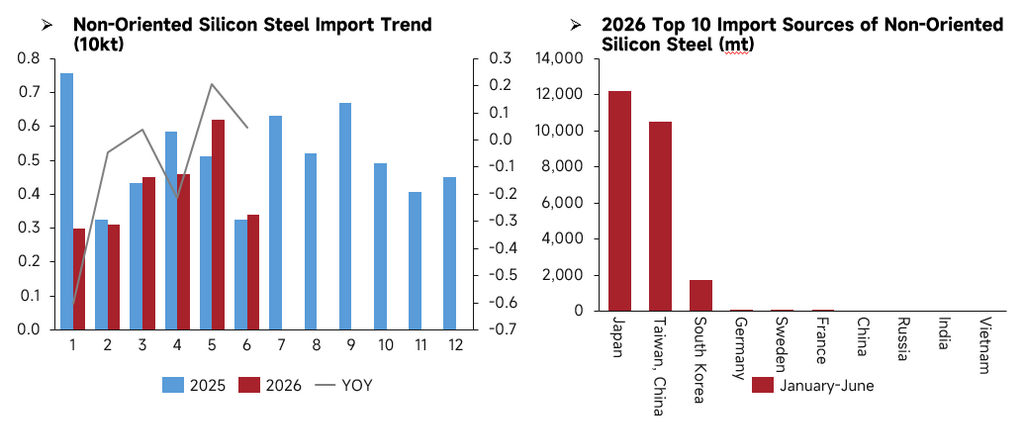 Data Source: General Administration of Customs of the People's Republic of China
2. Breakdown by Product Specifications
Imports of the two major specifications of non-oriented electrical steel from January to June 2026 were characterized by highly concentrated supply sources and obvious tiered pricing.
Wide-width products (HS Code 72251900, width ≥ 600 mm)
Core supplies came from Japan and Chinese Taiwan, with half-year import volumes reaching 11,719.4 tons and 10,318.8 tons respectively. Their month-on-month increments in June stood at 948.9 tons and 2,378.7 tons, serving as the primary drivers of import growth in that month. In terms of prices, the average unit price for Japanese material was RMB 9,220 per ton, and that for material from Chinese Taiwan was RMB 8,090 per ton, showing a stable price gap. Small batches of high-grade material imported from France and Sweden carried substantially higher unit prices, while low-priced marginal supplies from Russia, Vietnam, India and other economies were negligible in volume.
Narrow-width products (HS Code 72261900, width < 600 mm)
The overall import volume was far lower than that of wide-width products, and imports were still dominated by Japan and Chinese Taiwan, with half-year imports of 453.7 tons and 202.4 tons correspondingly. Shipments picked up moderately in June, whereas import volumes from the second-tier suppliers including Germany, South Korea and Sweden remained basically flat.
Price divergence was far more drastic for narrow-width grades: average prices from Japan and Chinese Taiwan hit RMB 18,660/ton and RMB 11,870/ton respectively. Average prices of high-end European and American materials approached RMB 20,000 per ton, and the unit price of goods declared for domestic circulation and customs clearance exceeded RMB 31,000 per ton. Only sporadic imports were recorded from other countries.
Overall Summary
In the first half of the year, non-oriented electrical steel imports were heavily reliant on mid-range conventional products sourced from Japan and Chinese Taiwan. The volume growth in June was entirely contributed by increased wide-width shipments imported from these two regions. A massive price gap existed between domestic and overseas high-grade narrow-width materials. Small volumes of high-priced special grades were imported sporadically from Europe, while low-cost marginal supplies from minor origins exerted minimal impact on the market. The market demonstrated striking features of highly concentrated supply and obvious stratified pricing.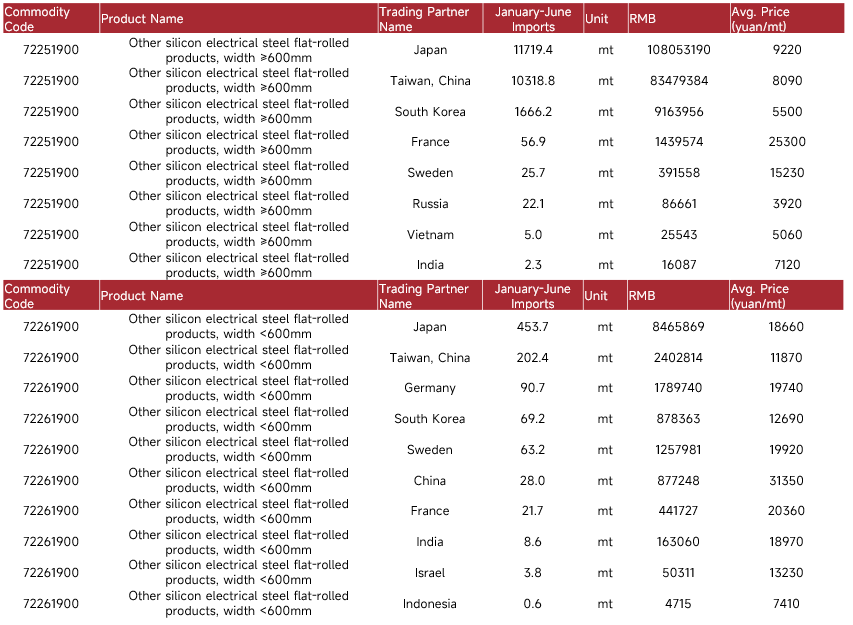
Data Source: General Administration of Customs of the People's Republic of China
Exports of Non-Oriented Electrical Steel: Extensive Overseas Demand Coverage with Notable Diversified Regional Distribution
1. Total Export Volume
Monthly exports of non-oriented electrical steel fluctuated throughout the first half of 2026. The aggregate monthly shipment volume from January to June was generally lower than the same period in 2025. Exports surged year-on-year in February to hit the highest point in the first six months, followed by volatile performance from April to June.
In terms of cumulative export destinations for January–June 2026, overseas demand covered a wide range of markets featuring remarkable regional diversification.
Vietnam ranked as China’s top export destination for non-oriented electrical steel with the largest purchasing volume in the first half of the year. Italy, Belgium, Mexico and Brazil formed the second major tier, with minimal gaps and comparable demand volumes among the four countries. South Korea, Serbia and Thailand fell into the third tier, while purchasing volumes from Pakistan and India were relatively low.
The export markets spanned Southeast Asia, Western Europe, Latin America, South Asia and other regions. Decentralized procurement by overseas industrial chains for home appliances and motor manufacturing provided steady underlying support for China’s exports of non-oriented electrical steel.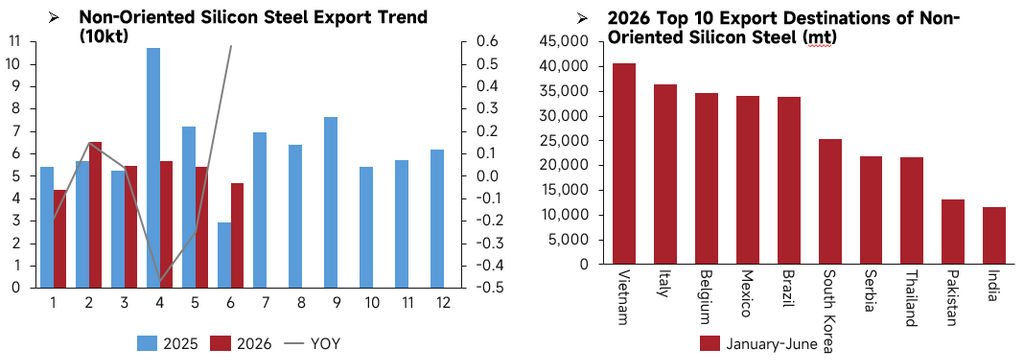 Data Source: General Administration of Customs of the People's Republic of China
2. Breakdown by Product Specifications
Exports of the two major specifications of China’s non-oriented electrical steel in January–June 2026 were marked by clear volume tiers, as well as prominent divergence in regional flow and transaction prices.
Wide-width non-oriented electrical steel (HS Code 72251900, width ≥ 600 mm)
This specification constituted the absolute mainstream export product with robust growth in overseas demand. In the first half of the year, exports to Italy reached 36,428.2 tons, ranking firmly first, followed by Mexico at 33,499.6 tons and Brazil at 33,097.3 tons. Belgium, South Korea and Thailand formed the second-tier destinations, while Vietnam, Pakistan, India and Malaysia served as supplementary markets. Export destinations covered Europe, Latin America, Southeast Asia, South Asia and other regions, with Mexico recording the most remarkable volume increase in June.
Prices for this wide-width grade showed narrow gaps and generally stable performance. Pakistan had the lowest average price at RMB 3,920 per ton, while Belgium and South Korea saw the highest price of RMB 5,230 per ton. Transaction prices for other countries mostly fell within the range of RMB 4,100–4,800 per ton.
Narrow-width non-oriented electrical steel (HS Code 72261900, width < 600 mm)
Its total export volume was far lower than that of wide-width products, with highly concentrated export destinations. Vietnam (24,797.1 tons) and Serbia (21,808.7 tons) were the core absorbing markets, and the volume growth in June was mainly driven by these two markets.
Pricing presented huge tiered gaps: the average export price to Japan stood at RMB 13,480 per ton, and RMB 11,680 per ton to Serbia, reflecting substantial premium for high-grade products. Mid-range materials shipped to Belgium and Slovenia were priced at RMB 8,000–9,000 per ton, whereas low-end conventional grades exported to Iran, Bangladesh and other countries were only around RMB 4,000 per ton.
Overall Conclusion
Wide-width products achieved volume expansion via diversified exports across multiple regions with relatively unified quotations. Narrow-width products relied heavily on two core markets, Vietnam and Serbia, and high-end exported grades enjoyed strong premium capability. Distinct structural differentiation was observed across the two specifications in terms of export volume, target markets and transaction prices.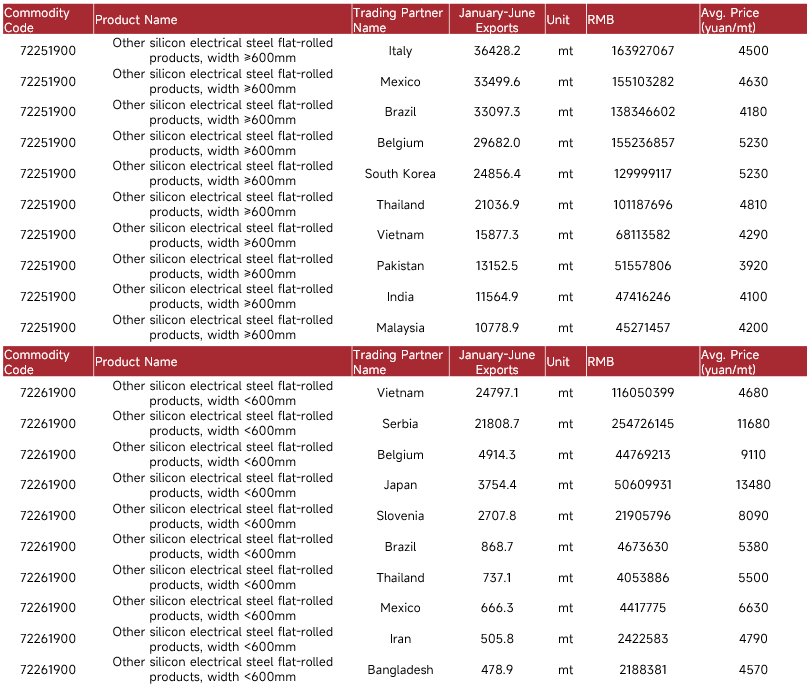
Data Source: General Administration of Customs of the People's Republic of China
Conclusion
On the import side, imports of wide and narrow width non-oriented electrical steel are predominantly sourced from Japanese manufacturers and Chinese Taiwan, which together account for the overwhelming majority of total import volume. The import volume growth in June was mainly driven by increased arrivals of wide-width products from Japan and Chinese Taiwan, resulting in an extremely high concentration of import supply sources.
On the export side, wide-width non-oriented electrical steel serves as the absolute backbone of overseas shipments, with exports dispersed to multiple countries across Europe, Latin America and Southeast Asia. Italy, Mexico and Brazil are the core purchasing markets, and Mexico, South Korea and other destinations posted notable export volume increments in June, accompanied by relatively stable average transaction prices. By contrast, narrow-width non-oriented electrical steel registers a much smaller export volume, whose excess capacity is largely absorbed by Vietnam and Serbia. Significant price premiums are obtained from high-end overseas orders, and there is a clear divergence in purchasing volumes and transaction prices among different destination countries.
In summary, China’s non-oriented electrical steel industry is basically export-oriented, with only a small volume of high-grade products imported from Japan and Chinese Taiwan as supplementary supplies.
![[SMM Steel] Vietnam Steel Prices Hold Steady as Weak Demand Limits Recovery](https://imgqn.smm.cn/usercenter/ENDOs20251217171718.jpg)