Southeast Asia’s flat-steel trade is becoming increasingly policy-driven, as anti-dumping duties, anti-circumvention measures and certification requirements shape market access alongside price and freight. Malaysia reflects this shift clearly: it is strengthening protection for domestic CRC and coated-steel producers while remaining dependent on imported HRC, specialised grades and specifications that local mills cannot yet fully supply. The result is a more selective import market, with sourcing decisions increasingly determined by product scope, origin, exporter treatment and downstream requirements.
Source: SMM
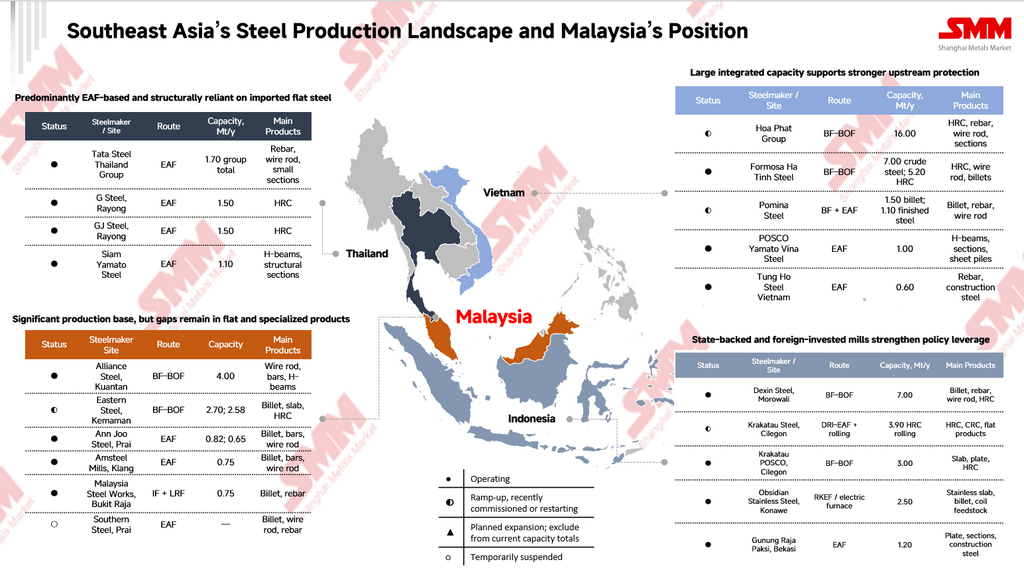
Across Southeast Asia, steel protection is taking different forms depending on each country’s industrial structure, domestic production capacity and reliance on imports. Vietnam has adopted stronger trade remedies as its local flat-steel capacity expands, while Indonesia continues to protect strategic domestic producers through a combination of tariffs and state-backed industrial policy. Thailand, meanwhile, has focused heavily on closing circumvention routes involving alloy-added and reclassified steel products.
Malaysia occupies a more balanced position. Unlike markets with larger upstream production bases, it still depends on imports for selected flat products, specialised grades and technical specifications. Its policy approach is therefore more selective: protect products that can be supplied locally, while preserving access to imports that remain necessary for downstream manufacturing.
This makes Malaysia a key test case for whether trade protection can strengthen domestic steel production without significantly raising costs for pipe mills, service centres, fabricators and other steel-consuming industries.
Malaysia’s Import Positioning and Balance

Source: SMM
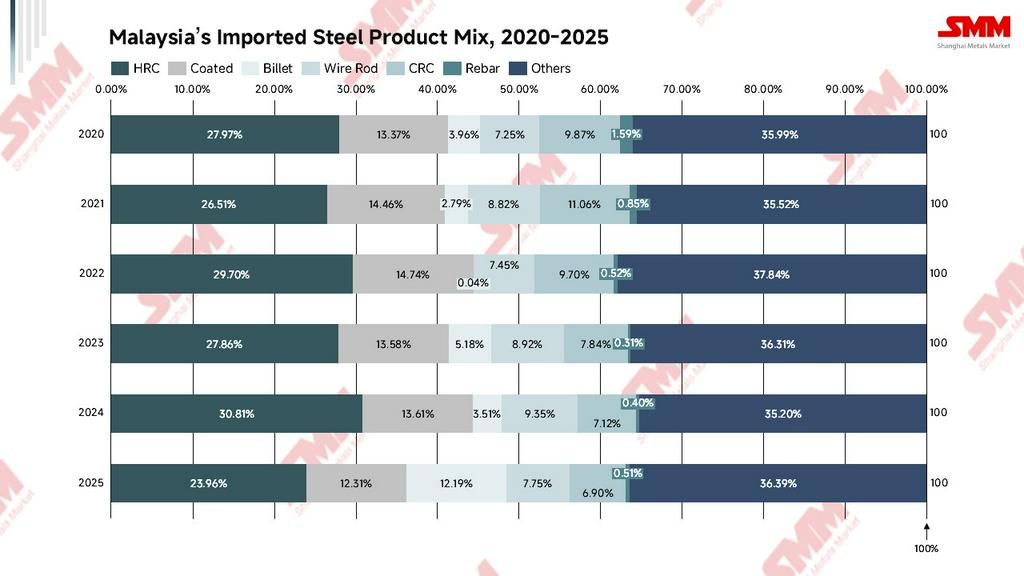
Malaysia’s import structure highlights the uneven coverage of its domestic steel industry. Although the country has significant steelmaking capacity, local production remains concentrated in selected long products and commodity grades, while imported material continues to play an important role in flat steel and semi-finished feedstock.
Between 2020 and 2025, HRC remained Malaysia’s largest identifiable imported steel category, accounting for around 30% of total steel-product imports. Coated steel, CRC and wire rod also represented sizeable shares, while rebar imports remained below 1% over the six-year period. This supports the view that Malaysia has relatively stronger domestic coverage in construction bars, but remains more dependent on overseas supply for flat products and selected upstream materials.
The import mix also shifted noticeably in 2025. HRC’s share fell from around 31% in 2024 to approximately 24%, while billet imports rose sharply to more than 12% of steel-product imports. This suggests that Malaysia’s dependence is not limited to finished flat steel; it can also extend to semi-finished material when local supply, pricing or operating conditions change.
These structural gaps help explain why Malaysia’s trade protection remains selective rather than comprehensive. Measures targeting specific products and origins may support domestic producers, but broad restrictions could raise costs for downstream manufacturers that still depend on imported feedstock
Malaysia’s Current Steel Anti-Dumping Measures and Reviews
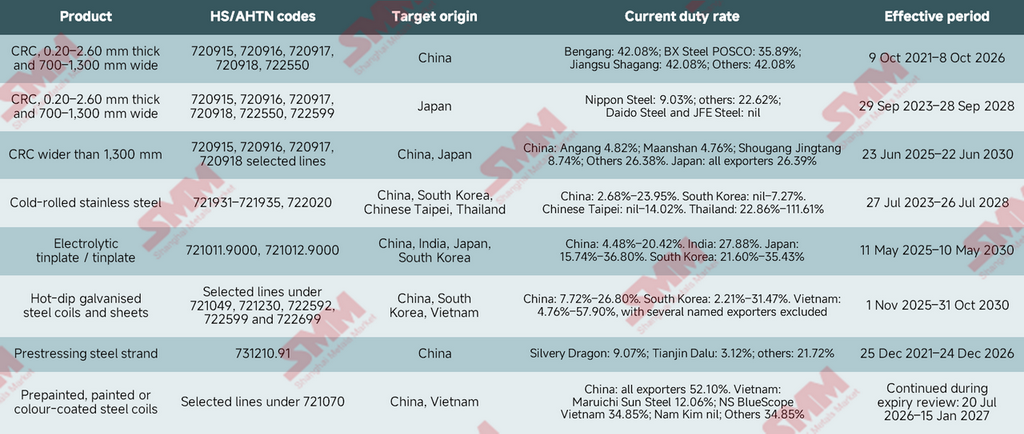
Selected measures in force as of July 2026 (Malaysia)
Source: WTO
Malaysia’s anti-dumping coverage is uneven because its domestic steel industry is not equally developed across every stage of the value chain. The country has a relatively broad downstream flat-steel sector, including cold rolling, galvanising, colour coating, tinplate and stainless-steel processing. These producers rely on imported or locally sourced upstream feedstock, but compete directly with imported finished and semi-finished flat products.
This helps explain why Malaysia’s active trade remedies are concentrated in CRC and higher-value coated products. Imported CRC, galvanised sheet, prepainted coil, tinplate and cold-rolled stainless steel compete directly with established Malaysian rolling and coating lines. When these products enter at low prices, the impact is felt not only by upstream steelmakers but also by domestic processors that have already invested in value-added production capacity.
Source: SMM
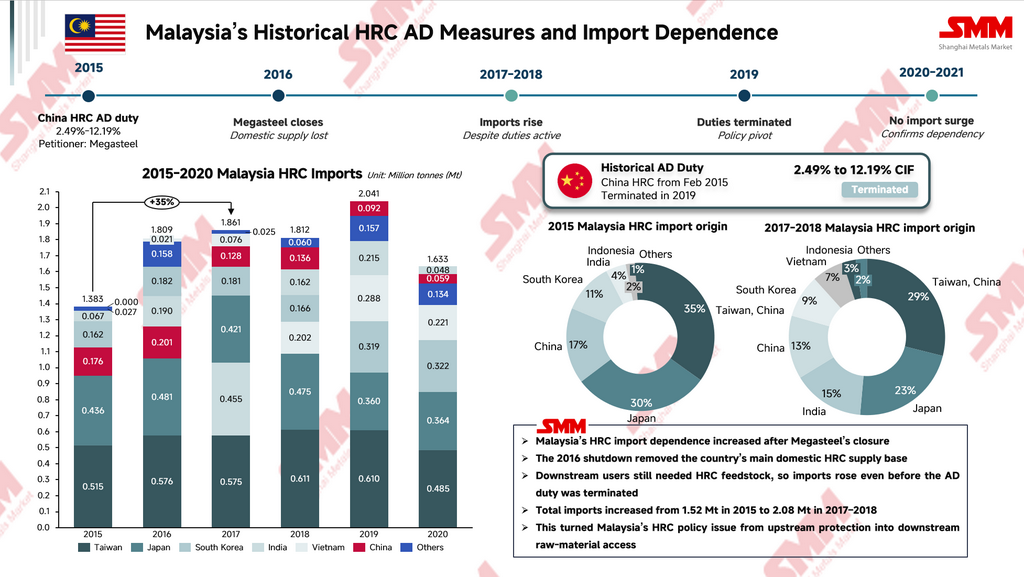
By contrast, Malaysia currently has no definitive anti-dumping duty on HRC. Historically, at a certain point in time, Megasteel was Malaysia’s only domestic HRC producer. Its Banting plant had a major position in the local flat-steel supply chain, and Malaysia previously imposed HRC duties on imports from China and Indonesia. However, Megasteel ceased operations in 2016 after years of losses, while the earlier HRC anti-dumping measure was terminated in 2019. With no consistently operating domestic HRC producer able to serve the market at that time, maintaining broad HRC protection would have risked raising feedstock costs for cold rollers, pipe mills and service centres without providing equivalent domestic supply.
This historical gap made imported HRC essential to Malaysia’s downstream steel industry. Cold rollers and coated-steel producers needed access to competitively priced coil, while pipe makers and service centres depended on imported HRC for standard and specialised specifications. In such a market, imposing strong HRC barriers could protect an inactive or insufficient upstream asset while weakening a larger group of downstream users.
The situation has begun to change with Eastern Steel’s entry into domestic HRC production. Malaysia now has a renewed upstream flat-steel base, reducing its previous dependence on Megasteel and imports alone. Nevertheless, the policy environment has not yet shifted toward broad HRC protection, partly because the new capacity is still relatively recent and the market must assess its product range, utilisation and ability to meet downstream requirements consistently. MIDA had already identified the arrival of a new domestic flat-steel producer as a potentially significant change to Malaysia’s steel industry.
Billet, wire rod and rebar also face less extensive current protection for a different reason. Malaysia has several domestic long-steel producers, but the market has also struggled with excess capacity, weak utilisation and varied operating conditions. In these segments, import competition is only one part of the problem; domestic overcapacity, production costs and demand weakness also affect mill performance. Malaysia’s wider steel roadmap has therefore emphasised restructuring, capacity management and movement toward higher-value production rather than relying solely on trade remedies.
Are Malaysian Cold Rollers Buying More HRC?
In practice, however, current market feedback suggests that this policy effect is being overshadowed by weak downstream demand. Malaysian market participants told SMM that HRC purchasing remains slow mainly because of limited project activity and subdued end-user orders, rather than changes in CRC anti-dumping duties.
Trade protection alone is therefore unlikely to generate a significant increase in HRC procurement. Even where imported CRC becomes less competitive, domestic cold rollers are unlikely to raise output materially until demand from construction, manufacturing and other steel-consuming sectors improves.
Eastern Steel may still benefit from a gradual shift toward domestic processing, while imported HRC remains important for price competition and specification coverage. In the near term, however, purchasing is likely to remain cautious and requirement-based, with downstream order flow carrying more influence than trade protection alone.
Regional Trade Diversion: Where Will Restricted Flat-Steel Cargoes Go?
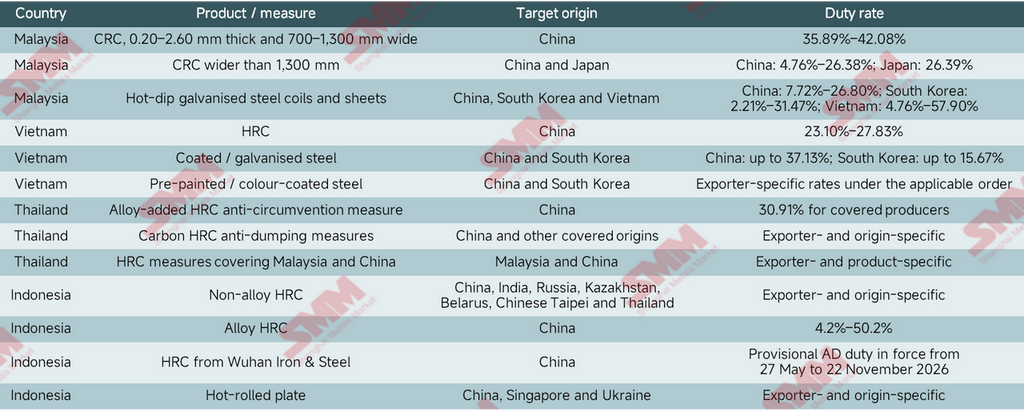
Regional Trade Barriers and Import Dependence Across Southeast Asia
Source: SMM
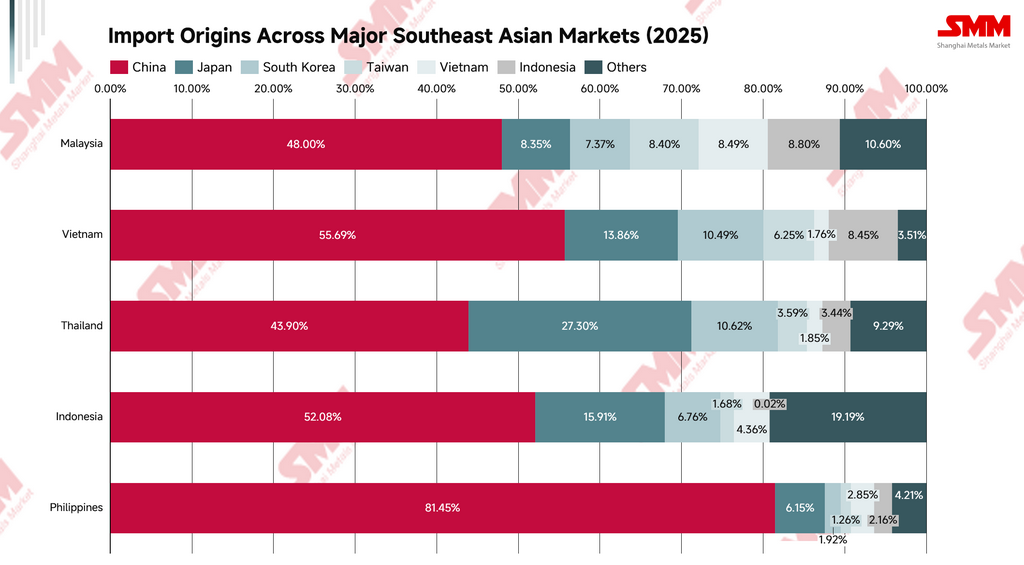
China remained the dominant steel supplier across all five major Southeast Asian markets in 2025, although the level of dependence varied considerably. Chinese material accounted for around 48% of Malaysia’s imports, 56% of Vietnam’s, 52% of Indonesia’s and more than 81% of the Philippines’ total. Thailand had a more diversified supplier base, with Japan accounting for a comparatively large share alongside China.
This concentration means Chinese exporters are the most exposed as regional trade barriers expand. However, restrictions in one market do not automatically redirect the same cargoes into another major Southeast Asian destination. Vietnam maintains anti-dumping duties on Chinese HRC, Thailand has extended protection against alloy-added and reclassified HRC, while Indonesia applies multiple measures across non-alloy and alloy flat steel. Malaysia’s restrictions are concentrated further downstream in CRC and coated products.
The Philippines appears to be the most accessible large alternative market, but its already high dependence on Chinese supply suggests that additional redirected volumes could intensify competition rather than create substantial new demand. Thailand’s more diversified import structure and existing HRC measures also limit its ability to absorb unrestricted cargoes, while Vietnam and Indonesia remain difficult destinations because of their expanding domestic industries and stronger upstream protection.
Exporters may therefore need to adjust both destination and product strategy. High-duty CRC and coated-steel suppliers could redirect limited volumes toward the Philippines or smaller ASEAN markets, but they may also shift toward HRC, specialised grades or products outside existing duty scopes. Some suppliers may increasingly look beyond Southeast Asia altogether.
SMM Outlook: Competition May Shift from Direct Imports to Localised Production
Source: SMM, SEASI, SteelOrbis, Hoa Sen Group
In the near term, Malaysia’s flat-steel market is still likely to be constrained by weak demand. Market participants report that HRC and CRC purchasing remains subdued because of limited project activity and soft downstream orders. CRC duties may support domestic cold rollers, but they are unlikely to generate a sharp increase in HRC demand until end-user consumption improves.
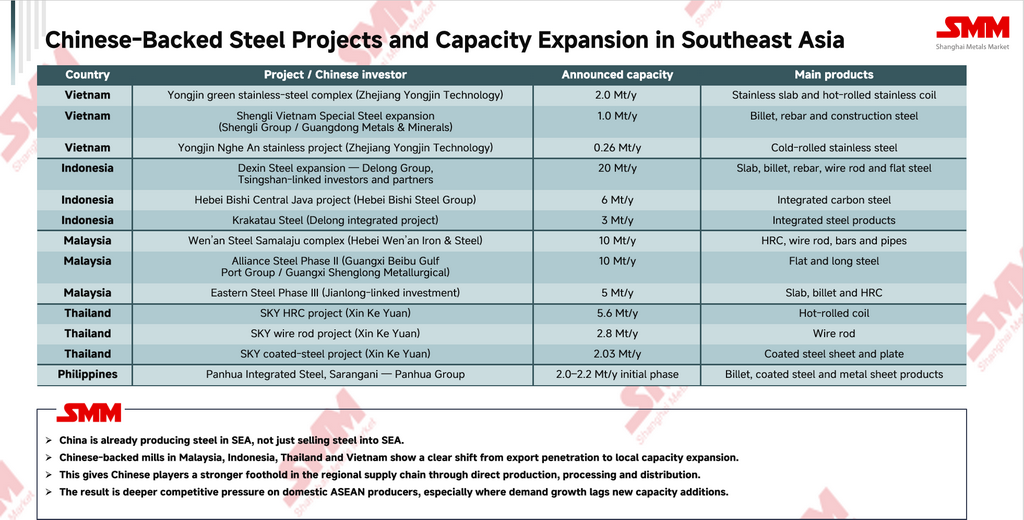
Over the longer term, the more important change may be the localisation of steel production. Chinese-backed projects are expanding across Malaysia, Indonesia, Thailand, Vietnam and the Philippines, covering HRC, coated steel, stainless steel and long products. This suggests that Chinese participation in Southeast Asia will increasingly extend beyond direct exports into local production, processing and distribution.
For Malaysia, proposed expansions involving Alliance Steel, Eastern Steel and the Samalaju project could materially strengthen domestic upstream capacity. If these projects proceed, local buyers may have greater access to domestically produced HRC and other steel products, while the distinction between imported Chinese steel and Chinese-backed steel made in Malaysia becomes less clear.
This could reduce some dependence on direct imports, but it may also intensify competition within the domestic market. New capacity would arrive at a time when demand growth remains uncertain, increasing the risk of oversupply and stronger price pressure on existing ASEAN producers.
Conclusion: Malaysia’s flat-steel policy is becoming more selective rather than fully restrictive. CRC and coated-steel duties may support domestic processing, while HRC remains comparatively open to preserve feedstock access for cold rollers and other downstream users. In the near term, however, weak project activity and subdued end-user demand will remain the main constraints on both HRC and CRC consumption.
Over the longer term, Chinese-backed capacity expansion across Southeast Asia may reshape competition more fundamentally than tariffs alone. Trade barriers may reduce direct imports, but they are also encouraging production to move closer to end markets. Malaysia will therefore need to balance domestic investment, import flexibility and downstream competitiveness as the regional steel landscape becomes increasingly localised and policy-driven.