Key Points:
-
Jiuwu Hi‑Tech’s proprietary LATP electrolyte, applied in NCM811 pouch cells, passed GB38031‑2020 extreme overcharge (4.62V) and over‑discharge (0V) tests – no fire, smoke, explosion, swelling, or leakage; temperature rise ≤5°C.
-
The company pursues a dual‑track approach: oxides (LLZO & LATP) and sulfides (high‑purity Li₂S).
-
Ton‑scale oxide electrolyte production is already supplying top Chinese cell makers; a 100‑ton‑scale pilot expansion is under way.
-
Leveraging nearly 30 years of ceramic‑membrane expertise, Jiuwu is positioning itself as a key material supplier for solid‑state batteries.
-
Preface & Test Results
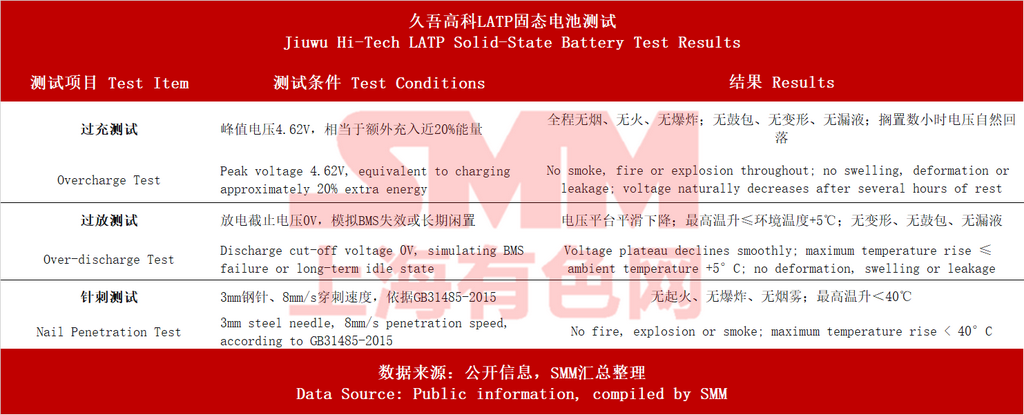
On July 17, 2026, Jiuwu announced that its LATP solid electrolyte had been successfully used in 1Ah NCM811/graphite pouch cells (initial SOC 95%). Under GB38031‑2020, the cells withstood:
-
Overcharge to 4.62V (≈20% extra energy) – no smoke, fire, explosion, swelling, leakage; voltage naturally relaxed after rest.
-
Over‑discharge to 0V – smooth voltage decline; temperature rise ≤ ambient +5°C; no deformation.
-
Nail penetration (3mm steel needle, 8mm/s, per GB31485‑2015) – no fire/explosion/smoke; temperature rise <40°C (vs. >400°C for liquid cells).
LATP (Li₁₊ₓAlₓTi₂₋ₓ(PO₄)₃) is a NASICON‑type oxide with ionic conductivity of 1.2‑1.3×10⁻³ S/cm, wide electrochemical window (>5V), excellent thermal stability (>800°C), and air stability. This test confirms LATP’s effectiveness in enhancing safety for high‑energy cells.
I. Technology Roadmap
Dual‑track development:
-
Oxides (LLZO & LATP): Self‑developed low‑temperature solid‑state synthesis with doping, nano‑sized particles (D50<500nm, D90<900nm), batch consistency >95%. LLZO conductivity: 1.0 mS/cm; LATP: 1.30 mS/cm.
-
Sulfides: High‑purity Li₂S (≥99.8%, customizable to 99.9%) for sulfide electrolytes like LGPS and LPSCl.
-
Applications: Separator coating, cathode/anode coating, electrode blending, and electrolyte membrane.
II. Cell Introduction
Tested in 1Ah NCM811 pouch cells with LATP‑coated separator. Safety tests passed GB38031‑2020 and GB31485‑2015. The LATP material provides a wide electrochemical window and excellent interfacial stability, effectively blocking thermal runaway and enabling both high energy density and extreme safety.
III. Production Capacity
-
Current: Ton‑scale production of LLZO and LATP powders; multiple stable shipments to top Chinese cell makers.
-
Expansion: 100–200‑ton pilot line planned for 2026–2027, with 1,000+‑ton long‑term goal aligned with customer demand. The company is accelerating pilot construction and market promotion in 2026.
IV. Company Profile & Patents
-
Founded in 1997 by academicians from Nanjing University of Technology, Jiuwu Hi‑Tech (300631.SZ) is China’s pioneer in ceramic membranes, holding the #1 market share in China and top‑3 globally.
-
Honors: National High‑tech Enterprise, “Little Giant”, National Manufacturing Single‑Champion, four National Science and Technology Progress Awards, etc.
-
Q1 2026 revenue: RMB 126M (+46.29% YoY); net profit RMB 15.83M; recurring net profit +13.11%.
-
IP: Over 60‑80 patents, covering LATP formulation, low‑temperature sintering (<1000°C), high‑adhesion coating on PE/PP separators, particle coating, and composite separator structures.
V. Financing & Cooperation
-
Customers: Supplying LATP/LLZO to leading battery makers (including CATL, BYD, EVE, Gotion) for pilot validation; expanding sulfide material cooperation.
-
Funding: In July 2026, the company held a convertible bond roadshow to discuss solid‑state electrolyte and membrane projects.
-
Major shareholder: Dehui Group, focusing on high‑tech investments.
VI. Recent Milestones
-
Jul 2026: Overcharge/over‑discharge test success announced.
-
Jul 17, 2026: Investor briefing – small‑batch supply to top cell makers, capacity expansion ongoing.
-
May 2026: Exhibited at CIBF2026 with full material matrix (LLZO, LATP, Li₂S), attracting global attention.
-
Apr 2026: Nail penetration comparison – LATP‑coated cells passed with <40°C rise vs. liquid cells >400°C (violent ignition).
-
Mar 2026: Participated in the All‑Solid‑State Battery Technology Conference.
-
Nov 2025: LATP coating improved low‑temperature rate performance by lowering interfacial impedance.
**Note:** For further details or inquiries regarding solid-state battery development, please contact:
Phone: 021-20707860 (or WeChat: 13585549799)
Contact: Chaoxing Yang. Thank you!
![Solid-State Battery Next Decade Series, Part 9 of 9: A Brand-New Track, Not a "Simple Sequel" to Liquid Lithium Batteries [SMM Analysis]](https://imgqn.smm.cn/usercenter/ezoBg20251217171730.jpg)
![[Solid-state: Chunli New Energy's 1GWh solid-state battery plant starts production in Jiangxi]](https://imgqn.smm.cn/usercenter/MaxcL20251217171730.jpg)