Key Points
要点:2026年被业界普遍视为固液混合电池的“量产元年”。然而,关于固液混合电池与全固态电池的产业定位与时间节奏,业内专家观点呈现明显分化。蜂巢能源董事长杨红新与中科院物理研究所黄学杰等专家倾向于“固液混合长期主流论”,而宁德时代董事长曾毓群、国轩高科首席科学家朱星宝等则从技术成熟度与成本角度对全固态电池保持审慎乐观。
2026 is widely seen as the start of mass production for hybrid solid‑liquid batteries, but experts are split on the long‑term role of hybrid vs. all‑solid‑state batteries.
Pro‑hybrid camp (long‑term mainstream):
-
Huang Xuejie (CAS): 2026 is the launch year; all‑solid‑state won’t “overturn” before 2035. Hybrid batteries can reuse >90% of existing liquid‑battery production lines, avoiding huge capex.
-
Yang Hongxin (SVOLT): Hybrid is not transitional but will remain dominant until at least 2035. SVOLT’s first hybrid cell (245 Wh/kg, 6C peak charge) goes into production in Q3 2026, with cost parity with liquid batteries.
Cautious camp on all‑solid‑state:
-
Zeng Yuqun (CATL): Solid‑state tech is only at TRL‑4 (lab stage); 1 million vehicles by 2030 is “very unlikely.” Key interface issues remain unsolved.
-
Zhu Xingbao (Gotion): Solid electrolytes don’t inherently enable high energy density or fast charging; their value is in enabling high‑nickel anodes safely. Hybrid routes are technically more demanding than assumed.
Cost inflection debate:
-
SVOLT expects no cost advantage for all‑solid‑state even by 2035.
-
Gotion and SMM predict costs will drop to ~¥1/Wh (comparable to high‑nickel ternary) around 2030–2031, provided sulfide raw material costs fall sharply.
-
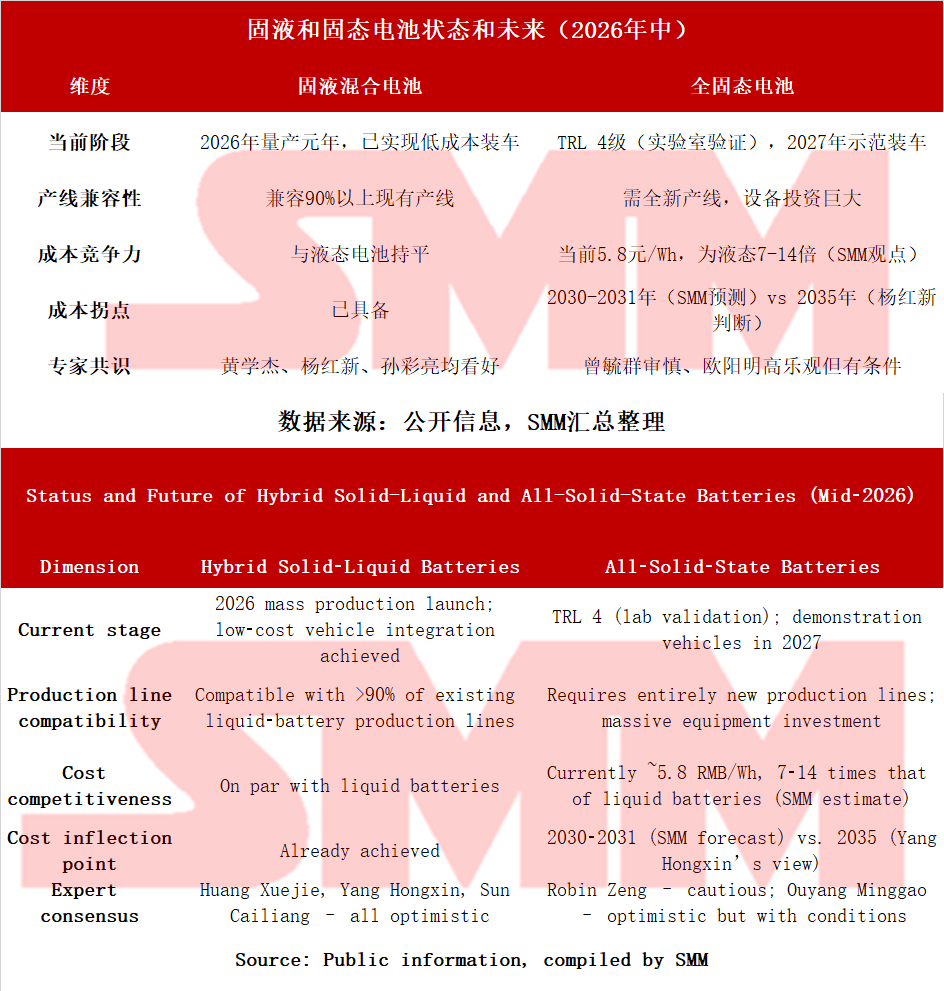
Conclusion: Hybrid solid‑liquid batteries will lead the near‑term commercial wave, while all‑solid‑state remains a long‑term goal dependent on fundamental breakthroughs—not fixed timetables.
**Note:** For further details or inquiries regarding solid-state battery development, please contact:
Phone: 021-20707860 (or WeChat: 13585549799)
Contact: Chaoxing Yang. Thank you!
![Solid-State Battery Next Decade Series, Part 9 of 9: A Brand-New Track, Not a "Simple Sequel" to Liquid Lithium Batteries [SMM Analysis]](https://imgqn.smm.cn/usercenter/ezoBg20251217171730.jpg)
![[Solid-state: Chunli New Energy's 1GWh solid-state battery plant starts production in Jiangxi]](https://imgqn.smm.cn/usercenter/MaxcL20251217171730.jpg)