LME copper prices remained elevated and rangebound throughout the first half of July. In the week beginning July 7, LME copper opened at $13,365/mt on Monday before edging higher. In the following week, beginning July 14, LME copper opened at $13,459/mt and maintained a relatively strong trend, although prices retreated toward the end of the week. Overall price fluctuations remained limited.
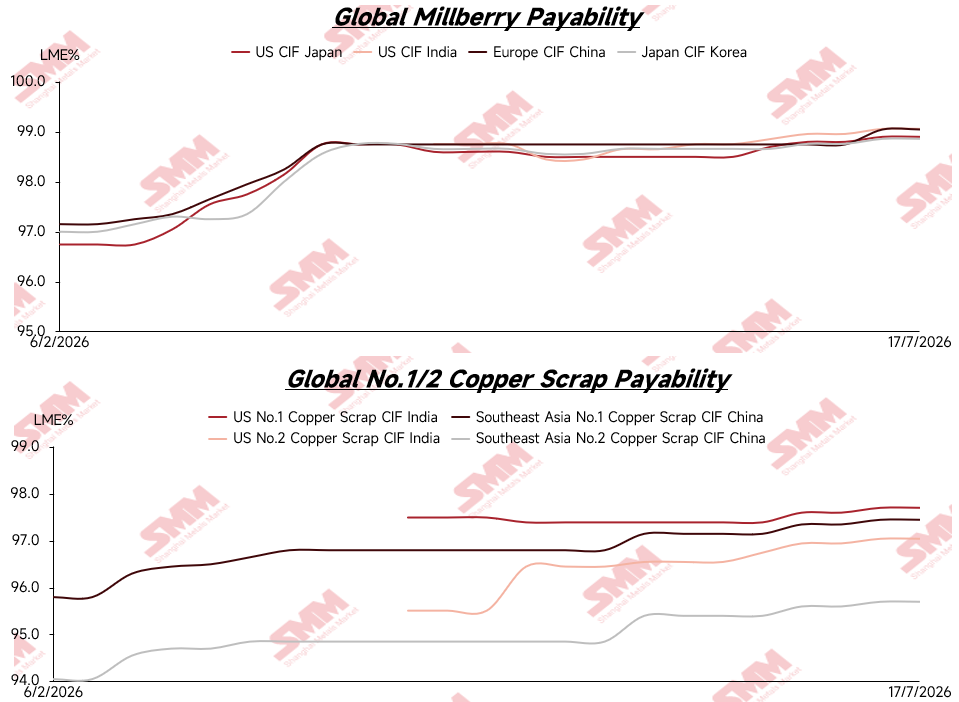
Despite elevated copper prices, overseas copper scrap payabilities did not follow the traditional pattern of “higher copper prices leading to lower payabilities.” In early July, stronger procurement demand from China and persistently tight overseas supply pushed mainstream copper scrap payabilities up by around 0.2 percentage points. By mid-July, buyers had become more cautious, weakening the momentum for further increases. Nevertheless, payabilities remained elevated and showed no noticeable decline.
Specifically, mainstream payabilities for overseas Millberry remained high at 98.5-99%, approaching the upper end of the range acceptable to most traders and downstream consumers. This has limited the potential for further increases. No. 1 copper scrap payabilities were mainly quoted at around 98%, while No. 2 copper scrap payabilities ranged from approximately 96% to 98.5%, depending on cargo quality, impurity levels, and the content of precious metals such as gold and silver.
On the supply side, tradable overseas copper scrap remained limited, and the tight supply situation showed no clear signs of easing. Some suppliers remained optimistic about the copper price outlook. Coupled with difficulties in replenishing inventories, this strengthened their willingness to hold firm on offers or delay sales. Even with copper prices at relatively high levels, suppliers were reluctant to lower payabilities. Limited cargo availability therefore remained the key factor supporting elevated payabilities, and the situation is unlikely to improve significantly in the short term.
On the demand side, tighter availability of domestic VAT invoices in China during early July prompted Chinese companies to step up enquiries and procurement of overseas copper scrap. This strengthened overseas offers and suppliers’ firm pricing sentiment, while market trading activity improved compared with the previous period. However, as the market entered mid-July, the impact of the traditional consumption off-season became increasingly evident. Downstream orders remained modest, while buyers showed limited acceptance of cargoes offered at both high copper prices and high payabilities. Procurement strategies therefore turned cautious again, leading to weaker trading activity.
Overall, the overseas copper scrap market is currently characterised by tight supply and cautious demand, resulting in subdued activity on both sides. The lack of additional supply is limiting the downside for payabilities. Although some demand remains supported by essential procurement needs, large-scale restocking is unlikely in the short term due to the traditional off-season, elevated copper prices and high payabilities. As a result, trading volumes are unlikely to increase significantly, and negotiations between buyers and sellers are expected to remain difficult.
Looking ahead, LME copper prices are expected to remain elevated and rangebound in the short term, while tight overseas copper scrap supply is unlikely to ease quickly. Although the traditional off-season will continue to weigh on downstream procurement, limited tradable supply, firm offers from suppliers and essential purchasing demand in certain markets are expected to keep overseas copper scrap payabilities at elevated levels. A significant decline in payabilities therefore remains unlikely in the near term.