NLMK Group is a top-20 global and the No.1 Russian steelmaker. Its 2025 annual report tells not Tata Steel's two-speed story of Indian expansion and European transition, but a defensive one built on vertical integration and rock-bottom costs — holding volumes and liquidity under the combined squeeze of shrinking demand, record Chinese exports and a stronger rouble, while keeping decarbonization options open through a roadmap that reaches to 2050. A caveat: since the 2022 sanctions, NLMK no longer discloses a consolidated income statement, so financial detail here is limited and USD figures are converted from roubles at the 2025 average of 83.8 RUB/USD, indicative only.
1. Industry backdrop: weak demand, deeper oversupply, record Chinese exports
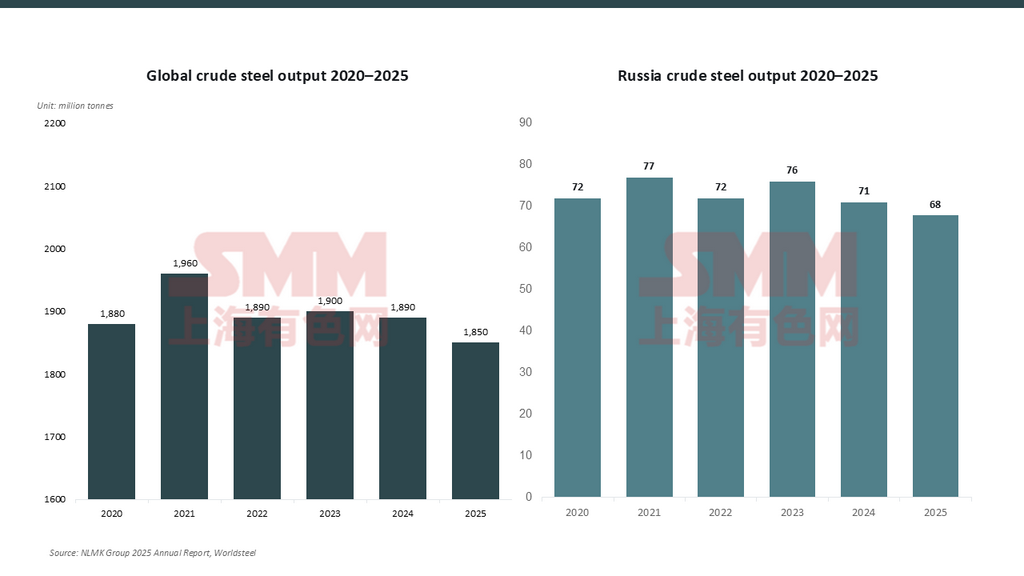
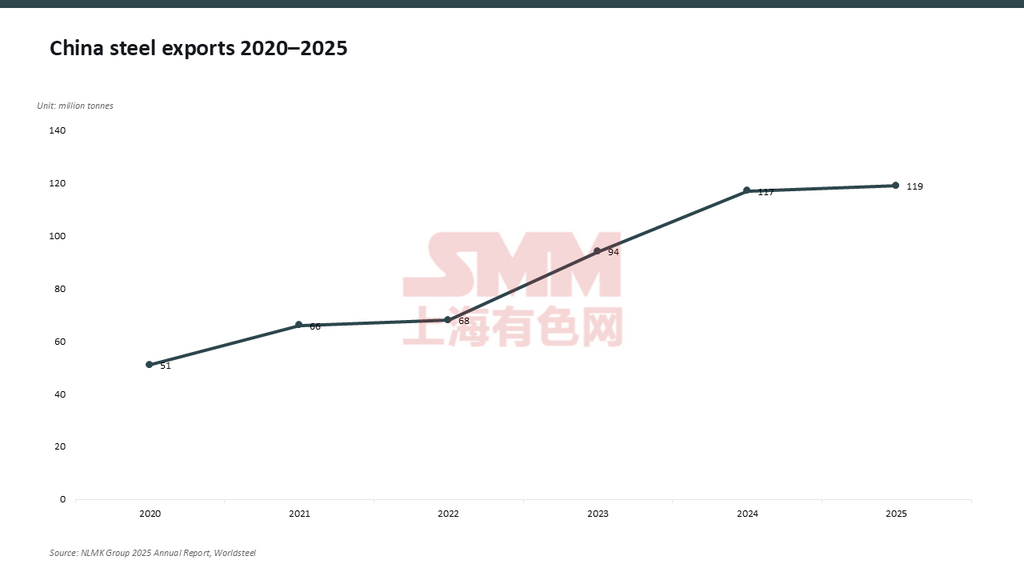
The global steel industry faced structural headwinds in 2025. Global crude steel output fell to 1,850 million tonnes, down about 2% year on year (Worldsteel reports 1,849.4 million tonnes). Weak Chinese demand plus re-routing pushed Chinese steel exports to a record 119 million tonnes, transmitting oversupply into global prices, which eased around 3%. Russia was hit harder: crude steel output dropped to 67.8 million tonnes (down 4.5%), a 15-year low; the central bank's high key rate throttled construction and other demand, domestic prices fell 5% in dollar terms, and domestic demand for rolled steel dropped 13% (about 2.7 million tonnes). A stronger rouble eroded export competitiveness while Chinese mills pushed into traditional Russian markets.
2. Operational performance: vertical integration is the real moat
In a year of two-way swings in both steel and raw-material prices, NLMK's resilience comes from controlling the whole chain — raw-material self-sufficiency of up to 100%, consumed close to the mills, minimizing external shocks and logistics risk. Annual steel capacity at its main sites is about 14.3 million tonnes, and its product mix spans conventional hot-rolled coil to high-value niche grades such as electrical steel, diversifying demand across sectors. From late Q1 2025 the company cut purchase prices, renegotiated contractor rates, deferred non-critical repairs and drew down inventory, freeing roughly USD 72 million of working capital — protecting liquidity while holding output at target.
3. Financial performance: playing the cost and working-capital levers
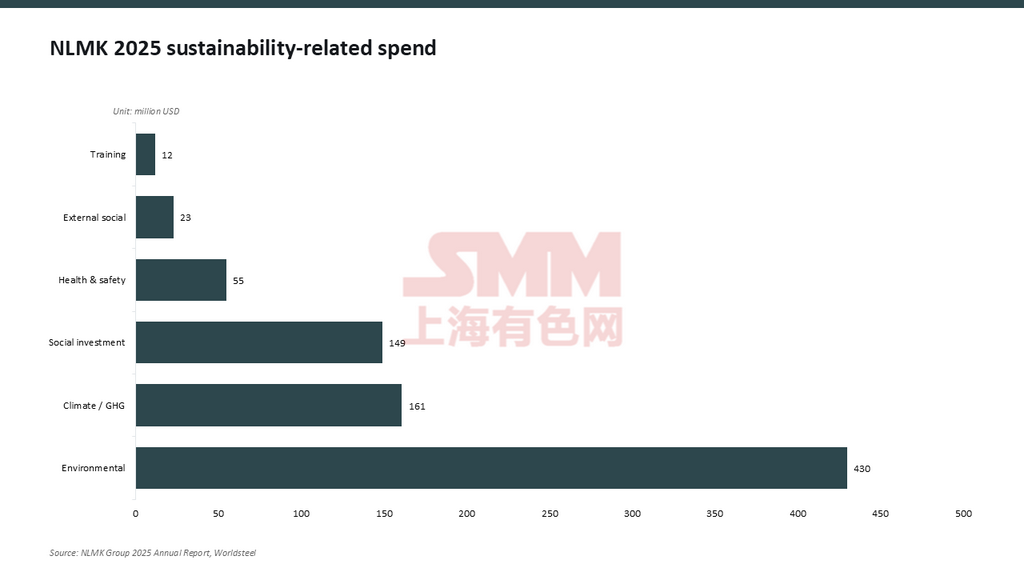
Unlike other steel mills, NLMK discloses no consolidated income statement under sanctions, so its financial posture can only be sketched from scattered spend and risk disclosures. The logic is defend costs, protect liquidity: revenue is capped by global steel prices, and because revenue is in foreign currency while costs are in roubles, a stronger rouble directly erodes export margins. Where spending is disclosed, environment and climate are the main capital destinations — 2025 environmental spend exceeded USD 430 million, with about USD 161 million on climate/GHG projects, USD 149 million on social investment and USD 55 million on health and safety — reflecting both the 2030 Climate Programme and best-available-technology upgrade obligations.
4. Key business activities: decarbonization is a marathon tied to blast-furnace overhaul cycles
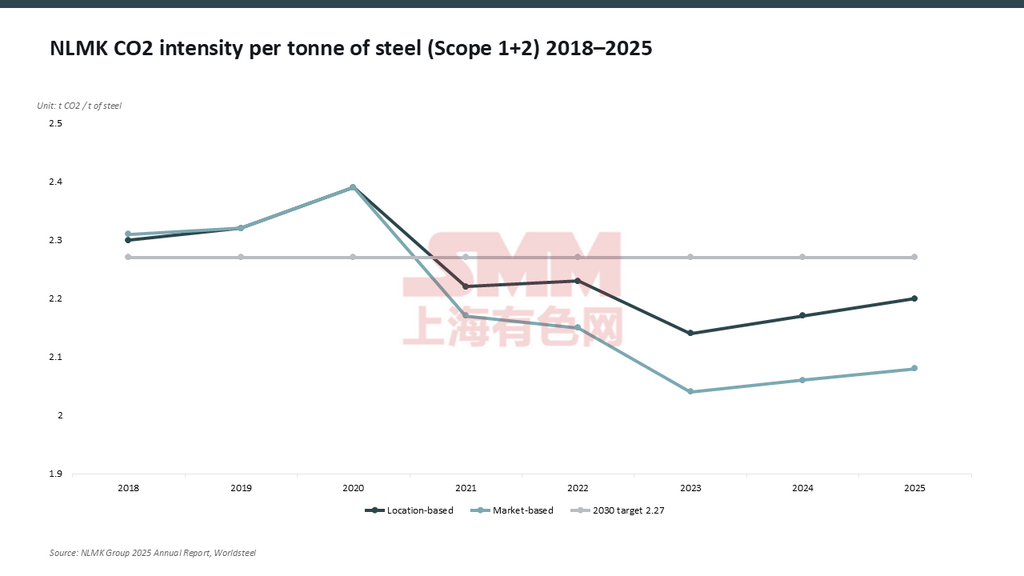
NLMK's CO2 intensity per tonne of steel has long sat in the 2.0–2.4 t range. Its 2025 intensity — 2.20 location-based and 2.08 market-based — is already below its own 2030 (location-based) target of 2.27, implying a conservative target where the real abatement must come from a post-2030 process revolution. The long-term roadmap: a full shift to HBI+EAF (hot-briquetted iron + electric arc furnace) using captive iron ore by 2050, cutting intensity to no more than 1.2 t (about −40%); and once industrial hydrogen-based reduction and ample low-carbon power arrive, paired with CCUS or offsets, down to 0.2 t (about −90%) and eventual carbon neutrality.
Meanwhile NLMK pulls two ready levers. In 2025 nuclear power met almost all of its Russian sites' external electricity (about 5.4 billion kWh, a Scope 2 cut of 1.8 million tonnes CO2), taking market-based Scope 2 close to zero; it also used 19.6 billion m3 of blast-furnace and coke-oven gas (containing about 2.8 billion m3 of pure hydrogen), with captive power covering over 60% of Lipetsk's electricity. Its products also cut customers' emissions — target volumes supplied in 2025 let customers avoid 2.4 million tonnes of CO2 a year, about 29.9 million tonnes over the full lifecycle. On environment, Lipetsk achieved zero wastewater discharge (a first in Russia), recyclables reuse exceeds 99%, and the injury frequency rate (LTIFR) fell 18% with severe cases down 29%.
Conclusion: can the low-cost fortress outlast the decarbonization marathon?
NLMK's 2025 is not an expansion story but one of resilience under constraint. Where Tata Steel's proposition is to use India's cash flow to fund Europe's green transition, NLMK faces colder arithmetic: how, in a sanctioned environment with limited access to green hydrogen and low-carbon equipment, to reserve the capital and technology options for a path that only truly begins after 2030. Its 2030 intensity target (2.27) has already been modestly beaten by 2025 reality (2.20), signalling limited near-term abatement — the real leap waits on mature HBI+EAF and industrial hydrogen-based reduction. The ultimate question: while the external enablers are still missing, can NLMK's cost-fortress cash generation sustain financial discipline and carry this 2050-spanning decarbonization marathon all the way through?
![[German Green Steel and Power shares reverse listing gains, down 8% from IPO price]](https://imgqn.smm.cn/usercenter/LMnqz20251217171717.jpg)
![[South Africa Moves to Ban Cash Scrap Metal Sales to Curb Infrastructure Theft]](https://imgqn.smm.cn/usercenter/DpLok20251217171715.png)
![[India's Steel Exchange India hits record monthly rebar output; September at 25,095 tonnes]](https://imgqn.smm.cn/usercenter/gmcdk20251217171720.jpg)