Scenario 1: Full Implementation of Gradual Tariffs on Copper Cathode
If the US Department of Commerce confirms on June 30 the implementation of the copper cathode tariff path, the market will be trading not the tax rate, but the repricing of US copper resources.
The currently active Section 232 copper tariffs primarily cover copper semi-finished products and copper-intensive derivatives, while copper cathode (refined copper), copper concentrates, copper anode, and copper scrap have not yet been included in the 50% tariff range. The key variable tomorrow is: whether the US confirms a phased universal import tax on copper cathode of 15% starting from 2027 and 30% from 2028.
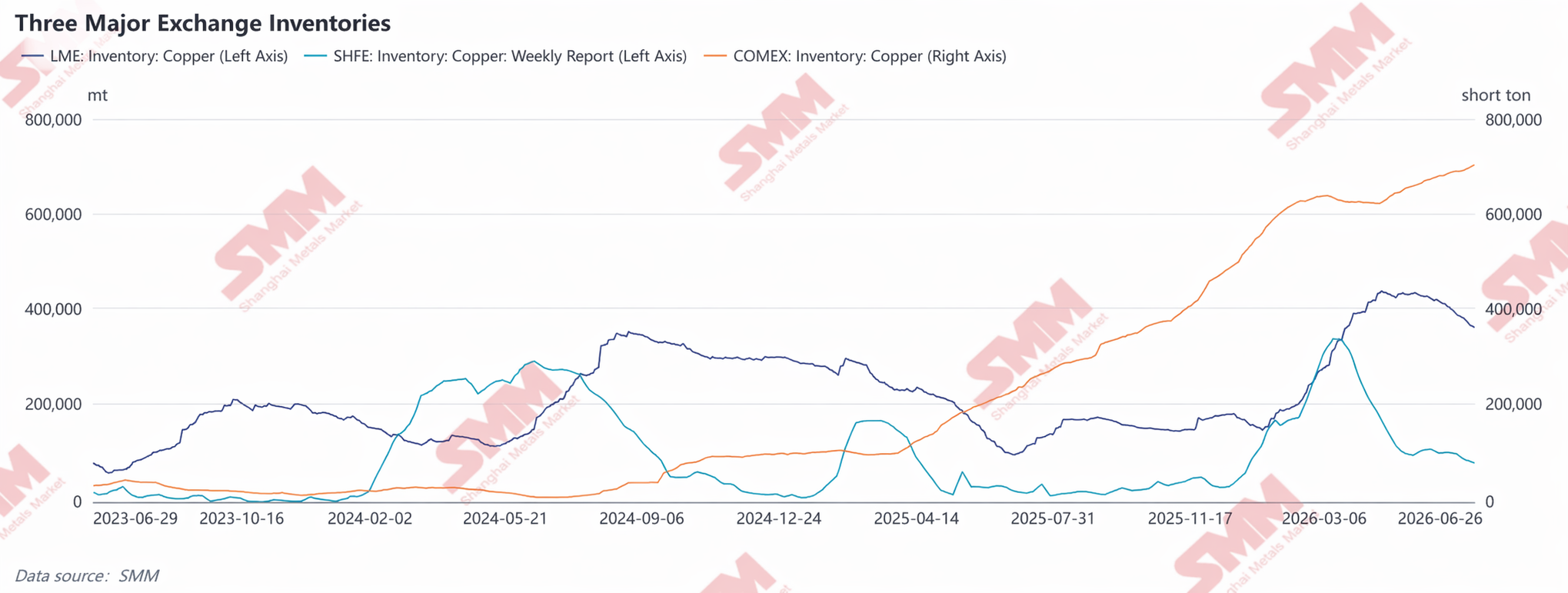
If implemented, US domestic spot premiums would be affected first . Previously, the sharp buildup in COMEX inventory was essentially the result of front-loaded tariff stockpiling and cross-market arbitrage. After tariff confirmation, the US market will shift from an import rush to consuming locally sourced material, and the massive inventory will be released first. In the short term, inventory will buffer the tight supply in the US, but rising incremental import costs will still support COMEX’s premium over LME. Traditional copper cathode flows to the US from Chile, Peru, etc., will be affected. If post-tariff profits from entering the US are eroded, some material may be redirected to Asian and European markets, increasing supply pressure outside the US temporarily. LME and SHFE will come under relative pressure, and cross-market price spreads will widen further. For the US domestic market, the impact will eventually pass through to downstream processing and end-user industries. Copper is no longer just an industrial metal; it is a core cost item in computing infrastructure.
Scenario 2: Implementation of Targeted or Phased Tariffs
If the US does not adopt an across-the-board copper cathode tariff but instead imposes targeted restrictions based on HTS classification, origin, purity, or form, the market impact will be more subtle but more lethal to the supply chain.
The first category of risk lies in copper scrap . The policy impact in this segment does not stem from tariffs on US copper scrap exports; rather, the US may reduce the availability of copper scrap for overseas markets by increasing the domestic sales ratio of high-grade copper scrap, implementing export licenses or other export controls. If such measures are implemented, the global trade flows of copper scrap could be re-adjusted. US high-grade copper scrap has long been an important supplement to the recycled copper systems in China and Southeast Asia. Once external supply tightens, scrap dismantling, sorting, and processing enterprises in Malaysia, Thailand, Vietnam, and other regions will face rising raw material procurement costs and compressed processing margins, and the supply chain of copper scrap that is processed in Southeast Asia and then shipped back to China could also tighten.
The second category of risk is "origin laundering" arbitrage . If USMCA countries are granted exemptions, Mexico and Canada could become hubs for copper logistics repackaging. Traders may use copper cathode for regional transshipment, restructuring delivery routes to the US. At that point, what the market truly needs to watch is not nominal tariffs, but rules of origin, substantial transformation criteria, and HTS classification.
The third risk lies in the stratification of the industry chain. Concentrates are mine-end raw materials, with tariff impacts reflected more in domestic US smelting security; copper cathode is a basic input for power and manufacturing industries, with the most direct impact; copper scrap links to the global secondary copper arbitrage system, and once policies tighten, the shock will spread from the US to Asian processing sectors.
III. Scenario 3: Exemption or Indefinite Postponement
If the final recommendation on June 30 exempts copper cathode from new import tariffs, the market's previously established tariff expectations will be revised, and the COMEX-LME price spread would face convergence pressure; if only a postponement is recommended, tariff expectations will remain, and the COMEX-LME spread may continue to run with high volatility. Regardless of exemption or postponement, the cross-market arbitrage and pre-stockpiling demand previously formed based on tariff expectations could cool down. US spot premiums face pullback pressure, and some of the inventory that had concentrated in the US earlier may gradually return to a normal digestion pace, creating some supply pressure on the near-term US spot market. This, however, does not mean that copper's medium and long-term logic has changed. If tariffs are postponed, it only means the pace of trade restructuring is pushed back, without altering the insufficient supply capability of US copper cathode and its long-term reliance on imported resources. Meanwhile, high-end manufacturing and other sectors will continue to support copper consumption, while the synergistic demand from critical metals such as tin, tungsten, tantalum, and silver with the AI hardware industry chain is further strengthening copper's long-term allocation value as a "computing-power metal."
IV. COMEX-LME Price Spread: The Market Has Already Priced in Tariff Expectations
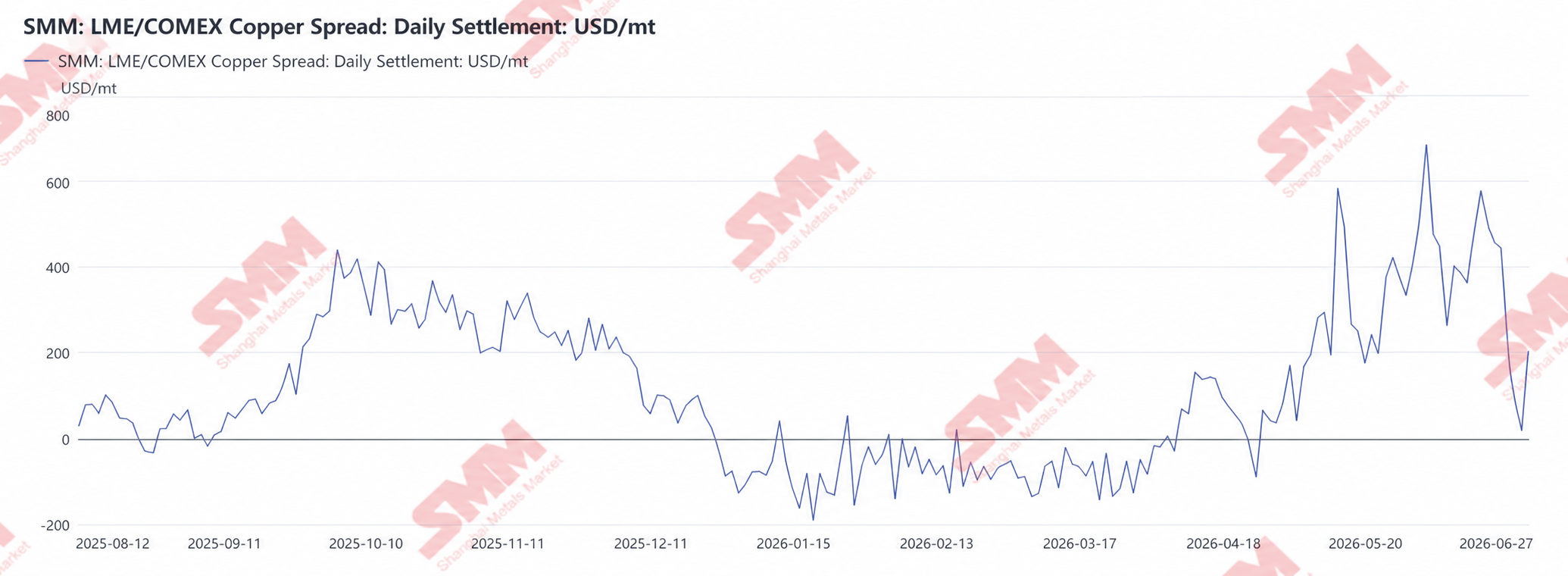
Since April 2026, the COMEX-LME copper price spread has continued to widen, repeatedly exceeding $400/mt, and at the beginning of June it approached $690/mt, reflecting that the US market had already priced in copper cathode tariff expectations. In late June, as some arbitrage cargoes gradually arrived in the US, the Section 232 investigation entered a critical policy period, and a stronger US dollar exerted more obvious pressure on COMEX copper prices, the COMEX-LME spread narrowed rapidly, pulled back to near zero at one point, and then rebounded to about $200/mt, indicating that the market is still waiting for the final policy signal. This round of spread fluctuations was not driven by significant changes in global copper supply and demand, but was mainly influenced by factors such as tariff expectations, cross-market arbitrage, and inventory front-loading. Previously, to avoid potential tariffs, traders shipped large volumes of copper cathode to the US in advance, driving a rapid buildup of COMEX inventories and pushing COMEX prices consistently above LME, briefly opening a significant cross-market arbitrage window.
As the market gradually completed the import rush and front-loaded inventory arrangements, the price spread has pulled back recently, indicating that some tariff expectations have been priced in ahead of time. However, if the US Department of Commerce finally confirms a progressive tariff plan for copper cathode on June 30, the COMEX-LME spread may still widen again; conversely, if the policy is delayed or exempted, the large number of arbitrage positions built earlier could be unwound in a concentrated manner, and both COMEX Premium and the cross-market spread face the risk of a rapid correction. Therefore, what the Section 232 investigation truly impacts is not just copper prices, but the re-pricing of global copper flows, regional spot premiums, and the COMEX-LME cross-market spread. Yet regardless of which scenario unfolds, the US copper supply chain security issue will not disappear.
![Diverging African Supply: June China Copper Anode Imports Recover, Q3 Maintenance May Weigh on Imports [SMM Analysis]](https://imgqn.smm.cn/usercenter/Bwtty20251217171714.jpeg)

![Copper Prices Continue to Rise, Copper Scrap Suppliers Actively Selling [SMM Secondary Copper Daily Review]](https://imgqn.smm.cn/usercenter/EFLYr20251217171714.jpeg)