[SMM Analysis] Decoding China's H1 2026 Sulphur and Sulphuric Acid Customs Data: Shifting Volume, Source and Momentum

Published: Jul 20, 2026 19:03
Focused on H1-2026 customs data — a cliff in sulfur imports with a reshuffled source mix; acid exports collapsing under the export ban. Three charts decode the shifts in volume, source and momentum.

I.China monthly sulfur imports (2025–2026, Jan–Jun)

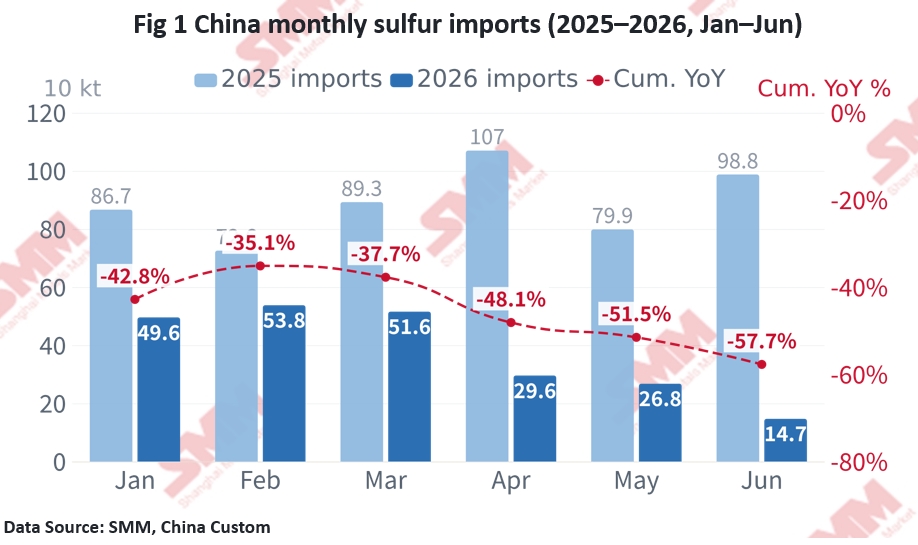
    In H1-2026 China's sulfur imports accelerated their contraction. Cumulative Jan–Jun imports were ~2.26 Mt, down 57.7% from ~5.34 Mt a year earlier; the monthly average fell from ~0.80 Mt in 2025 to ~0.38 Mt.

    Monthly, Jan–Mar held around 0.50 Mt (0.50 / 0.54 / 0.52 Mt); a cliff set in from April — 0.30 Mt in April, 0.27 in May, and just 0.147 Mt in June (−85.1% YoY), under one-fifth of the year-earlier level.

    Full-year 2025 imports were ~9.61 Mt (avg ~0.80 Mt/mo), and June's 0.147 Mt is a multi-year low. If the geopolitical conflict and Kazakhstan's export ban persist, H2 imports may weaken further — full-year 2026 is on track for only ~40% of 2025.
II.China sulfur import-source mix (FY2025 vs H1-2026)

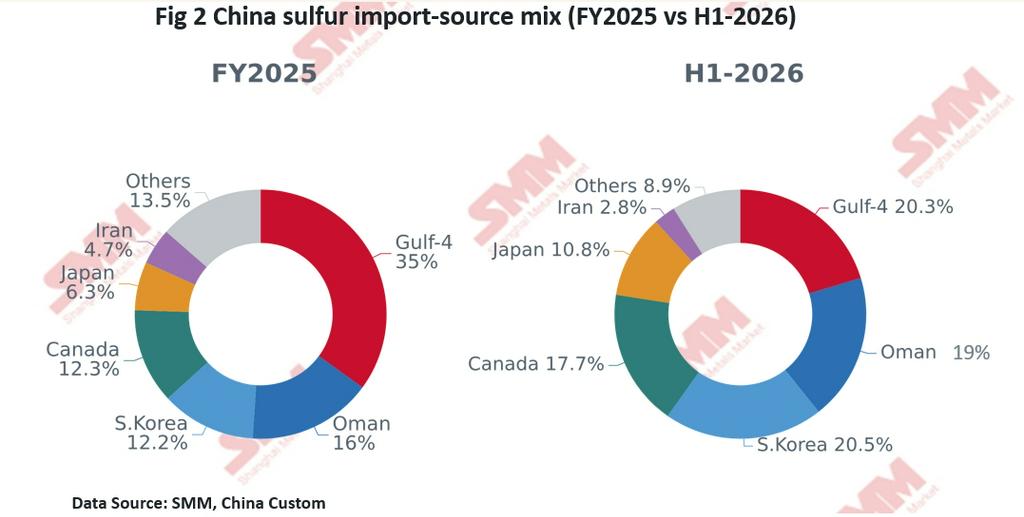
    China's sulfur import-source mix was fundamentally reshaped in H1-2026. In 2025 total imports were ~9.61 Mt, highly concentrated in the Middle East — Saudi Arabia, UAE, Qatar and Kuwait together ~35% (Oman another ~16%); sanctioned Iran was only ~4.7%, in sporadic cargoes.

    In H1-2026 the Gulf-4 share halved to ~20%South Korea jumped to #1 at ~0.46 Mt (20.5%), Oman ~0.43 Mt (19.0%) and Canada ~0.40 Mt (17.7%) — together ~58% — becoming the core alternative suppliers, with Japan (10.8%) close behind. Notably, Iran shipped ~62 kt directly in April (via Hainan), its first large direct arrival since the conflict, showing some cargoes have transited the Strait.

    Behind this is the double shock of the Hormuz closure and Kazakhstan's export ban. The halving of the Middle-East share passively narrows China's geopolitical exposure, but the stability, price and durability of alternative sources remain to be seen.
III.China monthly sulfuric-acid exports & the export ban (2025–2026, Jan–Jun)

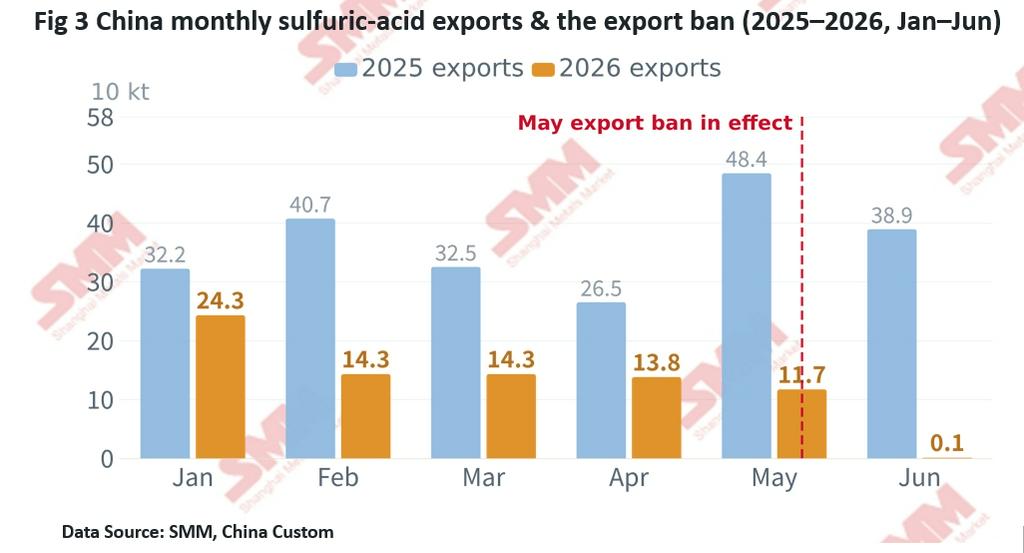
    China's sulfuric-acid exports show a gradual decline then a June cliff to zero. Cumulative H1-2026 exports were ~0.78 Mt, down 64.2% from ~2.19 Mt a year earlier.

    2026 exports weakened month by month: 0.24 Mt in January, easing to 0.11–0.14 Mt over Feb–May, then collapsing to ~980 t (0.001 Mt) in June — −99.7% YoY, ~−99% MoM, as export controls / quota cuts took hold and acid "stayed domestic".

    Versus 2025 (full-year ~4.65 Mt, avg ~0.39 Mt/mo, peaking at 0.525 Mt in December), H1-2026 was only ~36% of the year-earlier level, and June (0.001 Mt) was under 0.3% of June-2025 (0.389 Mt).

    Destinations reshaped too: 2025 was led by Chile (32.4%), Indonesia (14.7%), Morocco / Saudi (~12% each); in H1-2026 Indonesia (HPAL nickel) jumped to #1 (28.0%), Chile fell to 18.4%, Saudi / India ~13% each. Buyers highly dependent on Chinese acid (e.g. Chile, ~one-fifth of its copper output uses acid) face direct supply-chain pressure, reshaping global acid trade.
IV.Core Conclusion:

  1.     Sulfur imports: Volume cliff, source reshuffle — H1-2026 imports ~2.26 Mt (−57.7% YoY; June −85%); the Gulf-4 share halved (~35% → ~20%), replaced by S.Korea / Oman / Canada (~58% combined).
  2.     Acid exports: Ban to zero — H1-2026 exports ~0.78 Mt (−64% YoY); June only ~980 t (−99.7% YoY), a cliff exit; Indonesia becomes the top destination.
  3.     Common logic: Geopolitical conflict + export controls together — China shifts from a "global sulfur hub" to "self-protective contraction".

Data Source Statement: Except for publicly available information, all other data are processed by SMM based on publicly available information, market communication, and relying on SMM's internal database model. They are for reference only and do not constitute decision-making recommendations.

For any inquiries or for more information, please contact: lemonzhao@smm.cn
For more information on how to access our research reports, please contact:service.en@smm.cn
Related News
SMM Daily Comment: Spot Lithium Carbonate Prices Surged 5% on August 24
4 hours ago
SMM Daily Comment: Spot Lithium Carbonate Prices Surged 5% on August 24
Read More
SMM Daily Comment: Spot Lithium Carbonate Prices Surged 5% on August 24
Today, the SMM battery-grade lithium carbonate spot price surged 5% from the previous trading day. In futures, the most-traded contract LC2701 opened higher at 161,500 yuan/mt, hit a high of 162,500 yuan/mt during the session, and closed the morning session with a gain of nearly 3%. The sharp price surge was mainly due to the slower-than-expected progress of production resumptions at Jiangxi mines, which continuously heightened market concerns over tightening lithium ore supply, pushing prices to climb rapidly. Demand side, as month-end approaches, downstream material plants are actively stockpiling for next month's production, and spot order purchase willingness has notably strengthened; on the spot market, some lithium chemical plants undergoing maintenance continue to prioritize long-term contract supply, while those not in maintenance have seen a significant increase in their willingness to sell spot orders as prices broke through recent highs, with market inquiries and actual transactions becoming more active.
4 hours ago
South Korea to Add Auto and Battery Manufacturing to Integrated Environmental Management System
5 hours ago
South Korea to Add Auto and Battery Manufacturing to Integrated Environmental Management System
Read More
South Korea to Add Auto and Battery Manufacturing to Integrated Environmental Management System
South Korea’s Ministry of Climate, Energy and Environment announced that it will pre-announce revisions to the enforcement decree and rules of the Act on the Integrated Management of Environmental Pollution Facilities from August 26 to October 6. The revision focuses on adding industries that require integrated environmental management, taking into account changes in the industrial structure and fairness among sectors. Seven industries will be newly added: automobile manufacturing, secondary battery manufacturing, non-alcoholic beverage manufacturing, animal and vegetable oils and dairy product manufacturing, other food manufacturing, flat glass manufacturing, and rubber product manufacturing. The new rules will apply to automobile, secondary battery, flat glass and rubber product manufacturing from January 2029.
5 hours ago
July battery materials import and export data released: lithium carbonate imports up 93% YoY. How about other segments? [SMM Special]
6 hours ago
July battery materials import and export data released: lithium carbonate imports up 93% YoY. How about other segments? [SMM Special]
Read More
July battery materials import and export data released: lithium carbonate imports up 93% YoY. How about other segments? [SMM Special]
6 hours ago
[SMM Analysis] Decoding China's H1 2026 Sulphur and Sulphuric Acid Customs Data: Shifting Volume, Source and Momentum - Shanghai Metals Market (SMM)