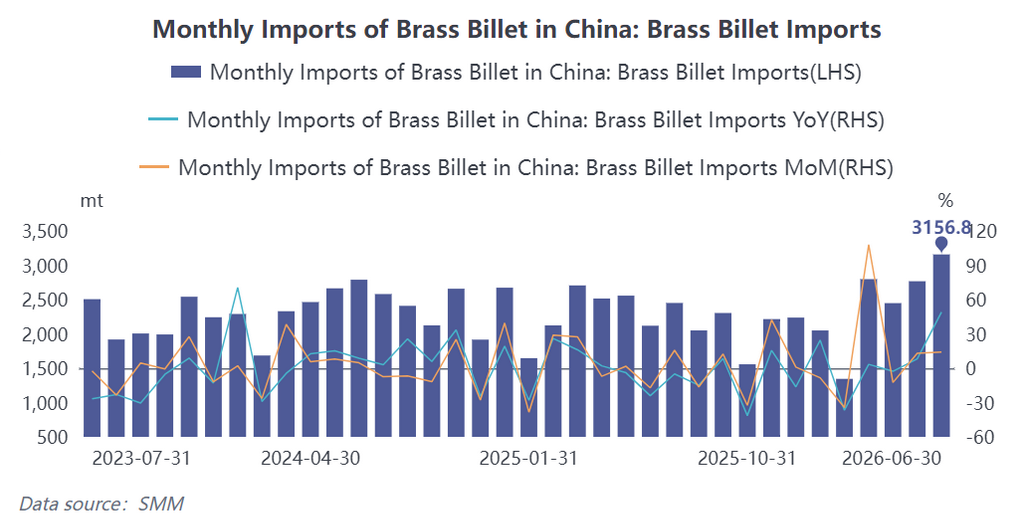
According to the latest customs data, China's imports of copper-zinc alloy (brass) bars and rods amounted to 3,156.8 mt in physical content in June 2026, up 48.99% YoY and up 14.11% MoM. Cumulative imports for January-June 2026 reached 14,600 mt in physical content, with the cumulative YoY growth rate swinging from negative in the first five months to an increase of 6.56% (HS codes 74072111, 74072119, 74072190). From April to June, the domestic downstream sector maintained its regular restocking pace, overseas producers delivered steadily, and some orders arrived at ports in a concentrated manner in June. This drove monthly imports to a second consecutive month of MoM recovery, with the YoY growth rate strengthening significantly, turning H1 total imports from weak to strong. However, overall terminal consumption from real estate, home appliances, and hardware did not exhibit concentrated release; the market merely saw phased replenishment, with sustained large-scale purchasing yet to emerge.
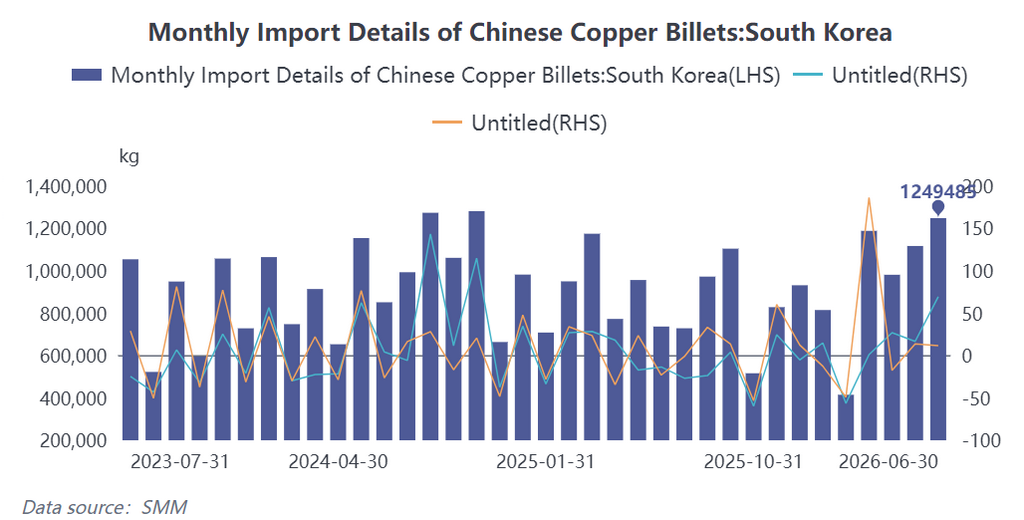
From the perspective of import source structure, South Korea remained China's largest source of brass billet imports. June imports from South Korea were 1,249.49 mt, up 11.77% MoM and surging 69.46% YoY, accounting for 39.58% of total monthly imports. Japan ranked second, with June imports of 509.22 mt, up 15.76% MoM and 12.05% YoY, representing a 16.13% share. Imports from these two traditional core suppliers, Japan and South Korea, both maintained a MoM uptrend, with their combined supply share exceeding 50%, solidifying the traditional East Asian supply landscape. Notably, supply growth from Thailand exploded, making it the third-largest import source. June imports from Thailand were 444.6 mt, up 126.46% MoM and skyrocketing 2,119.78% YoY, accounting for a 14.08% share for the month. The continuous release of capacity in Southeast Asia, improved cross-border logistics channels, and some enterprises' efforts to diversify procurement and broaden supply sources collectively propelled a leapfrog growth in brass billet imports from Thailand to China, further highlighting the trend of import source diversification.

Import value growth also accelerated in tandem, amplifying the volume-value divergence further and continuously highlighting upstream cost-side pressure. The import value of brass billets in June was $30,024,900, up 12.23% MoM and 85.95% YoY. The cumulative import value for January-June 2026 was $135,732,800, a cumulative YoY increase of 33.34%. A comparison of data clearly shows that while H1 imports by volume increased by only 6.56% YoY, the cumulative value of imported goods surged by 33.34%, with the gap between volume and value growth rates continuing to widen. The core driving logic remains the consolidation at highs of international copper raw material prices, which continuously pushes up the production and processing costs for overseas brass billets. This cost pressure is then transmitted downstream to the import trade sector, directly driving up the unit price of imports. Even as import volumes in physical content steadily recover, high-priced raw materials still lift the overall value of imports.
The core contradiction in the current brass billet market—characterized by high costs, weak demand, and pessimistic expectations—has not undergone a fundamental shift. On one hand, international copper prices continue to fluctuate at high levels, constantly raising the overseas production costs and domestic import procurement costs for brass billets, continuously squeezing the profit margins of domestic copper processing enterprises. As a result, enterprises' willingness to procure large-volume imports remains generally cautious. On the other hand, the recovery pace of traditional downstream terminals such as real estate, home appliances, and hardware/plumbing is slow. Downstream finished product orders are overall mediocre, the spot market trading atmosphere is sluggish, and enterprises predominantly restock on a small-scale, as-needed basis, lacking the impetus to actively destock significantly. Considering the June import performance and downstream terminal fundamentals, SMM expects the brass billet import market to remain under pressure in Q3.