Destacados: El 20 de julio de 2026, según datos aduaneros, las importaciones chinas de mineral de fosfato en junio de 2026 fueron de 137 000 toneladas, un 4,5 % más intermensual frente a las 131 000 toneladas de mayo. El valor total de importación ascendió a 12,567 millones de dólares, un 2,8 % más intermensual. El precio unitario medio de importación fue de 91,5 $/tonelada, un 1,7 % menos que los 93,0 $/tonelada de mayo.
1. Revisión de las importaciones y exportaciones de mineral de fosfato en mayo
En mayo de 2026, las importaciones chinas de mineral de fosfato alcanzaron 131 000 toneladas, un descenso intermensual del 36,4 %; el valor total de importación fue de 12,226 millones de dólares, un 38,1 % menos intermensual; el precio unitario medio de importación se situó en 93,0 $/tonelada, un 2,6 % menos intermensual. Los países de origen se concentraron fuertemente en Egipto: las importaciones procedentes de Egipto sumaron 128 000 toneladas (un 31,7 % más intermensual), representando el 97,7 % del total de importaciones; no hubo importaciones desde Perú ni Jordania ese mes. Antecedentes clave: El 13 de mayo, el Ministerio de Petróleo y Recursos Minerales de Egipto anunció que no firmaría nuevos contratos de exportación de mineral de fosfato, impulsando la transición de las exportaciones de materia prima hacia la fabricación de productos de alto valor añadido como fertilizantes fosfatados. Influido por esta señal de endurecimiento de políticas, el precio unitario de importación egipcio subió un 14,1 % hasta 93,0 $/tonelada en mayo, con precios CFR (ley del 26–27 %) cotizados a 95–100 $/tonelada.
La distribución provincial cambió drásticamente: Guangxi saltó al primer puesto con 78 000 toneladas (un 65,9 % más intermensual); Hubei, que lideró con 157 000 toneladas en abril, vio sus importaciones de mayo caer a cero (descenso intermensual del 100 %); Shandong importó 3 000 toneladas (un 171,2 % más intermensual), Zhejiang 1 000 toneladas, y otras provincias en conjunto importaron 50 000 toneladas (un 3 602,2 % más intermensual), diversificando aún más los canales de importación.
En el lado exportador, las exportaciones de mayo alcanzaron 32 000 toneladas, un 189,6 % más intermensual. Hubei exportó 21 000 toneladas (sin exportaciones en abril), Fujian 6 000 toneladas (un 40,6 % menos intermensual) y Guizhou 5 000 toneladas (sin exportaciones en abril), con provincias como Hubei y Guizhou experimentando una recuperación total de las exportaciones.
2. Análisis de las importaciones y exportaciones de mineral de fosfato en junio
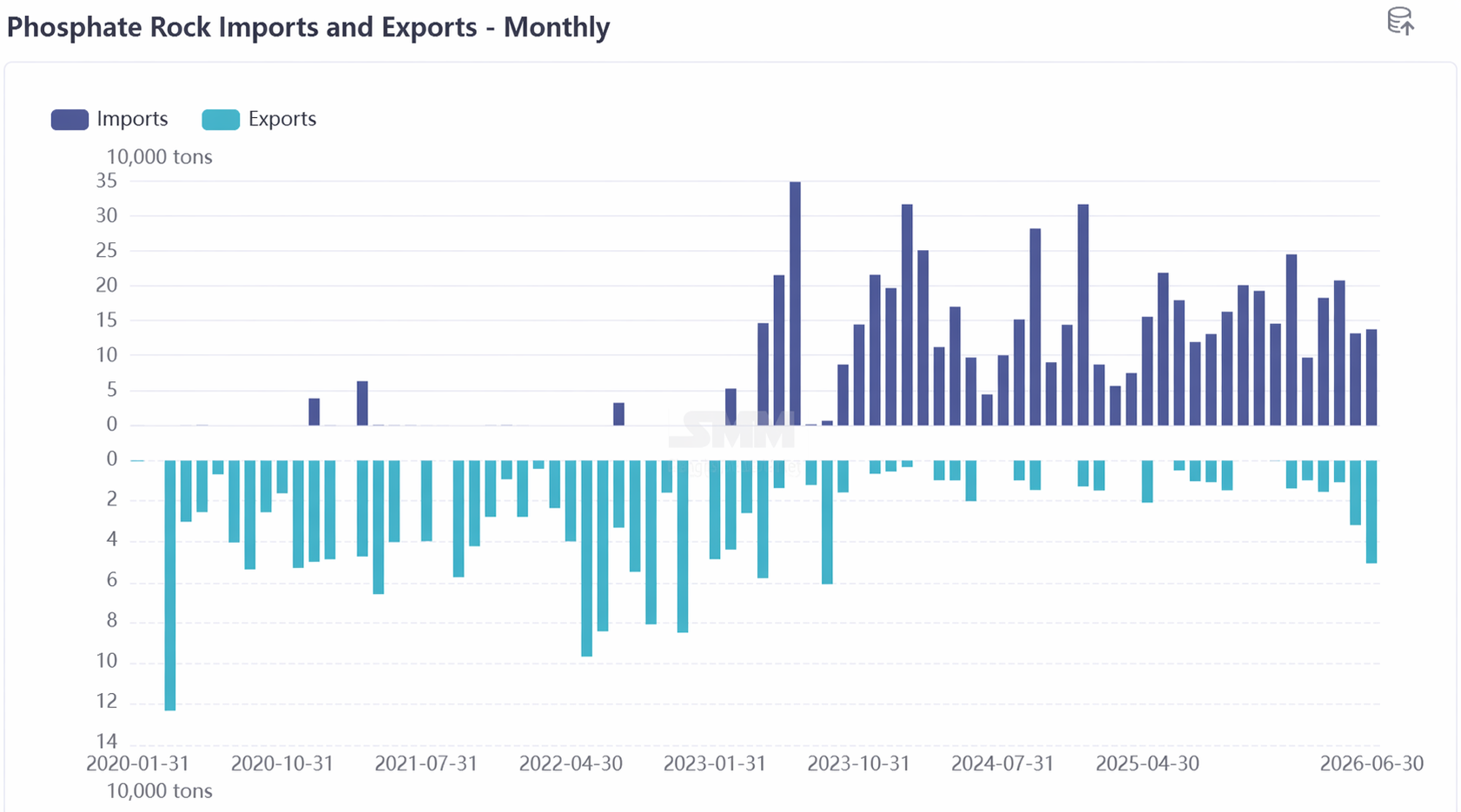
1. Importaciones de mineral de fosfato: crecimiento moderado del volumen, ligero retroceso del precio unitario
En junio de 2026, las importaciones chinas de mineral de fosfato ascendieron a 137 000 toneladas, un 4,5 % más intermensual frente a las 131 000 toneladas de mayo. El valor total de importación fue de 12,567 millones de dólares, un 2,8 % más intermensual. El precio unitario medio de importación fue de 91,5 $/tonelada, un 1,7 % menos que los 93,0 $/tonelada de mayo. El ligero repunte de las importaciones, combinado con un retroceso simultáneo de los precios unitarios reflejaba que el mercado entró en una fase transitoria de “compensar el precio con el volumen y cambiar de países proveedores” tras el shock político de Egipto en mayo.
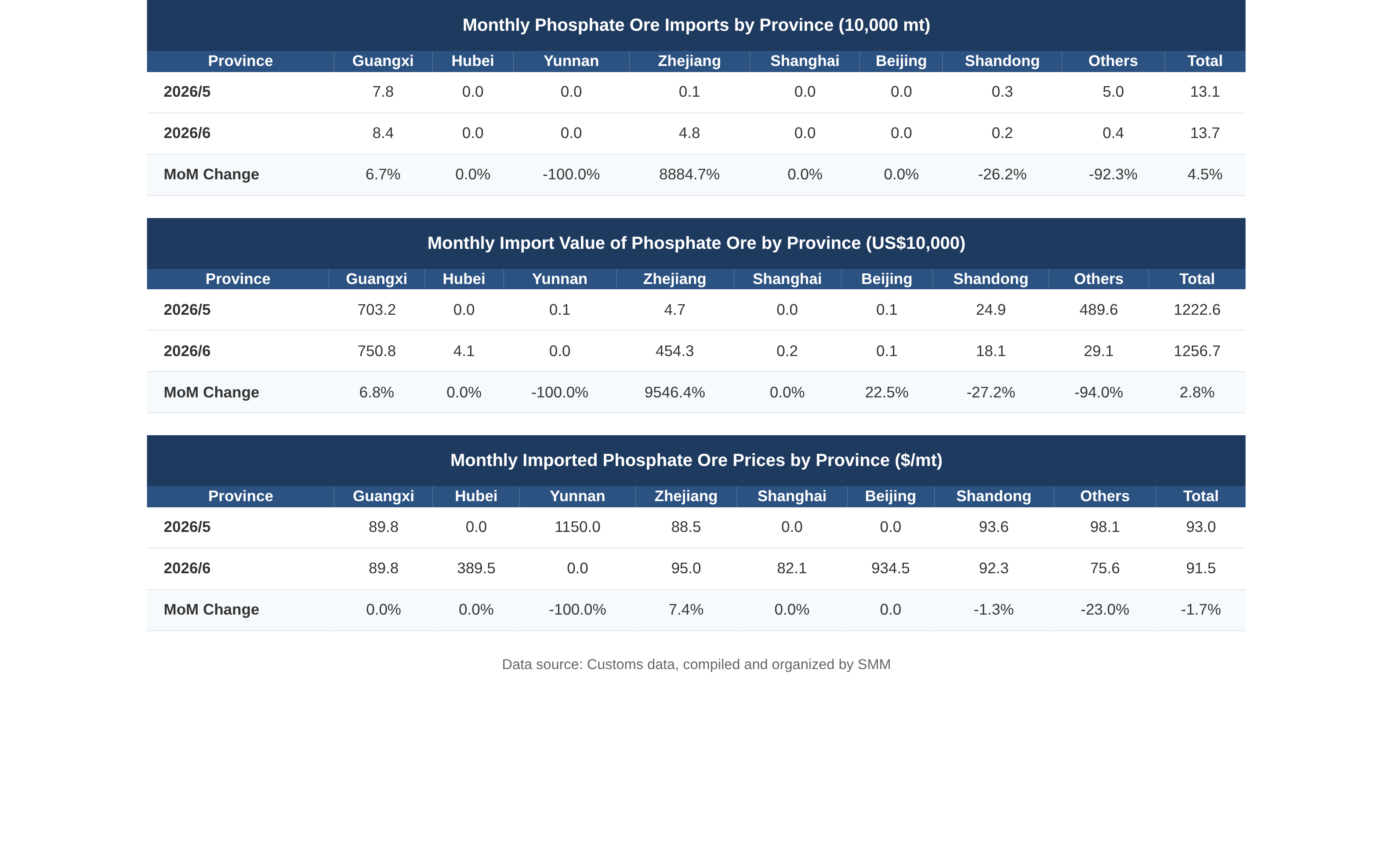
2. Importaciones de mineral de fosfato: reestructuración drástica de los patrones de países de origen, la cuota de Egipto se desploma al 61 %, Jordania/Marruecos/Kazajistán toman el relevo con crecimiento de volúmenes
La estructura de importación con un solo país dominante observada en mayo se reestructuró drásticamente en junio. Las importaciones procedentes de Egipto cayeron de 128 000 toneladas en mayo a 84 000 toneladas, desplomándose un 34,7 % intermensual, pero se mantuvo como el principal país de origen; su cuota del total se desplomó del 97,7 % en mayo a alrededor del 61 %, lo que indica que el efecto de la política del anuncio de Egipto del 13 de mayo de dejar de firmar nuevos contratos de exportación de mineral de fosfato ha comenzado a transmitirse materialmente.
Las importaciones desde Jordania se dispararon desde una base extremadamente baja (alrededor de 1 tonelada) en mayo hasta 48 000 toneladas, un incremento intermensual de decenas de miles de veces, saltando al segundo puesto; el precio unitario de importación fue de 95 $/tonelada, un 91,7 % menos intermensual que en mayo (debido principalmente al efecto base del precio unitario anteriormente elevado). El suministro jordano, principalmente de ley media y precios estables, se convirtió en la fuente alternativa principal para compensar el déficit egipcio este mes.
Pakistán importó 6 000 toneladas, un 71,6 % más intermensual, con un precio unitario de importación ligeramente a la baja, manteniendo un suministro estable como fuente cercana del sur de Asia. Otros países, como Marruecos, Kazajistán, Perú y Líbano, importaron conjuntamente unas 2 000 toneladas; el precio unitario de importación de Marruecos fue de hasta 5 050 $/tonelada y el de Kazajistán de 2 895,2 $/tonelada, afectados por minerales escasos de alta ley, con precios unitarios significativamente superiores a los del suministro mayoritario.
En cuanto al valor de importación, del total de 12,567 millones de dólares de junio, la participación de Egipto cayó significativamente (unos 7,7 millones de dólares, aproximadamente el 61 %), Jordania representó alrededor de 4,54 millones de dólares, y Pakistán, Marruecos y otros en conjunto tuvieron una cuota limitada. La divergencia entre el crecimiento intermensual del valor del 2,8 % y el del volumen del 4,5 % confirmó aún más el descenso estructural del precio medio impulsado por la reducción de la cuota de Egipto.
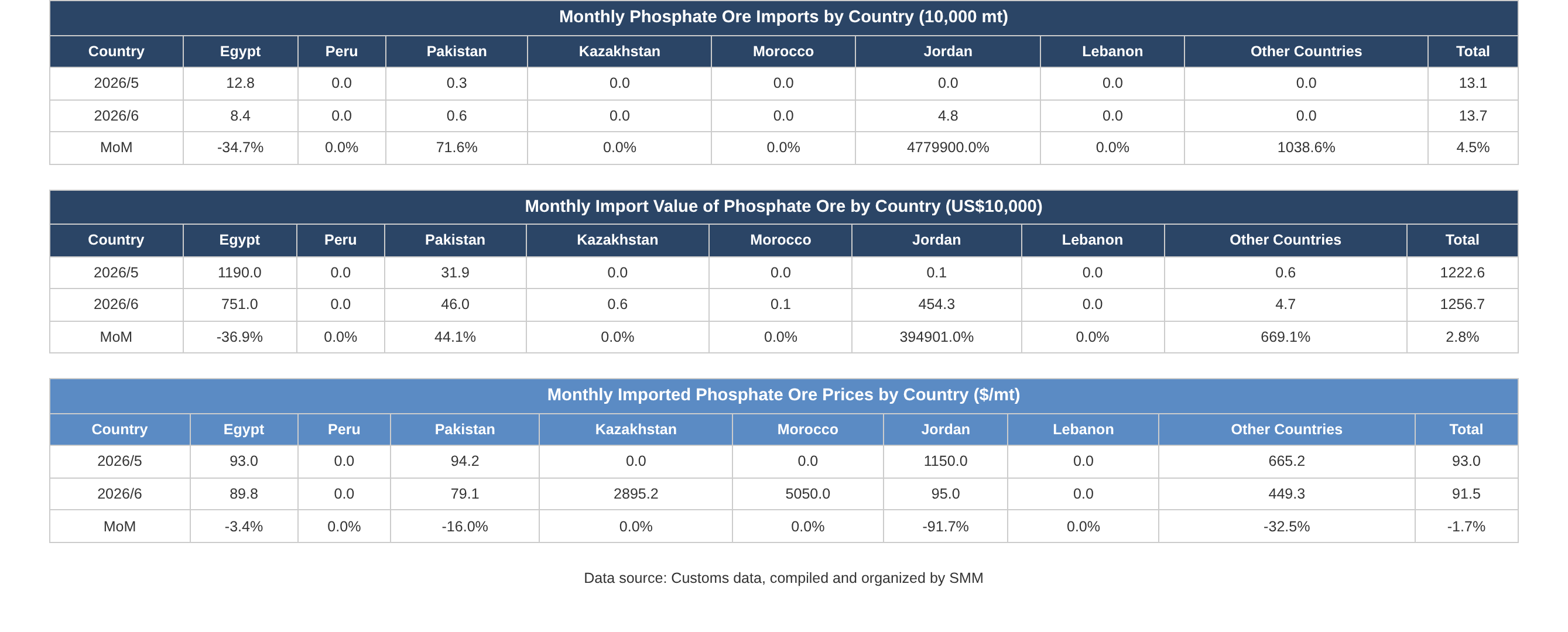
3. Importaciones de mineral de fosfato: los patrones provinciales cambian de nuevo, Guangxi se mantiene en cabeza, Zhejiang se dispara 89 veces
La estructura provincial de importaciones en junio continuó los drásticos ajustes observados desde mayo. Guangxi se mantuvo como la principal provincia importadora con 84 000 toneladas , un 6,7 % más intermensual, y un valor de importación de 7,508 millones de dólares (un 6,8 % más intermensual), manteniendo su ventaja tradicional en el manejo de suministros del norte de África y Oriente Medio, como los procedentes de Egipto y Jordania. Zhejiang importó 48 000 toneladas, un asombroso aumento del 8 884,7 % (aproximadamente 89 veces) respecto a las 500 toneladas de mayo, con un valor de importación de 4,543 millones de dólares, un 9 546,4 % más intermensual, saltando al segundo puesto, lo que refleja que los importadores del delta del río Yangtsé cambiaron rápidamente a fuentes alternativas como Jordania tras el shock político de mayo, superando con creces la velocidad de cambio de canal de otras provincias. Hubei, tras cero importaciones en mayo, reanudó algunas importaciones en junio, con un precio unitario de importación de 389,5 $/tonelada, notablemente por encima de la media nacional, reflejando características de suministro escaso de alta ley. El precio unitario de importación de Pekín, de 934,5 $/tonelada, fue el más alto del país, principalmente para compras de lotes pequeños de alta ley. Shandong, Shanghái y otras provincias mantuvieron importaciones estables de pequeños volúmenes. Yunnan no tuvo importaciones en junio, un descenso intermensual del 100 %, lo que indica notables ajustes estructurales regionales.
Precios unitarios de importación, el precio de Guangxi en junio se mantuvo estable en el rango de 89-90 $/tonelada, y el suministro interprovincial convencional en Zhejiang rondó los 95 $/tonelada, en general en línea con el precio medio nacional de 91,5 $/tonelada; provincias con precios altos como Pekín y Hubei vieron sus precios unitarios impulsados por compras de lotes pequeños de alta ley, sin elevar materialmente la media nacional.
La composición provincial de las importaciones experimentó un cambio drástico en mayo.Guangxi se disparó hasta el primer puesto con 78 000 toneladas de importaciones, un 65,9 % más intermensual; mientras que Hubei, que lideraba en abril con 157 000 toneladas, vio sus importaciones de mayo caer a cero, una disminución intermensual del 100 %. Shandong importó 3 000 toneladas, un 171,2 % más intermensual; Zhejiang importó 1 000 toneladas. Otras provincias en conjunto importaron 50 000 toneladas, disparándose un 3 602,2 % intermensual, reflejando una mayor diversificación de los canales de importación.
Valor de importación, Guangxi 7.032.000 $ (intermensual +84,5%), otras provincias 4.896.000 $ (intermensual +3.936,7%), Shandong 249.000 $ (intermensual +167,6%), Zhejiang 47.000 $.
Precios unitarios de importación: el precio de Guangxi en mayo fue de 89,8 $/tm, un 11,2% superior al de abril; otras provincias 98,1 $/tm, un 9,0% intermensual más; Shandong 93,6 $/tm.
4. Exportaciones de mineral de fosfato: 51.000 tm, aumento intermensual del 58,3%, Yunnan y Fujian lideran
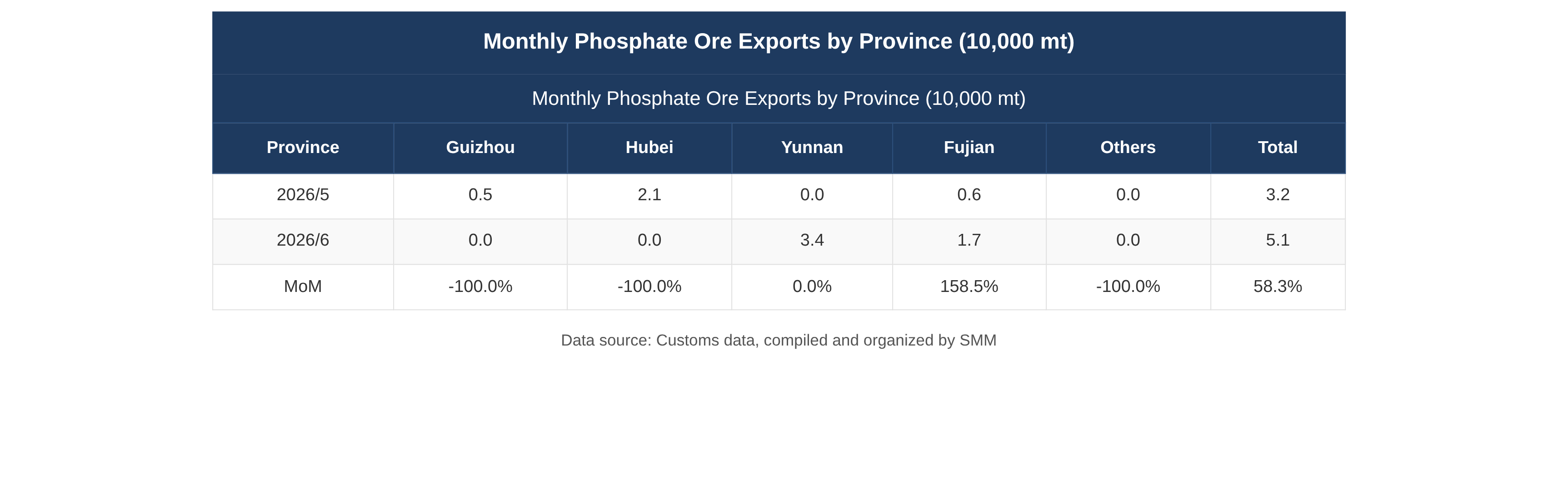
En junio de 2026,las exportaciones chinas de mineral de fosfato totalizaron 51.000 tm, un fuerte incremento intermensual del 58,3% respecto a las 32.000 tm de mayo,prolongando la tendencia de expansión continua del volumen desde abril.
Por provincia exportadora, Yunnan saltó al primer puesto con 34.000 tm (sin exportaciones en mayo), aportando la mayor parte del crecimiento, reflejando la entrega concentrada de pedidos de exportación previos por parte de líderes del sector como Yunnan Phosphate Chemical Group y Yuntianhua. Fujian exportó 17.000 tm, un 158,5% más intermensual frente a las 6.000 tm de mayo, manteniendo el ritmo constante de exportación observado de febrero a mayo. Guizhou y Hubei no tuvieron exportaciones en junio, dando lugar a una nueva estructura regional donde “Yunnan toma el relevo y Hubei sale”.
Contexto del repunte exportador: Impulsado por las crecientes expectativas de acopio invernal nacional de mineral de fosfato (el acopio invernal tradicional comienza de octubre a noviembre) y la demanda concentrada de fosfato de hierro en la cadena industrial de nuevas energías, el equilibrio oferta-demanda de mineral de fosfato en China se tensó temporalmente. La liberación concentrada de exportaciones en junio se debió principalmente a entregas de pedidos previos; conviene prestar atención a los cambios en el ritmo exportador del tercer trimestre.
III. Perspectivas del mercado
El mercado de importación de mineral de fosfato en junio presentó cuatro características principales:Primero, los volúmenes totales experimentaron un ligero repunte, aumentando solo un 4,5% intermensual tras el profundo bache creado por el impacto de la política egipcia en mayo, con un ritmo de recuperación de las importaciones por debajo de las expectativas del mercado.
Segundo, la composición por países de origen sufrió una reestructuración drástica, con la cuota de Egipto desplomándose del 97,7% a cerca del 61%, y orígenes alternativos como Jordania, Pakistán y Marruecos comenzando a aumentar, pero aún incapaces de compensar totalmente la brecha.
Tercero, la distribución provincial aceleró su cambio, con Guangxi firmemente en cabeza, Zhejiang multiplicándose por 89, y Hubei retomando importaciones a precios elevados, llevando el patrón de canales regionales a una fase de “reconstrucción”.
Cuarto, el lado exportador experimentó una liberación concentrada de volúmenes, liderada por Yunnan y Fujian, reflejando un equilibrio oferta-demanda interno temporalmente ajustado.
De cara al tercer trimestre,el impacto de la suspensión por parte de Egipto de nuevos contratos de exportación seguirá desplegándose: las importaciones de julio-agosto podrían mantenerse en el rango de 130.000-150.000 tm, con los precios unitarios de importación moviéndose lateralmente entre 90 y 100 $/tm.Tres puntos clave a vigilar:primero, la estabilidad del suministro y la estructura de leyes de fuentes alternativas como Jordania y Marruecos; segundo, cómo se materializa el ritmo de la demanda de temporada alta de fosfato amónico/fosfato de hierro nacional y estimula la demanda de importación; y tercero, los cambios en las políticas de exportación y los plazos de despacho aduanero antes y después de la temporada de acopio invernal (octubre-noviembre).
Se espera que el precio medio de importación del tercer trimestreoscile en el rango de 90-100 $/tm. A medida que la demanda de acopio invernal nacional se materialice en el cuarto trimestre, las importaciones volverán a dispararse, con el punto medio de precios probablemente desplazándose al alza hasta95-105 $/tm.
Nota: Si tiene alguna información complementaria sobre los detalles mencionados en este artículo o consultas sobre productos químicos de fósforo (mineral de fosfato, fosfato de hierro, LFP, etc.) y baterías de estado sólido, no dude en contactarnos. Datos de contacto:
Tel.: 021-20707860 (o WeChat: 13585549799), Yang Chaoxing. ¡Gracias!
![[SMM Revisión semanal del mercado de celdas de baterías de almacenamiento de energía 9.3] La escasez de láminas de cobre limita los programas de producción de septiembre, los precios de las celdas de baterías de almacenamiento de energía se mantienen firmes](https://imgqn.smm.cn/usercenter/tKgKv20251217171725.png)

![Lithium Carbonate Market Weekly Review: 8.31-9.3 spot lithium carbonate prices rose first then fell, overall downward trend [SMM Weekly Review]](https://imgqn.smm.cn/usercenter/PPLUj20251217171727.jpg)