La Administración Estatal de Regulación del Mercado y la Administración de Normalización de China emitieron conjuntamente en 2026 la norma nacional obligatoria GB 47835-2026 *Límite de consumo energético por unidad de producto de silicio monocristalino*, que entrará en vigor oficialmente el 1 de enero de 2027. La norma define claramente tres niveles de cuotas de consumo energético integral por unidad de producto para dos categorías: silicio monocristalino y obleas de silicio monocristalino. Adopta las obleas de 182mm × 210mm (210R) como calibre contable de referencia y establece factores de conversión para obleas de diferentes tamaños, proporcionando una base unificada de cumplimiento para la contabilidad del consumo energético y la evaluación de la eficiencia energética en la industria. A continuación se presentan los grados de cuota de consumo energético para lingotes y obleas de silicio:


Nota: Dado que la versión final oficial aún no se ha hecho pública, se utilizan los estándares del borrador para comentarios.
En el gráfico siguiente, el orden de las Empresas 1 a 16 se ha alterado por razones de cumplimiento. Además, los coeficientes de conversión de la energía de uso común a equivalente de carbón estándar y de los servicios energéticos de uso común a equivalente de carbón estándar son fijos, pero las cifras de consumo específicas de cada empresa son reportadas por las propias empresas y verificadas por las autoridades pertinentes, y prevalecerán los resultados oficiales publicados. Por lo tanto, para evitar disputas, no utilizo este método para estimar la magnitud de la capacidad a eliminar. En su lugar, considero las líneas de producción de lingotes/obleas de silicio construidas antes de 2021 (excluyendo 2021) y sobre las que no se ha realizado ningún anuncio público sobre transformación tecnológica para el ahorro energético o modificaciones de actualización a gran tamaño.
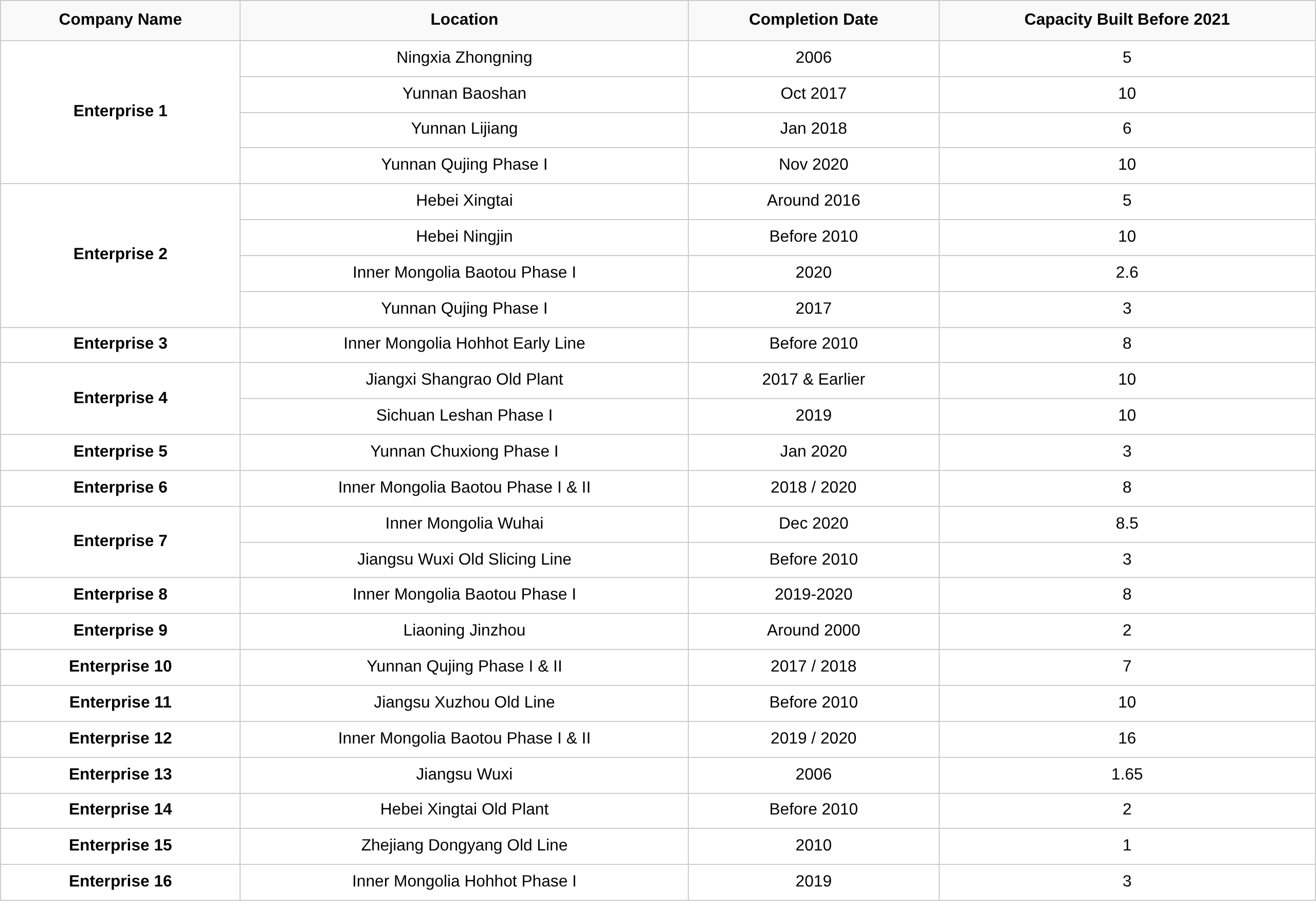
Según las estadísticas de SMM, se puede calcular que un total de 152,75 GW actualmente no cumple con los requisitos de consumo energético de nivel 3, lo que representa aproximadamente el 12,90 % de la capacidad total de obleas. Esta cifra excluye la capacidad en el extranjero de empresas financiadas por China (las bases en el extranjero en Malasia, Vietnam, etc., no están sujetas a las restricciones obligatorias de la GB 47835-2026 y no se clasifican como capacidad obsoleta según las normas de China). La norma nacional obligatoria (GB), aplicada de conformidad con la Ley de Normalización de la República Popular China y la Ley de Conservación de la Energía, significa que esta parte de la capacidad tendrá los siguientes impactos:
Julio de 2026 – Diciembre de 2026:
Las empresas que no cumplan con los requisitos de eficiencia energética deberán completar la verificación del consumo energético y las auditorías energéticas de todas las líneas de producción, implementar mejoras tecnológicas de ahorro energético para las líneas con viabilidad económica de modernización y obtener informes de detección de cumplimiento de terceros, y promover de manera ordenada el cierre y la salida de las líneas de producción antiguas con larga vida útil y sin valor de transformación tecnológica. Al mismo tiempo, pueden informar voluntariamente sus planes de rectificación a las autoridades locales de conservación de la energía.
A partir del 1 de enero de 2027:
Las líneas de producción cuyo consumo energético supere los límites del Nivel 3 infringen la normativa de uso de energía. Las autoridades locales de conservación de la energía ordenarán la rectificación en un plazo determinado conforme a la ley, que generalmente no excederá de seis meses. Si tras el plazo de rectificación establecido no se cumplen aún los requisitos de eficiencia energética del Nivel 3, o en casos graves, las autoridades de conservación de la energía informarán al gobierno popular del mismo nivel y ordenarán a la empresa suspender sus operaciones para su rectificación o incluso cerrar las líneas de producción afectadas. No existe un enfoque flexible de "producir primero, pagar multas después".
Base legal: Artículo 16 y Artículo 72 de la Ley de Conservación de la Energía de la República Popular China, y Artículo 20 de las Medidas para la Supervisión de la Conservación de la Energía Industrial.
Conclusión:
En términos sencillos, tras la publicación oficial del *Límite de Consumo Energético por Unidad de Producto de Silicio Monocristalino*, el gobierno concede un período de rectificación de seis meses. Para enero del próximo año, esta capacidad deberá someterse a una transformación y actualización tecnológica o salir del mercado. La cuestión que más preocupa a todos es la eficacia en la aplicación de esta política. Mi opinión es:
1. La norma nacional es obligatoria.
2. Los productos que no cumplan los requisitos no encontrarán compradores, por muy baratos que sean.
3. La política facilita una racionalización de la capacidad impulsada por el mercado, siendo la rentabilidad de los productos el criterio para determinar la finalización del proceso de racionalización.
De cara al futuro, esperamos que el segmento de obleas complete la racionalización de la capacidad desde el T4 de 2027 hasta el T2 de 2028. En ese momento, no se alcanzará el equilibrio entre oferta y demanda, y será normal que muchas líneas de producción operen por debajo de su capacidad. Las empresas cotizadas deben priorizar los intereses de los accionistas; por lo tanto, utilizo principalmente el margen de beneficio medio del sector para evaluar la salud de las operaciones de la industria fotovoltaica.
![[Solar: Bangladés introduce una tarifa de 0,086 dólares/kWh para la energía solar en tejados con medición neta y un objetivo de 5 GW]](https://imgqn.smm.cn/usercenter/zvkUO20251217171743.jpg)
![[Solar: Frontier Energy de Australia firma contratos para el proyecto híbrido solar-batería Waroona en Australia Occidental]](https://imgqn.smm.cn/usercenter/JNxfy20251217171742.jpg)
![[Solar: Malasia lanza el programa solar nacional LSS6 con 2,5 GW de energía solar y 1,25 GW de almacenamiento]](https://imgqn.smm.cn/usercenter/PkttC20251217171742.jpg)