[SMM Analysis] Demand Drives Continuous Growth in Electrolyte Production in H1 2026, Prices Remain in the Doldrums amid Structural Disturbances in Raw Materials

Published: Jul 10, 2026 13:49
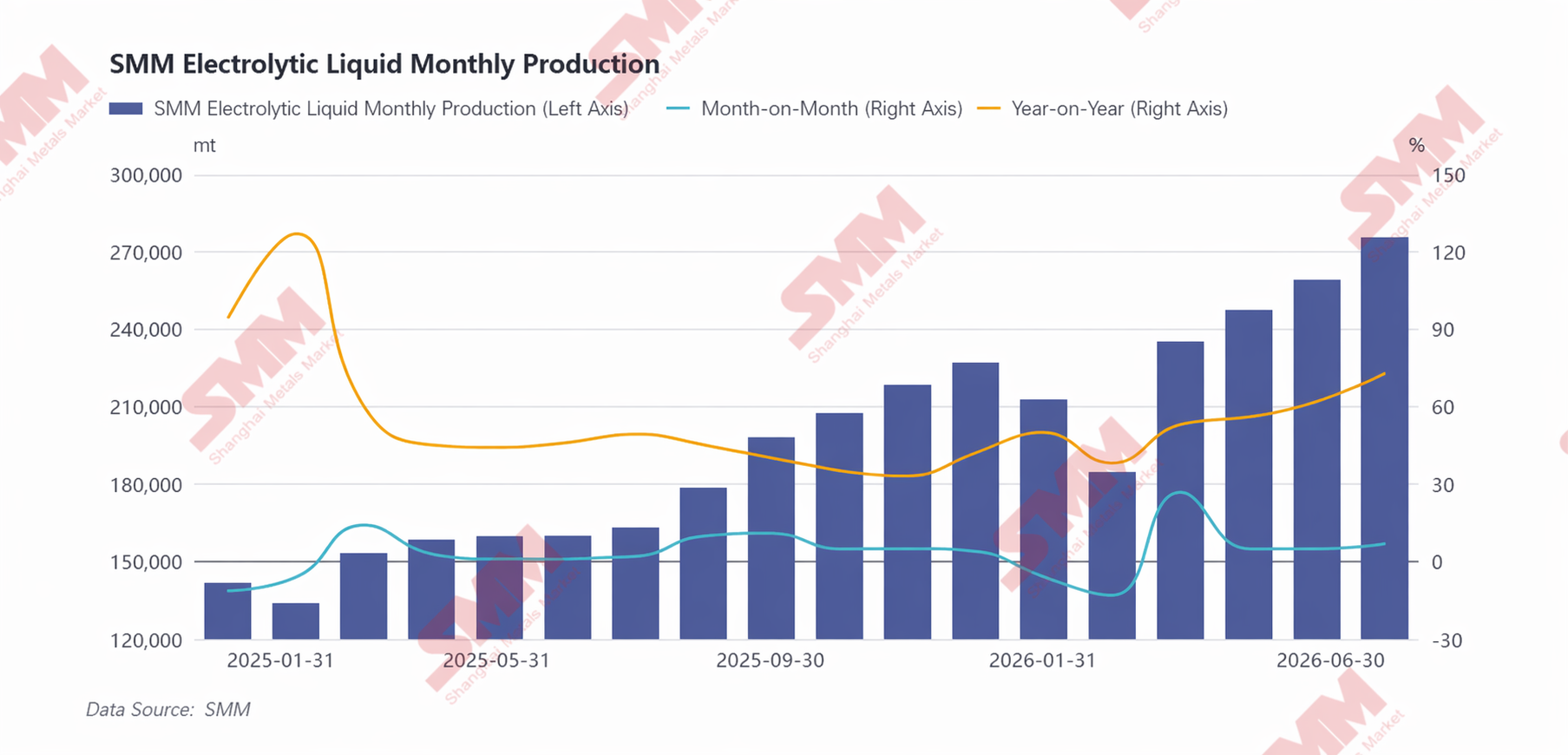
[SMM Analysis: Demand Drives Continuous Growth in Electrolyte Production in H1 2026, Prices in the Doldrums Due to Structural Disturbances in Raw Materials] According to SMM statistics, China's electrolyte production in H1 2026 was approximately 1.416 million mt, up about 56% YoY from H1 2025.

In H1 2026, China’s electrolyte market generally followed a first-down-then-up trajectory with pronounced structural divergence. Industry production and price trends moved in close step with downstream demand from power batteries and energy storage end-users, as well as upstream raw material price fluctuations.

In terms of production, the production pace of the electrolyte industry was highly tied to the operating rates of downstream battery cell manufacturers, with industry output fluctuating in sync with end-use lithium battery demand. Specifically, the market faced dual headwinds in Jan–Feb 2026. The NEV purchase tax shifted from “exempt” to “halved,” front-loading end-user car purchase demand, which, combined with the traditional off-season during the Chinese New Year holiday, led to a phased weakening of end-use demand. Downstream battery cell manufacturers proactively reduced their production schedules and compressed capacity utilization rates to match the sluggish demand, leading to a significant shrinkage in supporting electrolyte procurement orders and a concurrent month-on-month decline in industry output. After the Chinese New Year, the entire industry chain gradually resumed production, end-use demand began to recover, and electrolyte production sustained an uptrend from Mar–Jun. The power lithium battery segment provided strong support: on one hand, China’s passenger NEV exports stayed high; on the other, although overall domestic passenger vehicle sales fell short of expectations, steadily rising vehicle battery capacity, coupled with policies promoting new-energy heavy-duty and light-duty trucks that drove the penetration rate of commercial vehicle electrification steadily upward, effectively offset the pressure on overall vehicle sales and drove month-on-month growth in power battery cell demand. The energy storage track, driven by the long-term rigid demand from the global energy transition and China’s new-type power system construction, saw an accelerating pace in the implementation of tenders for wind and solar power supporting energy storage and standalone ESS projects, leading to steady expansion in ESS installations. With the dual drivers of power battery and energy storage markets, downstream battery cell enterprises continued to raise their operating loads, releasing supporting electrolyte production demand in tandem and sustaining a month-on-month increase in industry output. According to SMM statistics, over the past six months, China’s total electrolyte production reached 1.416 million mt, up 56% YoY from H1 2025.

From a structural perspective, H1 growth was highly concentrated among leading integrated electrolyte enterprises. These enterprises mostly held long-term locked-in orders from top battery manufacturers, ensuring demand certainty and providing a stable floor for production; simultaneously, by leveraging their own upstream raw material supporting advantages in LiPF6, solvents, etc., they could effectively hedge against raw material price fluctuations, guarantee continuous production and reasonable profits. Their overall capacity utilization rates stayed high, with some enterprises even running at full capacity. In contrast, small and medium-sized non-integrated enterprises, constrained by factors such as scattered orders and cost pressure, saw only limited production growth, with industry orders further concentrating among the leaders.
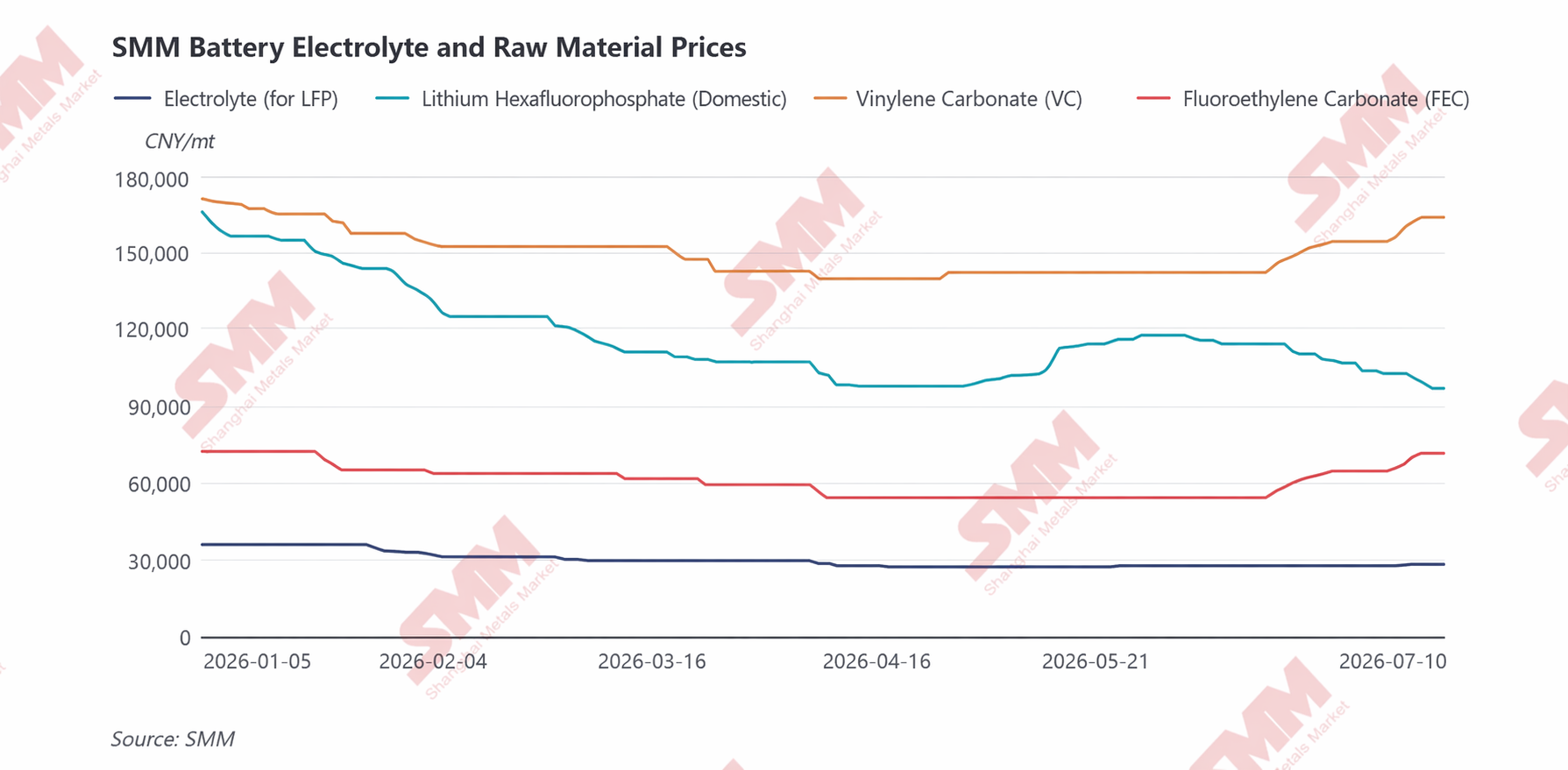
From a cost and price perspective, the H1 2026 electrolyte market was characterized by phased rotational adjustments and structural divergence driven by raw materials. Price trends at each stage were dominated by the intertwined strength and weakness of different cycles for solvents, LiPF6, and additives. The overall pattern was one of “declining costs and weak prices at the start of the year, then costs rebounding and prices stabilizing and rising mid-year driven by a tight additive supply-demand balance.”

In Jan–Feb, the industry was in a traditional demand off-season. As the concentrated end-use demand growth in Q4 2025 had tightened market supply-demand conditions, driving up electrolyte raw material prices (LiPF6, solvents, additives) to highs for the year, the slowdown in end-user procurement pace at the start of 2026 caused all upstream raw materials to simultaneously enter a downward price channel. This dragged the overall electrolyte production cost continuously lower, and prices further pulled back following the loosening on the cost side, resulting in an overall weak market at the start of H1.

Entering Mar–Apr, clear structural divergence began to emerge in the raw material segment. On the solvent side, logistical disruptions affecting upstream core raw materials like ethylene oxide due to geopolitical conflicts in the Middle East led to tightened supply expectations and rising risk-averse sentiment, rapidly driving up solvent raw material prices and subsequently causing carbonate solvent prices to surge in phases. However, the LiPF6 and additive segments were relatively in the doldrums, with overall ample industry supply and moderate profit margins for enterprises in the earlier period. Downstream electrolyte producers had a strong desire to bargain down procurement prices, causing LiPF6, VC, and FEC prices to continue drifting lower. The cost uplift brought by rising solvent prices during this period was limited and insufficient to offset the cost decline caused by LiPF6 and additives; the overall electrolyte cost still declined somewhat, and market prices continued to run weak.

In May–Jun, the electrolyte cost logic shifted again, with the market focus moving from solvents to LiPF6 and additives. In May, as earlier geopolitical risk sentiment on the solvent side gradually subsided, upstream raw material prices pulled back, combined with overall loose market supply, causing solvent prices to continue weakening and exerting some downward pressure on electrolyte costs. However, the LiPF6 market saw a phased recovery. Affected by a sharp rise in lithium carbonate prices, coupled with simultaneous price increases for phosphorus pentachloride and anhydrous hydrogen fluoride, cost pressure on LiPF6 producers increased significantly, with prices approaching the cost floor; meanwhile, the market had continued destocking earlier, resulting in tight circulating supply. The marginal repair of the supply-demand pattern pushed LiPF6 prices to bottom out, providing some support for electrolyte prices. Entering June, lithium carbonate prices began to pull back from mid-May, dragging LiPF6 prices down again and weakening lithium chemicals’ cost support for electrolytes. In stark contrast, the additive segment strengthened once more. As downstream power battery and energy storage demand continued to recover and electrolyte operating rates climbed steadily, VC and FEC demand continued to expand. However, new industry capacity ramp-up progress fell short of expectations, limiting effective supply growth, and market supply-demand conditions continued to tighten. Producers showed a strong willingness to hold prices firm and push for hikes; electrolyte manufacturers, to ensure normal order deliveries, had no choice but to passively accept raw material price increases, further fueling the rise in VC and FEC prices, which became the core dominant factor driving the phased increase in electrolyte costs.
Looking ahead to H2, the power segment is expected to show growth, driven by sustained strong new orders for passenger NEVs, increased vehicle battery capacity, and the gradual advancement of commercial vehicle electrification. Energy storage demand remains robust, and enterprises’ overall production schedules are expected to maintain firm growth. Supported by demand, H2 electrolyte demand is expected to improve further compared to H1, driving production growth. From a cost and price perspective, the continued recovery in downstream demand will further tighten the supply-demand balance for core additives like VC, with the short-term tightness persisting; LiPF6 prices, supported by lithium carbonate costs, are expected to stay high and move sideways. Overall, backed by the rigid support of core raw materials, H2 electrolyte prices are expected to sustain a drifting higher trend.


Note: If you have any supplements or corrections regarding the details mentioned in this article, please feel free to contact us. Contact information is as follows:

Tel: 021-20707858 Hu Xuejie, Thank you!


SMM New Energy Research Team

Wang Cong 021-51666838

Ma Rui 021-51595780

Feng Disheng 021-51666714

Lyu Yanlin 021-20707875

Zhang Haohan 021-51666752

Wang Zihan 021-51666914

Wang Jie 021-51595902

Xu Yang 021-51666760

Xu Mengqi 021-20707868

Hu Xuejie 021-20707858

Data Source Statement: Except for publicly available information, all other data are processed by SMM based on publicly available information, market communication, and relying on SMM's internal database model. They are for reference only and do not constitute decision-making recommendations.

Images in this article contain AI-translated captions for reference only.

For any inquiries or for more information, please contact: lemonzhao@smm.cn
For more information on how to access our research reports, please contact:service.en@smm.cn
Related News
[SMM Flash] Zimbabwean Spodumene Concentrate Prices Fall Across All Grades, Led by 5% Li₂O Down 1.99%
6 hours ago
[SMM Flash] Zimbabwean Spodumene Concentrate Prices Fall Across All Grades, Led by 5% Li₂O Down 1.99%
Read More
[SMM Flash] Zimbabwean Spodumene Concentrate Prices Fall Across All Grades, Led by 5% Li₂O Down 1.99%
[SMM Flash] Zimbabwean Spodumene Concentrate Prices Fall Across All Grades, Led by 5% Li₂O Down 1.99%
Zimbabwean spodumene concentrate prices, CIF Chinese main ports, declined across all three tracked grades on August 7, with the lower-grade material posting the steepest percentage drop. The 6% Li₂O grade (SMM-Li-SC-005) settled at $2,010/tonne, down $25 (-1.23%), trading in a $1,970-$2,050 range. The 5.5% Li₂O grade (SMM-Li-SC-006) closed at $1,885/tonne, down $30 (-1.57%), within a $1,860-$1,910 band. The 5% Li₂O grade (SMM-Li-SC-007) fell hardest, settling at $1,725/tonne, down $35 (-1.99%), with the widest daily range of the three at $1,660-$1,790. The pullback widened the grade differential at the lower end of the curve: the 6%-5.5% spread stood at $125/tonne, while the 5.5%-5% spread widened to $160/tonne, up from typical spread levels, pointing to comparatively softer demand for lower-grade Zimbabwean material relative to higher-Li₂O concentrate on the day. SMM View: The broad-based decline across all three Zimbabwean spodumene grades tracks the wider softness in China's lithium chemical complex, with lower-grade material bearing the brunt of the pullback as buyers favour higher-grade feedstock amid cautious purchasing. SMM will continue to monitor whether the widening 5.5%-5% spread persists into the next pricing session or reflects a single-day liquidity effect.
6 hours ago
[SMM Analysis] Corica Mali Wins $348M Open-Pit Mining Contract at Ganfeng's Goulamina Lithium Project
6 hours ago
[SMM Analysis] Corica Mali Wins $348M Open-Pit Mining Contract at Ganfeng's Goulamina Lithium Project
Read More
[SMM Analysis] Corica Mali Wins $348M Open-Pit Mining Contract at Ganfeng's Goulamina Lithium Project
[SMM Analysis] Corica Mali Wins $348M Open-Pit Mining Contract at Ganfeng's Goulamina Lithium Project
Corica Mali, a subsidiary of Corica Mining Services, has been awarded the open-pit mining services contract at the Goulamina spodumene project in Mali, valued at approximately $348 million. The contract follows a competitive tender process and covers six months of pre-production activity followed by a fixed five-year term. Corica has already mobilised to site under an early works arrangement and is currently carrying out pre-strip and direct shipped ore (DSO) mining and crushing. Scope covers grade control, drill and blast, load and haul, and plant ore-feed services, with a planned material movement target of 18-20 Mt/y over the contract term. This figure refers to total mined material (ore plus waste), distinct from finished spodumene concentrate output Goulamina's Stage 1 definitive feasibility study outlines nameplate production of roughly 506,000 tonnes per annum of 6% Li₂O spodumene concentrate (SC6), with test work validating high-quality, low mica concentrate. On logistics, Goulamina is landlocked, located roughly 50 km west of Bougouni in southern Mali, and spodumene concentrate produced at site is trucked overland to coastal ports for onward shipment to end markets, predominantly Chinese converters. Industry practice for landlocked West African spodumene projects is to sell concentrate on an FOB basis at the export port, with the buyer arranging and bearing ocean freight from that point; Mali-origin concentrate has historically moved primarily via Abidjan, with San Pedro and Dakar available as secondary corridors. Specific Incoterms and export routing for Goulamina's commercial shipments were not disclosed in the contract announcement and should be confirmed against offtake documentation rather than assumed. Goulamina holds all key approvals and permits required for production. Ownership has changed since the original mining contract announcement: Ganfeng Lithium, previously a 50% joint-venture partner, acquired the remaining 40% interest from Leo Lithium in a transaction completed through 2024-2025, and now holds the project alongside the Government of Mali's equity interest under the country's revised mining code terms of the state's current stake should be verified against the latest Malian government disclosure rather than the original 10% free-carry figure cited at contract signing. First commercial shipment from Goulamina occurred in August 2025, superseding the original H1 2024 production target referenced when this contract was first announced. Corica has operated in the West African mining services sector for over 20 years and reports more than 2,000 employees, according to company-supplied figures; these have not been independently verified by SMM. SMM View: The Corica contract underlines the scale of open-pit mining services demand accompanying Mali's ramp-up as a spodumene supply source, with an 18-20 Mt/y material movement target supporting Goulamina's roughly 506,000 tpa SC6 nameplate capacity. With Ganfeng now holding full private ownership following its 2024-2025 buyout of Leo Lithium's stake, offtake and logistics decisions at Goulamina sit entirely with Ganfeng and the Malian state, reinforcing China's direct control over a growing share of West African spodumene supply reaching Chinese conversion capacity. SMM will monitor further disclosure on Goulamina's export routing and contractual Incoterms as shipment volumes scale.
6 hours ago
[SMM Analysis] Zimbabwe Lithium Producers Commit $1.45B to Local Processing, Seek Export Ban Flexibility"
6 hours ago
[SMM Analysis] Zimbabwe Lithium Producers Commit $1.45B to Local Processing, Seek Export Ban Flexibility"
Read More
[SMM Analysis] Zimbabwe Lithium Producers Commit $1.45B to Local Processing, Seek Export Ban Flexibility"
[SMM Analysis] Zimbabwe Lithium Producers Commit $1.45B to Local Processing, Seek Export Ban Flexibility"
Zimbabwe's lithium producers have collectively committed approximately US$1.45 billion to local beneficiation infrastructure, according to Lithium Producers Association Chairman Innocent Rukweza, who also heads Mutapa Energy Resources. Speaking at the Mine Entra Beneficiation and Value Addition Symposium in Bulawayo, Rukweza said the industry has sought government flexibility on the pending export restriction on unbeneficiated spodumene concentrate, citing limited sulphate-plant readiness across the sector. SMM notes the ban's effective date and any adjustment to it should be confirmed against the latest government notice rather than symposium commentary, and that the US$1.45 billion figure is association-reported and has not been independently verified. Of seven major producers, only the Huayou-linked plant at Prospect Lithium Zimbabwe's Arcadia site has completed and commissioned sulphate conversion capacity to date. The US$400 million facility exported Africa's first locally produced lithium sulphate in April 2026 and is now operating. Sinomine's US$500 million sulphate plant at Bikita remains under construction, Kamativi Mining Company's US$200 million-plus sulphate project is at investment stage with commissioning status unconfirmed, and a fourth, unnamed facility is targeted for end-2027. The gap between committed capital and commissioned output is the operative supply constraint behind the industry's request for timeline flexibility: the remaining producers are still moving concentrate rather than sulphate and would be directly exposed if the unbeneficiated export restriction takes effect before their plants come online. Logistics add a further layer of risk to that timeline. Spodumene concentrate is currently exported CIF China, routed predominantly via Beira in Mozambique and Durban in South Africa, and sulphate output from commissioned and future plants will likely need to move through the same corridors absent dedicated arrangements. ZETDC grid instability continues to affect processing-plant uptime, bearing directly on how quickly the remaining sulphate facilities can ramp to nameplate capacity once commissioned, while congestion at the Machipanda border post and along the Beitbridge Durban and Maputo rail corridors affects turnaround times independent of on-site production readiness. Even where sulphate capacity comes online on schedule, these constraints will shape whether the sector can convert commissioned capacity into consistent export volumes ahead of any tightened concentrate-export policy. On the fiscal side, the industry's effective tax burden is estimated at around 40% of sales revenue, comprising a 10% export tax on unbeneficiated lithium, 7% royalties, a 3% community development levy, a 1% MMCZ marketing fee and 15.5% VAT, before corporate income tax, payroll and foreign currency retention requirements are added. The association has called for a review, noting Zimbabwe's rate sits above global peers. Beyond lithium, the association has pointed to unrecovered value in tantalum, niobium and caesium from lithium operations, and government has since introduced mandatory mineral declaration and on-site assay laboratory requirements at producing mines. Specific loss and investment figures cited for this by-product stream were not independently attributed at the symposium and are not carried here pending primary sourcing. SMM View: Zimbabwe's beneficiation drive is currently a one-plant story, with Arcadia commissioned and exporting sulphate while Bikita, Kamativi and the fourth facility remain at construction or investment stage. The binding constraints on closing that gap are not purely financial grid reliability and corridor congestion at Machipanda and along the Beitbridge–Durban and Maputo routes will shape how quickly commissioned capacity converts into consistent export volumes. The roughly 40% effective tax burden remains a separate and likely more durable point of friction with Harare. SMM will confirm the committed investment figure and current export-policy status once further primary disclosures are available.
6 hours ago