SMM, July 10:
Metals market side,
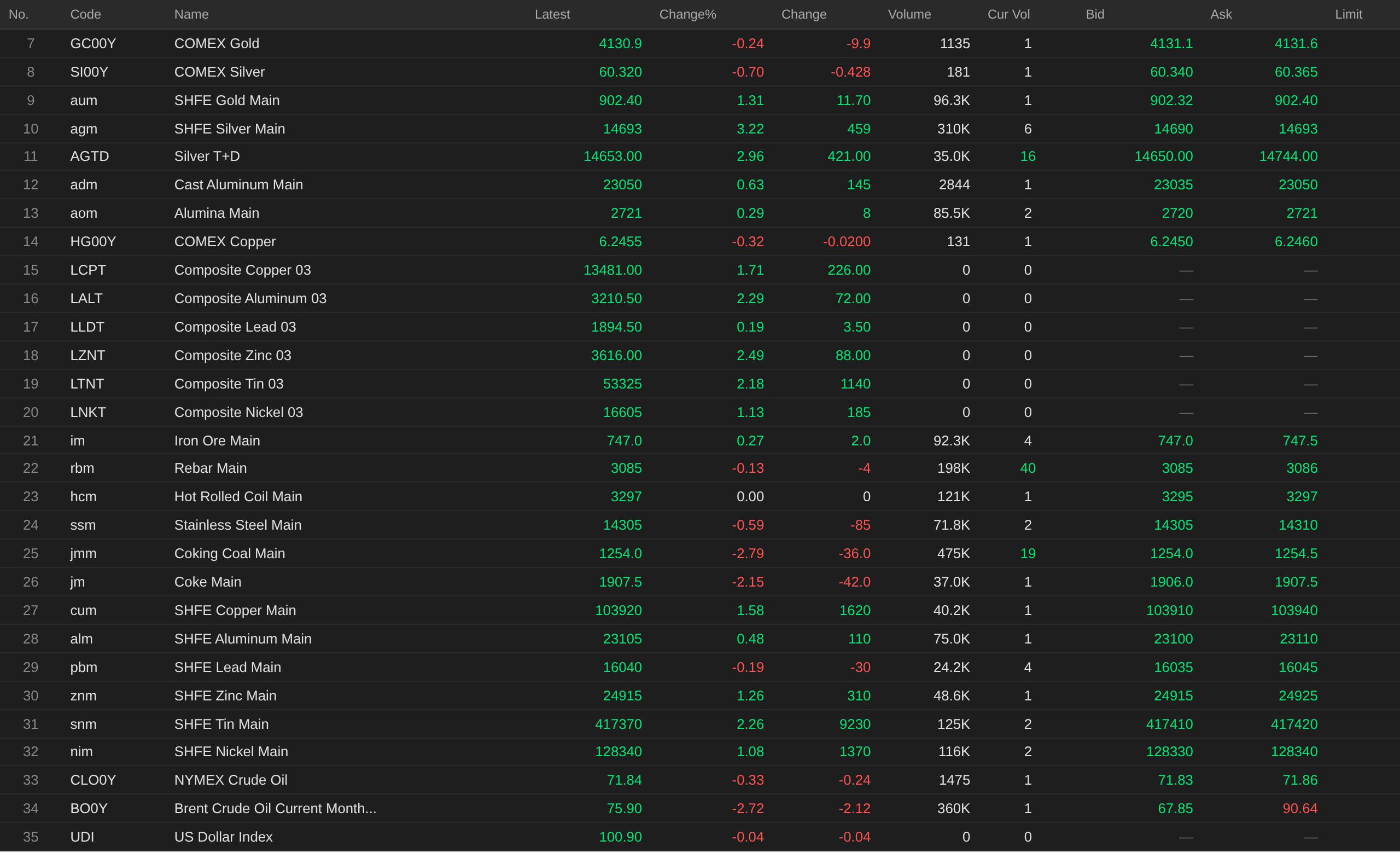
overnight, base metals on the domestic market mostly rose. SHFE copper rose 1.58%, SHFE aluminum rose 0.48%, SHFE lead fell 0.19%, SHFE zinc rose 1.26%, SHFE tin rose 2.26%, and SHFE nickel rose 1.08%. In addition, the most-traded alumina futures rose 0.29%, and the most-traded casting aluminum contract rose 0.63%.
Overnight, ferrous metals mostly fell. Stainless steel fell 0.59%, iron ore rose 0.27%, rebar fell 0.13%, and hot-rolled coil was flat at 3,297 yuan/mt. Coking coal and coke side, the most-traded coking coal contract fell 2.79%, and the most-traded coke contract fell 2.15%.
Overnight, on the overseas market, LME base metals all rose. LME copper rose 1.71%, LME aluminum rose 2.29%, LME lead rose 0.19%, LME zinc rose 2.49%, LME tin rose 2.18%, and LME nickel rose 1.13%.
Overnight, precious metals side: COMEX gold rose 1.23%, and COMEX silver rose 3.1%. Overnight, the most-traded SHFE gold contract rose 1.31%, and the most-traded SHFE silver contract rose 3.22%.
According to Polish central bank Governor Grabinski, the bank purchased billions of dollars worth of gold during the recent dip in gold prices. At a press conference in Warsaw on Thursday, Grabinski said the bank has purchased 82 mt of gold so far this year. This means that since the last official data release in April, the bank added another 37 mt of gold, worth approximately $5 billion at current prices. “Taking advantage of the recent price decline, we have been continuously purchasing gold,” Grabinski said. Poland reported more gold purchases than any other central bank in 2025 and is expected to continue this record this year. Gold prices have fallen over 10% since April. Grabinski reiterated the Polish central bank’s target of 700 mt of gold reserves. He said the bank currently holds 632.4 mt of gold, of which 105 mt is stored in Poland and the rest is held in London and New York. (Jinshi Data APP)
Bernstein raised its 2026 gold price forecast, expecting a H2 gold price target of $4,375 per ounce and a full-year target price of $4,533. The firm believes that continued central bank purchases and the high probability that the US Fed will not cut interest rates over the next 12 months will be key factors supporting gold prices. Bernstein expects the Fed to raise rates at most 1 to 2 times, and gold ETF outflow pressure will also be limited. Bernstein noted that in Q2 2026, rising real interest rates caused gold prices to pull back from $4,650/oz to around $4,000, but as rate expectations stabilize, gold still has upside room. The firm also warned that if inflation persistently exceeds expectations, prompting the Fed to hike rates more aggressively, that would become a major risk to gold’s upward movement. (Jinshi Data APP)
As of 7:12 AM on July 10, overnight closing market data:
Macro front
China side:
[State Council Issues “15th Five-Year Plan” Carbon Peak Action Plan: Carbon Emissions to Decrease 17% in 2030 Compared with 2025] On July 9, the “15th Five-Year Plan Carbon Peak Action Plan” was released, charting a “roadmap” for China to meet its carbon peak target before 2030. Over the next five years, China’s energy structure will undergo further adjustment and optimization. By 2030, China’s carbon dioxide emissions per unit of GDP will be reduced by 17% from 2025 levels, and non-fossil energy consumption will account for 25% of the total. In terms of specific measures, the Action Plan clearly mandates accelerating energy structure adjustment and optimization and vigorously promoting non-fossil energy development. During the 15th Five-Year Plan period, new electricity consumption will be increasingly covered by new clean energy generation. The Action Plan intensifies efforts to promote green and low-carbon industrial development, with a series of new measures being introduced. On one hand, it aims to deepen the low-carbon transition of traditional industries, advancing energy-saving and carbon-reduction projects in steel, aluminum, cement, flat glass, petrochemical engineering and other key industries. On the other hand, it focuses on vigorously developing emerging green and low-carbon industries such as green energy, green manufacturing, and green services. For existing capacity, it emphasizes “improving quality through green transition,” guiding enterprises from a zero-sum cost-driven competition mindset toward an innovative approach of low-carbon and zero-carbon development. For new capacity, it stresses “cultivating the new with green transition,” nurturing and expanding strategic emerging and future industries characterized by green, low-carbon features. In the transportation sector, the Action Plan proposes that by 2030, the ownership share of NEVs should reach 30%, and the ownership share of new energy operating vehicles should reach 25%. By the end of 2025, national NEV ownership accounted for about 12%, meaning this share will more than double within five years. For ordinary citizens, private NEV ownership will further increase during the 15th Five-Year Plan period.
US dollar side:
Overnight, the US dollar index fell 0.14% to 100.93. The latest data shows that for the week ending July 4 (which includes the US Independence Day holiday), US initial jobless claims decreased by 2,000 to 215,000, below market expectations of 217,000, remaining near historic lows. However, continuing claims, which reflect the re-employment situation for the unemployed, rose to 1.81 million, the highest level since March. Initial jobless claims persistently running low, together with recent non-farm payrolls data, paint a picture of a US labor market characterized by “reduced layoffs, slowing hiring.” (Wall Street News)
Fed Chairman Warsh Kevin has established five working groups to conduct a comprehensive review of the Fed’s monetary policy operating framework, covering areas such as balance sheet management, policy tools, and the impact of artificial intelligence. The Fed stated that the working groups will operate independently, conduct fact-based studies, and submit rigorous analyses to the Federal Open Market Committee (FOMC). The review will assess whether there is room for improvement in policy tools, analytical methods, and the policy framework. The review teams include several prominent economists and former central bank officials. Among them, Harvard economist Chetty Raj will co-lead the data working group, tech investor Andreessen Marc will head the productivity and employment working group, and former White House Council of Economic Advisers Chairman Mankiw Gregory will co-lead the inflation working group. Warsh said that the US economy has undergone dramatic changes over the past generation, and the current transformation is occurring at a faster pace, so the Fed needs to ensure it is in optimal condition to achieve its dual mandate of price stability and maximizing employment. (Jinshi Data APP)
Additionally, according to the Congressional Budget Office’s “Monthly Budget Review: June 2026,” the US federal budget deficit totaled approximately $1.4 trillion in the first nine months of fiscal year 2026, an increase of $35 billion compared to the same period last fiscal year. Federal revenues over the period were $4.2 trillion, up $142 billion or 4%, while outlays were $5.5 trillion, up $178 billion or 3%. (CCTV)
New York Fed Open Market Account Manager Perli stated that reserve management purchase operations have no preset course, and the New York Fed’s open market trading desk can adjust purchase amounts higher or lower depending on money market conditions. Additionally, Perli said that amid Fed Chairman Warsh appointing a working group on the Fed’s balance sheet, the trading desk is ready to implement any changes and interest rate control frameworks the committee may decide to adopt. The Fed began conducting reserve management purchase operations last December, driven by expectations that reserves would decline rapidly in April as tax payments flowed into the Treasury General Account. When the Treasury’s account balance at the Fed increases, reserves in the banking system decline. (Jinshi Data APP)
Dallas Fed President Lorie Logan stated that if the FOMC conducts open market operations through a voluntarily participated central clearing mechanism, it would help improve operational efficiency and effectiveness, and enhance US financial market stability. Logan noted that such an arrangement could improve the use of Fed tools, such as the Standing Repo Facility, which aims to provide liquidity to eligible institutions but has seen relatively low market usage so far. Some believe that simplifying clearing processes could increase its attractiveness. She also stated that market leverage levels need to be carefully managed, and financial markets must maintain an appropriate balance between the benefits and risks of leverage, and between leverage and liquidity. (Jinshi Data APP)
According to CME “FedWatch”: The probability of the Fed holding rates steady in July is 74.9%, while the probability of a cumulative 25-basis-point hike is 25.1%. Probability for the September meeting: holding rates steady at 35.7%, a cumulative 25-basis-point hike at 51.1%, and a cumulative 50-basis-point hike at 13.1%. (Jinshi Data APP)
Other currencies side:
Minutes from the ECB’s June meeting showed the bank could no longer ignore the energy shock, projecting that rising energy prices would push medium-term inflation above its 2% target. The ECB Governing Council unanimously decided to raise key interest rates to 2.25% last month, becoming the first major central bank to hike rates due to elevated energy prices caused by the Iran war. The minutes stated: “The current situation clearly falls no longer into the category of shocks that can be looked through.” “The longer energy prices stay high, the more likely it is that they will push up broader inflation through indirect and second-round effects. This increases the risk that the energy shock becomes entrenched in underlying inflation and medium- to long-term inflation expectations.” (Jinshi Data APP)
Macro side:
Data scheduled for release today include Germany’s June CPI final monthly rate, France’s June CPI final monthly rate, Switzerland’s June consumer confidence index, Canada’s June employment change, China’s June M2 money supply annual rate, China’s June year-to-date new yuan loans, and China’s June year-to-date aggregate social financing growth. Also in focus: 2026 FOMC voting member and Dallas Fed President Lorie Logan’s speech; SK Hynix’s American Depositary Receipts (ADRs) are tentatively scheduled to list on Nasdaq this July 10.
Crude oil side:
Overnight, both oil futures fell, with WTI oil down 2.33% and Brent oil down 2.72%. Although US-Iran military conflict escalated overnight, the market’s actual reaction was notably subdued, with crude oil closing lower. Brown Brothers Harriman’s Elias Haddad noted that the market views this attack as another “controlled escalation,” based on the premise that the economy can withstand the shock. Goldman Sachs’ Privorotsky shared a similar view, indicating that the market signal suggests no real interest from any party in expanding the conflict, preferring instead to maintain bargaining leverage. However, Privorotsky also warned that while crude oil prices have pulled back, the refined product prices that actually feed into inflation have yet to follow. (Wall Street News)
The US Central Command stated that Iran does not control the Strait of Hormuz. Since early May, US forces have been assisting in safeguarding navigational safety in this vital international trade route, with over 800 merchant ships and 380 million barrels of crude oil successfully passing through the strait. (Jinshi Data APP)
Additionally, sources said that the Saratov refinery in Russia has been shut down since Wednesday following a drone attack. (Jinshi Data APP)


![[SMM Analysis] H1 2026 Overseas Secondary Aluminum Market Review & H2 Outlook: Supply Eases, Demand Leads](https://imgqn.smm.cn/production/admin/votes/imageslvDRc20240314085754.png)