SMM July 7 News:
I. China's H1 Market Review
Imports: Recovery Growth, with Africa Driving the Increment
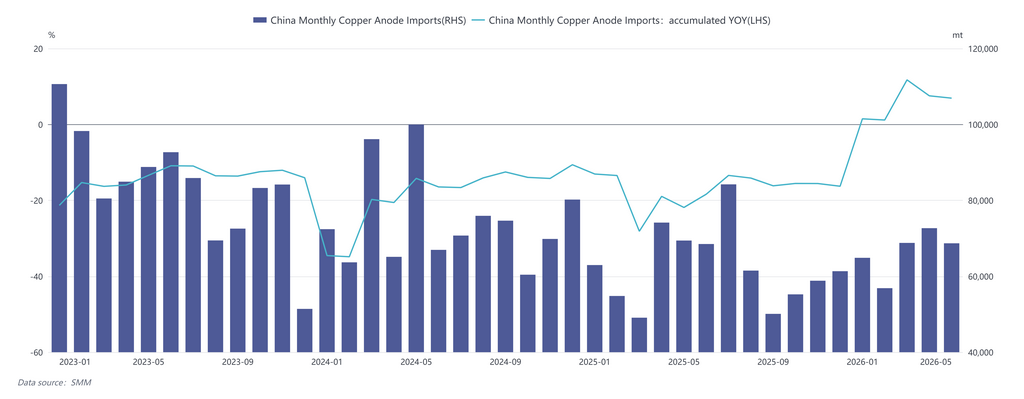
China's copper anode imports totaled 331,900 mt in January-May 2026, up 6.92% YoY, reversing the sluggish trend of a 15.88% YoY decline in full-year 2025. On a monthly basis, imports followed a "low-high-then-pullback" trend. The import source structure underwent significant changes. Zambia remained the top source, but its share gradually pulled back from 53% at the start of the year to around 40% in May. The DRC emerged as the largest source of increment, with its share of exports to China rapidly climbing from less than 10% in January to 22.60% in May, supported by continuous ramp-up of the Kamoa copper smelting project (with an annual blister capacity of 500,000 mt), and its YoY growth once exceeded 250%. In contrast, Chilean material continued to shrink due to persistent import price inversions, with its share falling to 4.48% in May.
Domestic Supply and Demand: Rapid Reversal from Easing to Tightening
The evolution of the domestic supply-demand pattern in H1 can be divided into two phases:
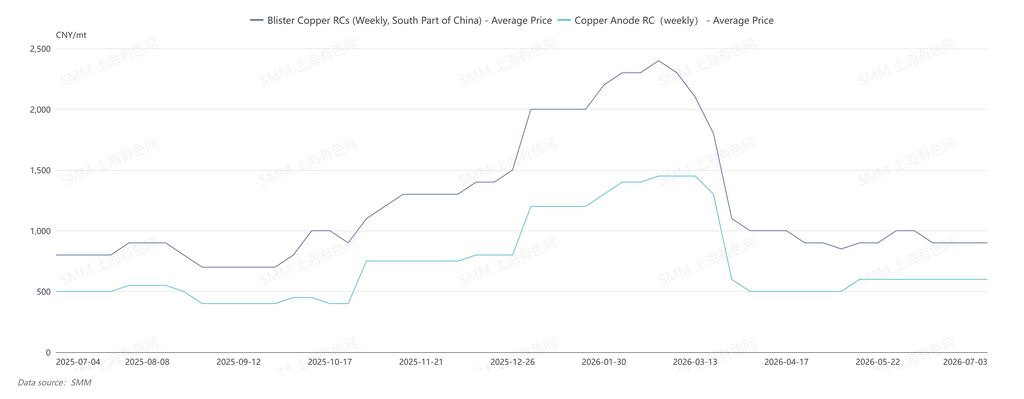
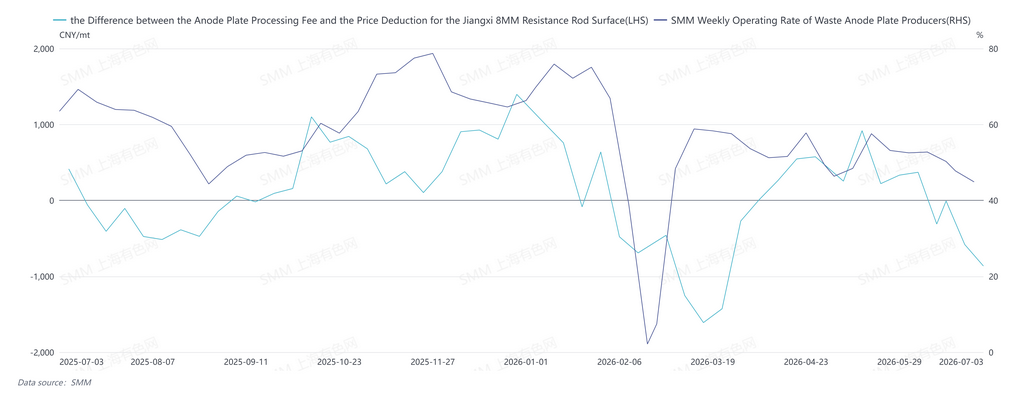
Q1 easing phase: Supply of scrap-derived blister copper and anode plates remained ample, extending the abundant state from the end of 2025. Smelters held high cold material inventories, and spot blister copper RCs in south China operated at high levels of 1,800-2,000 yuan/mt. Under the loose pattern, market reliance on imported copper anode temporarily declined.
A turning point emerged in mid-to-late March: as copper prices fell below the 100,000 yuan/mt mark, the price spread between primary metal and scrap narrowed rapidly. At the same time, industry policies tightened intensively—stricter compliance inspections for secondary copper and reduced financial support squeezed scrap-derived copper anode producers with high raw material costs, quickly eroding their production willingness and causing market supply to start contracting.
Q2 tightening phase: The supply-demand imbalance erupted intensively in Q2. The overall operating rate of SMM copper anode enterprises dropped from 50.42% in March to 45.95% in June, with the scrap-derived segment declining from 40.58% to 36.00%. Meanwhile, Q2 coincided with concentrated maintenance among domestic smelters, which instead increased their external procurement needs for cold material. Supply contraction and demand pulse moved in opposite directions within the same window, sharply widening the supply-demand gap. The monthly average of spot blister copper RCs in south China plunged to 950 yuan/mt in April, down 850 yuan/mt MoM, and further declined to 900 yuan/mt in May.
II. Analysis of Key Drivers Behind Supply-Demand Changes
(1) Tightening of secondary copper policies is the primary variable for supply contraction
The core driver of the supply-demand pattern reversal in H1 came from policy shocks to the secondary copper industry. Purchasing activities for secondary smelting enterprises were hindered, accompanied by a simultaneous reduction in supportive financial policies. The markets for tax-included and non-tax-included raw materials became notably polarized, which became the primary reason for enterprises to cut or halt production.
(2) Narrowing price spread between primary metal and scrap amplified supply imbalances
As copper prices lacked upward momentum, the price spread between primary metal and scrap narrowed rapidly. Copper scrap suppliers held back from selling, making it difficult to support a large inflow of secondary copper into the smelting segment, accelerating the reversal of the supply-demand pattern.
(3) Extremely low TCs pushed up cold material reliance from the cost side
Copper concentrate TCs continued to deteriorate in 2026. Against this backdrop, smelters proactively adjusted their raw material mix, increasing the usage ratio of cold materials such as copper scrap and copper anode. This substitution logic provided rigid and continuously expanding bottom support for copper anode demand.
III. H2 Outlook
H2 imports are expected to face pressure: Zambia’s scheduled maintenance of crude smelting capacity will extend into Q3, while rising demand from countries such as India intensifies competition for copper anode supply.
China's supply: The core variables on the domestic supply side remain the direction of secondary copper policies and the price difference between primary metal and scrap. The structural shortage of tax-inclusive copper scrap is hard to improve before any substantial policy relaxation, keeping the supply elasticity of scrap-derived copper anode constrained; under this condition, RC also face difficulty rebounding significantly. If policy easing emerges at the margin in H2, supply from the scrap-derived segment is expected to recover; otherwise, the tight supply pattern will persist.
China's demand: The demand side remains supported: low TC levels continue to boost substitution demand for cold materials; the medium and long-term trend of expanding refined copper capacity remains unchanged, and the raw material deficit persists.
IV. Summary
In H1 2026, the core operating logic of China’s copper anode market can be summarized as follows: overseas project startups drove a recovery in imports, but the tightening of domestic secondary copper policies rapidly shifted the supply-demand pattern from a surplus in Q1 to tightening in Q2. In H2, barring any policy stimuli, domestic supply elasticity remains limited, while smelters’ substitution demand for cold materials stays strong, keeping the overall market in a tight balance.
In the long term, the structural contradiction of refined copper capacity growth persistently outpacing crude smelting capacity growth persists, and the market position of copper anode as a key supplementary raw material will continue to strengthen. The rising share of scrap-derived copper anode, diversification of import sources, and the evolution of the supply system characterized by “supplementing ores with scrap” and “supplementing external sources with domestic sources” represent the core directions of copper anode market development.