Recently, China's lead prices have continued to weaken, with secondary smelters generally caught in a double dilemma of processing losses and a shortage of scrap battery raw materials. The SMM survey of production cuts and resumption plans at secondary lead smelters nationwide from June to July clearly reflects the current pressure on the industry.
I. June Secondary Lead: Significant polarization among enterprises, slight overall increase
In June 2026, smelter operations across regions polarized:
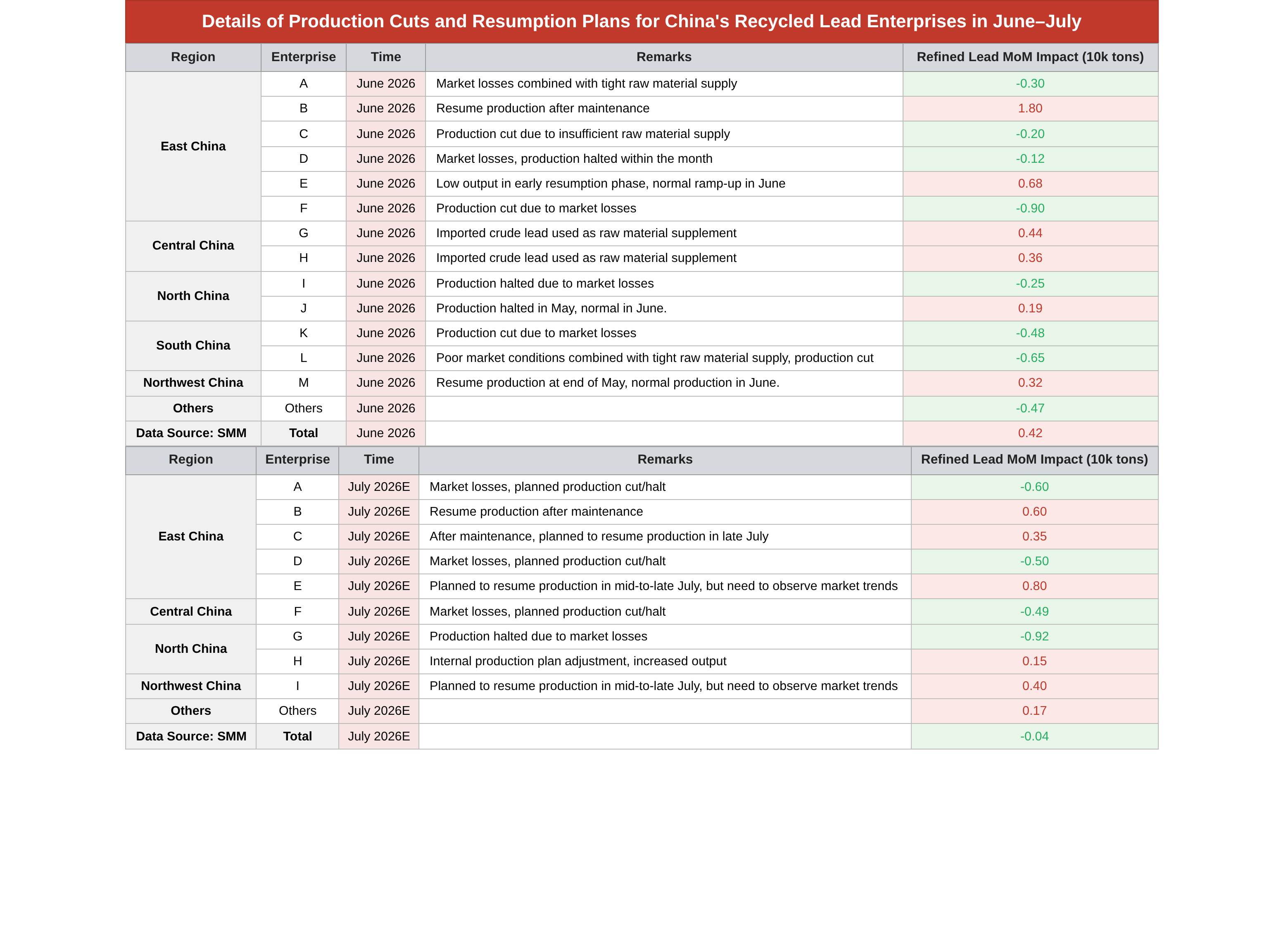
Core logic of production cuts: Multiple enterprises in east China (A/C/D/F), north China (I), and south China (K/L) proactively reduced loads or suspended production due to falling lead prices, which caused losses on production, and insufficient scrap battery recycling volumes. A single smelter in these areas cut output by as much as 9,000 mt; other scattered enterprises across other regions cut an additional 4,700 mt.
Increase offset by production resumptions: Smelters in east China (B/E), central China (G/H), north China (J), and northwest China (M) resumed production after maintenance and raised output using imported crude lead as feed, forming an offsetting increase. After combining increases and decreases, national secondary refined lead output in June edged up by 4,200 mt MoM, with supply still having some support.
II. July Expectations: Losses deepen, supply increase essentially disappears
Entering July (estimate E), the industry's loss-making scope expanded further, and the magnitude of production cuts escalated significantly:
Large-scale planned production cuts: Multiple smelters in east China (A/D), central China (F), and north China (G) explicitly planned to concentrate production cuts due to market losses, with a single smelter in north China reducing output by 9,200 mt - a scale far exceeding that of June. Although some enterprises had production resumption plans for mid-to-late July, they all indicated they need to watch lead price trends, making the pace of resumptions uncertain.
Limited increase from production resumptions: Only a few enterprises in east China (B/C), northwest China (I), and north China (H) resumed production after maintenance or adjusted internal output to raise volumes, with the increase unable to cover the production cut gap. Overall estimates for the full month show that secondary refined lead in July will edge down by only 400 mt MoM, shifting from a slight increase in June to basically flat, as the increase is fully offset by reduction cuts driven by losses.
III. Interpretation in the context of current lead market conditions
The current core contradiction in the lead market is centered on ample primary lead supply + weak downstream battery demand during the off-season, which has kept lead prices falling under pressure, directly squeezing secondary lead smelters' processing margins:
1. Scrap battery purchase prices remain rigid and hard to fall, while refined lead selling prices weaken, leading to inverted TCs for smelters. Proactive production cuts to avoid risks have become a common choice.
2. On the raw material side, scrap battery recycling volumes are already at off-season lows, and losses further reduce enterprises' willingness to purchase materials, forming a negative cycle of "price decline → less material collection → production cuts".
3. Although some maintenance-related production resumptions are scheduled for July, the willingness to resume highly depends on a lead price recovery. If the market remains sluggish, originally planned resumptions may be delayed, and further tightening expectations for secondary lead supply will provide bottom support for lead prices.
![SHFE lead ends slightly higher intraday, short-term rebound strength needs to watch downstream destocking realization [Lead Futures Brief Review]](https://imgqn.smm.cn/usercenter/xVgcv20251217171721.jpg)