In June, the sodium-ion battery industry chain showed strong momentum. End-use demand continued to be released upstream, driving high growth for both cathode materials and hard carbon anodes, further tightening the supply-demand balance. SMM data shows that sodium-ion battery cathode production rose 22% MoM and hard carbon anode production rose 17% MoM, while the pace of supply expansion still struggled to match demand growth, with a clear seller's market.
1. Cathode Materials: Undersupply Persists, H2 Gap Pressure Emerges
In June, sodium-ion battery cathode material production increased 22% MoM and climbed 36% YoY. By product structure, the polyanion route remained dominant, accounting for 82%, directly echoing the robust demand from sodium-ion battery energy storage.
The most prominent contradiction in the cathode market was severe supply shortage. Top-tier players largely maintained full production and full sales, with finished product inventories falling to extreme lows. Some enterprises could only prioritize shipments to key clients. Feedback from the downstream battery cell end showed instances of shipment delays being urged.
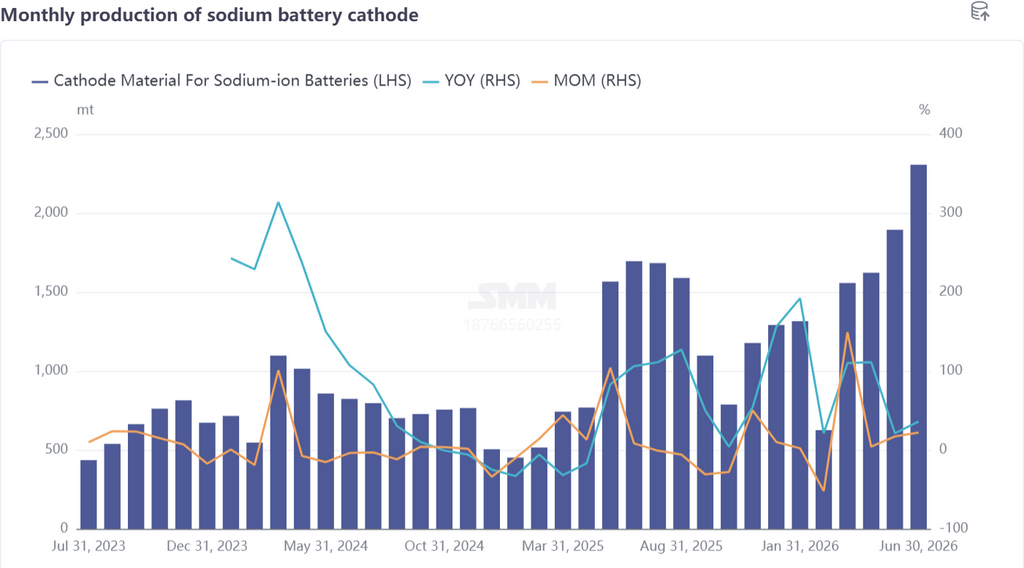
From a competitive landscape perspective, sodium-ion battery cathodes are still in the early stage of commercialization. Few enterprises truly possess the capability for large-scale shipments. The industry's overall monthly shipments remained at the hundreds-of-mt level, without yet achieving a kt-level breakthrough. This pattern suggests that the bargaining power of the cathode segment will remain relatively strong in the short term.
Looking ahead to H2, the supply-demand imbalance is expected to intensify further. The current period is a transition from H1 to H2, and downstream battery cell enterprises have already communicated their H2 demand estimates upstream. As H2 demand is released in a concentrated manner, SMM expects the tight cathode supply to persist, with potential periodic supply-demand gaps emerging in some segments.
The cost side is also under pressure. In June, NFPP (sodium iron phosphate) raw material costs continued to climb, with iron phosphate prices rising persistently. Upstream iron phosphate enterprises have proposed using SMM iron phosphate prices as the settlement benchmark, while NFPP cathode plants plan to use formula-based pricing to pass costs downstream to battery cell manufacturers. This move is expected to establish a more controllable cost pass-through mechanism and promote a virtuous commercial cycle in the industry chain. Against this backdrop, NFPP cathode prices saw a clear increase in June. In contrast, the layered oxide cathode remains tepid, and progress in vehicle installation has yet to accelerate. However, as car models equipped with layered oxide routes may be launched in H2, this route is expected to leverage the momentum and gain volume.
July Outlook: The positive demand trend continues, and production schedules are expected to keep increasing. SMM expects sodium-ion battery cathode production in July to increase 8% MoM and be up 47% YoY.
2. Hard Carbon Anode: Capacity Release Accelerates, High-End Product Shortage Continues
In June, the sodium-ion battery hard carbon anode market continued in an undersupply state, with production up 17% MoM and surging 145% YoY, maintaining robust growth momentum.
Supply side, the industry operated with extremely low inventory overall, with finished products shipped immediately upon completion and a very short safety stock cycle, confirming sustained strong demand-side pull. Meanwhile, new entrants are accelerating commissioning and ramp-up of production lines, and supply-side increments are already on the way.
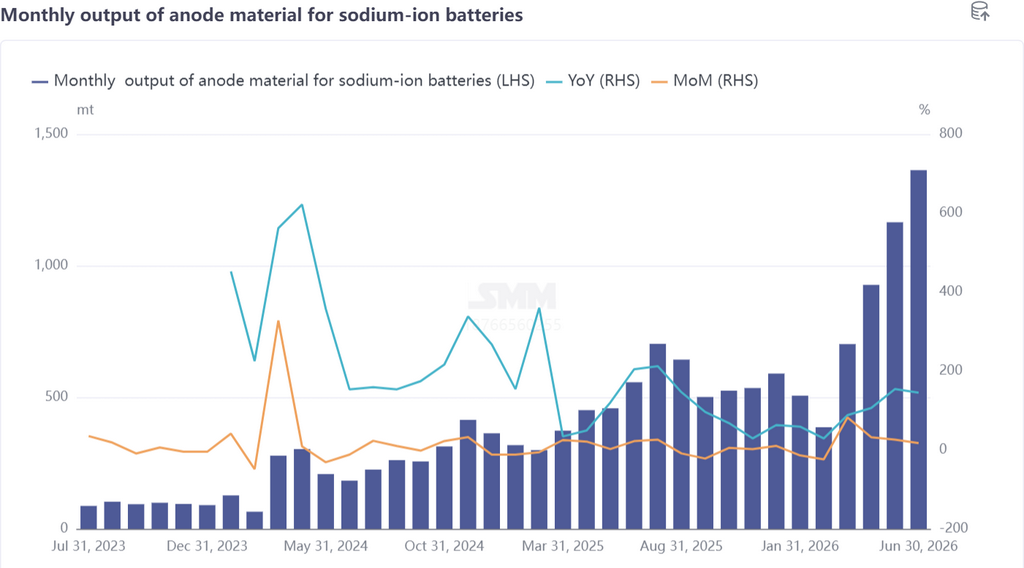
Demand-side signals are positive. In H2, some lithium battery enterprises are expected to have anode procurement volumes exceeding 1 kt, and related engagement progress could achieve substantial breakthroughs in the second half, further driving volume growth in the anode market.
From a competitive landscape perspective, constrained by capacity limitations, the hard carbon anode market clearly exhibits seller’s market characteristics. Notably, subtle shifts are underway within the industry: some upstream enterprises are forming client-binding ties with downstream players to lock in supply volumes and priority supply rights. Due to insufficient capacity, toll processing arrangements are gradually increasing, but uneven quality control standards under the toll processing model are also emerging, which to some extent hampers the full release of hard carbon product quality and battery cell performance.
July Outlook: Expectations for market volume ramp-up are clear in July-August, and industry confidence is relatively high. However, the tight supply pattern for high-end products is likely to persist, and enterprises with process upgrade capabilities and stable quality control are expected to secure more advantageous positions amid this upswing. SMM expects hard carbon anode production to increase 13% MoM and 119% YoY in July.
3. Overview: Supply-Demand Mismatch Persists, Industry Chain Embraces a Growth Window Period
Overall, the sodium-ion battery industry chain was highly prosperous in June, with the supply-demand mismatch pattern persisting on both the cathode and anode sides. Upstream capacity expansion was accelerating but still on the way, yet in the short term it could not meet the concentrated release of downstream demand, with clear seller’s market characteristics.
Cost-side pressure gradually transmitted upward, and pricing mechanisms trended toward marketization, favoring a more balanced profit distribution across the industry chain. In H2, as sodium-ion battery car models may be launched and delivered, energy storage project tenders accelerate, and large-scale procurement by lithium battery enterprises materializes, the sodium-ion battery industry chain is expected to encounter a key window period for accelerated demand release. At this stage, enterprises with large-scale capacity realization, stable quality control, and cost transmission capabilities will be the first to break through in the reshaping of the competitive landscape.
![[Lithium Battery: Samsung SDI Plans Battery Lines For Solid-State, LFP, Sodium]](https://imgqn.smm.cn/usercenter/cTxNb20251217171727.jpg)
![Sodium-ion Battery Market June Review (I): Cathode Undersupply and Anode Volume Release Resonate, Industry Chain Prosperity Continues to Rise [SMM Analysis]](https://imgqn.smm.cn/usercenter/ajAmi20251217171726.jpg)
![[SMM Cobalt Morning Brief] Cobalt intermediate product quotations firm, cobalt salt stabilizes, restocking cautious](https://imgqn.smm.cn/usercenter/ChqBy20251217171724.jpeg)