SMM, Jul 2:
Metals Market:
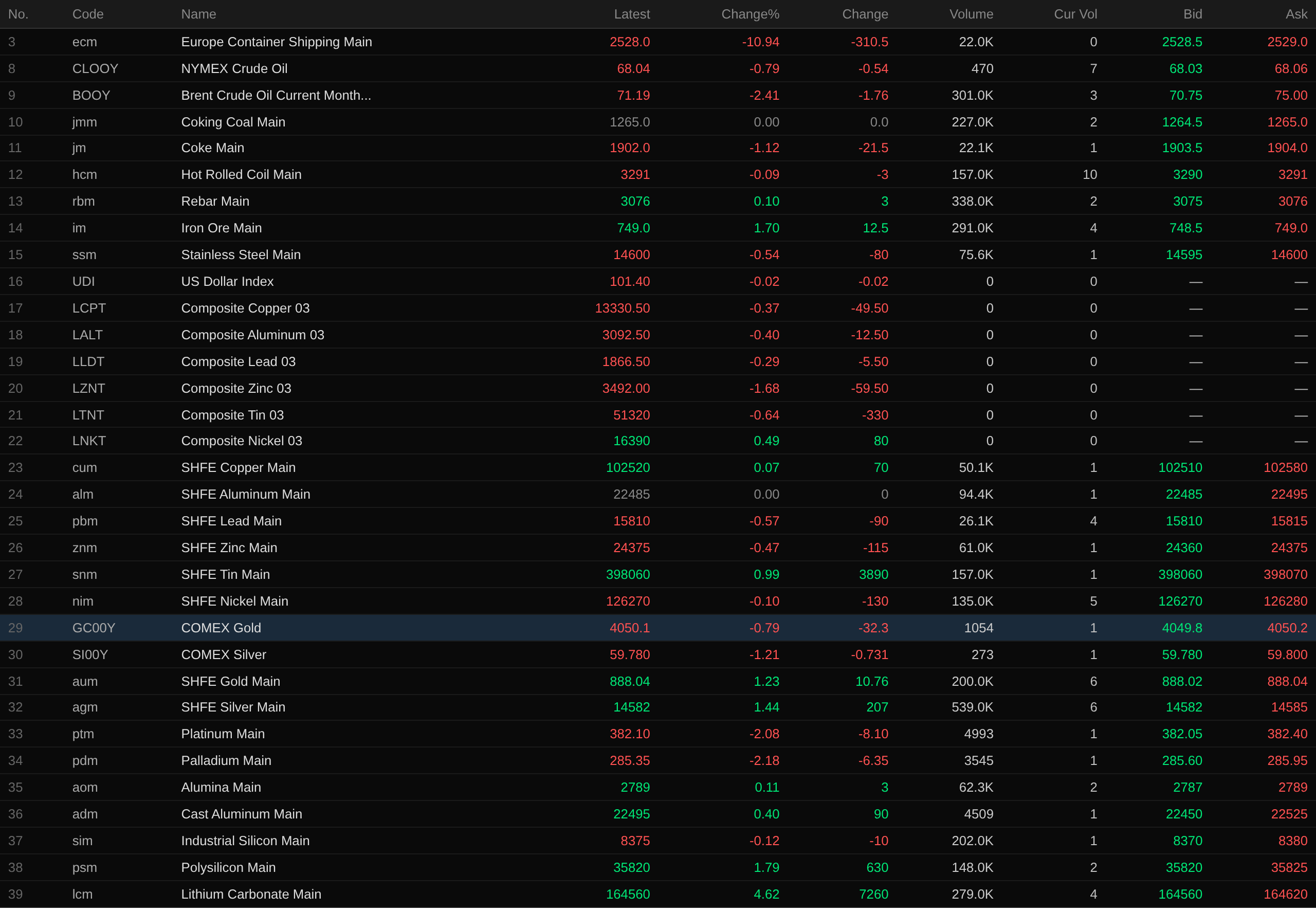
Overnight, base metals on overseas and China markets showed mixed performance. Only LME nickel, SHFE copper, and SHFE tin rose, with SHFE tin up 0.99%, LME nickel up 0.49%, and SHFE copper up 0.07%. SHFE aluminum closed flat at 22,485 yuan/mt. LME zinc led the decline, down 1.68%, while losses in other metals were within 1%. The most-traded alumina contract rose 0.11%, and the most-traded aluminum casting contract rose 0.4%.
In the ferrous metals sector overnight, iron ore led gains, up 1.7%. Rebar rose 0.1%, while stainless steel fell 0.54% and hot-rolled coil edged down 0.09%. Coking coal and coke, coking coal closed flat at 1,265 yuan/mt, and coke fell 1.12%.
In the precious metals sector overnight, COMEX gold rose 0.15% and COMEX silver fell 0.53%. On the domestic front, SHFE gold rose 1.23% and SHFE silver rose 1.44%.
As of 6:43 a.m. on Jul 2, overnight closing quotes:
Macro Front
China:
The Caixin China Manufacturing PMI, compiled by RatingDog, came in at 51.7 in June, staying in expansion territory for the seventh consecutive month.
[Shenzhen Housing Market Trading Volume Hits Near 6-Year High in June] Data released today by the Shenzhen Centaline Research Center showed that combined new and second-hand residential home sales in Shenzhen reached 8,878 units in June, down 11.9% MoM but up 14.2% YoY. This was the highest transaction volume for the same period since 2021. Specifically, online registrations of new homes (pre-sale and move-in) totaled 3,785 units, down 16.7% MoM but up 15.6% YoY. Second-hand home transfers reached 5,093 units, down 8% MoM but up 13.1% YoY. (Jinshi Data APP)
US Dollar:
As of the overnight close, the US dollar index rose 0.24% to 101.41. Fortress Securities stated that investors are underestimating the likelihood of the Fed raising interest rates as early as this month, as Chairman Kevin Warsh appears ready to take a more preemptive approach to fighting inflation. The firm's head of macro strategy, Frank Flight, continues to view two rate hikes this year—in September and December—as his base case. Even so, he noted that the market is pricing in a roughly 30% probability of a July hike, a level he considers too low. (From Wallstreetcn APP)
Fed Chairman Kevin Warsh set an ambitious timetable for the US central bank to "discover" and begin relying on real-time economic data, which he argues would be superior to what he described as "problematic government reports." "My aspiration is that in nine to 12 months, we will be leveraging new technologies to understand what is happening in the real economy in a synchronous, real-time manner, enabling us as central bank policymakers to make better decisions. We will no longer rely solely on data from government agencies that suffer from statistical biases and where surveys have lost their relevance," Warsh said at a monetary policy forum in Portugal. "My ideal data is 'what's happening now.' If we do our jobs well, a year from today we will say: we have uncovered data that helps us make better decisions."
Fed Chairman Kevin Warsh stated at the ECB Forum on Central Banking (the final day of the Sintra annual conference) that inflation risks have receded over the past four weeks, while he reaffirmed his commitment to price stability. He declined to provide any forward guidance on future interest rate policy. He described the labour market as "holding steady," noting robust economic demand and strong supply-side performance. Deutsche Bank analysis pointed out that Fed officials' public remarks have declined notably since the Jun 17 FOMC meeting, confirming Warsh's earlier policy stance that "US central bank officials talk too much" and that there is a need to reduce forward guidance and push for "institutional change." (Wallstreetcn)
Data: US private-sector job growth slowed in June but increased for the 12th consecutive month, showing the labour market cooldown has yet to evolve into a sharp slowdown. Data released Wednesday by ADP Research showed US private payrolls rose by 98,000 in June, below the 119,000 estimated by economists. The prior month's figure was an increase of 122,000. Although the gain missed expectations, the data still supports the judgment that the labour market has been stabilizing this year.
Macro Front:
Data releases today include the US June unemployment rate, US June seasonally adjusted non-farm payrolls, US initial jobless claims for the week ended Jun 27, US June average hourly earnings YoY, US June average hourly earnings MoM, US May factory orders MoM, Switzerland June CPI MoM, and the Eurozone May unemployment rate.
Due to the US Independence Day holiday (Jul 3), US June non-farm payrolls data will be released earlier, at 8:30 p.m. Beijing time on Thursday, Jul 2. The US stock market will be closed on Friday, Jul 3. Trading in CME precious metals, energy, foreign exchange, US Treasury, and equity index futures contracts will end early at 1:00 a.m. Beijing time on Jul 4. Trading in ICE Brent crude oil futures contracts will end early at 1:30 a.m. Beijing time on Jul 4. Investors are advised to take note. (Jinshi Data APP)
In addition, the Ministry of Commerce will hold its first regular press conference for July. 2027 FOMC voter and San Francisco Fed President Daly will attend a conference on the Spanish economy.
Crude Oil:
Overnight, oil prices fell across both benchmarks, with WTI crude down 2.03% and Brent crude down 2.41%. The immediate driver of the heavy sell-off was a rapid easing of geopolitical tensions in the Middle East. A White House spokesperson explicitly stated there is a strong chance of reaching a deal between the US and Iran, with delegations from both sides having held indirect talks in Doha on Jul 1 on topics including unfreezing assets and ensuring maritime security in the strait. Both Goldman Sachs and Morgan Stanley concluded that the global oil market is about to return to severe oversupply. Even accounting for the massive global demand to replenish strategic petroleum reserves, the daily average net surplus in the crude oil market next year will still approach 2 million barrels, exerting long-term pressure on oil prices. (Wallstreetcn)
Official data showed US crude oil inventories fell from 415 million barrels at the end of February to 331 million barrels as of Jun 19, hitting their lowest level since 1983. Although these depleted reserves urgently need to be rebuilt, this is not enough to reverse the surplus pattern. Samantha Dart, Goldman Sachs' co-head of global commodities research, estimated global demand to replenish strategic petroleum reserves is slightly above 1 million barrels per day. While this will tighten the market to some extent, it can only partially offset the anticipated surplus, with the market ultimately still facing a net surplus of nearly 2 million barrels per day. Regarding market concerns over future shipping costs in the Strait of Hormuz, Goldman Sachs believes the material impact on global energy prices would be limited. (Wallstreetcn)
![Futures Stopped Falling and Surged, Spot Aluminum Managed to Hold Firm [SMM South China Aluminum Spot Daily Commentary]](https://imgqn.smm.cn/usercenter/tkWbz20251217171654.jpg)
![Amid mid-year settlements, suppliers slashed prices to sell, with overall trading sluggish [SMM South China Spot Copper Cathode Weekly Review]](https://imgqn.smm.cn/usercenter/udUol20251217171712.jpg)
![North China spot copper cathode discounts rise, supply is tight, suppliers hold prices firm, and rigid demand provides a floor [SMM North China Copper Spot]](https://imgqn.smm.cn/usercenter/HhNHP20251217171708.jpg)