Transactions remained sluggish throughout the off-season, Operating rates of brass billet producers weakened further.

Published: Jun 30, 2026 10:51
The brass billet industry is currently deep in the traditional consumption off-season. Weighed down by weak demand, tight raw material supply, and fluctuating costs, production in the sector remained under pressure.

The brass billet industry is currently deep in the traditional consumption off-season. Weighed down by weak demand, tight raw material supply, and fluctuating costs, production in the sector remained under pressure. According to SMM data, the operating rate of China’s brass billet industry fell to 50.73% last week, down 1.44 percentage points MoM, broadly in line with earlier forecasts.
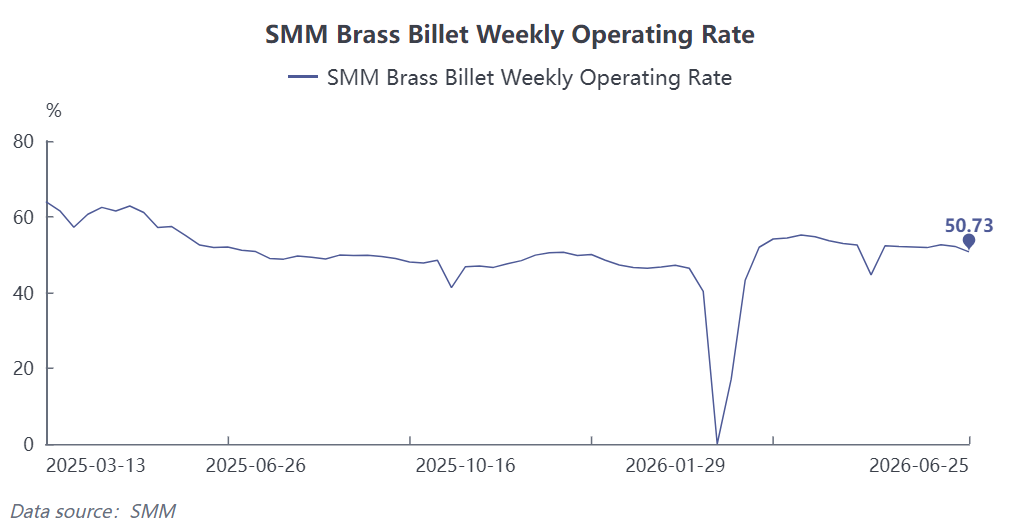
The tight supply of recycled brass raw materials saw no significant improvement. Imported and domestic secondary brass remained at low circulation levels, keeping procurement difficulties high. Although copper prices pulled back at certain stages, prompting some producers to engage in limited stockpiling and driving raw material inventory days at sampled enterprises slightly higher to 3.84 days, most firms were generally concerned about insufficient processing margins and refrained from large-scale restocking. Most factories only purchased raw materials as needed, maintaining low inventory levels for production. Raw material shortages continued to constrain capacity release at small and medium-sized producers.
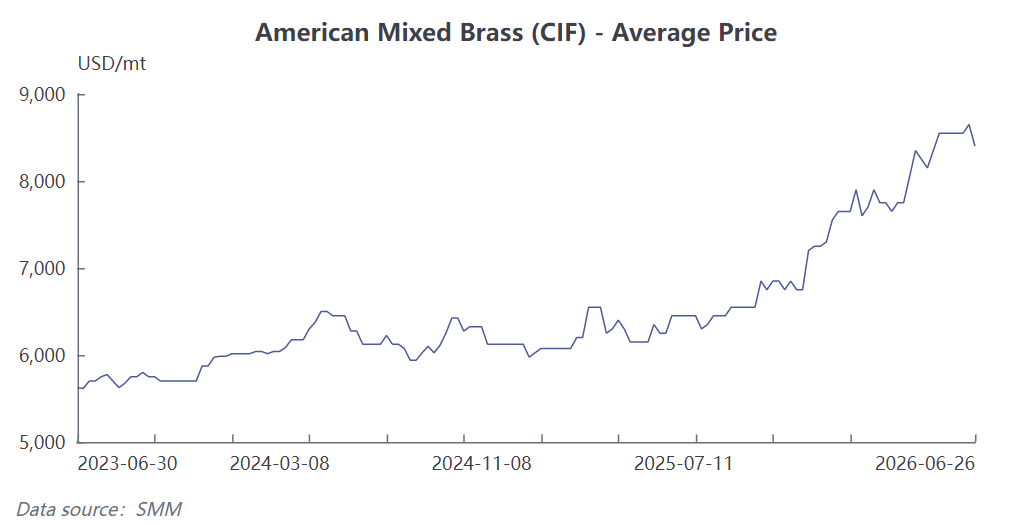
Meanwhile, the off-season effect fully materialized among downstream end-users in the home appliance, sanitary ware, and hardware fittings sectors. The overall procurement pace continued to slow down. The vast majority of brass billet producers could only sustain production schedules with existing past orders, while new orders were few and far between.

Last week, only after a sharp pullback in copper prices did long-waiting downstream players ease slightly, releasing a concentrated batch of small-scale restocking orders based on rigid demand. However, the incremental order volume was extremely limited, nowhere near enough to reverse the overall pattern of sluggish transactions. With downstream cargo pick-up slow, finished product destocking was hindered. Finished product inventory days at sampled enterprises remained at 5.32 days, and the financial pressure from inventory buildup persisted.

Looking ahead to this week (6.26–7.02), the traditional industry off-season is unlikely to end quickly. End-users will likely remain cautious and on the sidelines amid consolidating copper prices, making it difficult for orders to see a meaningful recovery. The tightness in recycled brass raw material supply is also unlikely to ease in the near term, with persistent cost disruptions. SMM expects the operating rate of brass billet producers to edge up 0.29 percentage points MoM to 51.02% this week. Overall industry production schedules will remain low, and operational pressures on enterprises are unlikely to ease in the short term. 

Data Source Statement: Except for publicly available information, all other data are processed by SMM based on publicly available information, market communication, and relying on SMM's internal database model. They are for reference only and do not constitute decision-making recommendations.

For any inquiries or for more information, please contact: lemonzhao@smm.cn
For more information on how to access our research reports, please contact:service.en@smm.cn
Related News
Sluggish Trading on the Mid-Year Settlement Day, with Neither Buyers nor Sellers Being Active [SMM South China Spot Copper]
1 hour ago
Sluggish Trading on the Mid-Year Settlement Day, with Neither Buyers nor Sellers Being Active [SMM South China Spot Copper]
Read More
Sluggish Trading on the Mid-Year Settlement Day, with Neither Buyers nor Sellers Being Active [SMM South China Spot Copper]
1 hour ago
Copper prices pull back slightly and weaken, while month-end downstream wait-and-see keeps discounts steady [SMM North China Spot Copper]
1 hour ago
Copper prices pull back slightly and weaken, while month-end downstream wait-and-see keeps discounts steady [SMM North China Spot Copper]
Read More
Copper prices pull back slightly and weaken, while month-end downstream wait-and-see keeps discounts steady [SMM North China Spot Copper]
Today in North China, spot #1 copper cathode against the front-month contract was reported at an average discount of 170 yuan/mt to 110 yuan/mt, with an average discount of 140 yuan/mt, unchanged from the previous trading day. The average transaction price was 102,060 yuan/mt, down 250 yuan/mt from the previous trading day.
1 hour ago
[SMM Flash] Kazakhstan Follows Russia in Full Suspension of Sulfur Exports
1 hour ago
[SMM Flash] Kazakhstan Follows Russia in Full Suspension of Sulfur Exports
Read More
[SMM Flash] Kazakhstan Follows Russia in Full Suspension of Sulfur Exports
[SMM Flash] Kazakhstan Follows Russia in Full Suspension of Sulfur Exports
The ban took effect on June 27, with an exception for exports to Russia, dealing another heavy blow to global sulfur supply: According to Order No. 1363 signed by Kazakhstan's Ministry of Energy on June 26, Kazakhstan fully suspended sulfur exports starting June 27, 2026, and the ban will remain in effect "until further notice." Notably, sulfur shipments destined for railway stations within the Russian Federation are exempted. The ban covers all categories, with logistics operators responsible for enforcement: This ban includes all mainstream industrial sulfur categories such as liquid sulfur, granular sulfur, and lump sulfur. The responsibility for supervision and enforcement has been explicitly assigned to relevant railway structures and logistics operators, including Dar Rail LLC and TTT Service LLC. Russia and Kazakhstan Take Successive Actions, Global Supply Sees Precipitous Contraction: Just one day before Kazakhstan's ban—on June 25, the Russian government signed Decree No. 785, extending the ban on industrial sulfur exports, originally set to expire on June 30, to December 31, 2026. The Russian ban also covers liquid, granular, and lump sulfur, with officials stating the move aims to prioritize domestic fertilizer production and strengthen national food security.
1 hour ago
Transactions remained sluggish throughout the off-season, Operating rates of brass billet producers weakened further. - Shanghai Metals Market (SMM)