In June, the overall PMI for China’s aluminum semis industry came in at 46.6%, a sharp drop of 4.2 percentage points from May, with all sub-segments posting widespread declines. Aluminum plate/sheet and strip (47.1%), aluminum foil (46.3%), architectural extrusions (45.4%), industrial extrusions (45.7%), primary alloy (47.6%), and secondary alloy (37.0%) all stayed below the 50 mark, while only aluminum wire and cable (53.5%) remained in expansion territory, albeit with notably weakened expansion momentum. The common pressure factor across segments was weak domestic end-use demand: automotive sheets & plates were dragged down by “steel-for-aluminum substitution,” air-conditioner foil production schedules softened, general-purpose sheets and packaging foil entered the off-season, and new energy vehicle supporting orders declined marginally. On the export side, performance was mixed—new export orders for aluminum plate/sheet and strip and aluminum foil remained resilient, but the new export order index for aluminum wire and cable slumped 16.6 percentage points to 46.97%, signaling a marked narrowing of the export window. Secondary alloy was hit by the “reverse invoicing” policy, which pushed up compliance costs for aluminum scrap, tight raw material supply, and weakening auto production and sales, sending its PMI to the lowest level among all segments.
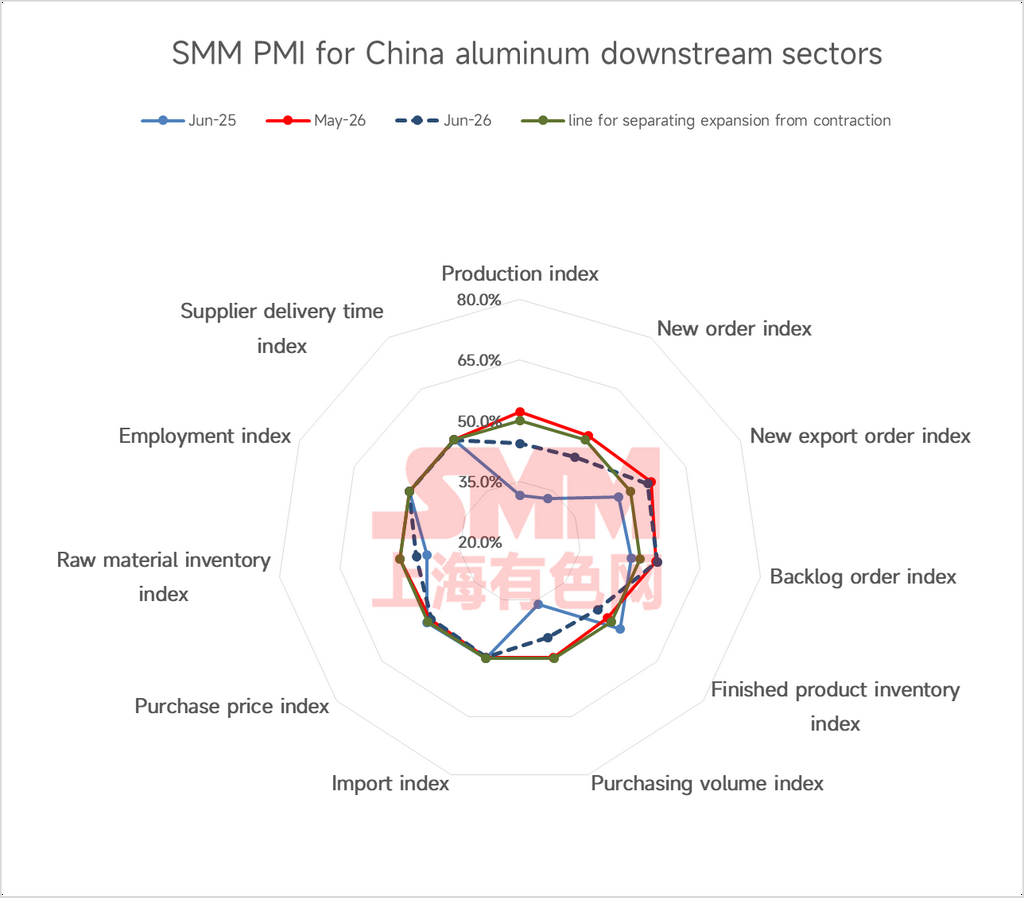
By product type:
Aluminum plate/sheet and strip: The monthly composite PMI for aluminum plate/sheet and strip stood at 47.1% in June, below the 50 mark. Looking at sub-indices, the new export order index and backlog order index both came in at 61.2%, in high-expansion territory, supported by strength in overseas markets in the first half of the month and restocking cycles outside China. Export orders on hand were full, and delivery lead times for newly received orders had extended to late August or even September. However, the new order index and production index both recorded only 45.4%. China’s general-purpose sheet market had long been suppressed by high aluminum prices, with civilian aluminum semis demand shrinking sharply, and fixed-price engineering project orders were widely delayed because their cargo pick-up would incur outright losses. Meanwhile, automotive sheet & plates were impacted as automakers broadly pushed “steel-for-aluminum substitution” to control costs: exterior panels of low and mid-end car models were almost all switched to steel, and structural parts were also replaced with steel in batches, to some extent weighing on automotive aluminum sheet & plate consumption. On the price side, the purchase price index printed at 49.1%. The reality that aluminum prices pulled back from highs during the month and spot aluminum prices tumbled to 22,850 yuan/mt at the end of June (a weekly drop of more than 1,000 yuan) dealt a huge blow to market sentiment, intensifying downstream users’ speculative wait-and-see mentality of “rushing to buy amid continuous price rises and holding back amid price downturns.” The finished product inventory index (45.4%) and raw material inventory index (47.6%) both stood in contraction territory, with enterprises proactively controlling production schedules and destocking amid weak demand. In summary, although export and energy storage terminal orders provided a solid bottom support, multiple intertwined pressures—persistent softness in general-purpose sheets, shrinking automotive aluminum demand, and wild swings in aluminum prices—are expected to keep the aluminum plate/sheet and strip PMI under pressure below the 50 mark in July. Aluminum Foil: The aluminum foil industry's PMI registered 46.3% in June, with all core sub-indices weakening across the board. The new orders index and production index both fell to 43.3%. Specifically, the air-conditioner foil segment was the biggest drag on the downturn. Weighed by the sluggish real estate market and persistently high raw material prices, end-user finished product enterprises sharply cut their domestic sales production schedules in June to control cash flow and avoid inventory blowups, leading to a simultaneous disruption in air-conditioner foil production schedules. In the packaging foil segment, the traditional off-season effect accelerated, June-August, with demand for pharmaceutical foil and video pouch in China continuing to weaken. Some small and medium-sized aluminum foil clients have begun intermittent holidays due to insufficient orders. The new export orders index (56.7%) and backlog orders index (55.8%) remained in expansion territory, reflecting relatively stable external demand. Customs data showed that aluminum foil exports rose 4% MoM in May, with export order delivery times for related enterprises extended to September. The raw material inventory index fell to 43.7%, as enterprises began large-scale procurement pullbacks and rescheduled production plans amid a deepening off-season. Overall, while battery foil and export orders provided some resilience for the industry, given the heavy drag from air-conditioner foil, the deepening off-season in packaging foil, and the disruption of downstream procurement pace caused by wild price swings, the aluminum foil PMI is expected to continue operating below the 50 mark in July.
Construction Extrusion: The construction extrusion industry's composite PMI registered 45.4% in June, pulling back below the 50 mark. The production index was recorded at 42.6% this month, with both the new orders index and procurement volume index at 43.1%, as the industry's prosperity shifted into a downturn territory. North China was relatively less impacted by the industry off-season, with end-user consumption for home decoration aluminum extrusion and doors/windows still showing resilience. The off-season characteristics were more pronounced in south China, where orders declined markedly after entering June. Although large-scale engineering orders had previously supported industry operations, the completion and delivery of aluminum extrusion for some projects recently left a lack of sufficient new orders to take over, dragging down industry production. Additionally, the downward shift in the aluminum price center brought limited incremental order volume, insufficient to offset the impact of weakening demand during the industry off-season. The export orders index was recorded at 51.8% this month, with extrusion exports remaining prosperous, as demand for construction extrusion products like system curtain walls and doors/windows showed ample resilience in regions such as Southeast Asia, Australia, and South America. Looking to July, the industry off-season will persist further. Temperatures are expected to climb in south China, slowing the progress of downstream end-user door/window replacement demand and large-scale engineering projects, with order demand anticipated to contract. On the export side, the price spread between Chinese and overseas markets has been narrowing recently. If this price spread cannot be restored going forward and enterprise profitability cannot recover, aluminum extrusion export volumes face the risk of pulling back later on. Overall, construction aluminum extrusion's PMI is expected to remain below the 50 mark in July. Industrial Extrusion: The composite PMI for the industrial extrusion sector registered 45.7% in June, pulling back below the 50 mark as industry sentiment shifted into contraction territory. The production index stood at 41.9%, new orders at 42.5%, and procurement volume at 41.3%. Demand from the energy storage segment continued to expand during the month, providing a rigid floor for industry operating rates. On the NEV side, however, some enterprises reported weakening end-user sales for specific car models supplied to automakers, with downstream matching orders pulling back at the margin, directly dragging overall operating rates lower. In June, downstream demand in the industrial extrusion sector showed low sensitivity to price stimulus from lower aluminum prices, with downstream end-users mostly making just-in-time procurement based on orders on hand and production schedules. The finished product inventory index came in at 50%, as enterprises broadly avoided passive inventory buildup and factored in downstream payment collection and cargo pick-up performance when taking orders, maintaining light-inventory operations to safeguard cash flow health. The new export orders index registered 51.2%, with some enterprises reporting a marginal recovery in orders for aviation-grade aluminum extrusions sold overseas through traders. In addition, some enterprises leveraged their deep-processing strengths to export aluminum outdoor leisure equipment, extending the positive trend in export sentiment into June. Heading into July, the narrowing price spread between Chinese and overseas markets will compress export margins, and industrial extrusion export volumes are expected to pull back at the margin. Combined with a deepening off-season, the industrial extrusion PMI is expected to remain below the 50 mark in July.
Aluminum Wire and Cable: China’s aluminum wire and cable industry PMI registered 53.5% in June, down 0.8 percentage points MoM. While still above the 50 mark, expansion momentum weakened and industry sentiment pulled back at the margin. By sub-index, the production index registered 57.51%, up 1.8 percentage points from 55.75% in May, as production enthusiasm remained relatively robust, supported by sustained export order scheduling and aluminum price declines that revived orders from State Grid. The new orders index registered 55.64%, down 3.4 percentage points from 59.06% in May, as only the second batch of UHV orders was formally placed and the third batch entered the tender process during the month, with the relatively slow pace of new order placements leading to notably weaker new order performance. The new export orders index registered 46.97%, tumbling 16.6 percentage points from 63.59% in May, plunging from expansion territory into contraction territory—a clear signal of a narrowing export window. The backlog order index registered 51.63%, down 6.3 percentage points from 57.89% in May, retreating from expansion territory to near the 50 mark as enterprises accelerated the digestion of previously backlogged orders and orders on hand began normalizing. The procurement volume index registered 59.06%, up 2.1 percentage points from 56.92% in May, as raw material purchasing maintained a positive trend and tight supply of aluminum rod in the market confirmed that restocking demand from producers remained in release. The raw material inventory index registered 46.97%, down 6.1 percentage points from 53.03% in May, indicating a marked destocking of raw materials at plants. Taken together, the production side of the aluminum wire and cable industry stayed high in June, while the procurement side continued active restocking. Yet signals such as sluggish new order growth, rapid digestion of backlog orders, and especially the sharp plunge in new export orders indicate that the sector’s expansion momentum is decelerating at an accelerating pace. As the diminishing price spread between Chinese and overseas markets shuts the export window, the aluminum wire and cable industry PMI is expected to pull back significantly to around 45.6% in July, with the sector likely re-entering contraction territory. Primary Alloy: The primary aluminum alloy industry's PMI recorded 47.6% in June, below the 50 mark, indicating a slight contraction in industry prosperity. Examining the sub-indices, the production index, finished product inventory index, and purchasing volume index all stood at 42%, while the purchase price index was 49%, showing overall weak performance across indicators. Most enterprises currently maintained normal production, primarily to fulfill existing long-term contracts, with no significant improvement seen in spot market trade. Traders largely operated on a buy-the-dip strategy, while overall downstream sectors continued to maintain restocking for rigid demand, with no substantial change in procurement pace. Despite the continuous decline in aluminum prices leading to higher market offers, enterprises were cautious in actual order-taking, generally concerned that aluminum price fluctuations would erode profits. Therefore, this month was mainly characterized by a wait-and-see approach, with no active pursuit of new orders. Additionally, compounded by holiday factors, downstream demand edged down slightly, which also had some impact on production. Weakness in overseas aluminum prices may drag on China's aluminum alloy wheel hub exports to some extent, with overall demand remaining subdued. However, considering that aluminum prices continued to edge down in July, low prices could stimulate consumption to some degree. The PMI is expected to rebound to 53.1% in July, with a slight recovery in industry prosperity.
Secondary Alloy: The secondary aluminum industry's PMI recorded 37.0% in June, pulling back 1.3 percentage points MoM, remaining continuously below the 50 mark and indicating persistent weakening in industry prosperity. The supply side contracted significantly, with monthly production falling to its lowest point of the year excluding the Chinese New Year month. This was mainly due to stricter enforcement of "reverse invoicing" policies in many regions, which drove up compliance costs in the aluminum scrap recycling and circulation process. The supply of invoice-bearing cargo became tight, and enterprises broadly faced the dual pressure of "invoice shortages" and climbing costs, leading to continuously declining operating rates. Tax and invoice issues have become the core bottleneck constraining supply. Meanwhile, imported aluminum scrap remained at an inverted price spread, and combined with strong sentiment among suppliers to hold back from selling, the availability of market cargo tightened further, intensifying the tight raw material supply. The demand side continued its off-season weakness. Weakening automobile production and sales dragged down orders for secondary aluminum enterprises, while the motorcycle sector performed relatively stably, with some export orders seeing slight growth driven by the price spread between Chinese and overseas markets. However, overall demand remained in a contractionary trend, and demand insufficiency also led to weaker enterprise operating rates. On the inventory front, hindered by tax invoice constraints and high prices, enterprises found it difficult to restock aluminum scrap, keeping raw material inventories at low levels. The supply contraction drove a simultaneous decline in finished product inventories, while factory buyback activity also led to destocking in social aluminum alloy inventories for four consecutive weeks. Looking to July, if the invoice tightness is not substantially alleviated, pressure on enterprises to procure raw materials will persist. However, given that current production cuts are already quite sufficient, the downside room for further output reduction is limited, while demand remains in the off-season. It is expected that the industry PMI will continue to operate below the 50 mark. Brief Comment:
Overall, in June the aluminum processing industry exhibited a pronounced divergence pattern of "external demand outperforming domestic demand, with the aluminum wire and cable industry unable to sustain the market on its own." Export orders, energy storage, UHV, and other areas provided structural support, but a combination of weak domestic consumption, wild swings in aluminum prices, and policy disruptions made it difficult for the overall industry sentiment to recover markedly in the short term.


![Concentrated east China arrivals, slow rebound in SHFE aluminum spot premiums [SMM Aluminum Spot Midday Review]](https://imgqn.smm.cn/usercenter/YYogD20251217171650.jpg)