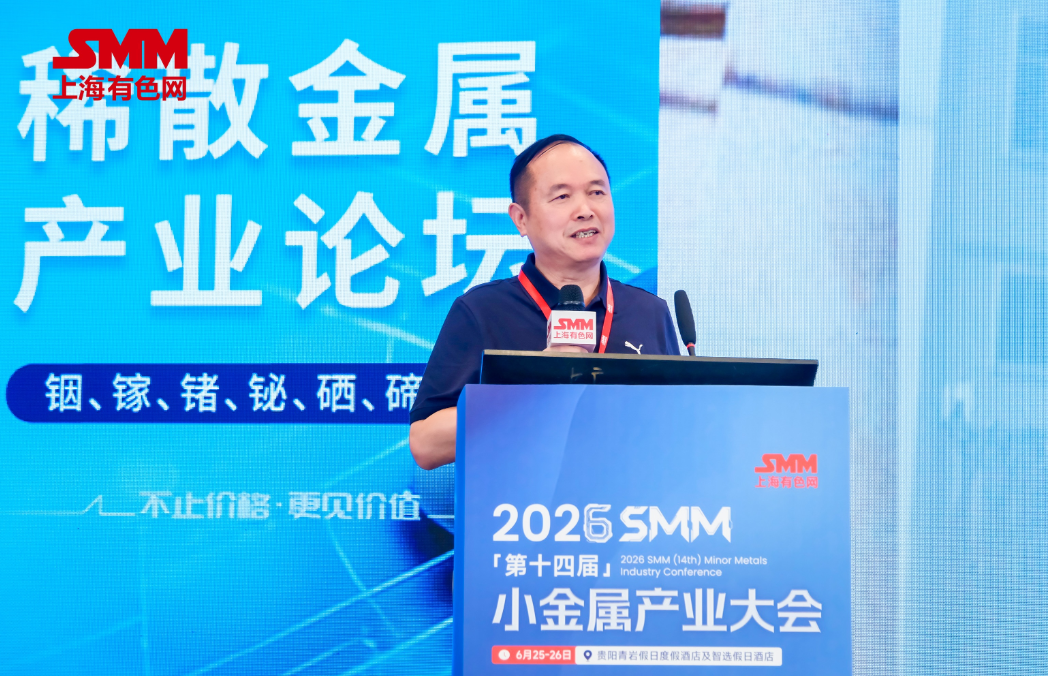
On June 26, at the hosted by SMM Information & Technology Co., Ltd. (SMM) with title sponsorship from Guangxi Yusheng Germanium High-Tech Co., Ltd., Ou Haiguang, Chairman of Lianzhou Tuosheng New Energy Co., Ltd., Qingyuan, Guangdong, shared “The Development and Application of Selenium.”
I. Global Selenium Market Overview
The global selenium market exhibits a combination of steady overall growth and rapid structural upgrading.
Global Selenium Market Characteristics
The global selenium market presents the dual characteristic of “steady overall volume and structural upgrading.” Growth in traditional sectors is slowing, while high-value-added niche segments show strong potential.
► Overall Market: Moderate Growth
It introduced the global selenium market size in 2025 and future compound annual growth rate, among other aspects.
► High-End Market: Rapid Expansion
High-purity selenium used in electronics, semiconductors, and solid-state batteries is the core growth driver. The global high-purity selenium market reached $1.8 billion in 2023 and is expected to exceed $3.5 billion by 2030, with a strong CAGR of 10%.
Selenium is a key material supporting the development of high-tech industries
It is a fundamental material for developing new materials, new devices, and new consumer goods (pharmaceuticals, agriculture, food).
Demand for selenium from military, new energy, and medical & health sectors is increasing daily.
Ultra-high-purity rare and scattered metals have been designated as key national strategic emerging industries under the “Strategic Research on New Materials Powering the Nation by 2035” (2020).
High-purity selenium was included by the National Development and Reform Commission (NDRC) in the “Catalogue for the Guidance of Key Products and Services in Strategic Emerging Industries” issued in Announcement No. 1 (2017).
The EU identified selenium as a critical raw material for strategic low-carbon energy technologies (2020).
Price Trend Review and Forecast
First, it reviewed the selenium price trend in recent years.
► Future Trend Forecast, 2026-2027
The global economic slowdown is weighing on the profitability and operating rates of traditional selenium-consuming industries such as glass, ceramics, and pigments, causing prices of ordinary industrial-grade selenium products to continue falling under pressure. However, high-purity, customized high-end selenium products used in PV, electronics, and other sectors are seeing price support due to high technical barriers and scarce supply, with the market showing a clear divergence in price trends.
► Market Insight: Supply-Demand Pattern Driving Divergence
As demand growth in traditional sectors such as PV glass slows, prices of basic products are heavily influenced by capacity. However, the technological barriers in high-value-added fields such as infrared, electronics, and solid-state batteries will support the price resilience of high-end selenium products, making them the core growth driver for future corporate profits.
II. In-Depth Analysis of China’s Selenium Industry
China is the global center for selenium production and supply, and its industry development trends have a decisive impact on the global market.
Production and Supply: The World’s Core Producing Region
China is the global center for selenium production and supply, accounting for nearly half of the world’s output, which continues to grow steadily.
► Production Scale and Growth: In 2025, China’s primary selenium production reached 2,030 mt (up 12% YoY), accounting for nearly half of the global total. The growth momentum came from the expansion of domestic copper smelters and their increased focus on the comprehensive recovery of rare and precious metals.
► Core Producing Region Distribution: Influenced by the layout of the copper smelting industry, China’s selenium is primarily produced in four provinces: Yunnan, Jiangxi, Anhui, and Hubei. The high degree of synergy between resources and the processing industry has formed a stable supply chain cluster.
► Industry Leader Landscape: Top-tier players such as Jiangxi Copper Corporation, Tongling Nonferrous Metals, Yunnan Copper, and China Daye Non-Ferrous Metals dominate production and are actively extending their reach into downstream deep processing, continuously refining their industry chain layout.
► Future Production Forecast: Production is expected to maintain an upward trend: it is projected to reach 2,165 mt in 2026 and further increase to 2,340 mt in 2027, continuously solidifying its core global supply position.
Consumption Structure and Trends: Replacing Old Growth Drivers with New Ones
► Changes in China’s selenium consumption structure are a microcosm of global trends, with emerging applications rapidly on the rise.
● Metallurgy (32%): A traditional mainstay field, with relatively stable demand.
● Flat Glass (24%): Driven directly by the rapid development of the PV industry, maintaining solid growth.
● Agricultural and Livestock Health (21%): A beneficiary of the upgrade in health consumption, it has become an important growth point.
● Ceramics and Chemicals (13%): A traditional, low-end application affected by environmental protection policies and alternative technologies, with demand continuing to shrink.
★ Electronics, Infrared, and PV (8%): The fastest-growing segment and the core new momentum driving the industry’s long-term development.
Trade Pattern: From Net Importer to Near-Balance
China’s selenium trade pattern has undergone a historic transformation, gradually achieving self-sufficiency and control over its resource supply and demand.
► Historic Transformation: Reshaping the Supply-Demand Pattern
In the past, as the world’s major selenium consumer, China was in a state of net imports for a long time. In recent years, thanks to the steady growth of domestic primary selenium smelting capacity and significant advances in recovery technologies for secondary resources like copper and selenium scrap, China’s reliance on selenium from outside China has dropped sharply, achieving a fundamental optimization of its trade structure.
► Key Milestone: 2025 Trade Data
In 2025, China's selenium trade achieved a historic breakthrough: both imports and exports totaled 728 mt, remaining basically flat. This data marks China's successful shift away from a passive "resource-importing" model, achieving basic self-sufficiency in selenium supply and demonstrating strong risk resilience.
► Future Trend: Moving Toward Net Exporter Status
Driven by both production growth and technological strengths, China is expected to continue expanding its selenium resource production scale and technology exports in the coming years. Leveraging its complete industry chain support and cost advantages, China is poised to gradually complete its transformation from a "net importer" to a "net exporter," further enhancing its discourse power in global selenium trade.
► Policy Support: Export Promotion, Brand Certification & Subsidies
To support domestic superior resource products in international competition, the nation continues to implement industrial support policies. 1. High-purity selenium and selenium compound targets are included in the new materials export credit insurance support categories. 2. Key equipment imports for high-purity selenium compound synthesis and monocrystalline production are exempted from customs duties and import-stage VAT. This policy effectively strengthens the competitiveness of Chinese selenium products in the international market, providing strong policy support for the industry's "going global" strategy.
III. High-Growth Track Analysis
Amid broadly steady market growth, which sub-sectors are experiencing explosive expansion? This chapter focuses on three high-growth tracks: nano-selenium, high-purity selenium, and indium selenide.
► Track 1: Nano-Selenium
Biomedicine and Healthy Agriculture — One of the fastest-growing sectors in the selenium industry
Core Strengths: High bioavailability | Low toxicity
It addresses the pain point of balancing effectiveness and safety in traditional selenium agents, offering dual value in nutrition and pharmaceuticals.
Sharing also included market size forecasts, diverse application scenarios, and national policy support.
► Track 2: High-Purity Selenium (Semiconductors and PV)
• Positioning as a critical basic material:
High-purity selenium (purity ≥5N) is a strategic critical material underpinning the development of semiconductor chip manufacturing and PV solar cell industries, holding an irreplaceable position in the advanced manufacturing supply chain.
Current Industry Status: Overall market demand is growing rapidly, but exhibits a significant "structural supply-demand mismatch," characterized by low-end overcapacity coexisting with a shortage of high-end products.
• Market Demand and Structural Issues
Demand Growth: China's total market demand is projected to maintain a 16.8% average annual compound growth rate from 2026 to 2030, indicating enormous potential.
Polarization: Relatively surplus capacity in 5N low-end products; severe shortage of 6N and above high-end products, with import dependency reaching as high as 71%.
• Technology Barriers and Localisation Substitution Opportunities
Core Barriers: The preparation of 6N high-purity selenium involves complex processes, primarily relying on "zone melting" and "chemical vapor transport (CVT)" technologies, posing extremely high technical thresholds.
Policy Driver: The National IC Fund has provided targeted capital injection to support breakthroughs, with a clear industrial goal of achieving over 60% localisation rate for high-end high-purity selenium by 2027.
► Track 3: Indium Selenide (Infrared Detection and Advanced Optoelectronics)
• Material Overview
Indium selenide (In₂Se₃) is a new-type layered semiconductor material with excellent optoelectronic properties. With its unique band structure, high carrier mobility, and good flexibility, it holds tremendous application potential in cutting-edge fields such as infrared detection, flexible optoelectronic devices, and new-type PV, making it a current hot topic in semiconductor material R&D.
• Market Size Forecast
Chinese market size in 2025: 382 million yuan; expected to reach 429 million yuan in 2026; up 12.3% YoY.
• Competitive Landscape: Highly Concentrated
Industry barriers are high, with a prominent head effect: the top three enterprises command approximately 68.3% market share.
• Core Application Scenarios
01 Infrared focal plane detectors, widely used in security surveillance and industrial temperature measurement, represent the primary downstream demand.
02 Energy and new energy: Used as a buffer layer in CIGS (copper indium gallium selenide) thin-film solar cells, serving as an important raw material for the PV industry.
03 Flexible electronic devices: Leveraging advantages of layered structure, high-performance flexible displays and wearable device sensors can be developed.
IV. Cutting-Edge Technologies and Future Trends
Technological innovation is the fundamental driving force behind industrial development.
Breakthroughs in Cutting-Edge Technologies: Antimony Selenide Sulfide Solar Cells
Core Technical Advantages: The material combines excellent photoelectric conversion properties with outstanding chemical stability, featuring low production costs and strong process compatibility, thereby solving the trade-off between performance and stability in traditional PV materials.
Industrial Application Prospects: Viewed as a highly promising next-generation PV technology direction, it not only broadens the selection of PV materials but also opens up a completely new path for high-value application of "selenium" resources in the new energy field.
Industrial Development Trends
01. Technology-driven high value-addition | The core of industrial competition is shifting from resource acquisition to technological innovation, where technical barriers will become the fundamental foundation for enterprises to thrive.
2. Deep Localisation Substitution | Driven by national strategic support and market demand, the localisation process of key materials will continue to accelerate.
3. The "Materials-as-a-Service" Model Emerges | Upstream producers are no longer limited to mere product supply but are deeply integrated with downstream clients, providing customised solutions.
4. Green, Low-carbon, and Circular Economy | Stricter environmental protection policies are forcing industry upgrades, and green production processes and efficient resource recycling technologies will become increasingly important.
5. Strategic Recommendations
Based on the above analysis, it provides some specific strategic recommendations for industry participants and investors. Whether enterprises or investors, in the current complex and volatile market environment, all need clear strategic guidance to seize opportunities and avoid risks.
► Recommendations for Enterprises
1. Focus on High-Growth Sectors: Decisively allocate resources toward high-value-added areas such as nano-selenium and 6N high-purity selenium, and avoid homogeneous competition with low profits.
2. Strengthen Technology R&D and Cooperation: Establish an independent R&D system to maintain core competitiveness, while actively engaging in industry-university-research cooperation with universities and research institutes.
3. Build Industry Chain Synergy: Extend toward upstream raw material sources to ensure stable supply, and expand toward downstream application ends to deeply integrate core clients, enhancing risk resistance capabilities.
4. Enhance Quality and Brand: Establish and strictly enforce a high-standard quality control system, cultivate a high-end, professional brand image, and compete with premium quality and pricing.
► Recommendations for Investors
1. Focus on Technologically Leading Enterprises: Prioritize investment in enterprises with independent intellectual property rights in core technologies to build competitive barriers.
2. Seek Enterprises with Strong Downstream Integration: Choose enterprises that have established long-term and stable cooperation with downstream key clients to ensure robust operational performance.
3. Allocate to Entire Industry Chain Enterprises: Focus on enterprises with a complete industry chain layout from mineral resources to end-use applications to enhance risk resistance capabilities.
4. Beware of Market Fluctuation Risks: Fully assess the impact of periodic selenium price fluctuations on enterprise costs and profits, and implement risk hedging.
Furthermore, it also provides an introduction to Lianzhou Tuosheng New Energy Co., Ltd.