Asked "Dear Board Secretary, I would like to inquire whether your company, as found online, can stably mass-produce semiconductor-grade ultra-high-purity magnesium metal ingots and is the only publicly listed firm for such products. Also, what has been the sales proportion of such products in the company's total sales in recent years?" Baowu Magnesium Industry responded on the investor interaction platform on June 23: The company's businesses include magnesium material business, magnesium products business, aluminum products business, mineral products business, and building formwork business. Its main products include magnesium alloys, magnesium alloy deep-processed products, aluminum alloys, aluminum alloy deep-processed products, master alloys, and strontium metal. For the revenue breakdown by product, please refer to the 2025 annual report. The company has not publicly disclosed information regarding the specific products and sales proportions you mentioned. Please refer to the company's officially released periodic reports or announcements for such information.
Regarding the question "1. What is the commissioning progress of the mine in the Qingyang project in Anhui, and what is the current ore output? 2. What advantages does the company's vertical retort magnesium smelting technology have? How does it compare with peers in Fugu?" Baowu Magnesium Industry responded on June 17 on the investor interaction platform: The company adopts vertical retort magnesium smelting technology, which features outstanding technical advantages: increased single-retort capacity, shortened production cycle, improved production efficiency, extended service life of reduction retorts, and a higher level of mechanized and automated operations. The Anhui Qingyang mine project has reached a capacity of 20 million mt per year .
On June 3, during a survey, Baowu Magnesium Industry stated that the company already has a certain level of technology reserves in magnesium-based hydrogen storage, but the development of the hydrogen storage industry mainly relies on downstream application expansion, which takes time. Currently, downstream application expansion is slow: the hydrogen energy industry chain (production/storage/transportation/utilization) lacks overall maturity, and orders have yet to materialize at scale.
On June 3, during a survey, Baowu Magnesium Industry stated that in terms of end-use breakdown, the largest use of magnesium is in magnesium alloys, accounting for about 49%; followed by addition to aluminum alloys, about 26%; steel desulfurization, about 12%; as a metal reducing agent, about 8%; and other fields, about 5%.
On June 3, during a survey, Baowu Magnesium Industry stated that the company's magnesium ingot production costs have the following advantages: 1. The company has a complete industry chain advantage, especially in stable raw material supply. 2. The company continues to increase investment in original magnesium smelting technology, enhancing the cost competitiveness of its primary magnesium through large-scale vertical retort magnesium smelting technology and energy efficiency optimization.
Baowu Magnesium Industry announced on May 26 that it recently received a notice from its controlling shareholder, Baosteel Metal Co., Ltd., that 263 million shares (26.53% of total shares) will be transferred at no cost to China Baowu Steel Group Corporation Limited. After the transfer, the controlling shareholder will change to China Baowu, while the actual controller remains the State-owned Assets Supervision and Administration Commission of the State Council, unchanged. The announcement shows Baosteel Metal is a wholly owned subsidiary of China Baowu. Before this transfer, China Baowu indirectly held 26.53% of Baowu Magnesium through Baosteel Metal, being the indirect controlling shareholder. After the transfer, China Baowu will directly hold 26.53% and become the controlling shareholder.
Performance: Baowu Magnesium Industry disclosed its 2025 annual report on April 29, showing: In 2025, the company achieved revenue of 9,911,752,817.29 yuan, up 10.34% YoY, and net profit attributable to shareholders of the publicly listed firm was 18,548,946.85 yuan, down 111.62% YoY. The decline was mainly due to the continued downward trend of magnesium prices, which caused a significant YoY decline in the magnesium material business profit; meanwhile, the joint venture Anhui Baomei Light Alloy Co., Ltd. is in the ramp-up stage of a new project, with low production and high costs, plus low magnesium prices, which dragged down the company's investment income YoY.
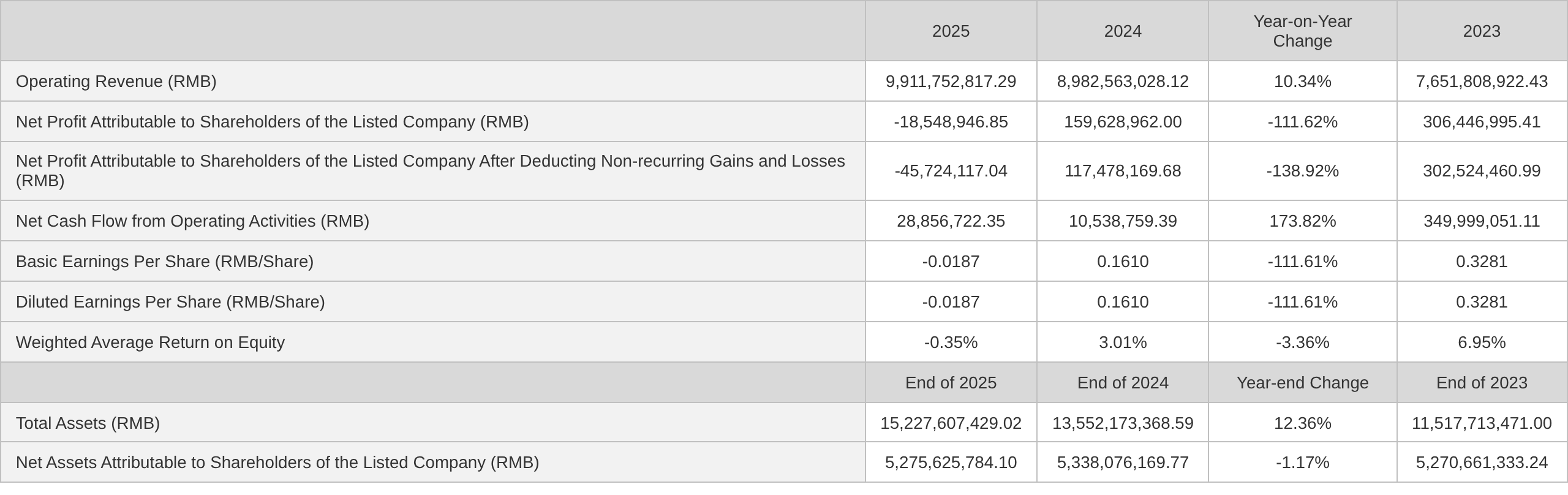
Regarding the main business activities during the reporting period, Baowu Magnesium Industry introduced in its 2025 annual report: The company is a leader in magnesium-based new materials under China Baowu, with advantages across the entire industry chain and mine resources, leading vertical retort magnesium smelting technology, and its magnesium alloy capacity and market share are among the global frontrunners. The company focuses on lightweight materials, with products covering automotive, consumer electronics, e-bikes, building formwork, etc. After more than 30 years of development, the company has become a high-tech enterprise integrating mining, non-ferrous metal smelting, and processing, aiming to be a global leader in the magnesium industry. Its businesses include magnesium material business, magnesium products business, aluminum products business, mineral products business, and building formwork business. Its main products include magnesium alloys, magnesium alloy deep-processed products, aluminum alloys, aluminum alloy deep-processed products, master alloys, and strontium metal.
Outlook on future development: Baowu Magnesium Industry stated in the 2025 annual report: 2026 marks the start of the company's 15th Five-Year Plan, and the industry will see an important period of high-end and large-scale development. The board will guide management with the core positioning of "building a lightweight solutions provider and becoming the new materials main force of China Baowu," focusing on the main business, deepening cultivation, advancing full-industry-chain upgrading, technological innovation, market expansion, and green development, to achieve sustained improvement in operating performance and significant enhancement of core competitiveness. 1. Strengthen strategic guidance and solidify the foundation for new quality productive forces in the magnesium industry. Accelerate building a full industry chain from primary magnesium to alloys, deep processing, and terminal applications, concentrate on breakthroughs in green smelting and stable, low-cost production technologies, and speed up large-scale promotion of key products. 2. Coordinate the construction of key projects to synergistically improve overall operational efficiency. Speed up construction and comprehensive acceptance of the Huayuan Wujia mine in the Qingyang project, orderly advance main plant construction and production indicator optimization, and steadily push forward key projects in Gansu Baomei, Wutai Baomei, and Chaohu Baomei. 3. Deepen magnesium industry reform and innovation, promoting modern corporate governance. Steadily advance business transformation and renewal, promote asset integration, and further optimize governance, management control, and business management models. 4. Accelerate intelligent development layout and fully advance IT system construction. Complete full implementation of the Baowu standard financial system and rollout of cost systems in subsidiaries, create a full-process IT model project for magnesium business, further enhance operational control, cost calculation, compliant operations, and risk prevention and control capabilities. 5. Focus on attack on primary magnesium cost to continuously enhance market competitiveness. Reduce manufacturing costs of three core components: reduction retorts, center pipes, and cones; optimize steel grades to extend retort service life; reduce auxiliary energy consumption and material-to-magnesium ratio. 6. Implement cost-conscious management and systematically build a high-quality development business model. Deepen overall benchmarking to identify and address gaps, systematically attack the "four major costs" — primary magnesium, energy, logistics, and quality — and improve the operational control system. 7. Strengthen safety and environmental protection fortresses, systematically elevate green development. Continuously strengthen safety and environmental compliance rectification. Highlight risk management in key areas and enhance intrinsic safety. Accelerate green factory and low-carbon capability building.
8. Main risk factors and countermeasures (1) Risk of fluctuating main raw material prices The company's main business is magnesium and aluminum alloys and deep processing, with primary raw materials being magnesium and aluminum metals. Prices are affected by supply-demand dynamics, global and Chinese economic conditions, and closely tied to automotive lightweighting progress, 3C industry demand, etc. If magnesium and aluminum prices swing wildly in the future, it will affect cost control and profitability. The company is raising the self-sufficiency ratio of raw materials, adjusting product mix, and increasing the proportion of deep-processed products to mitigate the impact. (2) Risk of fluctuating market demand The company's magnesium and aluminum lightweight alloy products are mainly used in automotive and consumer electronics. Currently, seizing auto lightweighting opportunities, the company is expanding into downstream deep processing such as magnesium alloy automotive die castings, magnesium alloy building formwork, and aluminum extrusion products. The pace of automotive lightweighting and 3C electronics demand are influenced by macro-economy, industrial policies, and process technology innovation. If downstream demand falls short of expectations, it will affect operating performance. The company is expanding product applications in various fields, increasing penetration rates, to reduce the risk of demand fluctuations.
In addition, the Q1 2026 report released by Baowu Magnesium Industry shows: In Q1 2026, revenue was 2.132 billion yuan, up 4.86% YoY; net profit attributable to shareholders of the publicly listed firm was 5.0891 million yuan, down 81.94% YoY.
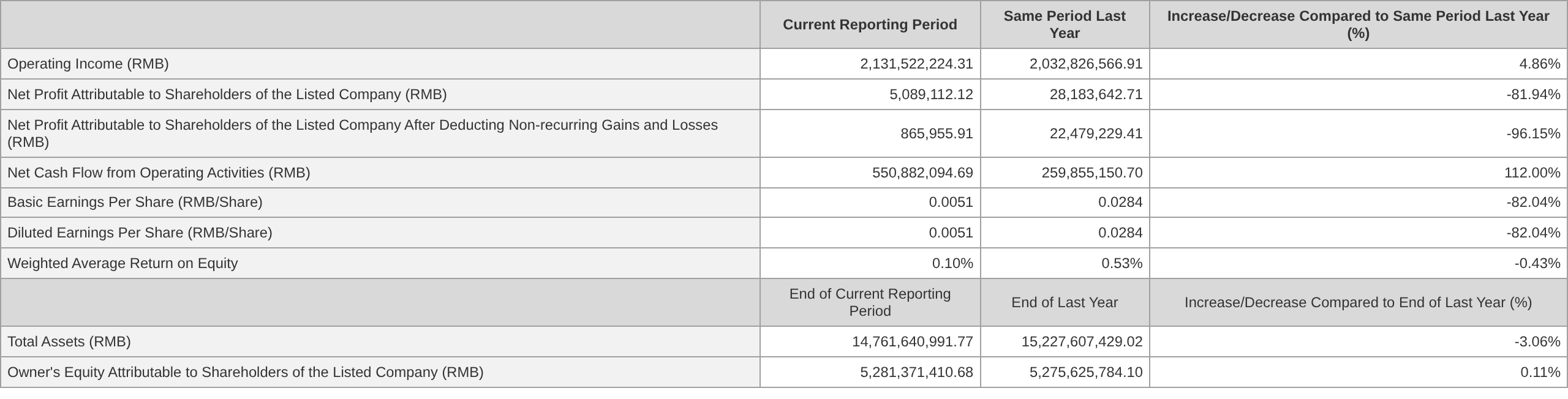
Regarding the increase in Q1 revenue, Baowu Magnesium Industry explained: Sales of main products and material prices rose YoY. For the decline in net profit, the company said it was due to a decrease in product gross margins and increased losses from joint ventures.
Baowu Magnesium Industry mentioned that its magnesium alloy capacity and market share rank among global leaders.
Looking back at the performance of SMM magnesium alloy AZ91D in Q1 this year: The average price on March 31, 2026 was 19,650 yuan/mt, compared with 17,950 yuan/mt on December 31, 2025, the average price rose by 1,700 yuan/mt in Q1, or 9.47%. The daily average price in Q1 2026 was 18,932.14 yuan/mt, up 1,320.74 yuan/mt, or 7.5% YoY, from 17,611.4 yuan/mt in Q1 2025.
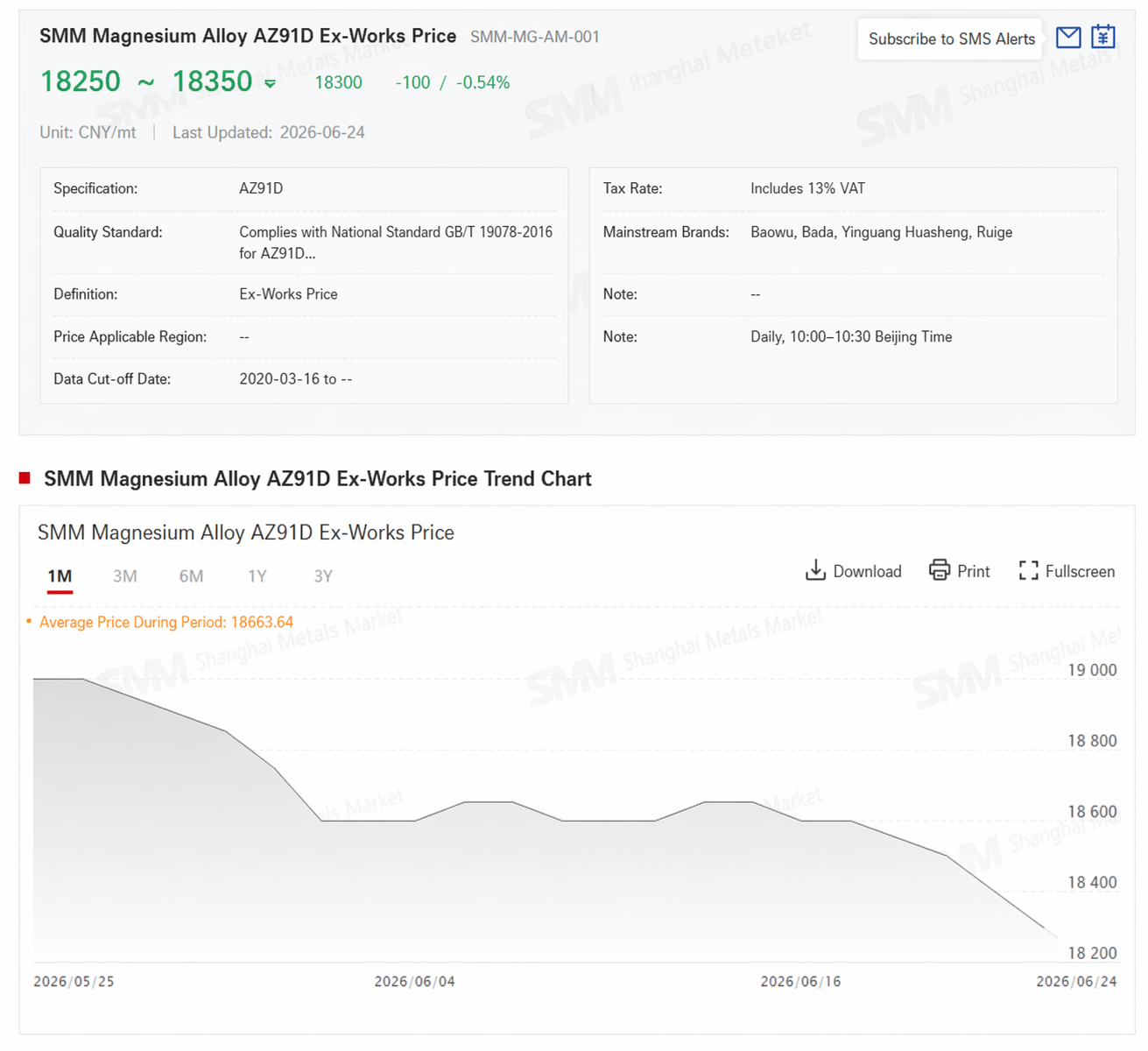
According to SMM price quotes: The EXW price of SMM magnesium alloy AZ91D on June 24 ranged from 18,250 to 18,350 yuan/mt, with an average of 18,300 yuan/mt, down 0.54% from the previous trading day. Currently, magnesium alloy prices are in the doldrums alongside magnesium ingot prices, with overall low trading sentiment. Fundamentals side: Supply side, magnesium alloy smelters have stable operating rates, ample spot supply in the market, and overall supply is loose; demand side, downstream die-casting plants show significant divergence in orders, with stable automotive orders, persistently sluggish two-wheeler orders, and alloy processing fees in the doldrums. Overall, the magnesium alloy market maintains a supply-strong-demand-weak pattern, with prices expected to remain in a weak consolidation phase in the short term.
![[SMM Lecong HRC Inventory] This week, inventory destocking in Lecong slowed down.](https://imgqn.smm.cn/usercenter/ikbxI20251217171718.jpg)
![[SMM Analysis] EAF Steel Mills Plan to Reduce Operating Hours](https://imgqn.smm.cn/usercenter/QMaot20251217171719.jpg)